
Introduction
For years, organizations viewed sustainable IT infrastructure as a corporate responsibility initiative. In 2026, it has become a business priority. One of the biggest reasons is the rapid rise of AI. As enterprises deploy GPU-intensive workloads, expand AI data centers, and process massive volumes of data, their IT infrastructure is consuming more power. Building AI-ready infrastructure is not the biggest challenge now. Running it efficiently is.
So, governments, investors, and customers are expecting enterprises investing in energy-efficient AI hardware, liquid cooling, renewable energy, intelligent infrastructure management, and circular hardware practices to reduce environmental impact without compromising performance.
Sustainable IT infrastructure has therefore become the foundation for balancing performance, energy efficiency, operational costs, and long-term business resilience. Organizations that embed sustainability into infrastructure design today will be better prepared to support future AI growth while meeting environmental and regulatory expectations.
In this blog, we’ll explore the key sustainable IT infrastructure trends shaping AI data centers in 2026 and how organizations can build greener, more resilient infrastructure for the future.
The Importance of Sustainable IT Infrastructure in 2026
AI data centers consume more electricity, generate more heat, and require greater computing capacity than traditional IT environments. Infrastructure decisions now affect operating costs, business continuity, and environmental performance.
According to Gartner, global data center electricity consumption will reach 565 TWh in 2026. AI-optimized servers will account for 31% of total data center electricity consumption this year. Gartner also predicts these servers will consume more electricity than conventional servers by 2027. These figures show that energy efficiency has become a business requirement rather than an environmental objective.
Sustainable IT infrastructure helps organizations address these challenges. Here are the key reasons sustainable IT infrastructure matters in 2026:
- Controls rising energy and operational costs.
- Supports AI and high-performance computing without unnecessary power consumption.
- Improves data center efficiency through modern cooling and power management.
- Reduces carbon emissions and environmental impact.
- Extends hardware lifecycles and minimizes electronic waste.
- Strengthens compliance with sustainability and ESG reporting requirements.
- Builds resilient infrastructure capable of supporting long-term business growth.
Key Trends Shaping the Future of Sustainable Infrastructure
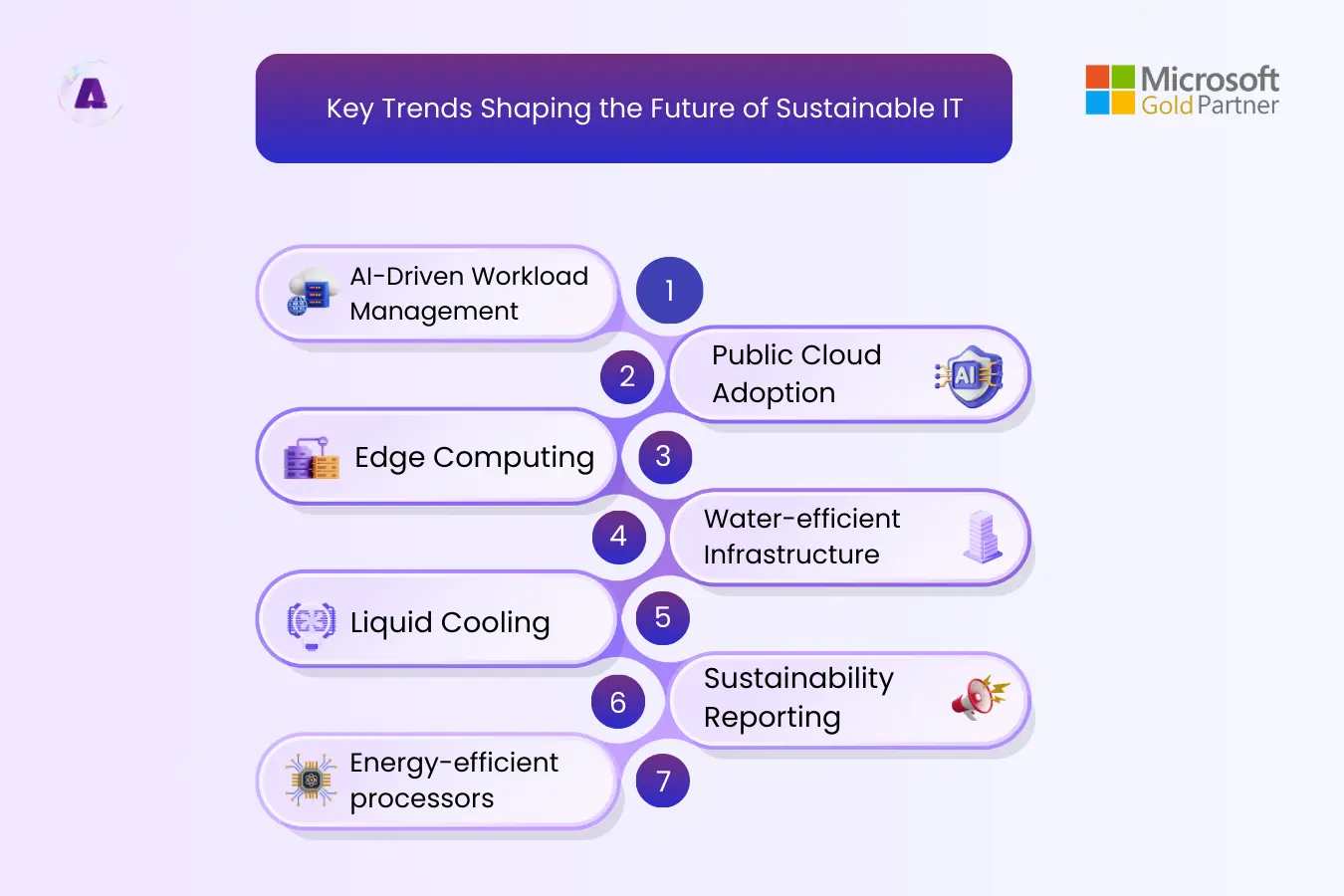
Intelligent Workload Management
Sustainable IT infrastructure is not only about renewable energy. It also depends on how efficiently computing resources are used. Many enterprise apps allocate more compute resources, leaving servers underutilized and consuming unnecessary power.
Intelligent Workload Management (IWM) addresses this problem by dynamically allocating compute resources based on workload demand. Instead of keeping infrastructure running at full capacity, IWM distributes workloads across available resources, prioritizes critical tasks, and scales compute only when required.
Why it matters
- Improves server utilization.
- Reduces unnecessary power consumption.
- Lowers infrastructure operating costs.
A practical example is Databricks Serverless SQL Warehouses, which use IWM to predict query resource requirements and automatically manage query execution. The platform queues, schedules, and distributes workloads across available compute resources while provisioning additional clusters only when necessary.
Sustainable Cloud Adoption
Cloud adoption has become an important strategy for building sustainable IT infrastructure. AWS states that its cloud infrastructure is up to 4.1 times more energy efficient than on-premises infrastructure. They also pointed out that it reduces the carbon footprint of workloads by up to 99% when workloads are optimized and powered by renewable energy.
Why it matters
- Prevents overprovisioning.
- Reduces energy waste.
- Improves infrastructure utilization.
However, moving workloads to the cloud alone does not guarantee sustainability. Organizations must optimize cloud resources by selecting the right instance sizes, eliminating idle workloads, enabling auto scaling, and adopting serverless services where appropriate. AWS describes sustainability as a shared responsibility. While AWS focuses on efficient infrastructure, renewable energy, and water stewardship, customers are responsible for optimizing workloads and minimizing unnecessary resource consumption.
Edge Computing
Edge computing can support sustainable IT infrastructure by processing data closer to where it is generated. This reduces the amount of data sent to centralized cloud environments and can lower network traffic and bandwidth requirements. The approach is particularly useful for IoT systems that handle large data volumes and require fast responses.
Why it matters
- Reduces network energy consumption.
- Supports latency-sensitive applications.
- Improves infrastructure efficiency.
A recent 2026 study also examines renewable-energy integration into edge service orchestration. This shows how workload placement can account for energy efficiency and renewable power availability. However, edge computing does not automatically make infrastructure greener. Distributed edge sites introduce additional hardware, cooling, maintenance, and power requirements. Sustainable deployment therefore depends on efficient resource management and careful placement of computing resources.
Water-Efficient Infrastructure
Water efficiency is becoming a critical part of sustainable IT infrastructure as AI workloads increase data center cooling requirements. In 2026, data centers are adopting direct-to-chip liquid cooling, closed-loop cooling, water reuse, and real-time cooling optimization to reduce freshwater consumption without compromising compute performance.
Why it matters
- Conserves freshwater resources.
- Reduces cooling costs.
- Supports environmental compliance.
Microsoft, for example, reported that its average data center Water Usage Effectiveness (WUE) improved from 2.3 L/kWh in its early facilities to 0.27 L/kWh in 2025. Its newer AI-optimized data center design uses closed-loop, direct-to-chip cooling with zero water evaporation during operation. For organizations building AI-ready infrastructure, integrating water-efficient cooling, monitoring WUE, and reusing water where possible can reduce environmental impact while supporting scalable and resilient sustainable IT infrastructure.
Liquid Cooling
GPU-dense servers generate far more heat than traditional enterprise servers. Air cooling alone cannot efficiently support these environments. Liquid cooling transfers heat more effectively, enabling higher rack densities while reducing cooling energy.
Why it matters
- Supports high-density AI infrastructure.
- Improves cooling efficiency.
- Reduces overall facility power consumption.
Gartner forecasts electricity used for cooling and supporting infrastructure will increase from 159 TWh in 2025 to 195 TWh in 2026. The report recommends investing in high-efficiency cooling technologies to support sustainable infrastructure expansion.
Sustainability Reporting
Enterprises are increasingly measuring infrastructure performance using metrics such as Power Usage Effectiveness (PUE), carbon emissions, renewable energy usage, and hardware utilization. These metrics help demonstrate progress toward sustainability goals while identifying opportunities for efficiency improvements.
Why it matters
- Supports ESG reporting.
- Improves operational transparency.
- Enables data-driven infrastructure decisions.
Gartner predicts that 50% of organizations will adopt sustainability-enabled monitoring by 2026 to track energy consumption and carbon-footprint metrics across hybrid cloud environments. The reporting scope is also expanding beyond emissions to include energy usage, water efficiency and greenhouse gas (GHG) emissions, making sustainability telemetry an important part of modern IT management and GreenOps practices.
Energy-Efficient Processors
Modern processors are delivering higher performance with lower power consumption. New CPU, GPU, and accelerator architectures are designed to maximize performance per watt, allowing organizations to process larger workloads without proportional increases in electricity usage.
Why it matters
- Lowers electricity consumption.
- Reduces cooling requirements.
- Improves long-term infrastructure efficiency.
According to Gartner, AI-optimized servers will consume 175 TWh of electricity in 2026, representing 31% of total data center power consumption. As power demand increases, efficient processor architectures become essential for controlling operational costs and supporting sustainable IT infrastructure.
Case Study: Microsoft’s Sustainable Data Center Strategy
Microsoft is redesigning its data center infrastructure to reduce energy and water consumption without compromising performance. Its sustainability strategy combines renewable energy, energy-efficient infrastructure, advanced cooling, and water conservation.
- Microsoft achieved its 2025 goal of purchasing enough renewable energy to match 100% of the electricity consumed by its data centres, buildings, and campuses.
- Contracted approximately 40 GW of new renewable energy capacity across 26 countries, helping expand renewable electricity supply while supporting its growing infrastructure.
- The hyperscaler research into direct-to-chip cooling found that this approach can reduce data centre water consumption by approximately 30–50% compared with conventional cooling approaches.
- The same cooling study found that direct-to-chip cold-plate cooling could reduce lifecycle greenhouse-gas emissions and energy demand by around 15% compared with conventional air-cooling approaches.
- Newer Microsoft data centre designs incorporate approaches such as higher operating temperatures, free-air cooling, and rainwater harvesting to reduce dependence on freshwater for cooling.
- Microsoft is working towards becoming water positive by 2030, meaning it aims to replenish more water than it consumes across its operations.
How Aptly Technology Supports in Building Sustainable IT Infrastructure?
Sustainability in IT comes down to using computing resources more efficiently. Aptly Technology supports this goal by helping businesses build AI-ready, scalable and efficiently managed IT infrastructure.
We deliver energy efficient, PUE-optimized, liquid-ready, renewable-integrated data centers design for AI workloads. Our managed Ops reduce energy 25% via AI scheduling and real-time DCIM.
- Infrastructure optimization: Helps improve resource utilization and reduce unnecessary compute and infrastructure capacity.
- Cloud efficiency: Supports hybrid cloud strategies that help businesses select and manage resources according to actual workload requirements, reducing overprovisioning.
- AI-ready infrastructure: Helps create infrastructure capable of handling growing AI workloads while maintaining efficient resource utilization.
- Automation: Infrastructure automation can reduce manual intervention and improve operational efficiency across IT environments.
- Better visibility: Monitoring infrastructure performance and utilization helps identify underused resources and areas for optimization.
- Scalable architecture: Designing infrastructure that scales with demand can minimise the need to maintain excess computing capacity.
Rather than treating sustainability as a separate initiative, Aptly Technology connects infrastructure efficiency, automation and modernization to help businesses build IT environments that are both performance-driven and more resource-conscious.
Ready to make your IT infrastructure more efficient and sustainable?
Connect with us to explore how Aptly Technology can help you achieve an energy-efficient infrastructure.
Final Thoughts
Sustainable IT infrastructure is not just an ethical choice—it’s a business necessity. Companies that embrace renewable energy, liquid cooling, cloud migration, and AI-driven optimizations will not only reduce their environmental impact but also gain a competitive edge. With industry giants like Aptly Technology & Microsoft are leading the way, 2026 is set to be a landmark year for sustainability in IT.
FAQs
Q1. What is sustainable IT infrastructure?
Sustainable IT infrastructure is the design and management of IT systems to reduce energy use, carbon emissions, water consumption and electronic waste while maintaining performance and scalability.
Q2. Why is sustainable IT infrastructure important in 2026?
The rapid growth of AI, cloud computing and data centres is increasing demand for electricity, cooling and computing resources. Sustainable infrastructure helps organizations manage this growth by reducing environmental impact.
Q3. How can businesses make their IT infrastructure more sustainable?
Businesses can improve sustainability by using energy-efficient hardware, renewable energy, efficient cooling systems, cloud resource optimization, infrastructure automation and responsible hardware lifecycle management.
Q4. How does AI affect sustainable IT infrastructure?
AI workloads can require significantly more computing power and cooling than traditional applications. Sustainable AI infrastructure focuses on efficient processors, workload optimization, liquid cooling, renewable energy and intelligent resource management.
Q5. How does liquid cooling improve data centre sustainability?
Liquid cooling transfers heat more efficiently than conventional air cooling, making it suitable for high-density AI and GPU workloads. It can help reduce energy requirements and, depending on the design, significantly lower water consumption.
Q6. How can Aptly Technology support sustainable IT infrastructure?
Aptly Technology helps businesses build scalable, AI-ready infrastructure through infrastructure optimization, automation, cloud efficiency and better resource utilization, supporting both performance and long-term sustainability goals.

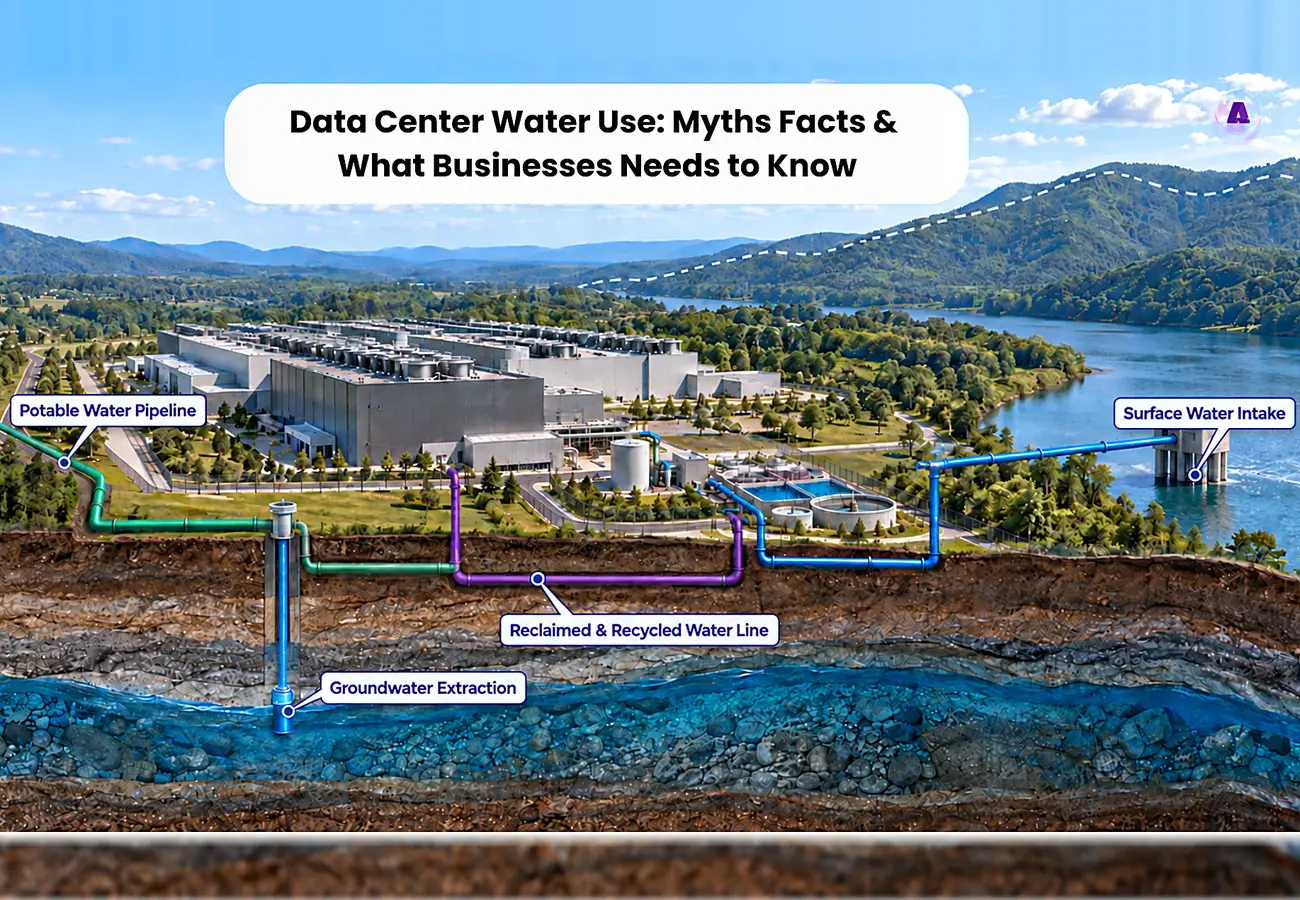



Table of content
- Introduction
- The Importance of Sustainable IT Infrastructure in 2026
- Key Trends Shaping the Future of Sustainable Infrastructure
- Intelligent Workload Management
- Sustainable Cloud Adoption
- Water-Efficient Infrastructure
- Liquid Cooling
- Sustainability Reporting
- Energy-Efficient Processors
- Case Study: Microsoft’s Sustainable Data Center Strategy
- How Aptly Technology Supports in Building Sustainable IT Infrastructure?
- Final Thoughts
- FAQs
- AI POC to Production: Deploying AI Successfully in Industry
- Secure Enterprise AI Infrastructure: Build and Deploy AI Without Exposing Sensitive Data
- How to Scale Data Center Infrastructure for Future Growth: A Comprehensive Guide
- A Practical Guide to Data Center Security Best Practices in 2026
- Data Center Network Architecture Design – Key Components, Challenges, and Insights
- Enterprise Data Center Buildout Guide (2026): Planning, Design, Cost & Infrastructure
- Top Alternatives to Big Data Center Integrators: Finding Agile, Cost-Efficient Partners in 2026
- Colocation vs On-Prem Build: Pros, Cons, Costs & How to Choose
- How to Build a Data Center from Scratch – A Complete Checklist for 2026
- Recommended Hyperscale Data Center Vendors in 2026: How to Build & Run AI-first Infra