Introduction: AI data center disaster recovery is a business continuity issue
A serious AI outage can stop customer-facing inference, interrupt a distributed training run, strand costly accelerators, or make model checkpoints unavailable. Uptime Institute’s 2026 outage analysis says 57% of respondents reported their most recent major outage cost more than $100,000, and one in five reported more than $1 million.
Those figures matter because AI infrastructure failures rarely affect a single server in isolation. A major incident can interrupt compute, storage, network fabrics, orchestration, model state, and the facility systems supporting the cluster at the same time. The business impact therefore depends on more than how quickly hardware comes back online. Organizations also need to know how much training progress was lost, whether model checkpoints remain usable, whether inference traffic has a healthy failover path, and whether the full service can return within the required recovery window.
That is where AI data center disaster recovery becomes a defined operational discipline rather than a generic backup process. It means restoring the compute, model state, data, orchestration, networking, and facility dependencies required to resume AI services after a major failure. For leaders asking what is data center disaster recovery, the practical answer is straightforward: recover the service to an acceptable state within an agreed time and with an acceptable amount of lost data or work.
GPU workload disaster recovery is harder than restarting a conventional server. A distributed training job may depend on hundreds of GPUs, a high-speed fabric, shared storage, a scheduler, container images, secrets, datasets, and a recent valid checkpoint. AI infrastructure disaster recovery therefore protects workload state as well as hardware. AI workload resilience starts by separating training, batch inference, and real-time inference because each needs different recovery targets.
What is AI Data Center Disaster Recovery and Why Does it Matter?
AI data center disaster recovery combines high availability, fault tolerance, backup, failover, and recovery procedures around GPU-intensive services. AI disaster recovery planning should connect AI infrastructure disaster recovery to business recovery objectives. For architects defining what data center disaster recovery is, the dependency map is the starting point. High availability reduces interruption during expected component failures. Fault tolerance keeps defined failures from stopping useful work. Disaster recovery restores a service after a disruption exceeds those local protections. AI data center business continuity connects technical recovery to revenue, customer commitments, regulatory obligations, and internal operations.
A Data center disaster recovery plan for AI must cover more than virtual machines and databases. AI data center disaster recovery also requires explicit ownership of workload state. It should protect model weights, checkpoints, datasets, container images, scheduler state, identity, configuration, storage, high-speed networking, and accelerator capacity.
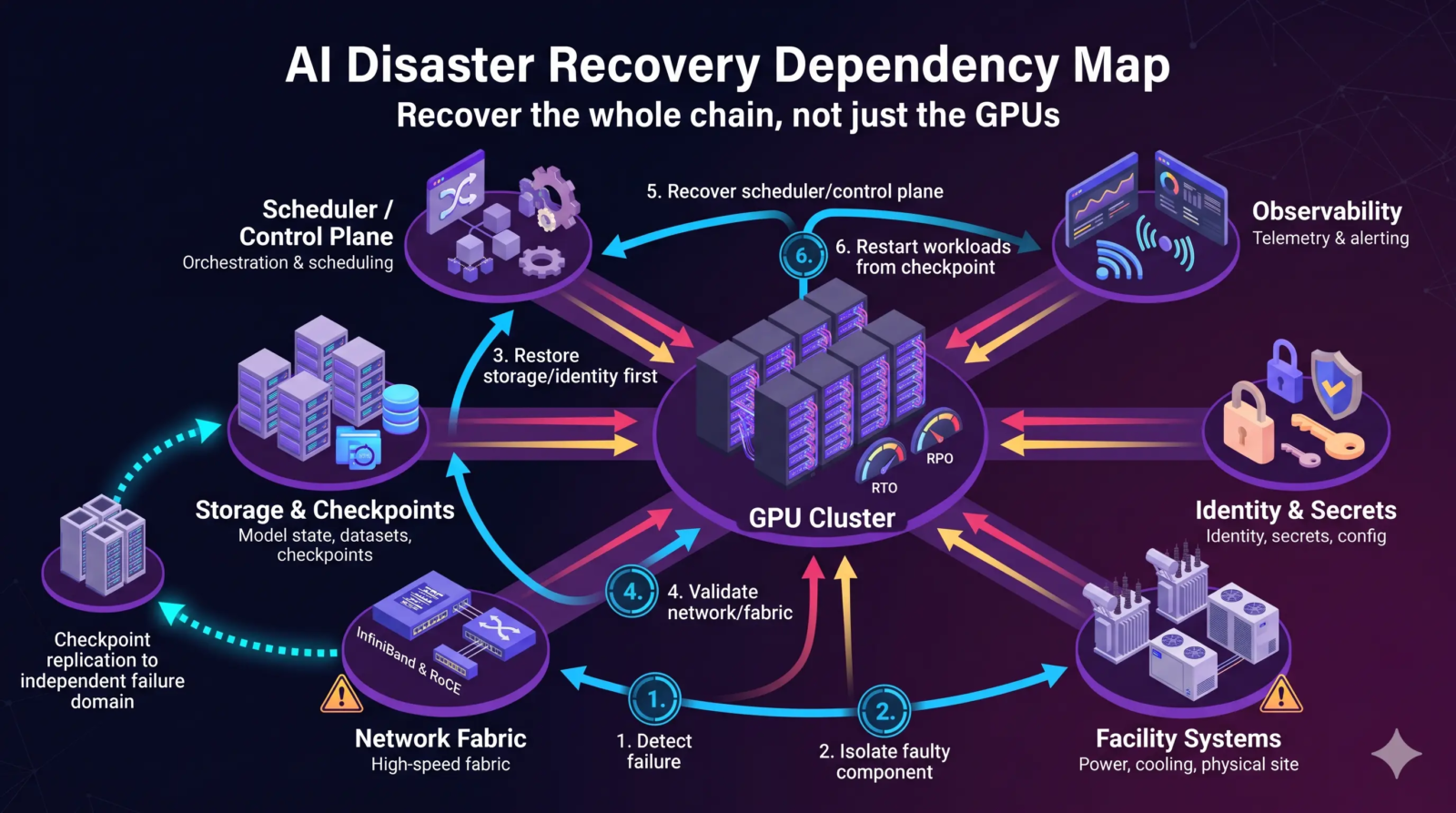
AI disaster recovery planning should begin with business services. AI workload resilience improves when those services have different recovery tiers. A fraud model serving live transactions, an internal assistant, and a long-running training job can share one GPU cluster but carry different consequences when unavailable. An AI infrastructure recovery strategy should map each workload to its Recovery Time Objective (RTO), Recovery Point Objective (RPO), dependencies, recovery path, and test evidence.
Why GPU Workloads make AI Infrastructure Disaster Recovery Harder?
Distributed AI increases the number of components that can stop a job. AI data center disaster recovery therefore needs a cluster-level failure model. The main recovery challenges include:
- Distributed training failure propagation: PyTorch notes that one process failure can disrupt an entire distributed training job. NVIDIA Recovery likewise focuses on crashes, hangs, and stragglers that interrupt progress across a GPU allocation. GPU cluster disaster recovery must therefore account for hardware, software, fabric, storage, and scheduler failures together.
- GPU cluster fault tolerance is necessary but not sufficient: GPU cluster fault tolerance reduces the impact of local faults, but it does not replace AI infrastructure disaster recovery. How to design fault-tolerant GPU infrastructure? Combine health detection, redundant dependencies, checkpoint-aware restart, and tested replacement capacity.
- Recovery must restore dependencies as a system: At cluster scale, what is data center disaster recovery becomes a question of restoring multiple dependencies together. GPU infrastructure redundancy should include network ports, storage endpoints, control services, power and cooling dependencies, not only spare accelerators.
- Lost training progress creates a cost-of-progress problem: GPU workload disaster recovery must account for the work completed since the last checkpoint. If a training run saves state every four hours, a failure just before the next save can erase almost four hours of computation.
- Checkpoint frequency creates a recovery trade-off: More frequent GPU workload checkpointing reduces lost work, but it also increases storage traffic and checkpoint overhead. AI disaster recovery planning should set checkpoint frequency using workload value, checkpoint size, storage throughput, failure exposure, and the RPO.
- GPU cluster failover requires usable replacement capacity: GPU cluster failover depends on having compatible GPU capacity available when a failure occurs. AI data center disaster recovery must therefore treat reserved capacity as part of the recovery design. A secondary site with no compatible GPU allocation is not a practical recovery site.
- Compatibility matters during recovery: AI data center disaster recovery should document acceptable accelerator substitutions, driver and framework compatibility, fabric requirements, and the level of performance degradation the business is prepared to tolerate during recovery.
Together, these factors make GPU cluster disaster recovery more complex than conventional server recovery. Successful AI infrastructure disaster recovery depends on restoring workload state, infrastructure dependencies, and compatible compute capacity as one coordinated recovery process.
GPU Workload Checkpointing: recovering training without starting over
GPU workload checkpointing saves the state required to resume training from a known point. For large models, distributed training checkpointing stores sharded model and optimizer state across ranks. PyTorch Distributed Checkpoint supports parallel save and load and can reshard state when a job restarts with a different cluster topology. NVIDIA Megatron Core also documents distributed checkpointing for large-scale multi-GPU and multi-node training.
AI model checkpoint recovery should be treated as production recovery, not merely a framework feature. How to recover distributed AI training jobs after failure? Restore a compatible environment, load a valid distributed checkpoint, rebuild the process group, and verify forward progress. Disaster recovery for AI workloads depends on the checkpoint being recoverable outside the failed environment. Checkpoint storage and replication must protect the latest valid state from the same failure that affected the cluster. A useful AI infrastructure recovery strategy often keeps recent checkpoints close to the training environment for fast restart, then replicates selected checkpoints to an independent failure domain.
Asynchronous checkpointing can reduce time spent blocking training by overlapping part of the save path with computation. PyTorch documents asynchronous staging and writes, while noting additional CPU-memory and resource requirements.
GPU cluster backup and restore testing should verify that checkpoint files are complete, readable, correctly versioned, and restorable with the software stack used at the recovery site. AI data center disaster recovery should treat restore validation as a release gate for critical training. Immutable backups for model weights are also useful for protecting approved release artifacts from deletion or modification.
How to Design GPU Cluster Disaster Recovery and Multi-region Disaster Recovery?
How to implement disaster recovery for GPU clusters? Treat recovery as a sequence of dependent steps. GPU cluster disaster recovery works only when compute, state, networking, orchestration, and replacement capacity recover together.
- Step 1: Map every recovery dependency. Start with more than the GPUs. Document datasets, model artifacts, checkpoints, secrets, identity services, routes, storage, schedulers, control planes, network fabrics, and compatible accelerator capacity. When teams ask what data center disaster recovery is, the answer should include the full dependency chain. A second GPU fleet alone does not provide recovery if the secondary environment lacks the systems needed to run the workload.
- Step 2: Choose the recovery architecture. Build the AI infrastructure recovery strategy around backup-and-restore, active-passive, or active-active patterns. AWS describes a spectrum from backup and restore through pilot light and warm standby to multi-site active-active. Lower RTO and RPO generally require more running infrastructure, coordination, and cost. Active-active vs. active-passive becomes especially important when GPU capacity is scarce or expensive to reserve.
- Step 3: Prepare the multi-region recovery environment. Multi-region disaster recovery should include cross-region data replication, checkpoint replication, configuration, identity, networking, and dependable accelerator capacity in the recovery location. AI data center business continuity depends on these elements remaining recoverable as one service. Microsoft’s reliability guidance also notes that sovereignty requirements can limit where recovery copies and failover environments are located.
- Step 4: Define the failover trigger. GPU cluster failover should begin only when predefined health conditions are met. Define which failures trigger local recovery, workload restart, or regional failover. The trigger might involve loss of GPU nodes, storage, network fabric, scheduler services, or an entire site.
- Step 5: Confirm destination capacity before moving workloads. How to implement failover for AI workloads? First confirm that the destination has compatible GPUs, enough memory and network capacity, correct drivers and frameworks, and access to required storage and model state. GPU cluster disaster recovery should not depend on recovery capacity that is unavailable during the incident.
- Step 6: Restore state and critical services in the correct order. Restore storage, replicated data, model checkpoints, secrets, and identity services where required. Then validate network and fabric health. Recover the scheduler or control plane before placing workloads. Slurm supports requeuing failed jobs, which can help restore interrupted workloads after suitable resources become available.
- Step 7: Recover orchestration and cluster control. Kubernetes disaster recovery requires protection of cluster state as well as application data. Kubernetes documentation recommends etcd snapshots for recovery scenarios including loss of all control-plane nodes. GPU cluster disaster recovery should verify the health of orchestration services before compute workloads restart.
- Step 8: Restart workloads from trusted state. Resume training or inference from validated checkpoints, replicated model artifacts, or approved deployment state. GPU cluster failover should avoid restarting from stale, incomplete, or inconsistent data. Validate checkpoint integrity before allocating large amounts of recovery capacity.
- Step 9: Validate service health before returning to production. Confirm workload progress, model availability, storage consistency, network performance, GPU health, scheduler state, and application behavior. AI data center business continuity depends on successful recovery at the service level, not simply on infrastructure becoming reachable.
- Step 10: Define rollback and failback. Every recovery process needs a rollback path if the destination environment is unhealthy. Once the primary environment returns, define how workloads, state, and traffic move back without creating conflicting or stale copies.
- Step 11: Automate repeatable recovery actions carefully. Automated workload failover and disaster recovery orchestration reduce manual delay when failure states are clear. Automation should cover well-defined actions such as health checks, capacity validation, state restoration, scheduler recovery, and workload placement.
- Step 12: Stop automation when data integrity is uncertain. Automated workload failover should not continue blindly when checkpoints, replicated data, or control-plane state may be inconsistent. In those cases, disaster recovery orchestration should pause and require validation before workloads resume.
This step-by-step process makes GPU cluster disaster recovery operationally repeatable. The goal is not simply to move workloads to another location. It is to restore the complete AI service, with trusted state, compatible GPU capacity, healthy orchestration, and a validated path back to normal operations.
Disaster Recovery for AI Workloads: Training vs. Inference
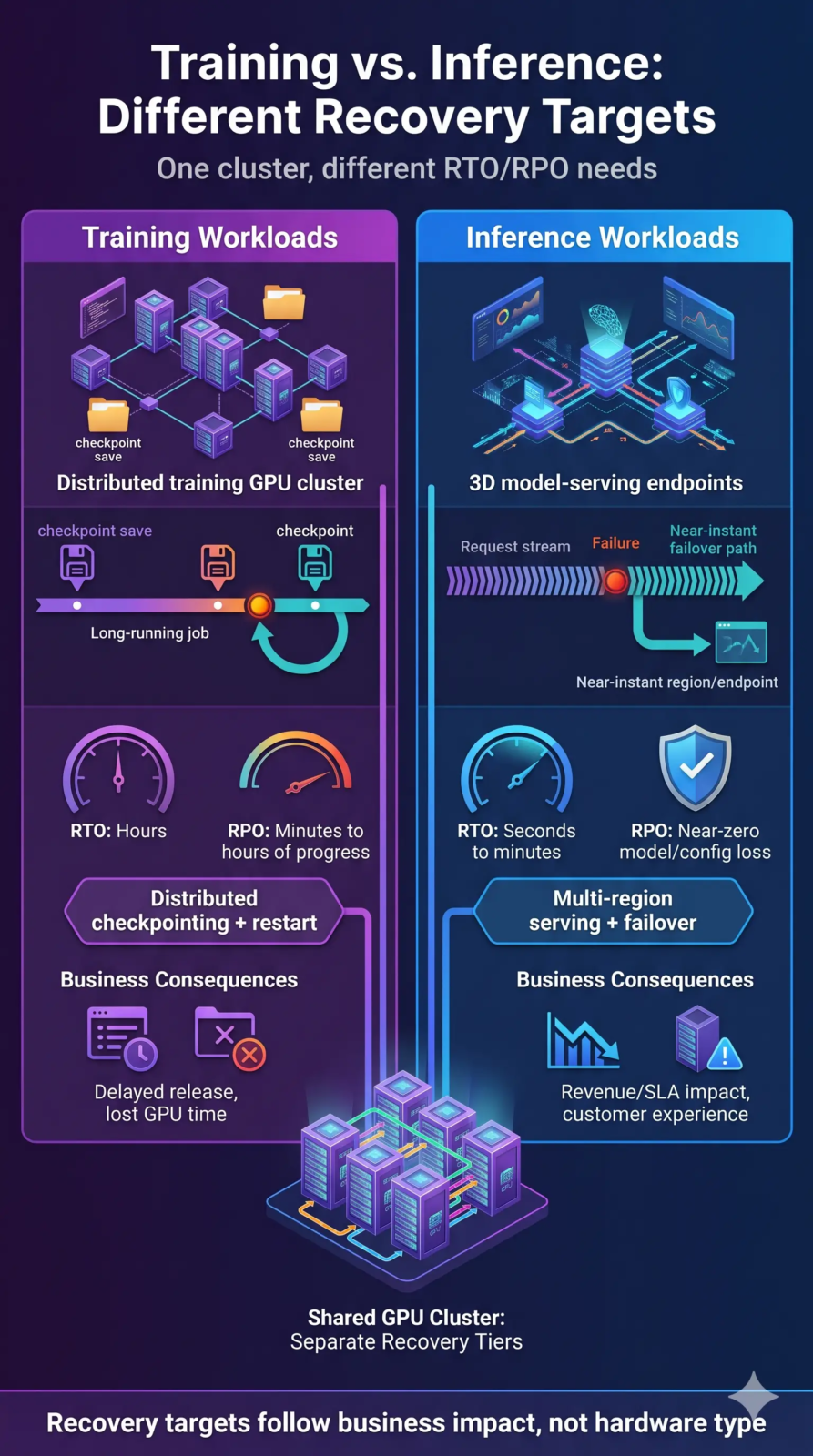
Disaster recovery for AI workloads should distinguish training from serving because the recovery priorities, acceptable downtime, state requirements, and failover architecture differ significantly.
| Area | AI Training Workloads | AI Inference Workloads | Business & Disaster Recovery Implications |
|---|---|---|---|
| Primary Objective | Resume interrupted training with minimal loss of completed compute work. | Restore model-serving availability and keep user or application requests flowing. | AI data center disaster recovery should assign different recovery targets to training and inference before teams select a failover architecture. |
| Typical RTO | Training can often tolerate a longer RTO when checkpoints preserve recent progress. | Real-time inference may require recovery within seconds or minutes. | Customer-facing or operational AI services usually justify a much shorter RTO than long-running training jobs. |
| Typical RPO focus | RPO is closely tied to the amount of training progress preserved by checkpoints. | RPO may involve model versions, configuration, session state, application data, or upstream features. | GPU workload disaster recovery should protect the most recent useful training state, while inference recovery must preserve the state needed to serve correct responses. |
| Core recovery mechanism | Restore the latest valid checkpoint, allocate compatible GPU capacity, rebuild the training environment, and resume the job. | Redirect traffic to healthy model-serving endpoints with available GPU capacity. | Training recovery focuses on computation already completed. Inference failover focuses on service continuity. |
| Checkpoint dependency | High. Checkpoints reduce the amount of training work lost after a failure. | Usually lower for live serving, although replicated model weights and deployment state remain essential. | Training can often accept a slower restart if the RPO protects most of the compute already spent. |
| Infrastructure dependency | Requires compatible GPUs, storage, high-speed networking, scheduler services, datasets, and a valid checkpoint. | Requires healthy serving endpoints, model weights, load balancing, networking, application dependencies, and available accelerator capacity. | What is data center disaster recovery differs by workload because the complete dependency chain must be restored, not only the GPU process. |
| GPU capacity requirement | Recovery capacity must be compatible with the distributed training configuration and workload requirements. | The failover region must have enough GPU capacity to absorb production traffic. | A recovery environment without sufficient accelerator capacity may be technically available but operationally unusable. |
| Capacity planning risk | Insufficient capacity may delay restart or force a smaller training configuration. | A surviving region near saturation may fail when redirected traffic arrives. | Inference failover needs explicit capacity planning to avoid creating a second outage during traffic migration. |
| High-availability model | Checkpoint-based restart, elastic training, warm standby, or replacement cluster capacity may be appropriate. | Active-active or active-passive model-serving endpoints are common patterns. | Architecture should reflect the cost of downtime rather than applying one recovery model to every AI workload. |
| Traffic routing | Usually not a primary concern because training jobs are scheduler-driven rather than request-driven. | Critical. Traffic must move quickly to healthy endpoints, zones, or regions. | Google Cloud recommends multi-region deployment for high-availability inference and routing requests to regions with available accelerator capacity. |
| Model serving high availability | Not normally the central recovery requirement for training. | Model serving high availability should protect the full request path, including routing, model state, application dependencies, and GPU capacity. | Restoring only the model process is insufficient if users still cannot reach the service. |
| Inference Failover | Usually not relevant to the training job itself. | Inference failover should use redundant endpoints, replicated model weights, healthy routing, and available GPU capacity in another zone or region. | Fast inference failover is especially important for customer-facing AI APIs and business-critical applications. |
| Workload prioritization | Training jobs may be paused, queued, or restarted later depending on business priority. | Critical inference traffic may need request prioritization, admission control, or degraded operating modes during recovery. | AI workload high availability should define which requests and workloads receive scarce recovery capacity first. |
| Degraded operating model | Teams may restart with fewer GPUs, lower parallelism, or delayed completion where the framework supports it. | Services may reduce throughput, limit non-critical requests, or prioritize essential users and transactions. | Degraded modes preserve partial business value when full capacity is unavailable. |
| Suitable recovery architecture | Backup-and-restore, warm standby, checkpoint replication, or multi-region restart may be sufficient for many training workloads. | Revenue-facing services may justify active-active deployment and fast regional failover. | AI data center business continuity should tier services according to business impact, not infrastructure type alone. |
| Example workload | Large model training, fine-tuning, research training, or scheduled retraining. | Customer-facing AI API, recommendation service, fraud detection, enterprise assistant, or real-time model endpoint. | Each workload should receive a recovery strategy based on its business role and acceptable interruption. |
The key difference is the recovery objective. GPU workload disaster recovery for training focuses on preserving computational progress and restarting from a trusted checkpoint. Inference failover focuses on restoring the complete request path quickly enough to maintain service availability. AI data center business continuity should therefore tier workloads and assign recovery architecture, RTO, RPO, and standby capacity according to business impact.
Understanding RTO and RPO for AI workload resilience
Recovery Time Objective (RTO) is the maximum acceptable time a service remains unavailable before business impact becomes unacceptable. Recovery Point Objective (RPO) describes how much data or progress can be lost. NIST SP 800-34 defines RTO in relation to maximum tolerable downtime and RPO as the point in time to which data must be recoverable.
In training, RPO often maps to lost training progress. Checkpoint frequency, checkpoint durability, and replication lag determine the rollback. In inference, RPO may relate to model versions, session state, application data, or upstream features. AI workload resilience depends on recovery objectives that engineering teams can measure.
Illustrative Recovery Priorities
| Workload | Business Concern | Illustrative RTO | Illustrative RPO | Typical Recovery |
|---|---|---|---|---|
| Large model training | Lost GPU time, delayed release | Hours | Minutes to hours of progress | Distributed checkpointing and restart |
| Fine-tuning | Delivery schedule | Minutes to hours | Latest checkpoint | Checkpoint restore and requeue |
| Batch Inference | Missed processing window | Hours | Input and Job State | Re-run or resume |
| Customer-facing Inference | Revenue, SLA, experience | Seconds to minutes | Workload-specific, often near-zero model/config loss | Multi-region serving and inference failover |
| Internal AI Assistant | Productivity | Minutes to hours | Application-dependent | Warm standby or alternate endpoint |
These are examples, not universal benchmarks. Every Data center disaster recovery plan should derive targets from business impact and the cost of protection.
How to Build a Data Center Disaster Recovery Plan for GPU Workloads
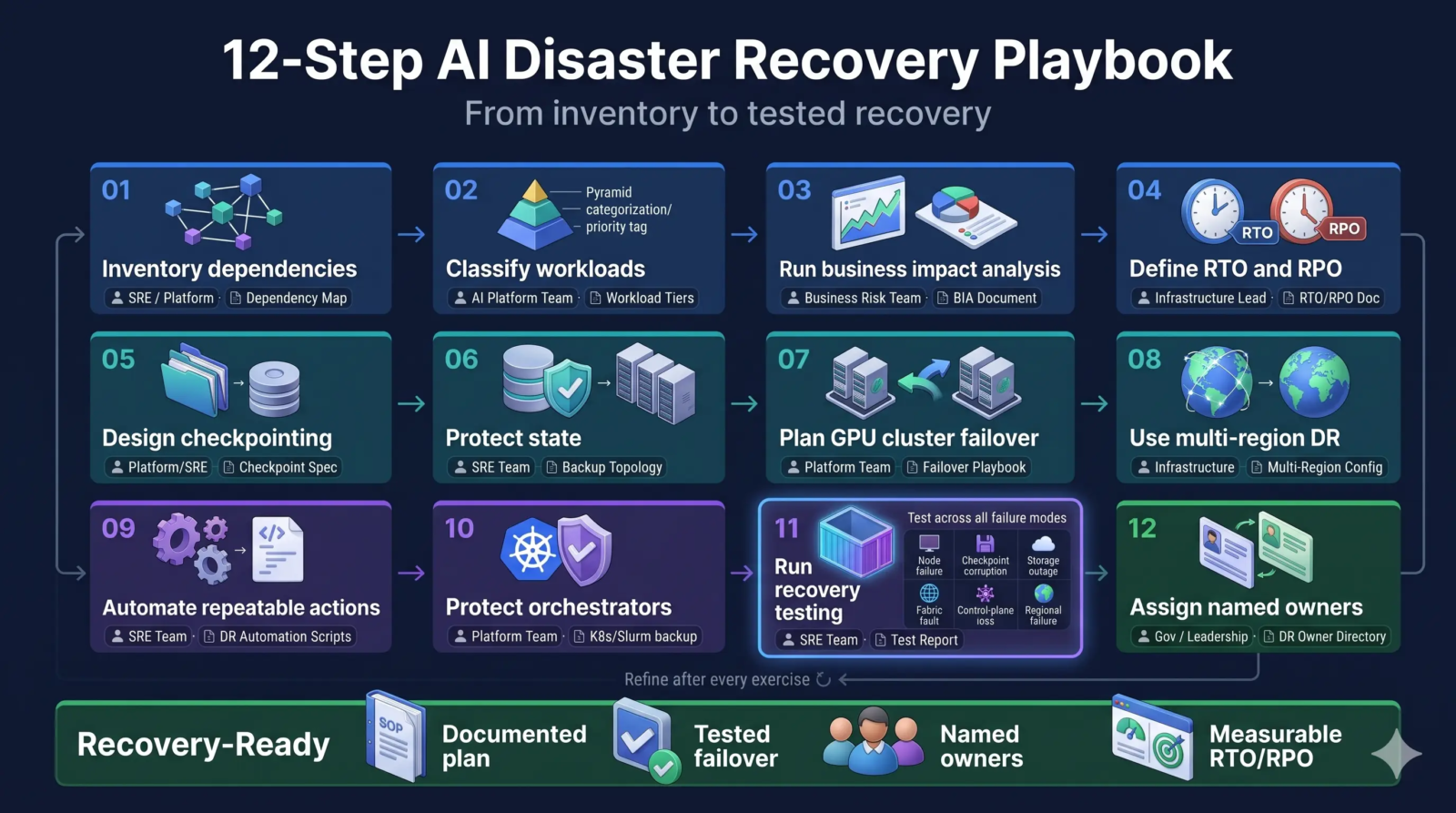
A Data center disaster recovery plan should cover twelve practical steps. AI data center disaster recovery becomes manageable when each step has an owner and evidence.
- Inventory GPU nodes, fabrics, storage, datasets, model registries, schedulers, secrets, identity, container images, observability, and facility dependencies.
- Classify training, fine-tuning, batch inference, and real-time inference by criticality.
- Run a business impact analysis covering revenue, delayed releases, idle GPU cost, SLA exposure, operational backlog, and customer impact.
- Define RTO and RPO for each service.
- Design GPU workload checkpointing, including frequency, format, retention, distributed training checkpointing, and AI model checkpoint recovery.
- Protect datasets, checkpoints, model weights, manifests, and configuration in independent failure domains. Checkpoint storage and replication should be monitored.
- Plan GPU cluster failover with known replacement capacity, compatible GPU types, network requirements, and scheduler configuration.
- Use multi-region disaster recovery where business impact warrants the expense and complexity.
- Automate repeatable actions. Automated workload failover and disaster recovery orchestration should use health checks and clear rollback conditions.
- Protect orchestrators. Test Kubernetes disaster recovery and Slurm workload recovery separately.
- Run AI infrastructure recovery testing across node, storage, fabric, control-plane, and regional failure scenarios.
- Assign named owners for activation, technical recovery, communications, failback, and post-incident review.
This AI infrastructure recovery strategy turns Disaster recovery for AI workloads into an operating process rather than a document. At executive level, what is data center disaster recovery is ultimately a question of acceptable loss, downtime, and recovery cost.
How AI can improve AI disaster recovery planning
How can AI improve disaster recovery planning in data centers? The strongest current uses are focused: anomaly detection, predictive maintenance signals, log correlation, incident classification, capacity forecasting, and faster identification of unhealthy infrastructure. Uptime Institute’s 2025 survey found operators commonly expected AI in operations to improve facility efficiency, reduce human-error risk, and improve staff productivity.
AI data center disaster recovery still needs deterministic recovery controls even when AI assists diagnosis. It cannot prove a checkpoint is valid or guarantee recovery meets compliance requirements without testing.
How to implement AI in data center disaster recovery workflows? Start with trustworthy telemetry and known failure signatures, then connect high-confidence conditions to predefined runbooks. The action may be GPU hardware failure isolation, automated workload failover, or escalation.
NVIDIA Recovery provides an example for distributed training. Its documentation describes detecting crashes, hangs, and stragglers, then coordinating with a scheduler to restart work and exclude problematic nodes. AI workload resilience therefore depends on durable state even when recovery control becomes more intelligent.
Real-world case study: Meta’s Llama 3 training run shows why GPU recovery must be designed for failure
Meta’s Llama 3 405B pretraining run provides a useful real-world example of why AI data center disaster recovery must assume that component failures will occur as GPU clusters grow. During a 54-day snapshot of pretraining on 16,384 NVIDIA H100 GPUs, Meta recorded 466 job interruptions. Of those, 47 were planned and 419 were unexpected, which works out to roughly one unexpected interruption every three hours. About 78% of the unexpected interruptions were attributed to confirmed or suspected hardware issues, while GPU-related issues represented 58.7% of unexpected interruptions. The reported causes included 148 faulty GPU events, 72 HBM3 memory events, and 35 network switch or cable events.
The important part of the story is what happened despite that failure rate. Meta reported more than 90% effective training time, and significant manual intervention was required only three times during the 54-day period. The team reduced job startup and checkpointing time and used automated monitoring and diagnostic tooling to identify failures and return training to useful work. Meta also noted that the synchronous nature of large-scale training makes these environments particularly sensitive because a single GPU failure can require the wider training job to restart.
For GPU workload disaster recovery, the lesson is that hardware redundancy alone is not enough. A Data center disaster recovery plan for a large AI cluster also needs GPU workload checkpointing, rapid fault detection, GPU node failure recovery, scheduler recovery, storage availability, network-fabric diagnostics, and a reliable path for AI training job resumption. AI infrastructure disaster recovery must protect the state of the workload as carefully as the physical accelerators.
The case also shows why GPU cluster disaster recovery and AI disaster recovery planning need to be built around frequent interruption rather than rare catastrophic failure. GPU cluster failover should be able to isolate unhealthy resources and move or restart work on known-good capacity without requiring lengthy manual diagnosis. AI workload resilience improves when distributed training checkpointing limits the amount of computation that must be repeated after each interruption.
From a business perspective, AI data center business continuity is therefore less about guaranteeing that every GPU remains available and more about controlling the impact when something fails. For leaders asking what is data center disaster recovery, Meta’s experience provides a useful answer: the objective is to prevent infrastructure faults from turning into prolonged loss of productive GPU time.
Although Meta’s example centers on large-scale training, the same principle applies to Disaster recovery for AI workloads more broadly. Training environments need fast checkpoint recovery and restart, while customer-facing serving environments need sufficient standby capacity and rapid Inference failover. In both cases, recovery mechanisms have to be exercised before a real incident.
The practical takeaway: at GPU-cluster scale, failures should be expected. What separates a resilient AI environment from a fragile one is how quickly the platform detects the fault, preserves trusted state, restores healthy capacity, and returns the workload to productive operation. That is why regular recovery testing becomes the next critical part of the design.
Best practices for AI data center disaster recovery
Best practices for AI data center disaster recovery. The practical starting point is testing. Google Cloud recommends judging recovery tests by data integrity, RTO, and RPO. In testing, what is data center disaster recovery becomes measurable through integrity, RTO, RPO, and restored service health.
AI infrastructure recovery testing should include GPU node failure, failed checkpoint writes, storage outages, fabric faults, scheduler or Kubernetes control-plane loss, and regional scenarios. AI data center disaster recovery should use those exercises to refine AI disaster recovery planning.
GPU cluster failover drills should measure detection, isolation, replacement capacity, checkpoint restore, distributed-job formation, and forward progress. Inference failover drills should measure health detection, routing convergence, model load time, cache warm-up, and performance after traffic shifts.
GPU cluster backup and restore should include intentionally corrupted or incomplete checkpoints. AI training job resumption should verify the job loads the correct state and produces expected metrics. GPU cluster disaster recovery also needs a failback procedure so restored primary infrastructure does not rejoin production with stale or inconsistent state.
Choosing an AI infrastructure recovery strategy
The right AI infrastructure recovery strategy balances downtime risk against the cost of standby GPU capacity. AI data center disaster recovery should make that cost-versus-risk decision explicit. Active-active provides the fastest continuity but duplicates more infrastructure. Active-passive costs less at steady state but relies on tested startup, replication, and reserved capacity.
Hyperscalers may distribute services across regions. Enterprise-owned clusters may use a second site or cloud capacity. Colocation customers must separate facility resilience from customer-owned GPU, storage, network, and software responsibilities. Hybrid environments must test identity, connectivity, and workload portability.
How to design multi-region disaster recovery for AI infrastructure? The answer depends on the service. Training may use checkpoint replication and restart. Critical inference may use active-active endpoints and inference failover. GPU cluster failover also needs a capacity decision: identical standby GPUs, a shared recovery pool, or compatible cloud capacity.
Aptly Technology and AI infrastructure disaster recovery
Aptly’s published AI Datacenter Buildout & Support service includes power and cooling validation, rack deployment, high-performance networking, burn-in, monitoring, incident management, capacity management, and 24×7 operations. AI data center disaster recovery benefits from that infrastructure context because recovery paths fail when underlying dependencies are not production-ready. Its AI Workload Deployment & Optimization service describes architecture validation, deployment automation, observability, functional testing, failover drills, and post-launch monitoring.
Those capabilities are relevant to AI data center disaster recovery because recovery depends on infrastructure readiness and workload operations together. AI infrastructure recovery testing can expose gaps in networking, monitoring, failover capacity, or workload deployment.
For a new GPU environment, resilience review before production can identify single points of failure. Disaster recovery for AI workloads should be included before production acceptance, not added after the first incident. For an existing environment, GPU cluster disaster recovery exercises and GPU workload disaster recovery tests can show whether the documented plan works under real operational conditions.
Conclusion: AI data center disaster recovery for AI data center business continuity
AI data center disaster recovery should follow the work the GPUs perform, not a generic server template. AI data center disaster recovery is strongest when business objectives, checkpoints, capacity, and operating procedures are designed together. Training needs durable checkpoints, replacement capacity, storage throughput, and reliable restart. Serving needs ready endpoints, replicated model state, traffic routing, and enough surviving capacity.
A credible AI infrastructure recovery strategy connects RTO, RPO, GPU infrastructure redundancy, checkpoint protection, multi-region disaster recovery, and testing. The Data center disaster recovery plan should document those choices in operational terms. GPU workload disaster recovery and GPU cluster disaster recovery require controls beyond conventional VM recovery, while inference failover needs its own service design.
The final test is operational: detect the failure, isolate it, restore trusted state, recover within the agreed window, and prove the service is healthy. AI data center disaster recovery should be judged by that evidence. That is the standard AI workload resilience should meet. Aptly Technology’s AI data center buildout, workload deployment, monitoring, and lifecycle operations capabilities can support the infrastructure and operating disciplines needed to put AI data center disaster recovery into practice.
Learn More:
- AI Datacenter Buildout & Support
- AI Workload Deployment & Optimization
- AI Infrastructure Managed Services
Frequently Asked Questions – AI data center disaster recovery:
- What are the best AI-driven disaster recovery solutions for data centers?
- There is no single product. AI infrastructure disaster recovery combines facility resilience, protected storage, checkpointing, observability, alternate capacity, and tested runbooks. AI data center disaster recovery works best when those layers are tested together. AI-assisted tools improve detection and diagnosis, but the Data center disaster recovery plan still needs durable backups and ownership.
- How to design disaster recovery for AI data centers?
- Start with service criticality, RTO, RPO, and a dependency map. For teams asking what is data center disaster recovery, the design should show how each dependency is restored. AI disaster recovery planning should decide which failures are handled locally and which trigger GPU cluster failover or multi-region disaster recovery. GPU cluster failover should have a tested activation threshold.
- How to build a disaster recovery plan for GPU workloads?
- Define checkpoint policy, replacement capacity, network and storage dependencies, scheduler recovery, and restart steps. GPU workload disaster recovery should measure how quickly the job resumes and how much training progress is lost.
- How to ensure business continuity for GPU workloads?
- AI data center business continuity requires workload tiers. Critical serving may need model serving high availability and regional failover. Training usually needs durable checkpoints, known replacement capacity, and tested restart procedures.
- How to recover AI training workloads after GPU failure?
- Detect and isolate the failed hardware, allocate healthy resources, restore the latest valid checkpoint, and restart the distributed job. GPU node failure recovery works best when GPU cluster fault tolerance and AI training job resumption have already been tested.
- How to define RTO and RPO for AI workloads?
- Use business impact. Disaster recovery for AI workloads should use different targets for training and inference. An AI infrastructure recovery strategy may accept hours for research training while requiring minutes or less for a revenue-facing service.
- How does checkpointing improve AI workload recovery?
- GPU workload checkpointing limits lost training progress. Asynchronous checkpointing can reduce save-path interruption, while checkpoint storage and replication protects state from larger failures. AI model checkpoint recovery must still be tested.
- Which companies offer AI-based disaster recovery services for data centers?
- Cloud providers such as AWS, Microsoft Azure, and Google Cloud provide disaster-recovery building blocks. NVIDIA provides checkpointing and distributed-training resilience technology. Infrastructure partners such as Aptly support buildout, workload deployment, monitoring, failover drills, and ongoing operations. Buyers should map each provider to the layer of the Data center disaster recovery plan it owns.