Introduction
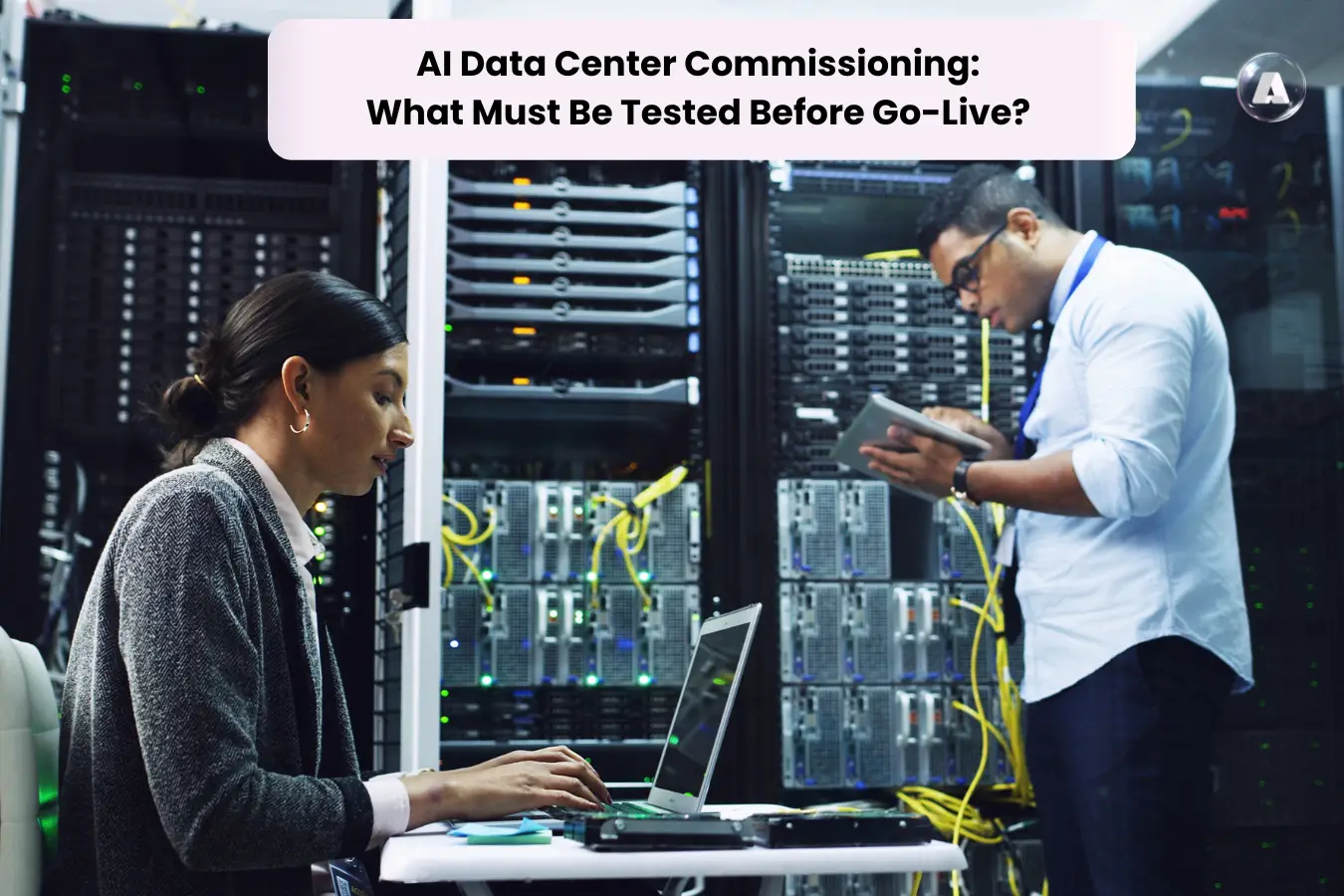
You can finish a GPU hall and still lose it on the first day of production. AI data center commissioning proves that your power, cooling, network, and controls perform as designed under real load. Without that proof, your first training run becomes the test, and that is a costly way to discover faults. This guide covers what must be tested before data center go-live, from power feeds to GPU clusters.
What Is AI Data Center Commissioning?
Data center commissioning is a structured process that verifies every system performs to the owner’s design intent. It begins during design review and ends only after the facility passes data center acceptance testing.
The process covers physical equipment, controls, electrical systems, cooling systems, networks, compute infrastructure, monitoring, and their interactions. A commissioning agent, or CxA, coordinates testing evidence and helps establish whether the facility is ready for operational use.
A complete data center commissioning process can include:
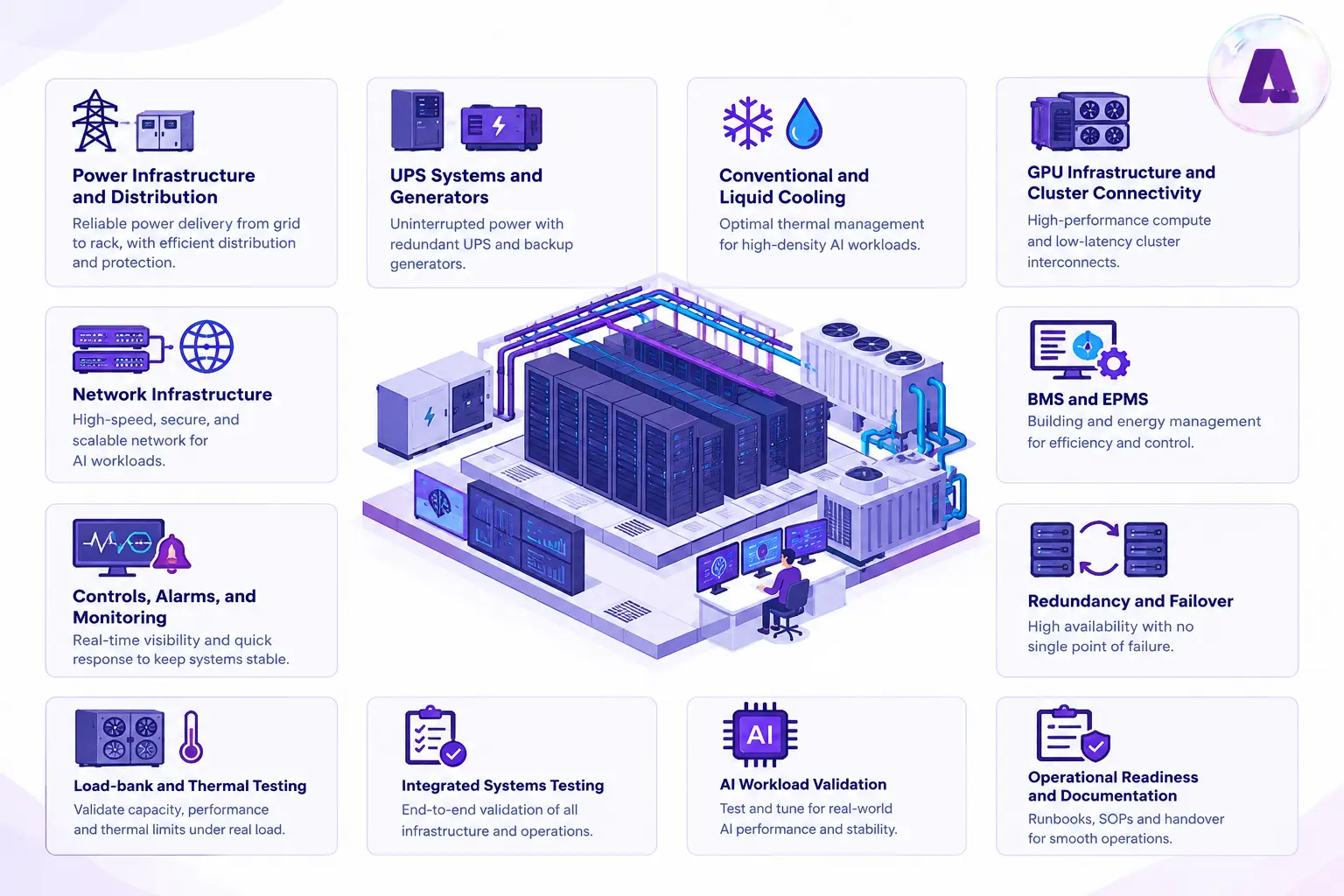
The objective is to establish evidence that the infrastructure behaves as designed, including during controlled failure conditions.
Data Center Testing vs Commissioning vs Validation
These terms overlap, but they describe different activities within the broader readiness process.
| Aspect | Data Center Testing | Data Center Commissioning | Data Center Validation |
| What it asks | Does the system perform the specified test? | Does the facility operate according to design intent? | Does the completed environment meet defined requirements? |
| Primary focus | Individual equipment or system behavior | Integrated facility performance | Evidence that requirements have been met |
| Typical scope | UPS, generators, chillers, pumps, networks, controls | Power + cooling + controls + IT + failure scenarios | Requirements, acceptance criteria, records and outcomes |
| Typical activities | Functional tests, load bank tests, failover tests | FPT, IST, sequence verification | Acceptance review, documentation, compliance checks |
| When it happens | Throughout construction and commissioning | Primarily during formal commissioning phases | Before acceptance and operational release |
| Main output | Test results | Commissioning report and issue log | Validation/acceptance evidence |
| Example | Test whether a UPS transfers to battery | Test whether UPS, generator, cooling and controls respond correctly to utility loss | Confirm the facility meets the approved resilience requirement |
In short, testing generates evidence, commissioning proves system behavior, and validation confirms that the evidence satisfies requirements.
The AI Data Center Commissioning Process
Before individual tests begin, you need a commissioning lifecycle that connects design intent with measurable results.
Step 1: Design and Documentation Review
Start by reviewing the documents that define expected performance. These typically include electrical single-line diagrams, cooling designs, network architecture, redundancy strategies, control sequences, equipment specifications, and AI workload requirements.
The commissioning team should also identify critical failure scenarios early. If a failure cannot be safely tested later, the test method should be defined before construction reaches the final stages.
Step 2: Installation Verification
Next, verify that equipment matches the approved design and has been installed correctly. Check equipment configuration, cabling, pipework, sensors, connections, labels, physical clearances, and control interfaces.
This stage prevents installation issues from becoming confusing functional-test failures later.
Step 3: Site Acceptance Testing
Site acceptance testing (SAT) checks equipment and systems after installation. Testing should follow manufacturer requirements, project specifications, and documented acceptance criteria.
SAT provides the bridge between installation verification and functional performance testing.
Step 4: Functional Performance Testing
During functional performance testing (FPT), you test operating sequences, setpoints, alarms, controls, interlocks, and safety mechanisms.
Each system should demonstrate the behavior expected under defined operating conditions. Results should be recorded rather than relying on verbal confirmation.
Step 5: Integrated Systems Testing
Integrated systems testing (IST) examines interactions between systems. Examples include utility failure, UPS operation, generator startup, cooling failure, network failure, and control-system failure.
ASHRAE describes integrated systems testing as Level 5, where systems operate together under real-world and failure scenarios.
Step 6: Full-Load and Failure Testing
The final stages introduce realistic electrical and thermal demand. Load banks can simulate IT power while representative GPU workloads can test the actual compute environment.
The objective is to understand how the facility behaves when power demand, heat generation, network traffic, and system dependencies reach realistic operating conditions.
Data Center Commissioning and 5 Levels of Testing
The five-level model below is a commonly used commissioning framework, but the exact terminology and scope can vary by project and methodology. ASHRAE’s current AI Data Center Energy Performance Framework describes L1 through L5 from factory acceptance through integrated systems testing.
The table below shows the five levels, so you can see what each stage proves before the next one starts.
| Level | Stage | What it proves | AI site example |
| 1 | Factory witness testing | Equipment meets specification before shipment | Witnessed UPS, CDU, and switchgear tests |
| 2 | Delivery and installation checks | Equipment arrives undamaged and is installed per design | Torque checks, pipe pressure tests, cable labeling |
| 3 | Startup and site acceptance testing (SAT) | Each unit powers up and runs on its own | Generator start, chiller start, pump rotation |
| 4 | Functional performance testing (FPT) | Systems respond correctly to controls and load | Load bank testing, thermal checks, BMS/EPMS points |
| 5 | Integrated systems testing (IST) | All systems work together during failures | Utility loss at full IT load, cooling failover |
- Levels 1 through 3 cover equipment quality, installation, and startup, so faults get caught while they are still cheap to fix.
- Level 4 data center commissioning testing exercises each system against its written sequence of operations and alarm limits.
- Level 5 then forces power, cooling, and controls to respond together while engineers simulate real failures on data center site.
Many hidden defects only appear at this final stage, which is why IST carries so much weight.
What Must Be Tested Before an AI Data Center Goes Live?
This is the core of an AI data center commissioning checklist. The goal is not simply to collect successful test results. You need evidence that critical infrastructure can support the intended workload and recover from defined failures.
Power Infrastructure Testing
Data center power testing starts at the utility feed and follows every conductor, breaker, and switch until it reaches the rack. Load bank testing pushes UPS units and generators to rated capacity, which exposes overheating, voltage sag, and breaker faults before real servers are at risk.
Uptime Institute’s 2026 analysis names UPS systems, transfer switches, and generators as the dominant sources of power failures. Give these components your longest data center power testing windows, since they cause the failures operators report most often.
UPS and Generator Testing
UPS and generator testing should demonstrate the complete emergency-power sequence rather than isolated component operation.
Test UPS functionality, batteries, automatic transfer switches, static transfer switches, generator startup, synchronization, fuel systems, and load-bank performance.
The critical question is whether the sequence protects the intended IT load. A generator that starts correctly during an individual test does not prove that the complete power chain will respond correctly during a facility event.
Cooling System Testing
Cooling deserves dedicated attention because power and cooling converge in high-density AI environments. The IEA notes that cooling can represent roughly 7% of electricity consumption in efficient hyperscale facilities and more than 30% in less-efficient enterprise facilities.
Various types include:
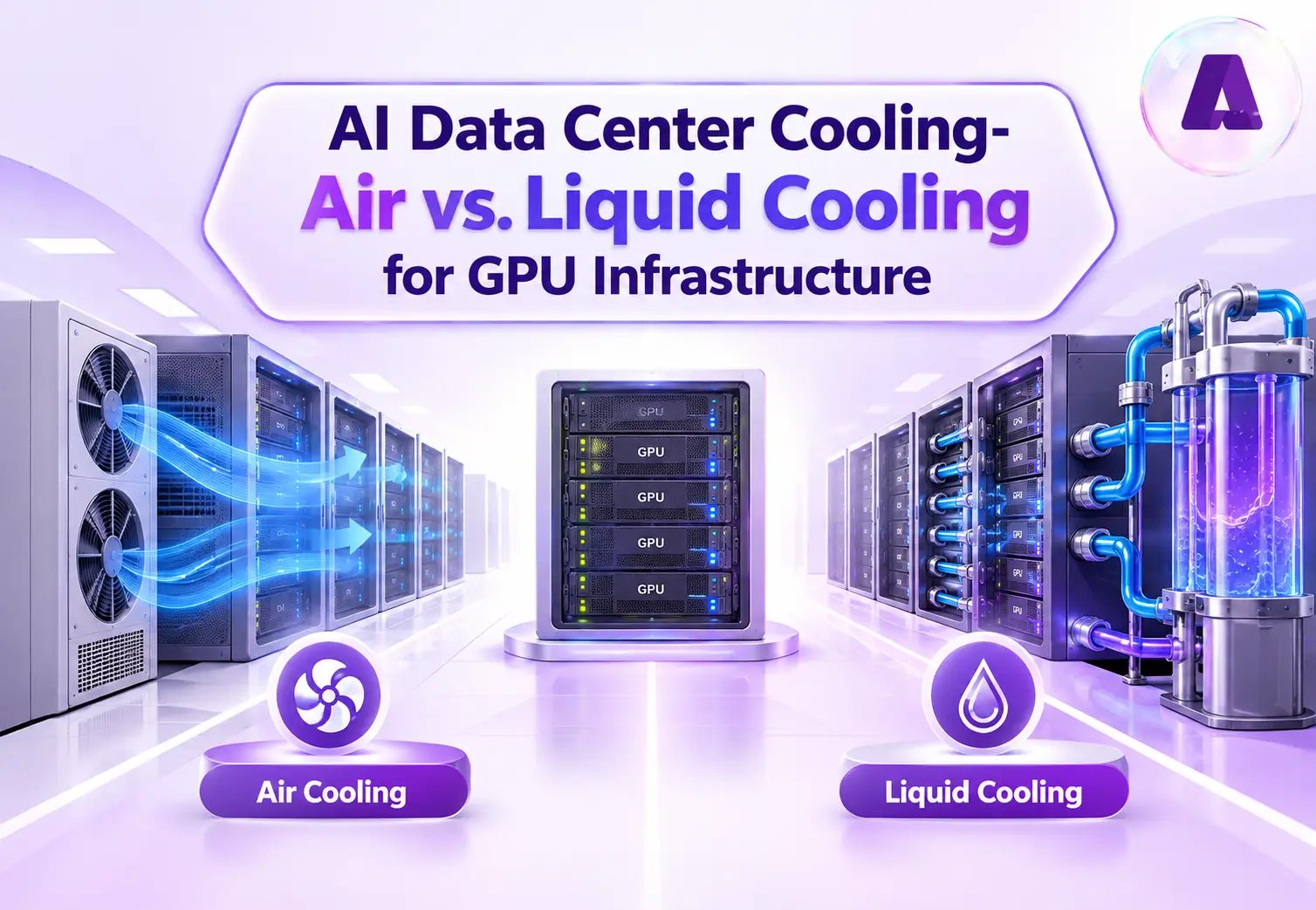
- Air-Cooling Commissioning: For air cooling, test airflow, temperature, fans, cooling capacity, humidity, and backup systems. Make sure the cooling system can handle higher workloads and alerts operators when temperatures rise.
- Liquid Cooling System Commissioning: For liquid cooling, flush and pressure-test each cooling loop. Check coolant quality, flow rates, supply and return temperatures, leak detection, and CDU operation. Also test CDU failover to make sure cooling continues if a component fails.
- Thermal Performance Testing: Thermal testing uses a real or simulated heat load to check cooling performance. Increase the load from low to peak levels while monitoring GPU temperatures, rack temperatures, coolant temperatures, and flow rates. This confirms that the cooling system can keep temperatures within safe limits during AI workloads.
Network Infrastructure Testing
Network infrastructure testing confirms that your fabric matches the design, so you find weak links before real workloads arrive. AI training needs low latency and lossless transport, so one faulty optic can slow an entire job. Test spine-leaf architecture, cabling, link error rates, and switch failover on both the compute fabric and the management network.
GPU Cluster Testing
GPU data center commissioning adds one extra step that older enterprise facilities rarely needed to perform. GPU cluster testing is where the physical infrastructure finally meets the workload it was built to support. Run burn-in jobs that hold accelerators near peak draw, and watch power, temperature, and error counters at the same time.
This AI data center testing step shows how to validate AI data center infrastructure before deployment, because it proves the facility can carry real training jobs.
BMS/EPMS Testing
BMS/EPMS testing confirms that your monitoring layer reports exactly what the hardware is doing at every moment.
- Trigger alarms on purpose, then check that each one reaches the right dashboard and the right on-call engineer.
- Verify point mapping, trend logging, and control sequences, because operators depend on these signals during real incidents.
Failover and Redundancy Testing
Failover and redundancy testing shows whether your N+1 or 2N design behaves the way the drawings promise. Pull a utility feed, trip a UPS module, stop a chiller, and record how each system responds.
Uptime Institute lists failure to follow procedures as the leading driver of human error outages, so script each test for your team to rehearse.
Key AI Data Center Commissioning Case Studies and Approaches
Here are a few core use cases related to data center commissioning
The Pikes Peak AI Lab – Dell
- Challenge: Transforming a legacy 1990s-2000s data center into a high-density, liquid-cooled AI center of excellence.
- Solution: Utilized virtual reality and digital twin technology to simulate equipment placement and overhead direct liquid cooling layouts before breaking ground, avoiding costly overbuilding.
Hyperscale Fleet Load Management – Thermon
- Challenge: Simulating real-world electrical and liquid-cooling demand for high-density AI footprints without centralized oversight.
- Solution: Deployed a scalable platform of fleet-ready liquid load banks with centralized control of 250+ units from a single interface to accelerate startup times.
Power Monitoring and Speed-to-Market – Janitza Report
- Challenge: A global social media leader faced deployment delays threatening revenue during AI infrastructure scaling.
- Solution: Integrated automated power quality solutions and energy data feeds into existing SCADA/EPMS platforms, achieving 44% faster commissioning.
AI Tools for Data Center Commissioning
AI tools for data center commissioning are starting to shorten test cycles and widen coverage.
- Commissioning-Native AI Platforms
- CxPlanner / CxAI: A purpose-built data-center commissioning platform covering L1–L5 testing, checklists, asset tracking, scheduling, issue management, reporting, and handover. Its CxAI layer can generate test scripts/checklists, extract information from P&IDs and nameplates, analyze project data, and assist with reporting.
- ODUM AI: An AI-enabled commissioning and operational-readiness platform focused on bringing together commissioning data, project information, field execution, and readiness intelligence. It can be positioned around AI-assisted decision support and visibility across complex critical-facility commissioning workflows.
- AI Infrastructure Commissioning & Validation
- Aptly Technology: Aptly Technology supports AI data-center infrastructure buildout services, including deployment, validation, testing, and commissioning, particularly for GPU/AI infrastructure. It is more infrastructure and deployment-oriented than a traditional commissioning-management SaaS platform, making it a useful example in this category.
- NVIDIA Mission Control: NVIDIA Mission Control focuses on operating and validating AI-factory infrastructure across the cluster lifecycle, including continuous hardware/cluster health checks, power and cooling integration, workload orchestration, and automated recovery.
- DCIM / Intelligent Facility Operations
- Schneider Electric EcoStruxure: EcoStruxure provides a broader data-center infrastructure-management and facility-operations ecosystem, covering power, cooling, monitoring, automation, asset management, and analytics. Its relevance to AI commissioning is strongest where commissioning transitions into continuous monitoring, optimization, and predictive facility operations.
- Octave: Octave connects data-center design, construction, commissioning, turnover, and operational asset information in a common environment. It is useful for the transition from project delivery and commissioning into operational readiness and long-term asset management.
AI Data Center Commissioning Checklist
Before go-live, ensure the following checks are ready for your data center commissioning facility.
style=”border-collapse: collapse; border: 1px solid #000000;”
| Phase | Check / Test | Acceptance Criteria | Status |
| Documentation | Approved IFC/as-built drawings | Latest drawings available and coordinated | ☐ |
| Equipment schedules | UPS, generators, chillers, CRAH/CRAH units, PDUs, racks, network equipment documented | ☐ | |
| O&M manuals | Complete and approved | ☐ | |
| Commissioning scripts | Approved for all systems | ☐ | |
| Safety procedures | LOTO, emergency response and test permits approved | ☐ | |
| Electrical | Utility incoming supply | Voltage/frequency/phase sequence within design limits | ☐ |
| MV/LV switchgear | Protection, interlocks and alarms tested | ☐ | |
| Transformers | Ratio, insulation, protection and temperature tests passed | ☐ | |
| UPS systems | Load-bank test completed at required load levels | ☐ | |
| Battery systems | Capacity and monitoring tests passed | ☐ | |
| Generators | Start/stop, synchronization and load tests passed | ☐ | |
| ATS/STS | Automatic transfer and recovery demonstrated | ☐ | |
| PDUs/busways | Energization, protection and monitoring verified | ☐ | |
| Earthing/bonding | Resistance and continuity within design requirements | ☐ | |
| Cooling | Chillers | Full operating sequence verified | ☐ |
| Pumps | Duty/standby operation and controls tested | ☐ | |
| CRAH/CRAC units | Airflow, temperature and control sequences verified | ☐ | |
| CDU/liquid cooling | Flow, pressure, leak detection and controls tested | ☐ | |
| Cooling-water system | Design flow, temperature and pressure achieved | ☐ | |
| Redundancy | N+1 / 2N failure scenarios demonstrated | ☐ | |
| AI/GPU Infrastructure | GPU racks | Rack power and cooling requirements verified | ☐ |
| GPU server burn-in | CPU/GPU stress test completed without errors | ☐ | |
| GPU thermal performance | Temperatures remain within manufacturer limits | ☐ | |
| GPU fabric/network | InfiniBand/Ethernet links and topology verified | ☐ | |
| RDMA | Connectivity and performance tests passed | ☐ | |
| Storage | IOPS, throughput and failover tests passed | ☐ | |
| Management network | OOB/BMC access verified | ☐ | |
| Controls/BMS/DCIM | BMS points | All required points mapped and functional | ☐ |
| DCIM monitoring | Power, temperature, humidity and alarms visible | ☐ | |
| Alarm testing | Critical alarms generated and received correctly | ☐ | |
| Trend logging | Required parameters recorded at specified intervals | ☐ | |
| Automatic sequences | Start/stop, lead/lag and failure sequences verified | ☐ | |
| Integrated Systems Testing (IST) | Utility failure | Facility transfers to backup power as designed | ☐ |
| Generator failure | Redundancy/failure response demonstrated | ☐ | |
| UPS failure | Critical load remains within ride-through limits | ☐ | |
| Cooling failure | IT thermal conditions remain within limits | ☐ | |
| Network/fabric failure | AI workload connectivity/failover verified | ☐ | |
| BMS/DCIM failure | Required systems operate safely in degraded mode | ☐ | |
| Multiple simultaneous failures | Approved worst-case scenarios successfully demonstrated | ☐ | |
| Performance | Full-load test | Facility supports contractual/design IT load | ☐ |
| AI workload test | Representative GPU workload sustained for agreed duration | ☐ | |
| Power quality | Voltage, frequency, harmonics and transients within limits | ☐ | |
| PUE measurement | Measured against project target | ☐ | |
| Cooling performance | Supply/return temperatures and flow meet design | ☐ | |
| Handover | Deficiency list | All critical defects closed | ☐ |
| Test records | Signed commissioning records complete | ☐ | |
| Training | Operations team trained | ☐ | |
| Emergency procedures | Tested and handed over | ☐ | |
| Spare parts | Required critical spares available | ☐ | |
| Final documentation | As-builts, O&M, settings and certificates handed over | ☐ | |
| Final acceptance | Owner/commissioning authority approval obtained | ☐ |
How Aptly Technology Supports Your Data Center Commissioning?
AI data center commissioning becomes especially important when power availability can determine whether GPU infrastructure reaches production readiness. Gartner predicts that 40% of existing AI data centers could be operationally constrained by power availability by 2027. This highlights the need to validate infrastructure capacity before GPU acceptance.
In this scenario, Aptly Technology can support AI data center infrastructure validation by assessing power readiness, validating distribution and redundancy, testing failover scenarios, and confirming that available capacity matches the requirements of planned GPU deployments.
The same commissioning challenge extends to high-density power and cooling requirements. For AI operators, this means commissioning cannot stop at checking whether individual systems work. Aptly can connect power and cooling monitoring, GPU infrastructure readiness, BMS/EPMS data analysis, AI-assisted anomaly detection, infrastructure performance monitoring, and commissioning data analysis to help identify readiness gaps before production workloads begin.
Conclusion
AI data center commissioning replaces assumptions with proof that your site can carry production workloads. The five levels take you from factory checks to integrated failure testing, and each layer catches faults the previous one misses. Power, cooling, network, GPU, and control systems each need their own tests before go-live, followed by joint tests. Use the checklist in this guide, involve an independent commissioning agent, and treat data center readiness as something you verify.
Ready to validate your AI infrastructure before production workloads begin, talk to Aptly experts today.
FAQs
Q1: What is data center commissioning?
Data center commissioning is a structured process that verifies each system meets the owner’s design intent. It covers design review, equipment checks, functional tests, and integrated failure testing across the whole facility. The process ends with documented proof that the facility is ready to carry production workloads for your users.
Q2: What must be tested before an AI data center goes live?
- You must test power, cooling, network, GPU clusters, and control systems, first alone and then together.
- Load bank testing, failover tests, and thermal checks carry the most weight, because they expose faults under realistic stress.
The full data center commissioning checklist before go-live appears in the checklist section earlier in this guide.
Q3: What does AI data center commissioning include?
AI data center commissioning includes:
- Design review
- Factory and site tests
- Functional performance testing
- Integrated systems testing
It adds GPU cluster testing and liquid cooling validation for the high-density halls that AI training requires. A commissioning agent documents every result, so you hold a complete record of what passed and what needed fixes.
Q4: How do you commission an AI data center?
To commission an AI data center:
- Appoint a commissioning agent early, and write the test plan during design so contractors can price it in.
- Progress through the five levels and close every open issue before the next level starts.
- Finish with an IST and a handover review, so your operations team understands every result before go-live.
Q5: What tests are performed during data center commissioning?
Typical tests include UPS and generator testing, load bank testing, cooling system testing, network infrastructure testing, and BMS/EPMS testing. Failover tests then confirm that backup paths carry the load without dropping servers or breaching temperature limits. AI sites add burn-in runs on the GPU cluster to prove that power and cooling hold under sustained training load.
Q6: What is integrated systems testing in a data center?
Integrated systems testing is the final commissioning level, and it is the one that tests every system together. It simulates failures such as utility loss or a chiller trip while the full IT load keeps running. You watch how power, cooling, and controls respond together, then compare recovery times against your design targets.
Q7: How do you validate power and cooling systems before data center go-live?
- Apply real electrical and heat load with load banks, then confirm each system holds its setpoints under stress.
- Trigger failures such as a chiller stop or utility loss, and record how long each system takes to recover.
- Compare every result against the design targets, and log any gap as an open item for the contractor to close.
Q8: What are the key data center commissioning phases?
The phases are design review, construction and delivery, startup, functional testing, integrated testing, and handover. Each phase has clear entry and exit criteria, and the commissioning agent verifies them before work moves forward. Skipping a phase does not remove the risk, because it simply pushes the problem into the next stage.
Q9: What is the difference between data center testing, commissioning, and validation?
Testing checks a single component or system against its specification and produces a pass or fail result. Commissioning is the managed process that plans, runs, and documents every test from design review to handover. Validation is the final confirmation that the finished site meets the requirements the owner wrote into the project brief.