Introduction
A data center site can look perfect on a property map. It might be large, well located, close to a metro area, and reasonably priced. But if the utility cannot deliver enough power, fiber lacks route diversity, or the site cannot support the cooling load, the project may never move forward.
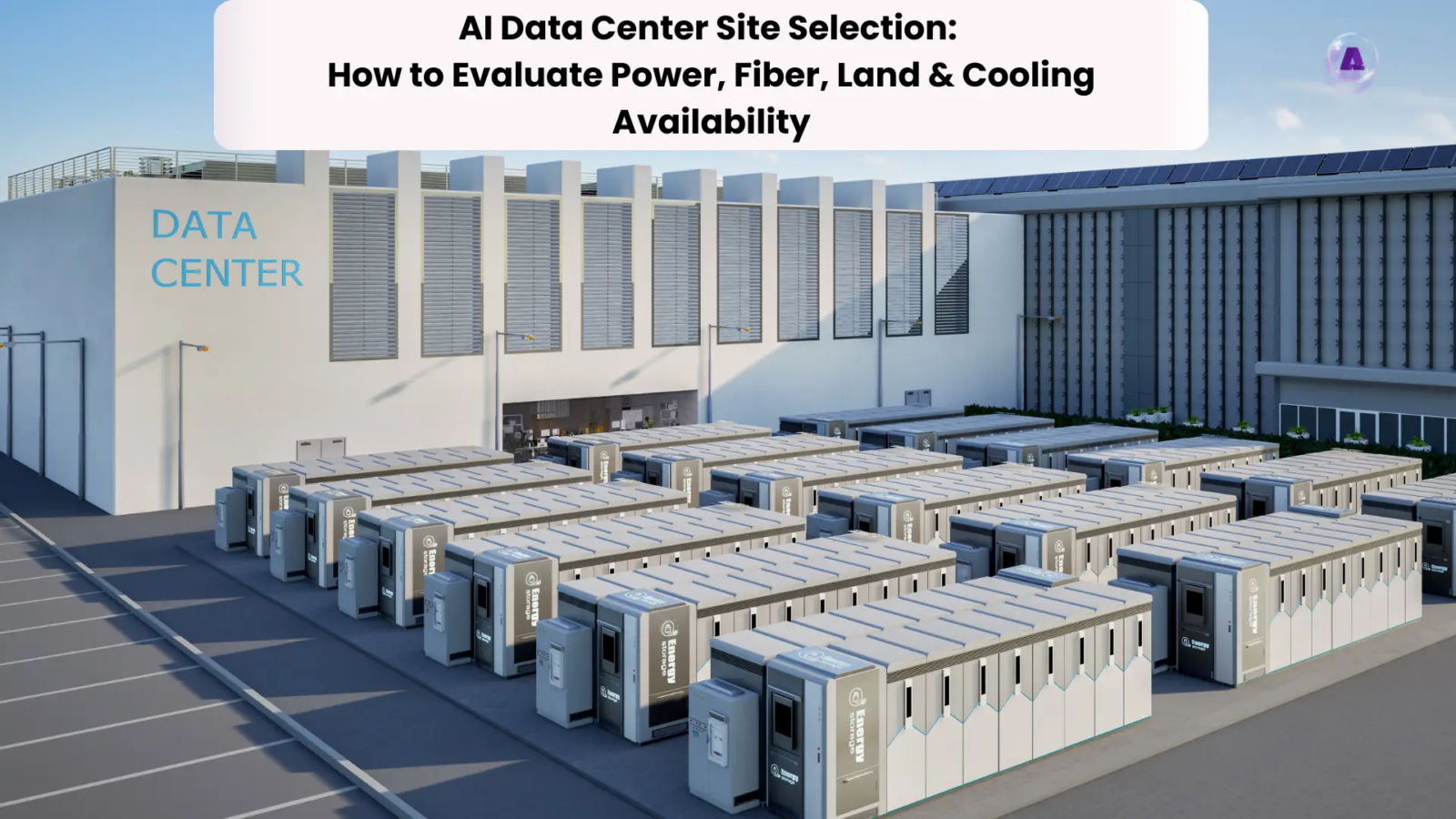
That is why AI data center site selection must happen before detailed engineering, procurement, or construction planning. The goal is to determine whether a parcel can support the power, connectivity, cooling, regulatory, and expansion needs of your AI data center infrastructure.
This guide focuses on four critical screening criteria: power, fiber, land, and cooling. Each section provides a practical verdict to help you decide whether a site is worth pursuing.
What Makes a Good AI Data Center Location?
A good AI data center location must satisfy four conditions at once.
- Power needs to be deliverable at the required scale and timeline.
- Fiber connectivity must support high-bandwidth, low-latency workloads.
- The land must legally and physically support the facility you’re planning.
- Cooling and water requirements need to be met without straining local resources.
Beyond those four pillars, several secondary factors shape whether a site holds up over time. Grid reliability, electrical redundancy, and environmental risk all affect long-term operating cost. Tax incentives, permitting timelines, workforce availability, and network diversity often decide whether a project stays on schedule.
These factors should not be treated as independent checkboxes. A large parcel has little value if grid interconnection takes several years. Likewise, an attractive power profile does not solve a site that lacks diverse fiber routes or suitable cooling infrastructure.
For GPU data center planning, the key question should not be “Is this land available?” It is “Can this land support the infrastructure architecture my AI workload will require?”
1. Power Availability: Can the Grid Support Your AI Workload?
Power is one of the first constraints in AI infrastructure planning. Before assessing rack layouts, GPU quantities, or facility design, determine whether the site’s electrical infrastructure can support your intended load.
That question is becoming more important as AI workloads drive higher power demand. According to the International Energy Agency (IEA), global data center electricity consumption increased 17% in 2025, while AI-focused data center consumption grew by 50%. The IEA expects overall data center electricity consumption to nearly double, from 485 TWh in 2025 to 950 TWh by 2030.
For AI data centers, the issue is not whether power exists nearby. You need to know whether the required capacity can reach the site, when it can be delivered, and whether the grid can provide the reliability and redundancy your infrastructure requires.
So, Don’t Ask Only “Is Power Available?”
Utility capacity comes in different stages, and the distinction can determine whether your project timeline is realistic:
- Existing capacity: Power already available through the local grid.
- Available capacity: Capacity the utility can currently offer.
- Allocated capacity: Capacity already committed to other customers.
- Interconnection capacity: Capacity that can be delivered once your project connects to the grid.
- Future capacity: Potential for expansion beyond the initial build.
A site with 50 MW of quoted capacity may not be viable if grid upgrades delay delivery for several years. AI data centers can also require power at a scale that makes these checks critical. Hyperscale facilities can exceed 100 MW, while some AI data center projects are planned at 200 MW or more, with larger developments targeting several hundred megawatts.
What to Evaluate
Before treating a site as viable, assess:
- Current utility capacity at the substation serving the parcel
- Proximity to existing substations and transmission lines
- Interconnection requirements and expected delivery timeline
- Electrical redundancy model, including N+1 and N+N requirements
- Room for expansion capacity beyond the first build phase
- Historical utility reliability for that service territory
- Feasibility of on-site generation or battery storage as a backstop
Power verdict: A site should move forward only when its required capacity, delivery timeline, redundancy, and expansion potential are understood. Detailed power engineering can come later; at the site-selection stage, the goal is to confirm that the grid can realistically support the project.
For a deeper look at power constraints and AI infrastructure planning, see Power Is the New Currency of AI: Operating Under AI Data Center Power Constraints.
2. Fiber Connectivity: Can the Site Support AI-Scale Networking?
Power gets the GPUs running. The network determines how effectively those GPUs can communicate. Modern AI workloads can distribute computation across large GPU clusters. That makes network bandwidth, latency, topology, and reliability important considerations during AI data center site selection.
A site served by a single fiber provider should not automatically qualify, no matter how attractive the rest of the parcel looks. Ask a handful of specific questions before ruling a location in:
- How many carriers actually serve the location?
- Are the physical routes genuinely diverse, or do they share a corridor?
- Is dark fiber available for future AI data center buildout?
- How close is the nearest carrier hotel or network hub?
- What latency can the site realistically deliver?
- Can connectivity scale alongside GPU cluster growth?
- Is there a second, physically independent path in case the primary route fails?
Connectivity verdict: Prioritize locations where multiple physically diverse paths can support the bandwidth, latency, redundancy, and growth requirements of your planned AI environment. Once the site passes this screen, detailed AI data center networking design can address technologies such as InfiniBand, RoCE Ethernet fabric, and high-performance GPU interconnects.
3. Land Availability: Is the Parcel Actually Developable?
When evaluating land, acreage is only the starting point. A 100-acre parcel does not necessarily provide 100 acres of usable development area.
Evaluate the Physical Site
Start with the physical characteristics of the land itself. Your physical assessment should cover:
- Total and usable acreage
- Site topography and soil conditions
- Road and construction access
- Construction logistics
- Setbacks, terrains, and environmental restrictions
- Utility easements and corridors
- Stormwater requirements
- Space for substations and electrical equipment
- Space for cooling infrastructure
- Future expansion areas
You should also determine whether you are evaluating a greenfield site or considering brownfield redevelopment. Existing infrastructure can create advantages in some locations, but legacy constraints can also increase redevelopment requirements.
Evaluate Regulatory Feasibility
Physical suitability does not guarantee approval. Review the following before treating the site as viable:
- Local zoning regulations
- Environmental permitting requirements
- Building restrictions
- Noise rules
- Water rights
- Local economic policies
- Property tax abatements
- Development incentives
Plan for the Next Infrastructure Generation
Your site should accommodate more than today’s GPU deployment. It needs room for the next infrastructure generation, and that requirement is specific to AI workloads compared with traditional data center planning.
A parcel that comfortably fits today’s deployment but leaves no room for additional substations, cooling plants, generators, or future buildings can become a real constraint within a few years. Build that expansion math into the site evaluation from the start, not as a follow-up question.
Land verdict: The right parcel is not necessarily the largest or the cheapest one available. It’s the parcel with sufficient development area, regulatory feasibility, infrastructure access, and room for future AI capacity.
4. Cooling and Water: Can the Site Support AI-Scale Networking?
Power and cooling are closely connected. Almost every watt consumed by IT equipment eventually becomes heat that the facility must remove. AI infrastructure can create much higher rack densities than conventional enterprise environments. As GPU concentration increases, the resulting heat load can push traditional room-level cooling approaches toward their practical limits.
Evaluate site’s cooling inputs:
- Ambient climate and how it affects free-cooling hours
- Water availability and water quality at the source
- Existing utility infrastructure for water delivery
- Cooling tower feasibility given local regulations
- Readiness for liquid-cooling infrastructure and direct-to-chip systems
- Heat rejection options available at the site
- Environmental restrictions on water withdrawal or discharge
- Sustainability requirements tied to local permits or incentives
Liquid cooling and direct-to-chip cooling are increasingly relevant for high-density GPU environments. However, there is no universal cooling architecture for every AI facility. The appropriate approach depends on workload characteristics, rack density, facility design, climate, water availability, and expansion plans.
Cooling verdict: Evaluate the site against your intended cooling architecture. If the location cannot support the thermal requirements of your planned GPU density, low-cost land or available power will not make the project viable.
Environmental and Geographic Risk Considerations
Infrastructure availability tells you whether you can build. Risk assessment helps determine whether the location remains practical over its operating life.
Your screening process should examine:
- Flood zones
- Seismic risk
- Extreme weather exposure
- Wildfire risk where applicable
- Water stress
- Environmental constraints
- Transportation access
- Emergency response considerations
These risks can affect construction, insurance, infrastructure design, permitting, and long-term availability. A site that requires extensive mitigation may still be developable, but those requirements should enter the feasibility model before you commit to the location.
Economics and Incentives
The purchase price of land is only one part of the financial equation. Your evaluation should include electricity costs, land acquisition, construction implications, network connectivity, water, cooling infrastructure, taxes, incentives, and future expansion.
Property tax abatements or other local incentives can improve the business case. According to the National Conference of State Legislatures, 38 states have specific laws offering data center tax incentives. These commonly include sales tax exemptions on equipment, electricity tax breaks, and property tax incentives. However, they should be considered alongside infrastructure costs rather than viewed as a reason to overlook site limitations.
The cheapest site is not necessarily the lowest-cost site. A location that requires expensive transmission upgrades, new fiber construction, major cooling infrastructure, or extensive site preparation may carry a much higher total cost over its lifecycle.
This is where AI infrastructure optimization begins before the first rack arrives. A good site reduces avoidable infrastructure compromises later.
AI Data Center Site Selection Checklist
Use this checklist as an initial screening framework before moving into detailed engineering.
| Evaluation Area | Questions to Consider |
|---|---|
| Power | Is sufficient capacity available at the required timeline? |
| Grid | What is the interconnection queue timeline? |
| Proximity | How far is the parcel from viable power, fiber, water, transportation, workforce, and other critical infrastructure—and what cost, schedule, and right-of-way constraints does that distance create? |
| Substation | Is there sufficient capacity and redundancy nearby? |
| Fiber | Are multiple, physically diverse routes available? |
| Latency | Does connectivity meet the workload’s requirements? |
| Land | Is enough developable acreage actually available? |
| Zoning | Is data center development permitted on this parcel? |
| Permitting | What approvals and timelines are required? |
| Cooling | Can the site support the planned thermal architecture? |
| Water | Is sufficient water available where the strategy requires it? |
| Risk | Is the site exposed to flood, seismic, or other environmental risk? |
| Expansion | Can the site support future phases of GPU deployment? |
| Economics | What incentives and lifecycle costs apply to this parcel? |
This AI data center site selection checklist is not a substitute for engineering due diligence. It is a screening framework that helps you identify obvious constraints before investing in detailed design.
How Do Hyperscalers Choose Data Center Locations?
Hyperscale data center site selection doesn’t evaluate these criteria one at a time. Power, connectivity, land, cooling, permitting, risk, scalability, and economics all get assessed together, because a weakness in any one area can undermine the rest.
That same principle applies to enterprises planning GPU infrastructure at a smaller scale. The difference is that enterprise teams often lack the internal resources to evaluate every infrastructure dependency independently, which is where an experienced infrastructure partner tends to add the most value.
How Aptly Tech Can Help You with AI Data Center Site Selection?
Site selection does not happen independently of infrastructure design. You can only judge a location properly when you understand the infrastructure that the site ultimately needs to support. This is where an infrastructure partner can become useful during the transition from feasibility to deployment.
Aptly Tech’s AI Data Center Buildout & Support services follows a lifecycle of assess, design, build, integrate, validate, deploy, commission, scale, and support. Its scope includes high-density GPU compute, networking, power, cooling, rack integration, validation, commissioning, and ongoing support.
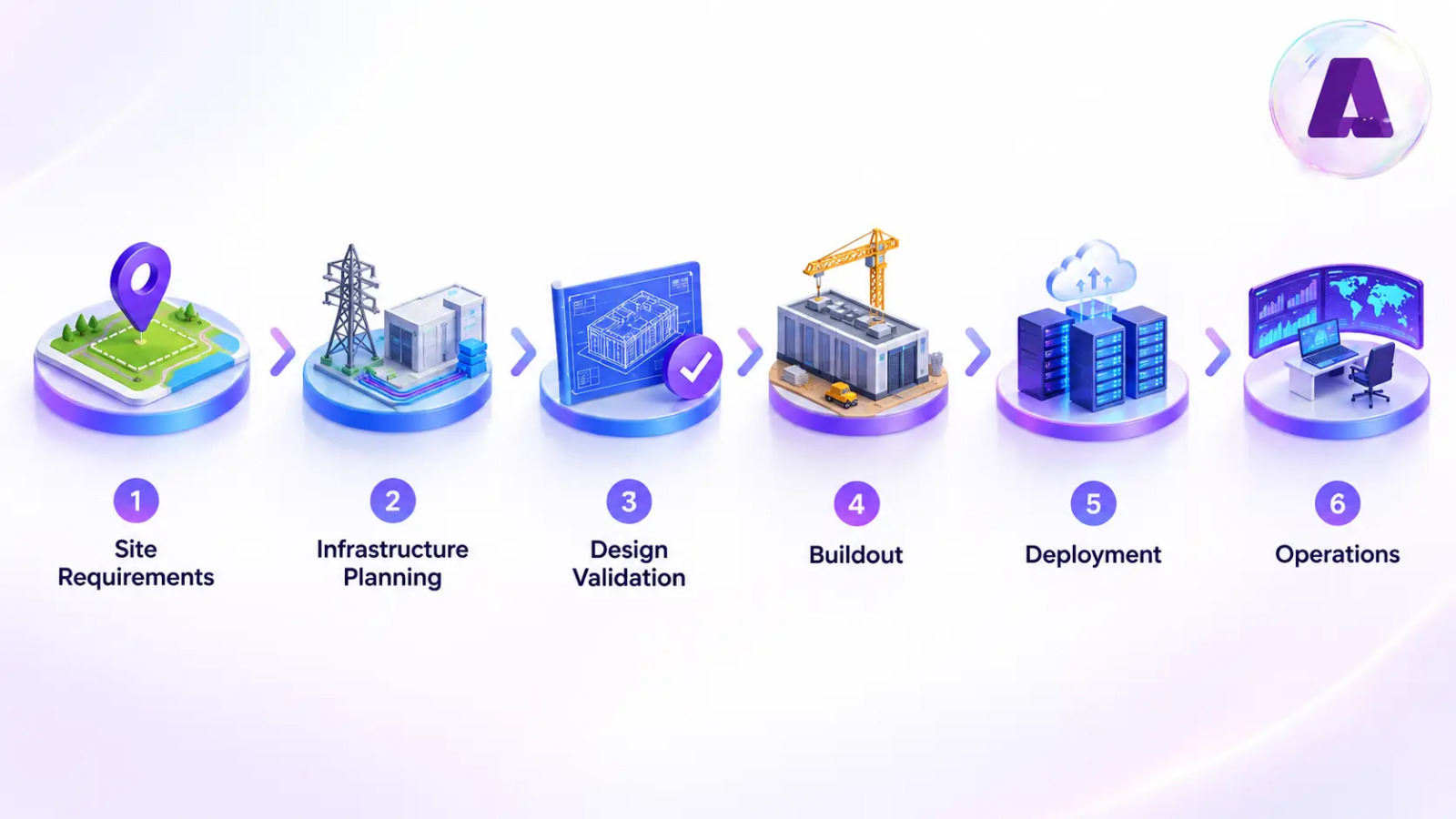
Once a site passes the initial feasibility screen, the next question is whether the facility can be designed and commissioned around the intended AI workload. Aptly can help organizations carry those infrastructure considerations into the next stages of the project. Its current services include:
- Design validation against GPU density and workload roadmaps
- Power and cooling assessment
- Network topology validation
- Rack integration
- Cluster burn-in and benchmarking
- Commissioning
- Ongoing infrastructure support
Conclusion
AI data center site selection is ultimately a feasibility exercise. The goal is not to find the largest parcel, the cheapest electricity, or the closest fiber route in isolation.
You need to determine whether power, connectivity, land, cooling, risk, economics, and future expansion can come together into a workable infrastructure environment. That assessment should happen before detailed construction commitments because correcting a poor site decision later can be expensive and time-consuming.
For organizations moving from site feasibility into AI infrastructure planning and deployment, Aptly Technology brings together GPU data center buildout, high-performance networking, infrastructure validation, workload-focused planning, and ongoing support. Its current AI data center services cover the transition from design validation through deployment, commissioning, scaling, and continuous operations.
Planning an AI data center? Start with the site selection. Then validate everything that needs to work there.
FAQs
Q1: What makes a good AI data center location?
A good AI data center location can support the required power, connectivity, cooling, land, permitting, risk, and expansion requirements. You should evaluate these factors together because a constraint in one area can affect the feasibility of the entire project.
Q2: How much power does an AI data center need?
There is no single power requirement for every AI data center. Your requirements depend on GPU generation, accelerator count, rack density, cluster architecture, storage, networking, cooling, and future expansion.
The important question during site selection is not simply how many megawatts you need. You also need to determine whether that capacity can be delivered within your project timeline and with the required electrical redundancy.
Q3: Why is fiber connectivity important for AI data centers?
Distributed AI workloads can require large amounts of data to move between compute systems. High bandwidth, low latency, and physically diverse network paths can therefore affect cluster performance and availability.
Your site assessment should examine carrier diversity, dark fiber options, network latency, route diversity, and future bandwidth requirements.
Q4: What cooling system is best for GPU clusters?
There is no universal answer. Cooling selection depends on GPU density, rack architecture, workload requirements, facility design, climate, water availability, and future capacity. Air cooling can remain practical for some environments, while high-density GPU deployments may require liquid or direct-to-chip cooling. The key site-selection question is whether the location can support the selected thermal architecture.
Q5: How much land is required for an AI data center?
Land requirements vary based on IT capacity, building design, power infrastructure, cooling systems, substations, generators, setbacks, site conditions, and expansion strategy. Instead of choosing land based on acreage alone, determine how much developable space the complete infrastructure plan requires.
Q6: What can disqualify a site for an AI data center?
Insufficient power, an impractical interconnection timeline, poor fiber diversity, inadequate cooling or water resources, restrictive zoning, environmental constraints, flood or seismic exposure, limited expansion space, and poor construction access can all make a site unsuitable. The exact threshold depends on your workload, infrastructure architecture, project timeline, and business requirements.
Q7: What should enterprises consider before building an AI data center?
Enterprises should evaluate power, fiber connectivity, land, cooling, water, environmental risk, permitting, economics, redundancy, and future expansion before committing to construction. The assessment should also connect those site conditions to the planned GPU infrastructure and workload roadmap.
Table of content
- TL; DR
- Introduction
- What Makes a Good AI Data Center Location?
- 1. Power Availability: Can the Grid Support Your AI Workload?
- 2. Fiber Connectivity: Can the Site Support AI-Scale Networking?
- 3. Land Availability: Is the Parcel Actually Developable?
- 4. Cooling and Water: Can the Site Support AI-Scale Networking?
- Environmental and Geographic Risk Considerations
- Economics and Incentives
- AI Data Center Site Selection Checklist
- How Do Hyperscalers Choose Data Center Locations?
- How Aptly Tech Can Help You with AI Data Center Site Selection?
- Conclusion
- FAQs