Introduction
Data center network architecture design sits at the core of every modern digital operation. It affects how fast data moves, how reliable your services are, and how easily your infrastructure can scale. Even with powerful hardware, a poor network design can slow everything down.
In the past, most traffic flowed between servers and users (north-south). Today, with microservices, containers, and distributed systems, most traffic happens between servers (east-west), which older network designs can’t handle well.
This guide walks through every layer of data center networking architecture from physical setup to software control. So, you can design or upgrade your network more effectively.
What Is Data Center Networking Architecture?
Data center networking architecture describes the structured set of technologies, topologies, and protocols that connect compute, storage, and services inside a data center. Its primary role is to ensure smooth data flow across systems while maintaining low latency and high throughput.
There are two traffic patterns that define how the network must behave.
- East-West Traffic: It flows within the data center and occurs between servers, containers, and virtual machines. Modern applications rely heavily on this communication pattern.
- North-South Traffic: It moves between the data center and external users or systems. This includes client requests, API calls, and internet-facing services.
The quality of your Data center network architecture design directly shapes three performance dimensions:
- Latency: How quickly a packet gets from A to B
- Bandwidth: The total throughput your fabric can sustain
- Reliability: Whether the network stays up when hardware or links fail.
Get these right, and everything built on top performs well. Get them wrong, and you’ll be chasing mysterious slowdowns forever.
Key Components of Data Center Network Architecture Design
Understanding what goes into the network helps you evaluate where your current setup falls short and where investment will have the biggest impact.
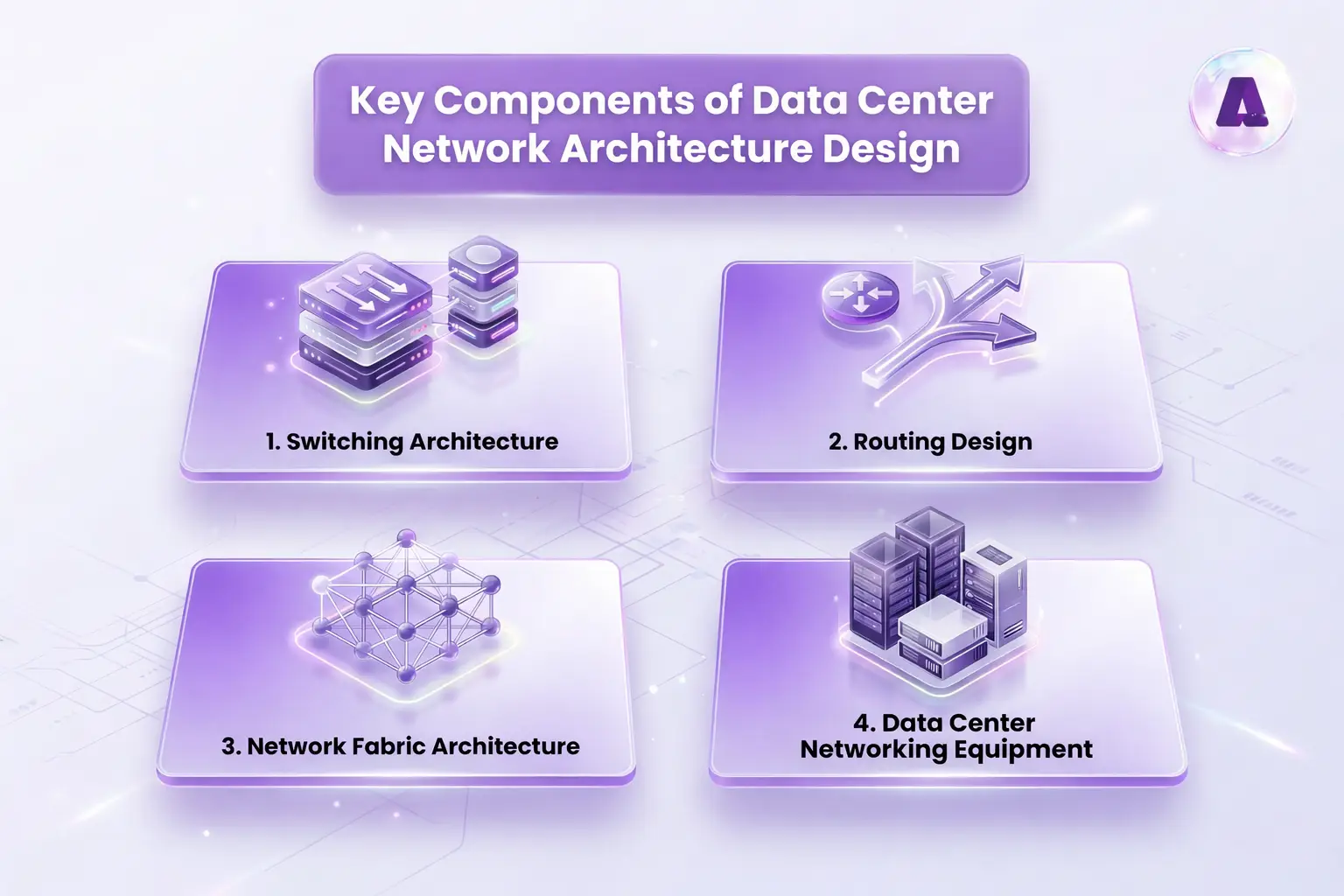
Data Center Switching Architecture
Switches form the foundation of data center connectivity.
- Access switches connect directly to servers and storage nodes.
- Aggregation switches sit above access switches and consolidate traffic before passing it upward.
- Core switches handle high-speed backbone routing between aggregation layers and external networks.
Routing Design
Interior routing protocols like BGP and OSPF manage how traffic finds its path across the switching fabric. A solid data center routing design ensures traffic always takes the optimal path, avoids asymmetric flows, and recovers quickly when a link drops. Equal-cost multipath (ECMP) routing spreads load across parallel paths — critical for east-west performance.
Network Fabric Architecture
The network fabric is the combination of switches, links, and protocols that form the underlying transport layer. A well-designed network fabric delivers predictable bandwidth between any two endpoints regardless of their physical location in the rack. This is the foundation of a scalable, high-performance data center.
Data Center Networking Equipment
Beyond switches and routers, your data center network relies on:
- Firewalls for perimeter and micro-segmentation security. Thus, it protects your infrastructure from threats.
- Load balancers to distribute traffic evenly across server pools, optical transceivers and structured cabling to carry signals between racks. This improves application performance.
Choices here affect both performance limits and operational cost over the lifetime of the infrastructure.
Types of Data Center Network Topology Design
Selecting a data center network topology design is the most critical decision. The layout you choose dictates how easily you can grow and how fast data travels between nodes.
Core-Aggregation-Access Architecture Data Center
This three-tier model was the standard for enterprise data centers through the 2000s. In this data center network architecture design, traffic flows vertically
- Server sends a packet to its access switch.
- Pass the packet up to aggregation.
- Routes the packet through the core to the destination.
This hierarchy works well when most traffic goes north-south to clients or the internet. For east-west flows, every server-to-server packet must climb multiple hops before it can come back down. This adds latency and creates scalability ceilings at the aggregation layer. Legacy enterprise environments still run this model, but few new deployments choose it.
Spine-Leaf Architecture
Spine-leaf architecture data center is now the dominant design for modern data center network architecture. It accounted for 48.25% of the market in 2025 because it offers consistent latency and scales in a simple, linear way. In a spine-leaf fabric,
- Every leaf switch (connected to servers) is directly linked to every spine switch (the backbone).
- There are no intermediate aggregation tiers.
- Any server can reach any other server in exactly two hops: one to the spine, one back down to the destination leaf.
This flat topology dramatically reduces east-west latency and allows you to add capacity by simply adding more leaf switches. All of which connect uniformly to the existing spine layer.
Spine-Leaf vs Three-Tier Architecture
When comparing spine leaf vs three tier architecture data center, the differences become clear.
| Feature | Spine-Leaf Architecture | Three-Tier Architecture |
|---|---|---|
| Scalability | Linear – add switches | Limited by aggregation |
| Performance | Handles heavy east-west traffic efficiently | Can face bottlenecks under heavy traffic |
| East-West Count | 2 fixed hops | 4-5 hops |
| Latency | Low | High |
| Design Complexity | Modern and modular | Traditional and structured |
| Failure Blast Radius | Spine failure is isolated | Aggregation failure is broad |
| Best For | Cloud, AI, and large data centers | Small, stable environments |
Choose three-tier only if you’re maintaining existing infrastructure where replacement cost outweighs performance gains. For any greenfield deployment or major refresh, spine-leaf is the right call.
How to Design Data Center Network Architecture (Step-by-Step)?
A structured approach prevents costly redesigns down the road. Here’s a practical data center network design guide.
1. Define Requirements
Start by understanding your business needs the network must support.
- Identify workloads such as enterprise applications, cloud-native microservices, and AI training clusters because each has different latency and bandwidth profiles.
- Determine performance expectations and growth plans.
- Document throughput targets, availability of SLAs, and security policies before touching any design tool.
2. Capacity and Bandwidth Planning
Accurate bandwidth planning data center what is spine leaf architecture in data center strategies prevent congestion.
- Estimate current traffic volumes and project 3-5 years of growth.
- Do bandwidth planning in data centers for peak utilization to avoid expensive emergency upgrades later.
3. Choose a Data Center Network Architecture Design
Decide between traditional and modern data center network architecture designs. Consider the spine-leaf vs. three-tier criteria from the previous section to pick your topology.
- Use spine-leaf for dynamic workloads
- Use three-tier for stable environments
This decision impacts your entire enterprise data center network design. Document your reasoning so future engineers understand why the design looks the way it does.
4. Design for Scalability
A scalable data center network architecture design means each new rack connects to existing spine switches with no changes to current leaf configurations.
- Adopt a modular rack-and-pod approach so you can grow the fabric without redesigning it.
- Plan your IP address space and VLAN structure with future expansion in mind.
5. Plan Redundancy and High Availability
Data center network redundancy is critical for uptime. It requires:
- Dual-homing servers to multiple leaf switches
- Deploying redundant spine switches
- Validating failover behavior under simulated failure conditions.
- Eliminating every single point of failure in the design phase
6. Integrate Security Architecture
A strong data center network security architecture protects sensitive data. It should be built in, not bolted on.
- Place firewalls at the perimeter and micro-segmentation policies inside the fabric.
- Use dedicated security zones for traffic management.
- Deploy intrusion detection systems that can analyze east-west flows.
Data Center Network Design Best Practices
To build a reliable system, follow the below established data center networking best practices. This helps you avoid common pitfalls and performance issues.
Low Latency and High Throughput
- Keep hop counts low by using spine-leaf topology.
- Select switches with cut-through forwarding rather than store-and-forward where microsecond latency matters.
- Use RDMA over Converged Ethernet (RoCE) for AI and HPC workloads to reduce CPU overhead on data transfers significantly.
Redundancy and Fault Tolerance
- Design every critical path with at least N+1 redundancy at the switch, link, and power levels.
- Run ECMP across multiple uplinks so that a single link failure causes automatic traffic redistribution without manual intervention.
- Test failover regularly because the Uptime Institute reports that nearly 40% of organizations have suffered a major outage caused by human error over the past three years.
Automation and SDN Integration
- Use SDN controllers to centrally push consistent configurations, as manual configuration doesn’t scale beyond a few hundred devices.
- Combine SDN with infrastructure-as-code tools to version-control your network configuration the same way you manage application code.
Monitoring and Observability
- Invest in visibility by deploying comprehensive monitoring tools to catch bottlenecks early. Leverage Aptly Tech services to support performance optimization and scalable network management.
- Deploy streaming telemetry from every switch to deliver per-second metrics. So that you can catch micro-bursts and congestion events before they escalate.
- Correlate network metrics with application performance data so you can pinpoint whether slowdowns originate in the network fabric or the application layer.
Modern Data Center Network Architecture Design Trends
The landscape of modern data center network architecture continues to evolve.
- Software-Defined Networking (SDN): SDN decouples the control plane from the data plane, letting operators program the entire fabric via API. It’s become table stakes for large-scale deployments.
- AI/ML Workload Optimization: GPU cluster networking demands ultra-low latency fabrics with 400G+ links and RDMA support. Data center network architecture design for AI workloads is its own subspecialty.
- Hyperscale Design: Hyperscale data centers use disaggregated hardware and massive pod-based spine-leaf fabrics to reach planetary-scale connectivity.
- Edge Data Centers: These are smaller, geographically distributed facilities push compute closer to end users. Edge data center build-outs are advancing at a 3.7% CAGR through 2032, according to Mordor Intelligence. With edge data centers, you can reduce latency for real-time applications and offloading backhaul from central facilities.
- Intent-Based Networking (IBN): IBN platforms translate business intent directly into device configurations, reducing operator error and configuration drift.
- Network Virtualization: VXLAN and other overlay protocols create logical networks on top of physical fabrics. This enables multi-tenant isolation and workload mobility across the data center.
Challenges in Data Center Network Infrastructure Design
Even with the right topology and the right equipment, the data center network architecture design comes with several challenges.
Managing Network Latency Data Center Environments
Network latency in data centers compounds quickly across microservice call chains. A single API request might traverse twenty internal hops. Latency budgeting forces teams to quantify rather than guess at performance requirements.
Handling East-West Traffic at Scale
As workloads grow, east-west traffic volumes can dwarf external traffic by orders of magnitude. Architectures that weren’t built for this pattern develop hot spots at aggregation layers. This creates unpredictable performance degradation that’s hard to diagnose.
Security in a Flat Network
Spine-leaf’s flat topology is great for performance but requires deliberate segmentation to prevent lateral movement by attackers. Without micro-segmentation policies, a compromised host can communicate freely with any other host on the fabric.
Hybrid and Multi-Cloud Complexity
Connecting on-prem data centers to the cloud adds routing complexity, BGP coordination, and latency challenges not seen in purely on-prem designs. Managing this consistently across environments is one of the harder operational challenges in enterprise networking today.
Data Center Network Architecture Design Checklist
Before you finalize your deployment plans, use this data center network architecture design checklist to verify your work. It helps ensure that no critical detail is overlooked during the planning phase.
Insights: Best Network Architecture for Modern Data Centers
The best architecture for modern data centers is undoubtedly the spine-leaf fabric. It provides consistent performance and horizontal scalability that today’s applications demand. By treating the network as a programmable fabric, you gain the agility needed to compete in a fast-paced market. Automation is a necessity for managing modern scale. Focus on building a data center network architecture design that is simple, modular, and ready for the next wave of AI innovation.
Leveraging Aptly Tech, you can strengthen this approach by bridging design and real-world operations. Through its GPU data center buildout services, Aptly validates architecture against AI workload needs, deploys high-performance networking, including InfiniBand and spine-leaf fabrics. It also ensures that power, cooling, and rack design are optimized from day one.
Beyond deployment, Aptly delivers end-to-end lifecycle support—from rack integration and network setup to continuous monitoring, benchmarking, and 24×7 operations. This makes Aptly not just a build partner, but a long-term operations layer that helps organizations run modern, high-density data centers efficiently and at scale.
Conclusion
A successful data center network architecture design requires a deep understanding of your current and future needs. By moving toward modern topologies like spine-leaf, you ensure your infrastructure can handle the demands of AI and cloud computing. Remember that performance, scalability, and security must work together to create a reliable system. Use the best practices and checklists provided here to guide your next build. With a strategic approach, you can create a network that serves as a competitive advantage for your organization.
Build it right with Aptly—partner with us to design, automate, and scale high-performance data center networks built for modern workloads and AI-driven growth.
FAQs
Q: What is data center networking architecture?
It is the structured design of network components that connect systems within a data center and manage data flow.
Q: How do you design a data center network?
For a better data center network architecture design, you must define requirements, plan capacity, choose architecture, ensure scalability, add redundancy, and integrate security.
Q: What are the components of data center network architecture?
Key components include switches, routers, network fabric, firewalls, load balancers, and cabling systems.
Q: What is spine-leaf architecture?
It is a modern data center network architecture design where every leaf switch connects to every spine switch, reducing latency and improving scalability.
Q: Spine-leaf vs traditional three-tier architecture: What’s the difference?
Spine-leaf offers better performance and scalability, while three-tier suits smaller, predictable environments.
Q: What is east-west traffic in data centers?
It refers to internal communication between servers and applications within the data center.
Q: How to design scalable data center networks?
Use modular data center network architecture designs, implement spine-leaf topology, and plan for future capacity expansion.
Q: How to design highly available data center network?
Include redundancy, failover mechanisms, and avoid single points of failure across the network for creating an effective data center network architecture design.