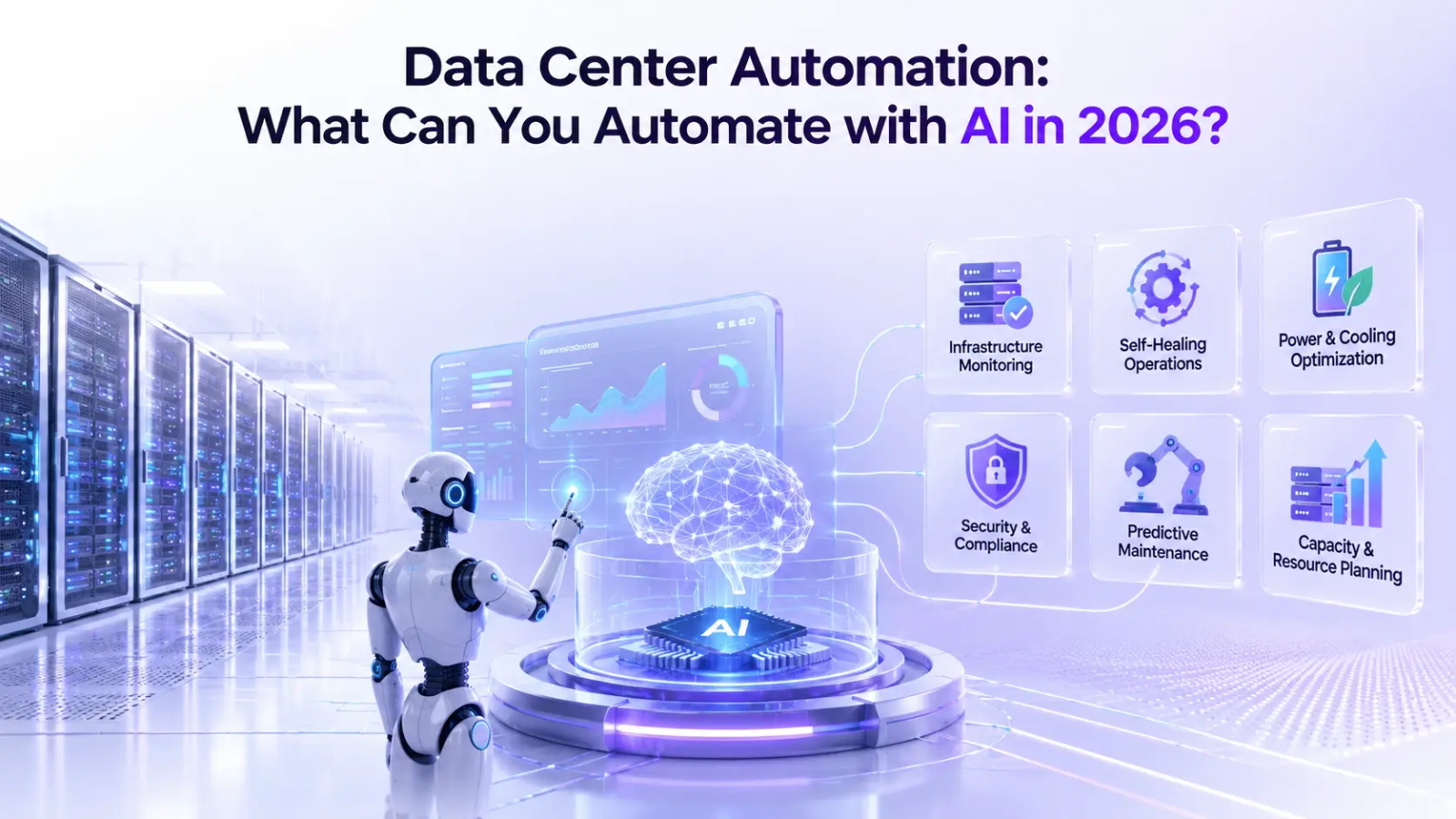
Introduction: AI data center power constraints change AI infrastructure scaling
AI data center power constraints have moved from a facilities concern to an enterprise compute constraint. A GPU procurement plan has little value when the site lacks energizable MW, cooling headroom, or PDU capacity. For CIOs and infrastructure leaders, power now governs how much AI capacity reaches users and when new clusters enter service.
The demand curve explains the pressure. The IEA 2026 outlook places global data center electricity use near 950 TWh in 2030, almost twice the 2025 level, while AI-focused data center electricity use triples. In the United States, the Berkeley Lab 2026 update places data centers near 11.8 percent of national electricity use by 2030 in its central estimate. AI data center energy consumption is rising faster than utility infrastructure in several high-growth regions.
Power has also become a public talking point among major AI leaders. At a September 2, 2026 G20 technology ministers meeting, Meta CEO Mark Zuckerberg and Elon Musk stressed the need for more AI data centers and the electricity to support them. Musk described a “crisis of power” and warned of a near-term shortfall, while saying his company was building generation for its data centers. For operators, the message is practical: AI data center power constraints now shape deployment timing at the same level as accelerator supply.
AI data center power constraints require a different operating model. Teams need one view of AI data center power demand, data center power availability, GPU utilization, rack loading, cooling headroom, and utility limits. AI infrastructure power constraints should feed scheduling and capacity decisions before teams buy more accelerators. The target is more useful AI work per constrained MW while preserving reliability and service objectives.
Why is power the biggest bottleneck for AI data centers? AI data center power demand meets data center grid capacity constraints
Why is power the biggest bottleneck for AI data centers? The answer starts with mismatched build timelines. AI compute capacity moves from purchase order to deployment faster than major transmission, substations, transformers, and utility generation. The IEA analysis puts around 20 percent of global data center capacity planned through 2030 at risk of connection delay from grid constraints. AI data center power constraints therefore appear before a facility runs out of physical floor space.
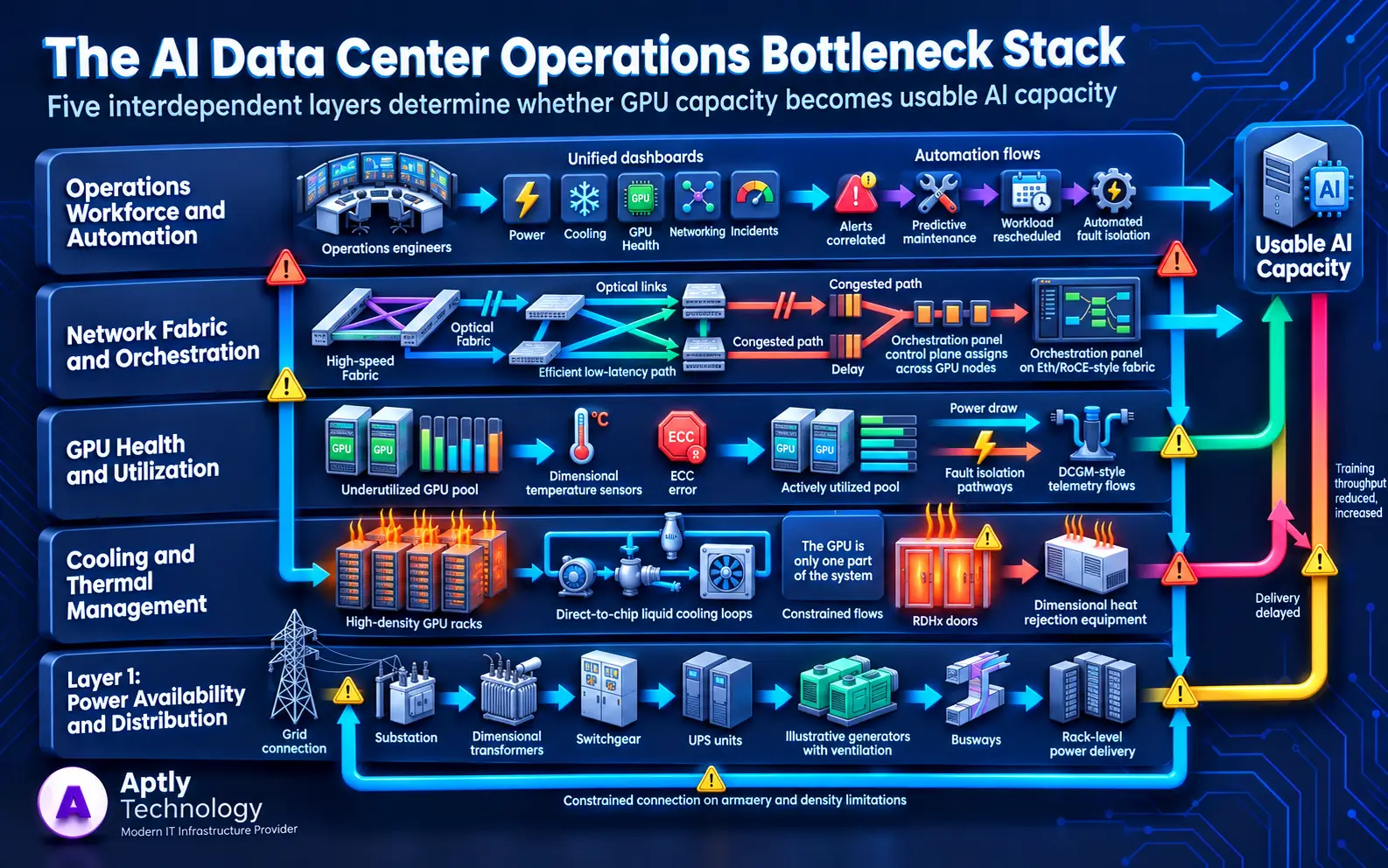
AI Data Center Power Constraint Stack
Data center grid capacity constraints are local. A region might have adequate annual generation yet lack feeder, substation, transformer, or transmission capacity at the exact point of connection. The IEA Electricity 2026 analysis notes more than 2,500 GW of generation, storage, and large-load projects stalled in grid queues worldwide. Grid infrastructure planning and construction also runs on longer timelines than a typical data center project. Those conditions turn grid interconnection into a schedule dependency for AI infrastructure scaling.
The phrase data center power shortage hides several limits. One site lacks contracted utility MW. Another has insufficient power distribution through switchgear and PDUs. A third lacks cooling capacity for high-density AI workloads. Operators need to identify the tightest layer. Data center expansion constraints move with the bottleneck.
The central issue is timing. AI compute deployment now moves faster than the grid, electrical distribution, and cooling infrastructure required to support it, so AI data center power constraints become the binding limit before floor space or GPU supply.
Rack power density, GPU power consumption, GPU TDP and high-density AI workloads
GPU power consumption has changed rack design. NVIDIA lists a maximum GPU TDP of up to 700 W for the H200 SXM GPU. Eight GPUs at the 700 W ceiling represent 5.6 kW before CPUs, memory, NICs, local storage, fans, and conversion losses enter the server budget. Rack power density rises again when operators pack multiple accelerated nodes into a cabinet.
Rack-scale systems push the envelope further. NVIDIA documents approximately 120 kW of rack power consumption for the DGX GB200 NVL72. Such power density changes busway design, PDU sizing, conductor selection, breaker coordination, coolant distribution, and failure-domain planning. AI data center power constraints become visible at the row and rack level, not only at the utility meter.
Operators should track average draw, sustained peak draw, transients, and delivered AI throughput. Nameplate ratings set design limits, while telemetry refines the operating model. AI data center power constraints are managed with measured envelopes, not GPU count alone.
AI compute power requirements and power capacity planning before AI infrastructure scaling
How much power does an AI data center need? Start with the workload and work backward. AI compute power requirements depend on model type, training or inference profile, concurrency, accelerator choice, utilization target, CPU and memory ratio, network fabric, storage, cooling method, and reliability architecture. A GPU count without those inputs is not a power plan.
A July 2026 PJM grid disturbance shows the operational risk at scale. After a transmission line failed near Washington, D.C., data centers disconnected more than 3 GW of load almost simultaneously. The sudden demand drop drove a regional voltage spike, and grid stabilization took more than 10 minutes. The event caused no blackout, yet it exposed a coordination problem: large AI facilities need ride-through, transfer, and staged reconnection logic as part of power capacity planning.
Power capacity planning should separate four numbers. Calculate expected IT load, convert the load to facility input through power usage effectiveness (PUE), compare the result with data center power availability across utility and power distribution layers, then preserve required operating margin. AI data center power constraints should use the lowest usable limit.
Treat MW / megawatt capacity as a hard operating budget. An illustrative 100-rack deployment at 120 kW per rack reaches 12 MW of rack IT load. At PUE 1.20, facility input reaches about 14.4 MW before project-specific reserve and reliability decisions. The 120 kW rack input comes from NVIDIA DGX GB200 documentation. The example is not a reference design.
Power capacity planning inputs for AI data center power constraints
| Planning Input | What to measure | Decision Output |
|---|---|---|
| AI workload profile | Training duration, inference latency, concurrency, job flexibility | Required compute throughput and service priority |
| GPU Platform | GPU TDP, server draw, network and storage overhead | Expected node and rack load |
| Power Distribution | Utility feed, transformers, switchgear, busway, PDU and breaker limits | Maximum energizable IT load |
| Cooling Efficiency | Coolant temperatures, CDU capacity, pumps, chillers, heat rejection | Thermal ceiling for sustained rack loading |
| Power Usage Effectiveness (PUE) | Total facility energy divided by IT energy | Facility input required for each IT MW |
| Data Center Capacity | Growth curve, failure domains, maintenance states, reserve policy | Phased rack release plan and expansion gate |
Data center capacity planning should release GPU racks in phases tied to proven power paths. Commissioning should verify breaker loading, PDU telemetry, coolant flow, thermal conditions, and cluster behavior under representative stress. Each new rack needs an electrical and thermal acceptance envelope before production workloads arrive.
Data center energy efficiency strategies: power usage effectiveness (PUE), liquid cooling, cooling efficiency and thermal management
Data center energy efficiency strategies matter most when they convert facility overhead into usable compute headroom. Power usage effectiveness (PUE) equals total facility energy divided by IT equipment energy. Uptime Institute reported an industry average PUE of 1.58 in 2023 and noted a range near 1.55 to 1.59 since 2020 in its PUE analysis. AI data center power constraints make each fraction of facility overhead more visible.
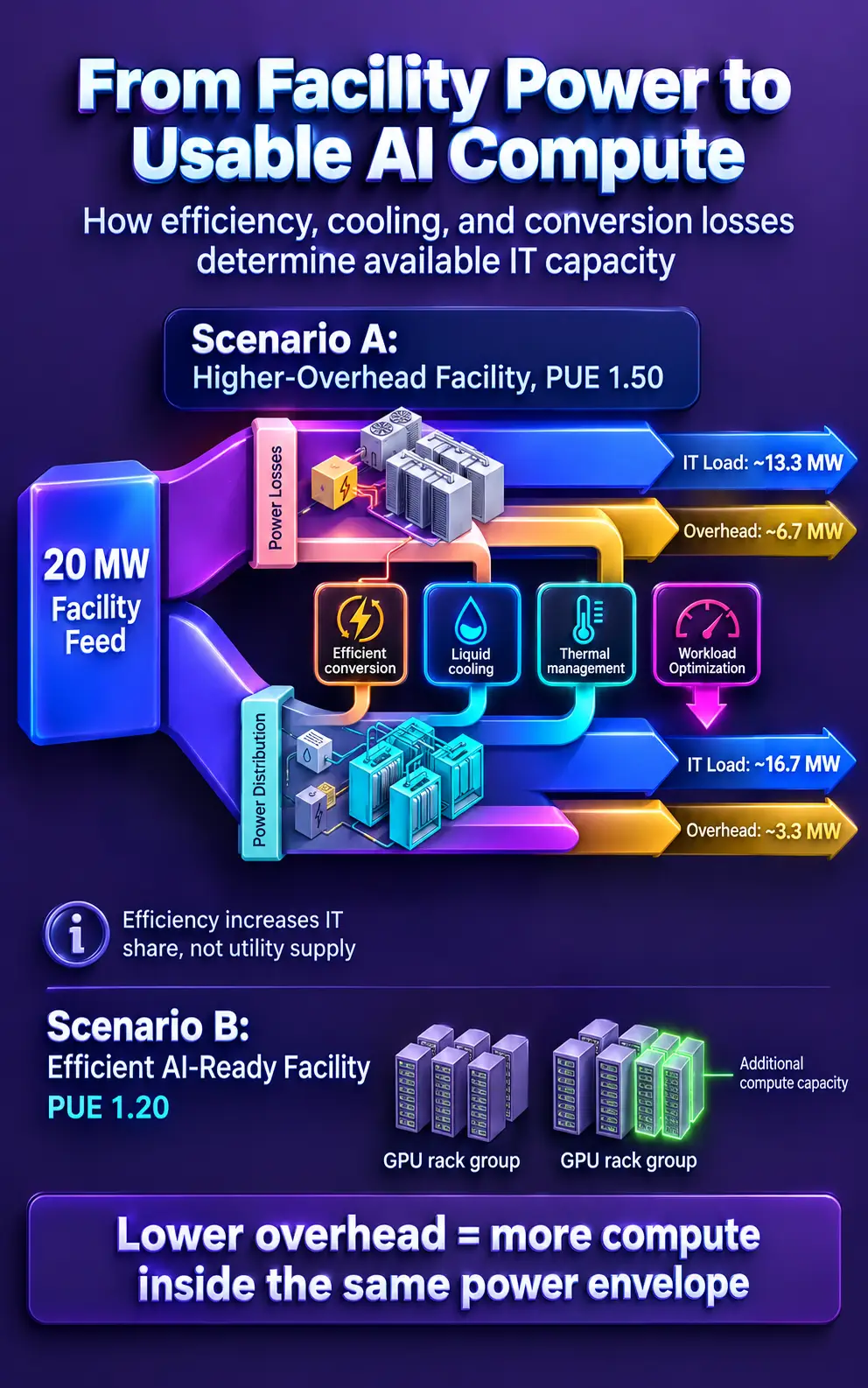
Turning Facility Power into Usable AI Compute
Consider a fixed 20 MW facility feed. At PUE 1.50, about 13.3 MW reaches IT load. At PUE 1.20, about 16.7 MW reaches IT load. The lower PUE frees about 3.3 MW for compute before local reserve requirements. AI data center power constraints turn cooling efficiency into a capacity variable.
Liquid cooling supports high-density AI workloads by moving heat closer to the source and reducing dependence on high-volume air movement. NVIDIA DGX GB rack systems include liquid cooling manifolds. Thermal management still spans cold plates, coolant distribution units, facility loops, pumps, heat exchangers, controls, leak detection, and heat rejection. Better cooling does not erase a grid limit, but lower cooling overhead frees facility power for compute.
Best strategies for AI data center power optimization: power-aware workload scheduling and dynamic power capping (GPU)
- Best strategies for AI data center power optimization start with cluster controls. AI data center power constraints should enter the scheduler beside GPU type, memory, network topology, and job priority. Power-aware workload scheduling assigns work against live electrical and thermal headroom.
- Separate workloads by flexibility. Keep reserved capacity for latency-sensitive inference, and move check pointable training, fine-tuning, indexing, evaluation, and batch inference first during constrained periods. Google reported 1 GW of data center demand response capacity under utility agreements in 2026, including limits or shifts for selected machine learning workloads.
- Dynamic power capping (GPU) sets an electrical ceiling for a GPU or node. NVIDIA documents nvidia-smi power management and policy-based limits through its Domain Power Service. Benchmark throughput per watt, tokens per second, training time, and SLA impact before production use.
- AI data center power constraints become more manageable when scheduling and power caps work together. A 10 MW IT ceiling should trigger workload placement and measured power caps before breaker alarms, with emergency curtailment reserved for the final layer.
Workload optimization and stranded GPU capacity under AI infrastructure power constraints
Workload optimization should target useful output per constrained MW. Idle GPUs waste capital and baseline energy. Stranded GPU capacity describes accelerators without a usable path to production because of utility power, PDU, cooling, network, or allocation limits. AI infrastructure power constraints make those forms of waste more expensive.
Aptly describes utilization monitoring and stranded GPU reduction as part of its AI Workload Deployment and Optimization service. For operators, the practical sequence is measurement, pooling, queue policy, right-sizing, autoscaling where the platform supports autoscaling, and workload placement based on service priority. AI data center power constraints should be visible beside GPU utilization so teams do not confuse an idle accelerator with an electrically unavailable accelerator.
Data center grid capacity constraints: grid interconnection, demand response, load management and data center power availability
- Data center grid capacity constraints require grid interconnection planning around utility schedules, transformer availability, tariffs, ramp limits, and curtailment terms. These factors define data center power availability. Berkeley Lab research on load flexibility identifies optimized controls, workload management, storage, and utility programs as tools for reliable growth.
- Demand response and load management should define which jobs are paused, power-capped, storage-backed, or moved to another region, plus response time, duration, and fixed service protections. AI data center power constraints need these rules before grid stress begins.
- Protect critical inference, safety systems, control planes, network services, storage integrity, and cooling. AI data center power constraints require a tested load-shed hierarchy and staged recovery so flexible operation does not become uncontrolled curtailment.
On-site power generation for data centers, behind-the-meter power data center, battery energy storage and microgrids
On-site power generation for data centers gives large loads another source of capacity when utility MW arrives slowly or when resilience requirements justify local generation. The U.S. Department of Energy Onsite Energy Program describes onsite generation and storage as behind-the-meter resources which reduce grid draw and improve flexibility for large energy users, including data centers.
A behind-the-meter power data center model places generation, storage, or both on the customer side of the utility meter. Battery energy storage supports peak shaving, short-duration load support, fast transitions, and energy shifting. Microgrids coordinate local generation, storage, and loads, with some designs able to operate in island mode. DOE described microgrids as a bridge for large data center loads in June 2026, especially where transmission or distribution expansion requires more time.
For teams asking can data centers generate their own power, the answer is qualified: yes, with suitable generation, storage, controls, protection, fuel or energy supply, permits, interconnection agreements, and economics. AI data center power constraints do not disappear after local generation arrives. Operators still need fault coordination, black-start or islanding logic where applicable, emissions and fuel planning, maintenance states, storage duration analysis, and a clear operating contract between the microgrid controller and the data center load manager.
How to operate a data center with limited grid power: data center capacity planning and power distribution checklist
How to operate a data center with limited grid power starts with one rule: never schedule more sustained load than the weakest validated layer supports. For teams asking how do data centers manage power constraints, the answer starts with one power budget from utility meter to GPU, exposed to workload controls, with capacity released only after power and cooling validation. AI data center power constraints then become an operating envelope instead of a surprise outage risk.
AI data center power constraints: how tech leaders are responding to the power bottleneck
- Elon Musk and Mark Zuckerberg: At the September 2026 G20 technology meeting, both stressed the need for more AI data centers and electricity. Musk called the situation a “crisis of power” and said his company was building generation to support its data centers.
- Microsoft: In a September 2026 infrastructure update, Microsoft described AI racks moving from tens to hundreds of kilowatts and campuses reaching gigawatt scale. Its response spans grid-to-chip co-design, lower-loss power delivery, and software-based power capping.
- Google: Google has integrated 1 GW of data center demand response into long-term utility contracts, with selected machine learning loads shifted or reduced during grid stress. Google pairs load flexibility with new solar, geothermal, and long-duration energy storage projects.
- No single solution is emerging. Leading approaches combine new generation, grid upgrades, higher-efficiency power distribution, battery energy storage, demand response, power-aware workload scheduling, and dynamic power capping (GPU). The mix depends on site constraints, utility terms, and workload flexibility.
Data center capacity planning checklist for AI data center power constraints
| Control | Required Action | Operating Signal |
|---|---|---|
| Utility MW | Confirm contracted supply, ramp schedule, curtailment terms, and interconnection milestones | Available and committed MW by date |
| Power distribution | Map transformer, switchgear, busway, PDU, breaker, and redundancy limits | Usable MW by failure domain |
| Rack power density | Set sustained rack envelopes from measured hardware behavior | kW per rack and row |
| Thermal management | Validate coolant flow, CDU capacity, heat rejection, and temperature margins | Thermal headroom by zone |
| Workload optimization | Classify critical, deferrable, check pointable, and relocatable jobs | Power-aware queue priority |
| Dynamic power capping (GPU) | Benchmark approved power limits against throughput and SLA | Watts per GPU plus performance response |
| Battery energy storage and microgrids | Define discharge, islanding, recovery, and reserve policies | MW, MWh, duration, state of charge |
| Demand response and load management | Predefine shed order and recovery sequence | MW reduction, response time, duration |
Set warning, control, and emergency bands for facility MW, PDU loading, rack draw, coolant temperature, pump capacity, and battery state of charge. Tie each band to a specific action. AI data center power constraints are easier to run when a 90 percent threshold changes scheduling before a 100 percent threshold causes a hardware trip.
Review the model after each GPU generation change. Higher GPU TDP, new rack architectures, denser networking, or a different liquid cooling topology shifts the power and thermal envelope. Capacity planning should follow measured production data, not a one-time commissioning spreadsheet.
Aptly Technology for AI data center power constraints and workload optimization
AI data center power constraints sit across design, deployment, commissioning, and operations. Aptly’s published AI Datacenter Buildout and Support capabilities include design validation against GPU density and scalability requirements, PDU and cooling assessment, thermal zoning, rack energization pre-checks, power-path verification, initial load staging, InfiniBand and RoCE integration, cluster burn-in, and production-readiness validation. Those steps address the facility and cluster handoff where power mistakes often become stranded GPU capacity.
Aptly also describes continuous GPU infrastructure monitoring, utilization tracking, infrastructure troubleshooting, spares coordination, capacity management, and 24×7 operations on its AI infrastructure managed services and buildout pages. For enterprises facing AI data center power constraints, the value sits in connecting rack-level telemetry, workload behavior, network health, cooling conditions, and capacity plans into one operating process. Aptly’s public service descriptions support infrastructure and workload operations. Utility interconnection engineering, power-plant development, and energy-market services should remain with qualified utility, electrical, energy, and regulatory specialists where required.
AI data center power constraints: power capacity planning for the next GPU expansion
AI data center power constraints are part of compute architecture. Power capacity planning should run from grid interconnection through rack telemetry and workload scheduling. Each GPU generation needs a model for facility MW, power distribution, power density, cooling, flexibility, and recovery behavior.
For teams preparing a new GPU deployment or trying to release stranded capacity inside an existing site, Aptly connects infrastructure buildout, rack energization, cluster validation, monitoring, workload operations, and lifecycle support. Contact Aptly Technology to review an AI infrastructure expansion plan against the power, cooling, networking, and operating limits already present in your environment.
FAQ: AI data center power constraints, data center power shortage and data center power availability
- How are data centers solving AI power constraints?
- Operators combine facility efficiency, better cooling, power-aware workload scheduling, GPU power limits, storage, demand response, and phased capacity release. AI data center power constraints rarely have one fix. The strongest programs connect utility MW, rack telemetry, thermal limits, and workload priorities so the control plane responds before electrical headroom reaches a hard ceiling.
- How do you build a GPU data center under grid power limits?
- Start with confirmed utility MW and the interconnection schedule, then size power distribution, cooling, racks, and cluster phases to the proven envelope. Avoid buying the final GPU count first. Commission each phase under representative load, then release the next phase after electrical and thermal acceptance. This approach keeps AI data center power constraints visible throughout expansion.
- What is causing the AI data center power shortage and AI infrastructure power constraints?
- Rapid AI data center power demand is meeting long grid and equipment lead times, local substation limits, high rack power density, and cooling constraints. AI infrastructure power constraints also arise inside facilities when switchgear, PDUs, or heat-rejection systems reach capacity before the utility feed does. The root cause differs by site, so operators need layer-by-layer measurement.
- How to reduce AI data center energy consumption with data center energy efficiency strategies?
- Raise GPU utilization, shut down idle capacity where service design permits, use efficient hardware, improve power usage effectiveness (PUE), apply liquid cooling where density requires liquid cooling, and schedule flexible jobs into lower-stress windows. AI data center power constraints reward measures which reduce facility overhead without reducing required business throughput.
- Can data centers generate their own power with on-site power generation for data centers?
- Yes, through suitable onsite resources such as generators, fuel cells, renewables, or other qualified technologies, often paired with battery energy storage and microgrids. Project feasibility depends on site energy resources, permits, fuel supply, emissions rules, protection design, utility agreements, economics, and reliability goals. Local power should complement a full capacity plan rather than mask unresolved facility limits.
- How do data centers manage power constraints with load management and demand response?
- Mature operations define a site power budget, rank workloads by service priority, monitor rack and thermal headroom, shift deferrable jobs, apply tested power limits, and use load management or demand response under predefined rules. Recovery matters too. Jobs should return in stages so the facility avoids a synchronized rebound peak after a grid event.
- Best strategies for AI data center power optimization and stranded GPU capacity
- Track watts, GPU utilization, throughput, queue time, cooling headroom, and stranded GPU capacity together. Then optimize scheduling, right-size resource pools, cap power where benchmarks support the trade, and add physical capacity only after power distribution and cooling validation. The result is a higher share of purchased GPU capacity doing productive work inside the site power envelope.