Introduction: What Is a Data Center and Why Should Business Leaders Care?
What is a data center? For a business leader, it is a purpose-built physical environment where computing systems run applications, store information, and process transactions. Customer portals, ERP workflows, payroll, analytics, video meetings, online purchases, and AI services all depend on physical computing infrastructure somewhere.
That makes the question commercial as well as technical. If your company depends on digital services, you depend on data center infrastructure even when you own no servers. The decision is how much infrastructure you should own, lease, outsource, or consume through cloud services, and how those choices affect cost, resilience, security, latency, compliance, and growth.
This guide explains what is a data center in practical terms, including what is inside a data center, how do data centers work, the main types of data centers, and how to compare data center vs cloud computing.
What Is a Data Center? A Plain-English Definition of Data Centers
Cisco defines it as a physical facility used to house critical applications and data, supported by computing, storage, and network resources. AWS gives a similar definition. In business terms, the definition of data centers is simple: controlled environments built to keep digital systems available, connected, protected, and manageable.
The data center meaning now covers a wide range of facilities, from a dedicated corporate room to a colocation suite, hyperscale campus, or edge site. If you see what is a data centre in UK English, it means the same infrastructure.
What is a data center for? It provides a stable operating environment for IT systems that ordinary office space is not designed to support. What is a data center used for? Databases, websites, customer applications, collaboration tools, financial systems, backups, analytics, virtual machines, private cloud platforms, and AI workloads all run there.
What Is the Purpose of a Data Center? A Decision Framework for Business Leaders
What is the purpose of a data center from a business perspective? It should place each workload in an environment that meets service, security, compliance, performance, and cost requirements without creating unnecessary operational burden.
Start with the workload. Ask what data it uses, who needs access, how much downtime the business tolerates, where users are located, how quickly demand changes, what recovery target applies, and whether specialized hardware is required. Then map those needs to the available types of data centers and cloud services.
Next, examine dependency risk. A single facility, power feed, carrier, storage system, cloud region, or control plane can become a failure point. Data center redundancy should reflect business impact. Uptime’s Tier framework helps assess facility infrastructure, while application architecture and operating procedures still determine end-to-end availability.
Then model lifecycle cost rather than purchase price. Servers, storage, networking equipment, licenses, racks, UPS systems, backup generators, cooling, staffing, maintenance, and refresh cycles all influence economics. In cloud, capacity commitments, data movement, managed services, and idle resources influence the bill.
Finally, decide what your team should operate directly. The best answer to what is a data center for your business is often a mixed architecture with clear ownership boundaries. That is the practical answer to what is a data center within an enterprise architecture.
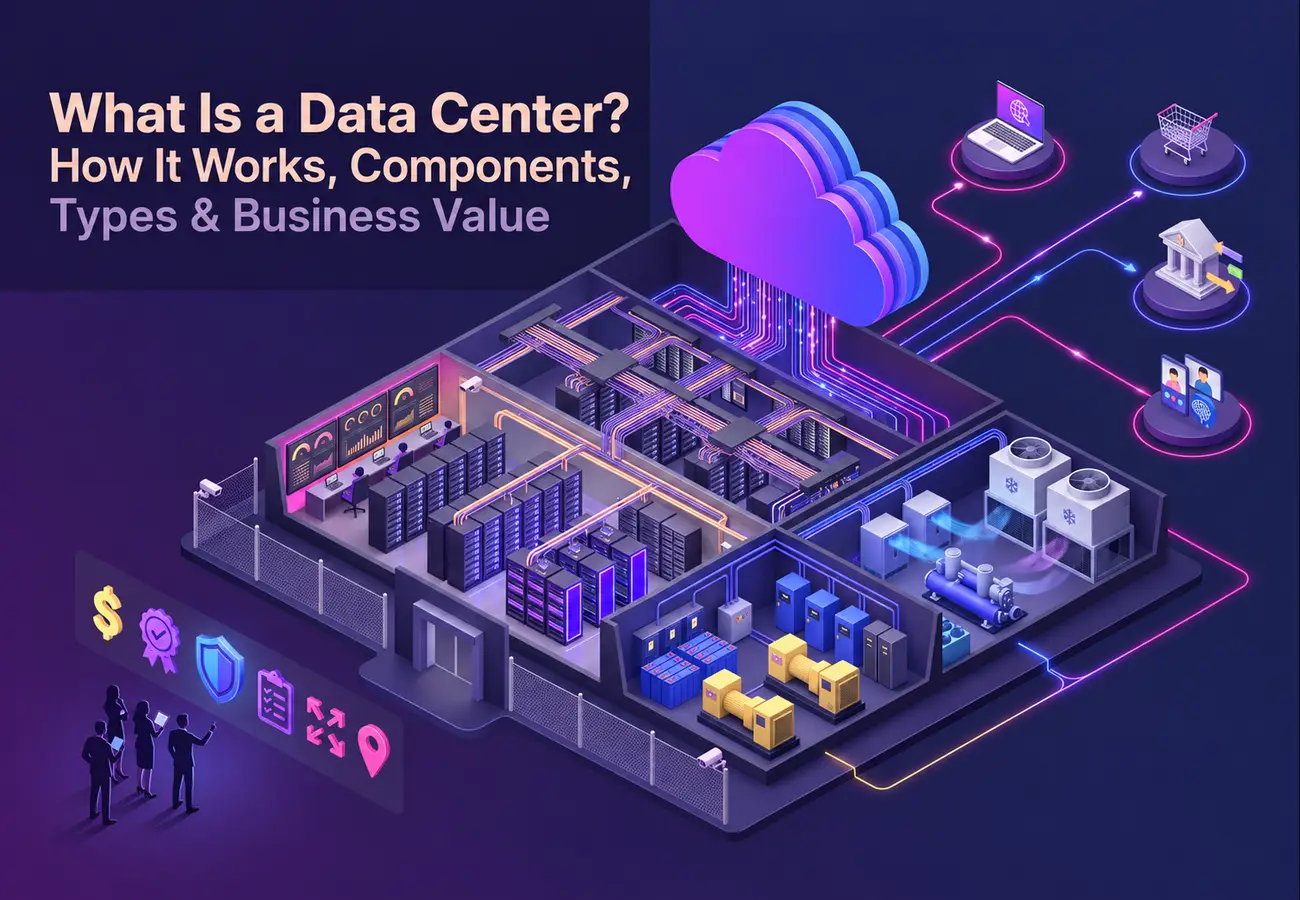
What Is Inside a Data Center? Core Data Center Components
When executives ask what is a data center, the next useful question is what is inside a data center. Reliable operation depends on several connected data center components working together, not servers alone.
- Compute layer: Data center servers provide the processing capacity behind applications, databases, web services, and virtual machines. CPU-based systems handle general-purpose workloads, while GPU servers accelerate AI workloads, analytics, simulation, and other parallel tasks. NVIDIA’s certified-system guidance shows that GPU systems have workload-specific configuration and environmental requirements.
- Storage layer: Data storage systems hold databases, files, backups, and application state. They give applications and users persistent access to business data even when individual servers are replaced, restarted, or taken offline.
- Networking layer: Networking equipment connects servers, storage, users, branch locations, the internet, and other data center facilities. Cisco identifies compute, storage, and networking as core data center components.
- Rack and physical integration layer: Server racks organize computing hardware, storage systems, network devices, power feeds, and cabling into manageable physical units. Good rack organization also supports maintenance, airflow, serviceability, and infrastructure expansion.
- Power layer: The data center power supply typically includes utility service, switchgear, an uninterruptible power supply (UPS), batteries, power distribution equipment, and backup generators. These systems keep equipment powered during normal operation and provide continuity when the primary electrical supply is interrupted.
- Cooling layer: Data center cooling systems remove the heat generated by IT equipment and keep servers, storage, and networking hardware within safe operating temperatures. The U.S. Department of Energy defines power usage effectiveness (PUE) as total facility energy divided by IT equipment energy, making it an important measure of overall facility efficiency.
- Physical security and monitoring layer: Physical data center security controls who can enter the building and access sensitive infrastructure. Microsoft describes physical security, availability, monitoring, and data protection as parts of its infrastructure model. NIST SP 800-53 also includes physical and environmental controls for facilities hosting concentrated computing resources.
Together, these layers form the data center infrastructure businesses rely on to keep applications available, data accessible, and digital services running reliably.
What Equipment Is Used in a Data Center? From Hardware to Facility Systems
What is a data center without its support systems? It is only a collection of computers. Dependable facilities combine rack servers or GPU servers, storage, switches, routers, firewalls, server racks, structured cabling, rack power strips, UPS systems, batteries, generators, cooling equipment, sensors, access controls, and monitoring platforms.
What equipment is used in a data center varies by workload. A financial database may emphasize high-availability storage and low-latency networking, while AI may require GPU servers, higher rack power, faster fabrics, and advanced cooling. For a buyer asking what is a data center supposed to include, the right answer is the equipment needed to meet a defined service level and business risk.
How Do Data Centers Work? From User Request to Business Service
How do data centers work? A user or application sends a request through a network. Routers, switches, firewalls, and load-balancing systems direct the traffic. Servers run the application logic, data storage systems supply or record information, and the network returns the result. How do data centers store and process data? Compute systems execute application instructions while storage systems read, write, replicate, and retain the information those applications need.
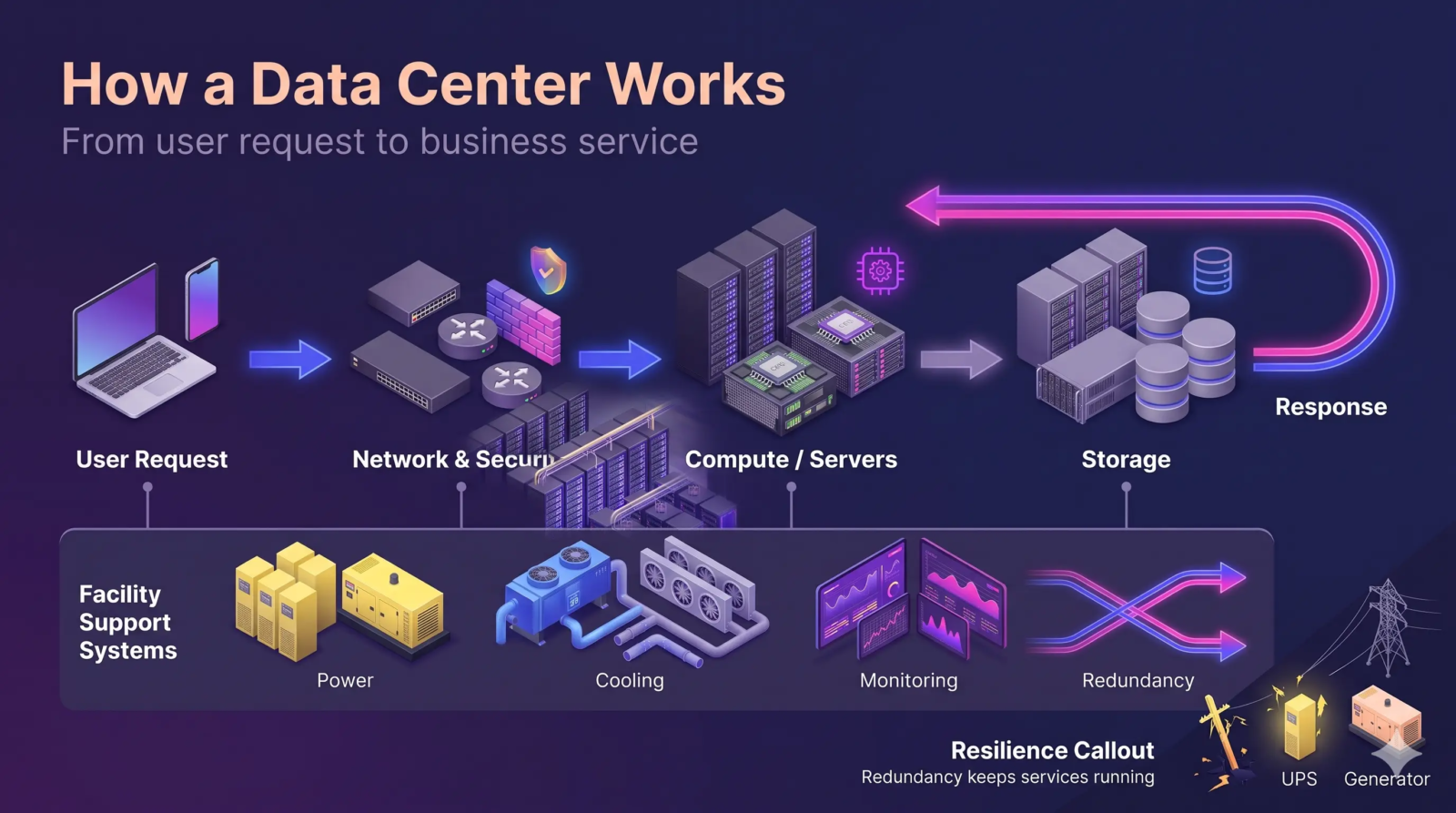
What is a data center doing behind that request? Data center monitoring tracks hardware health, power, temperature, connectivity, storage capacity, and faults. If utility power drops, the uninterruptible power supply (UPS) carries the load while backup generators or alternate sources start. If a server or network path fails, redundant resources can take over.
What does a data center do to protect availability? Data center redundancy reduces single points of failure. Data center uptime depends on power, cooling, network, hardware, software, procedures, and people. The Uptime Institute Tier Standard distinguishes basic capacity, redundant capacity components, concurrently maintainable infrastructure, and fault-tolerant infrastructure. How do data centers keep servers running? They combine redundancy, monitoring, maintenance procedures, spare capacity, and tested recovery paths.
Data center virtualization adds flexibility by abstracting physical compute, storage, and networking into resource pools. IBM notes that modern facilities increasingly virtualize physical resources and allocate them across workloads programmatically.
Types of Data Centers: Enterprise, Colocation, Cloud, Hyperscale and Edge
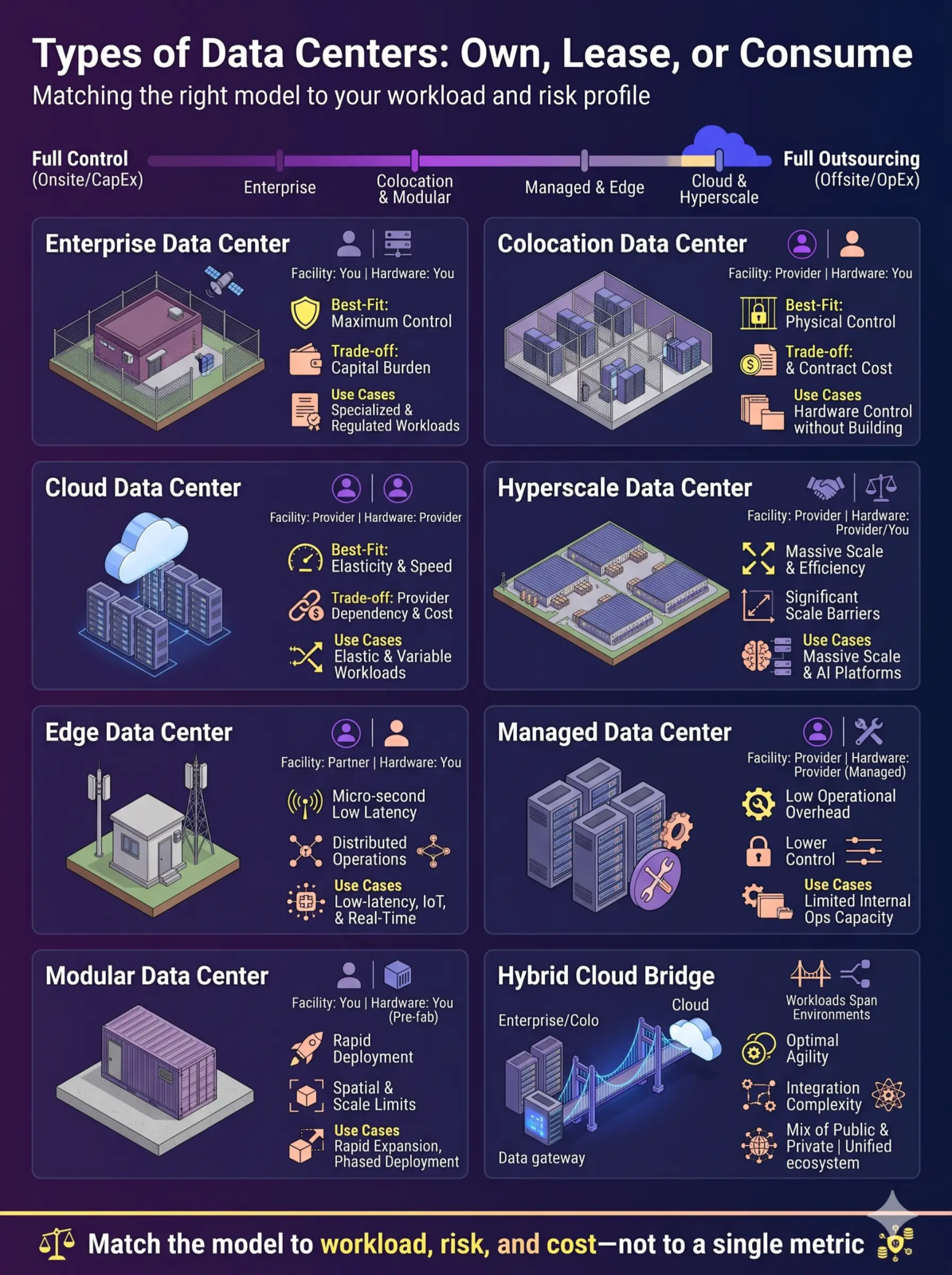
What is a data center in practice depends on who owns the facility, who owns the equipment, and who operates it. The main types of data centers serve different business needs, and many organizations use more than one model.
- Enterprise data centers: These are owned or controlled for one organization’s workloads. They provide direct control over hardware, security policies, networks, and change windows. The trade-off is responsibility for capital investment, staffing, power, cooling, maintenance, and infrastructure lifecycle management.
- Colocation data centers: These let a business install its own equipment inside a third-party facility. The provider supplies the building, power, cooling, physical security, and connectivity ecosystem, while the customer retains control of its servers and other hardware. Equinix describes colocation as rented data center space for customer-owned infrastructure.
- Cloud data centers: These are operated by cloud service providers. Customers consume compute, storage, databases, networking, and other services without owning or operating the underlying physical facility. AWS explains that its regions contain multiple isolated Availability Zones, each made up of one or more physical data centers.
- Hyperscale data centers: These facilities support large cloud, internet, content, and AI platforms. They use standardized infrastructure designs, automation, and large fleets of servers to operate at significant scale.
- Edge data centers: These are smaller facilities positioned closer to users, devices, branch locations, or industrial systems. Their main role is to reduce latency and support workloads that benefit from local processing. IBM identifies hyperscale data centers and edge data centers as modern infrastructure models.
- Managed and modular data centers: Managed facilities add third-party operational support, while modular designs use prefabricated infrastructure blocks that can be deployed or expanded in stages. These models give organizations additional options when speed, flexibility, or limited internal operations capacity matters.
The right choice depends on workload scale, risk, geographic requirements, growth plans, cost structure, and how much operational control your company wants to retain.
Data Center vs Cloud Computing: What Business Leaders Should Understand
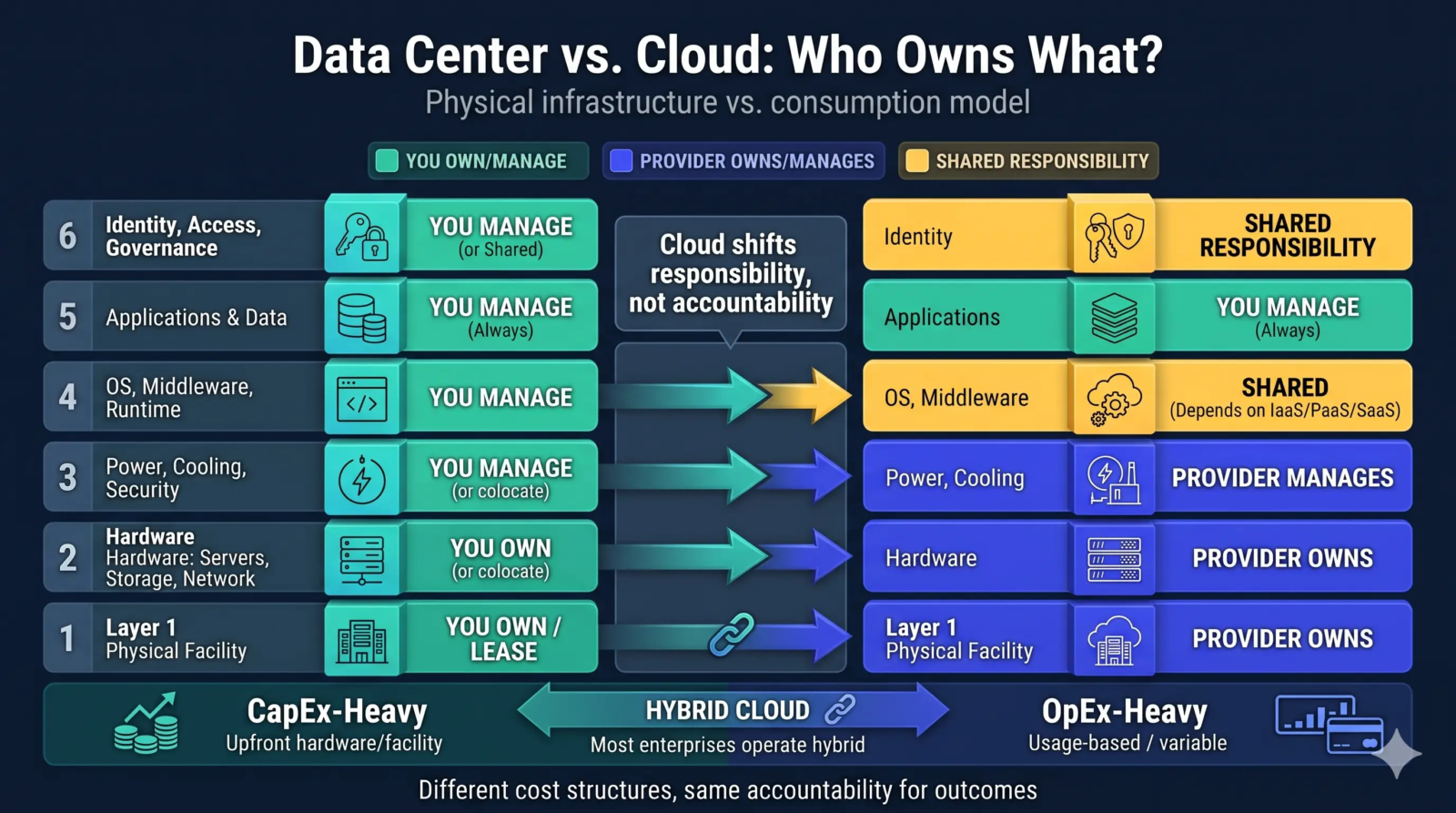
Data center vs cloud computing is often framed as physical infrastructure versus something virtual. What is a data center? It is the physical foundation. Cloud computing is an operating and consumption model built on data center infrastructure.
| Aspect | Data Center | Cloud Computing | What Business Leaders Should Understand |
|---|---|---|---|
| Definition | A data center is the physical infrastructure that houses servers, storage, networking, power, cooling, and supporting systems. | Cloud computing is a service and consumption model built on physical data center infrastructure. | The cloud does not replace data centers. It changes how infrastructure is owned, operated, and consumed. |
| Ownership | The business may own the facility and hardware directly or place its hardware in a colocation data center. | Public cloud providers own and operate the facilities and physical hardware. | The data center vs cloud computing choice determines how much infrastructure ownership your organization retains. |
| Cost Structure | Owned infrastructure generally involves capital spending on hardware, facilities, power, cooling, staffing, and lifecycle management. | Public cloud shifts more spending toward operating expense and usage-based pricing. | Cloud reduces upfront infrastructure investment, while owned capacity may offer better economics for some stable, predictable workloads. |
| Capacity & Scalability | Additional capacity requires physical servers, racks, power, cooling, networking, and deployment time. | Compute, storage, and other resources are generally easier to add or remove as demand changes. | Public cloud often suits variable workloads, rapid experimentation, and short-term capacity requirements. |
| Operational responsibility | The organization carries responsibility for hardware, maintenance, facilities, resilience, security controls, and infrastructure lifecycle management. | The cloud provider operates the physical data center infrastructure. The customer still manages architecture, identity, data, workload configuration, resilience, and cost governance. | Moving to cloud transfers some responsibilities, not all of them. Business leaders still need clear ownership of security, architecture, resilience, and spending. |
| Private cloud | Dedicated infrastructure is operated for one organization, often inside an enterprise or colocation data center. | Private cloud applies cloud-style automation, orchestration, and self-service to dedicated infrastructure. | Private cloud offers greater infrastructure control while retaining many cloud operating principles. |
| Hybrid cloud infrastructure | Enterprise or colocation data centers provide the private or on-premises part of the environment. | Public cloud services provide additional capacity and managed services. | Google Cloud describes hybrid cloud as an environment spanning public cloud, private cloud, traditional data centers, and sometimes edge locations. |
| Best fit for predictable workloads | Owned or collocated infrastructure may suit workloads with stable demand, specialized hardware, strict latency requirements, data sovereignty needs, or predictable long-term utilization. | Public cloud pricing may become less attractive for continuously running workloads if consumption is poorly managed. | Predictable utilization, hardware requirements, and long-term cost should influence the data center vs cloud computing decision. |
| Best fit for variable workloads | Physical capacity normally needs to be planned and provisioned before demand arrives. | Public cloud supports faster capacity changes and access to managed platform services. | Variable demand, temporary projects, development environments, and experimentation often fit public cloud well. |
| Control | Owned or colocated infrastructure gives the business greater control over hardware, networks, security policies, and maintenance schedules. | Public cloud customers have less direct control over the underlying physical infrastructure. | Workloads with strict hardware, compliance, latency, or sovereignty requirements may benefit from greater infrastructure control. |
| Common enterprise approach | Organizations keep selected workloads in enterprise or colocation data centers. | Other applications and services run in public cloud environments. | Many businesses use hybrid cloud infrastructure because one operating model rarely fits every workload. |
| Key decision | Determine whether direct ownership and control justify the capital, staffing, and operational responsibility. | Determine whether flexibility, managed services, and consumption-based capacity justify the ongoing cost and reduced physical control. | Asking what is a data center first helps clarify which responsibilities move to a provider and which remain with your organization. |
Asking what is a data center before choosing a cloud strategy helps clarify which responsibilities move to a provider and which remain with your organization. The right model depends on workload behavior, cost structure, control requirements, risk, latency, compliance, and how quickly your business needs to scale.
Why Do We Need Data Centers? Business Reliability, Risk and Everyday Digital Services
Why do we need data centers? Digital services need a controlled place to run. Banking, ecommerce, healthcare, manufacturing, logistics, streaming, collaboration, government applications, and cloud platforms depend on physical compute and storage. CISA describes data centers as important to everyday operations and critical infrastructure sectors.
What is a data center from a risk perspective? An outage can stop sales, interrupt production, delay support, or block access to data. Reliability requirements should follow the financial and operational cost of downtime, not a generic desire for the highest possible redundancy.
Security is broader than the building. Physical access, network controls, identity, backups, encryption, monitoring, and incident response all matter. A resilient facility does not compensate for weak access controls, and strong cybersecurity does not compensate for an unprotected site.
Capacity matters too. GPU servers and AI workloads can raise power, cooling, storage, and network requirements. What is a data center for in that context? It is the platform that turns computing hardware into reliable business capacity.
Efficiency affects cost. The DOE data center design guide defines power usage effectiveness (PUE) as total facility energy divided by IT equipment energy. PUE does not measure business value, but it helps operators track facility energy overhead.
What Does a Data Center Cost? Own, Lease or Use Cloud Capacity
If your finance team asks what is a data center from a cost perspective, start with ownership. An enterprise facility requires capital for space, electrical systems, cooling, connectivity, fire protection, physical security, server racks, IT equipment, monitoring, and commissioning. Operating costs include electricity, maintenance, staffing, spares, software, connectivity, compliance, and hardware refreshes.
Colocation shifts much of the facility capital burden to the provider. You pay for space, power, connectivity, cross-connects, and service levels while retaining ownership of your hardware. Equinix notes that tenants share operational costs for power, cooling, bandwidth, communications, and security.
Cloud replaces much of the physical ownership model with consumption-based services. The benefits are speed and elasticity. Long-running compute, data transfers, idle resources, premium managed services, and weak governance can still create high costs. AWS notes the setup, staffing, and running costs associated with operating your own facility.
Compare five-year or longer total cost, migration expense, staffing, power availability, depreciation, contract commitments, data transfer, disaster recovery, compliance, growth, and downtime risk. The data center meaning for finance is a portfolio of capital, operating expense, and risk decisions. In that sense, the data center meaning is also financial: who funds capacity, who carries utilization risk, and who pays when demand changes. Asking what is a data center in financial terms forces that ownership question into the open.
Types of Data Centers and the Own, Lease or Cloud Choice
The table below summarizes the operating choices business leaders usually compare. It is a starting point, not a substitute for workload-level financial modeling:
| Model | Who owns the facility | Who owns IT Hardware | Best Fit | Main business trade-off |
|---|---|---|---|---|
| Enterprise data center | Your organization | Your organization | Control, specialized workloads, strict data or latency requirements | Highest capital and operational responsibility |
| Colocation data center | Provider | Usually your organization | Hardware control without building a facility | Contract, power, cross-connect and support costs |
| Public Cloud | Cloud provider | Cloud provider | Elastic capacity, managed services, global deployment | Consumption governance, architecture and provider dependency |
| Hybrid Cloud infrastructure | Mixed | Mixed | Workloads with different risk, latency, cost or compliance needs | More integration and operating complexity |
| Edge data center | Your organization or provider | Varies | Low-latency processing near users, devices or sites | Distributed operations and lifecycle management |
How Data Center Infrastructure Supports AI Workloads and Modern Applications
What is a data center becoming as AI adoption grows? For many organizations, it is also the environment where GPU servers, high-speed networks, large storage systems, and new cooling designs support AI workloads.
How do data centers support artificial intelligence? They provide the physical environment for GPU servers and supporting CPUs, storage, network fabrics, power distribution, cooling, orchestration, and security. NVIDIA documents configuration considerations for GPU-based inference systems in data center and edge environments.
AI changes capacity planning. A room built for low-density enterprise servers may not support modern GPU servers without electrical or cooling upgrades. That does not make every facility obsolete. It means data center infrastructure planning should begin with actual facility limits and workload requirements. For an executive asking what is a data center ready for AI, the answer starts with verified power, cooling, network, and operational capacity.
What Is a Data Center Partner’s Role? Planning, Operations and Modernization
What is a data center partner useful for? Some organizations need design and buildout support. Others need migration, monitoring, infrastructure operations, lifecycle management, or help integrating on-premises systems with cloud services.
Aptly Technology describes enterprise infrastructure services across server hardware and virtualization, networking, storage and compute strategy, backup and disaster recovery, monitoring, and security tooling. Its enterprise data center buildout guidance connects workload requirements with power, cooling, network design, commissioning, and operations.
For AI expansion, Aptly also publishes capabilities around GPU data center buildout, workload deployment, infrastructure monitoring, and ongoing operations. A partner should reduce execution risk after you decide which responsibilities you want to retain.
Conclusion: What Is a Data Center and What Should Your Business Do Next?
What is a data center? It is the physical operating environment behind the digital services your company uses and delivers. Data center infrastructure combines compute, storage, networking, power, cooling, security, monitoring, redundancy, and operating processes so applications remain available and data remains accessible.
For decision makers, ownership and risk matter most. Decide which workloads need direct control, which belong in colocation, which benefit from cloud elasticity, and where hybrid cloud infrastructure makes sense. Compare total cost, reliability, security, latency, compliance, growth, and operational capability rather than choosing a model from one price metric. A useful board-level question is what is a data center responsible for in our operating model, and which parts of that responsibility belong with a provider?
Once those decisions are clear, the definition of data centers becomes useful instead of abstract. If your organization is planning a new build, modernization, cloud transition, or AI infrastructure expansion, Aptly Technology can help assess the infrastructure and operating path.
Frequently Asked Questions: What Is a Data Center?
- What is a data center and how does it work?
- A data center is a physical facility that houses computing, storage, networking, power, cooling, and security systems. Applications send requests through the network, servers process them, storage supplies or records data, and redundant facility systems support availability.
- What are the main components of a data center?
- The main data center components are servers, data storage systems, networking equipment, server racks, electrical distribution, an uninterruptible power supply (UPS), backup generators, data center cooling systems, monitoring, fire protection, and physical data center security.
- What are the different types of data centers?
- Enterprise data centers, colocation data centers, cloud data centers, hyperscale data centers, edge data centers, managed facilities, and modular facilities serve different combinations of control, cost, latency, and scale.
- How are data centers used in cloud computing?
- Cloud providers operate fleets of facilities and virtualize compute, storage, and networking so customers consume resources as services. Data center vs cloud computing describes two layers of the same system: physical infrastructure and the service model built on top.
- What is the difference between a data center and a server room?
- A server room is usually a smaller space inside a general-purpose building. A data center is designed around dedicated power, cooling, connectivity, security, redundancy, monitoring, and operating procedures.
- What companies offer data center services in the US?
- The market includes cloud providers such as AWS, Microsoft Azure, and Google Cloud, colocation providers such as Equinix and Digital Realty, and infrastructure service firms that design, deploy, operate, or support customer environments.
- What considerations are important when planning a dedicated server complex?
- Start with workload demand, power, cooling, network diversity, physical security, redundancy, expansion capacity, compliance, recovery objectives, staffing, and lifecycle cost.