Introduction
What happens when AI agents become your newest privileged users?
That question now defines modern enterprise cybersecurity. Organizations increasingly rely on AI for automation, analytics, software development, and business operations. Gartner predicts 40% of enterprise apps will use task-specific AI agents by 2026.
Modern AI environments now operate across cloud platforms, APIs, vector databases, orchestration layers, and autonomous agents. This distributed architecture significantly expands the enterprise attack surface.
Traditional perimeter-based security models cannot adequately protect these decentralized AI ecosystems. A single compromised AI workflow can expose sensitive data or enable lateral movement across enterprise systems.
This is why Zero-Trust AI Infrastructure is becoming essential for enterprise AI security. Organizations need Next-Generation Cybersecurity models that continuously verify identities, validate AI interactions, and secure AI workloads across dynamic environments.
What Is Zero-Trust AI Infrastructure?
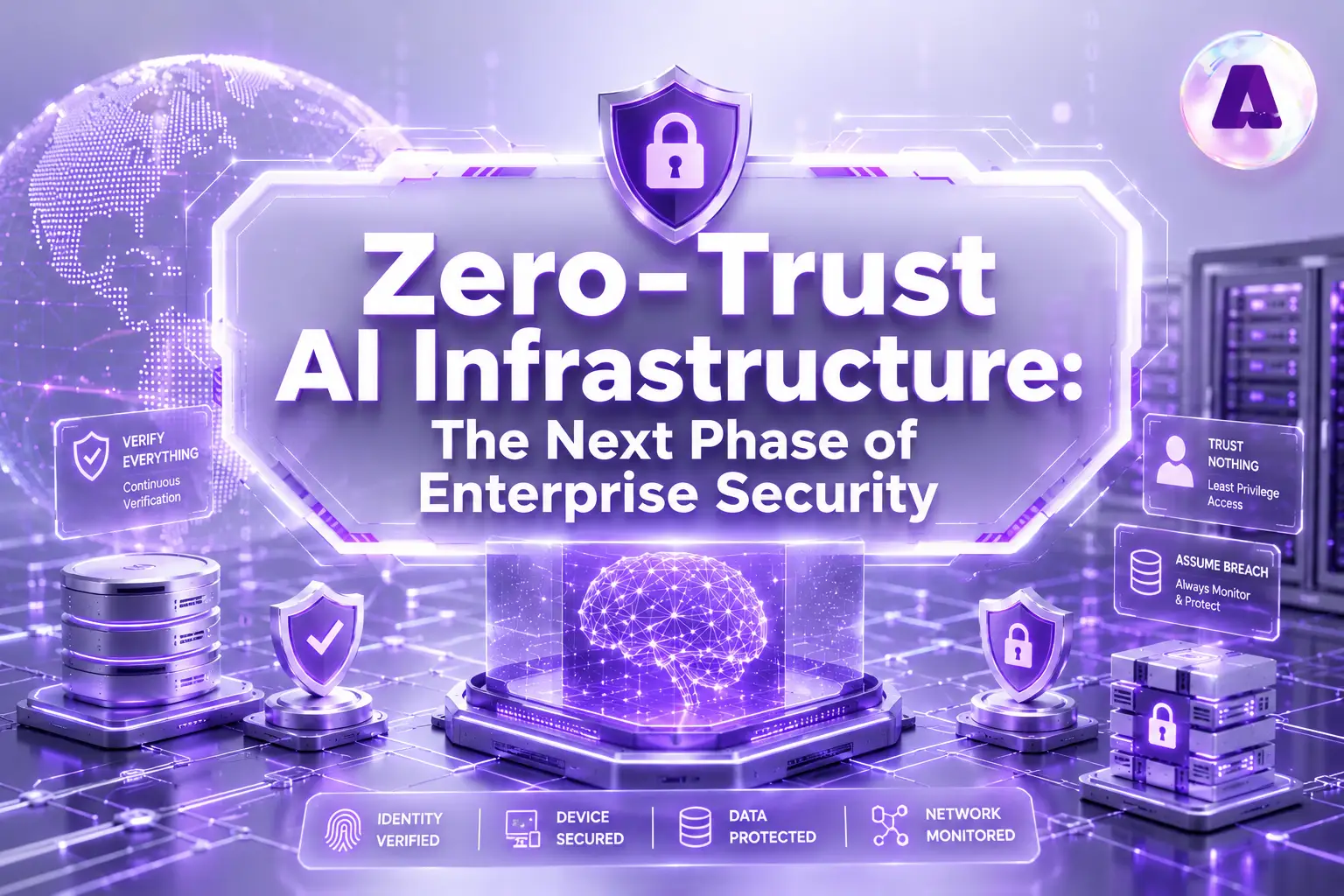
Zero-trust AI infrastructure is a security framework designed to protect AI systems through continuous verification, identity-aware controls, workload isolation, and real-time monitoring. Instead of assuming internal systems are trustworthy, the zero trust security model validates every interaction across users, AI agents, workloads, APIs, and datasets.
Unlike traditional security approaches, zero trust AI security treats AI systems as dynamic entities rather than static applications. AI agents can trigger workflows, access sensitive information, interact with APIs, and generate business decisions. Because of this behavior, enterprises must apply identity-first security to both humans and machines.
Core principles of zero trust AI security:
- Verify every AI interaction before granting access.
- Restrict model and dataset access using least privilege access.
- Continuously monitor AI behavior for anomalies.
- Encrypt AI traffic, workloads, and inference pipelines.
- Validate APIs, orchestration layers, and AI agents.
Several technical controls support this architecture:
- Identity and access management (IAM)
- Adaptive authentication
- Micro-segmentation
- AI identity governance
- Policy-driven authorization
- Workload isolation
Why Enterprises Need Zero-Trust AI Architecture in 2026?
Enterprise AI has moved beyond experimentation. AI now powers customer support copilots, predictive analytics systems, fraud detection platforms, internal assistants, and software engineering workflows. As AI becomes embedded within business operations, security risks increase significantly.
The following developments explain why enterprises need zero-trust AI architecture in 2026:
- Enterprise-wide LLM adoption continues to expand rapidly.
- Autonomous AI systems now perform operational tasks without human approval.
- Regulatory pressure around AI governance and compliance continues to increase.
- AI workloads increasingly operate across hybrid cloud environments.
- AI systems process highly sensitive enterprise data.
Traditional network segmentation alone cannot protect modern AI ecosystems. Once attackers compromise a single identity or service account, they may gain access to broader enterprise systems. Zero trust provides the operational model needed to secure these evolving environments.
The Biggest AI Infrastructure Security Risks Enterprises Face
AI adoption introduces security challenges that differ from traditional enterprise software risks. As organizations deploy AI at scale, their AI attack surface expands rapidly. The following risks are shaping AI infrastructure security challenges in 2026.
Model Theft and Unauthorized Access
AI models represent significant intellectual property investments. Stolen model weights can expose proprietary algorithms, training methods, and competitive business advantages. Attackers increasingly target poorly secured inference endpoints and internal repositories.
Shadow AI deployments create additional exposure. Teams sometimes deploy unofficial AI tools without governance approval, which weakens enterprise AI security controls. Unauthorized access to these systems may expose sensitive business data or confidential prompts.
Prompt Injection and Data Leakage
Prompt injection attacks manipulate AI behavior through malicious inputs. Attackers can override instructions, extract confidential information, or redirect AI systems toward unsafe actions.
Enterprise copilots and internal RAG systems face elevated exposure because they often connect directly to sensitive business repositories. Without proper validation controls, AI systems may unintentionally reveal customer records, financial data, or intellectual property.
Insecure AI Pipelines
Many organizations focus heavily on model performance while overlooking pipeline security. Vulnerable CI/CD workflows, weak orchestration security, and exposed APIs increase operational risk.
Secure AI pipelines require continuous verification across training, testing, deployment, and inference stages. Without policy enforcement, attackers may inject malicious code into model workflows or manipulate deployment artifacts.
AI Supply Chain Attacks
Enterprises increasingly rely on open-source models, external datasets, and third-party AI tooling. Compromised dependencies can introduce malware, backdoors, or manipulated model behavior.
Supply chain attacks now affect secure enterprise AI infrastructure because AI ecosystems depend heavily on interconnected frameworks. Security teams must validate model origins, dependencies, and orchestration layers before deployment.
Multi-Agent AI Risks
Secure multi-agent AI architecture for enterprises introduces another challenge. AI agents frequently interact across systems using machine-to-machine communication.
If permissions are excessive, attackers may exploit one compromised agent to move laterally across infrastructure. AI workload protection therefore requires strict identity controls, segmentation policies, and continuous runtime monitoring.
How Zero-Trust Architecture Works for AI Systems?
The following components explain how zero-trust architecture works for AI systems in enterprise environments.
Identity-Centric AI Access
Zero trust treats AI agents, applications, APIs, and workloads as identities requiring continuous authentication. Machine-to-machine communication must pass policy validation before interactions occur.
Organizations increasingly deploy AI identity governance frameworks to control model access, dataset permissions, and API usage. Role-based authorization reduces exposure by limiting access to only necessary resources.
Adaptive authentication strengthens protection further. AI systems accessing sensitive data may require contextual validation based on workload behavior, device posture, or operational risk signals.
Secure AI Workload Isolation
AI workloads may run inside containers and Kubernetes environments. Zero-trust framework for generative AI platforms requires segmentation between workloads, inference services, orchestration systems, and datasets.
Container isolation helps prevent lateral movement if one workload becomes compromised. Runtime protection tools continuously monitor execution behavior for suspicious activity.
AI workload protection also depends on policy-driven orchestration. Security policies should validate deployments before workloads access sensitive enterprise resources.
Continuous Verification and Monitoring
Zero Trust relies heavily on continuous visibility. AI-driven threat detection systems analyze workload behavior, API traffic, inference patterns, and authentication activity.
Behavioral analytics can identify abnormal interactions between AI agents, users, and infrastructure services. Model observability platforms also help security teams detect unusual outputs, prompt manipulation attempts, and operational drift.
Continuous verification allows organizations to respond quickly before attackers escalate privileges or access critical systems.
Data-Centric AI Security
AI data security remains central to enterprise protection strategies. AI models process sensitive datasets during training and inference operations.
Organizations should encrypt data both at rest and in transit. Confidential computing adds another protection layer by securing workloads during runtime processing.
Data-centric security controls also protect vector databases, embeddings, and retrieval pipelines. These controls reduce exposure within hybrid cloud AI environments.
Zero Trust becomes even more effective when integrated directly into MLOps and DevSecOps pipelines. Policy-driven workload orchestration allows enterprises to validate AI deployments continuously instead of relying on static approvals.
Best Practices for Secure AI Deployment in Enterprises
The following best practices can help your organization strengthen secure AI deployment strategies while supporting long-term operational governance.
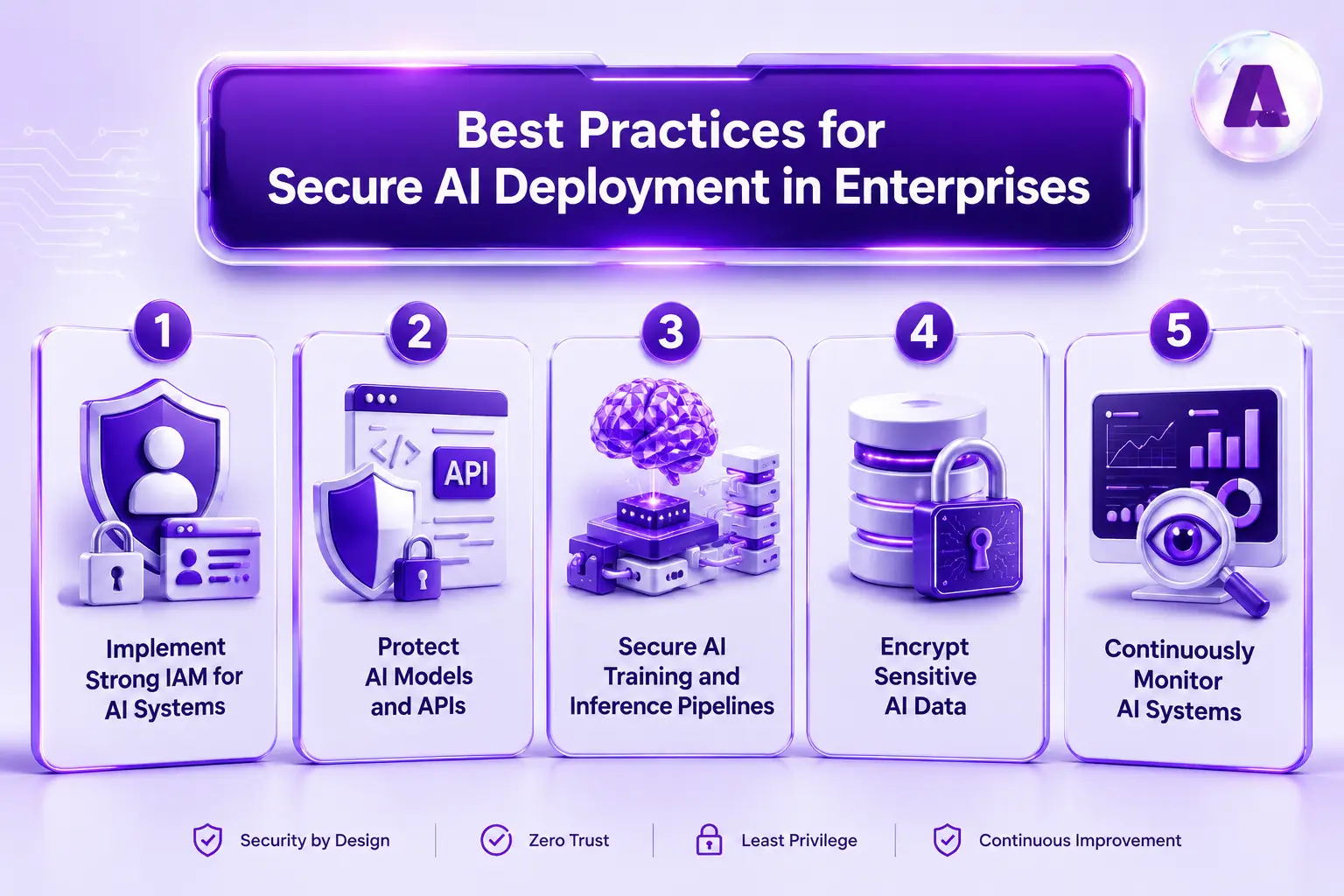
Implement Strong IAM for AI Systems
AI environments require identity-first security controls. Every AI agent, model endpoint, orchestration platform, and user should authenticate through centralized identity and access management systems.
Role-based access control reduces unnecessary exposure. Just-in-time access also limits standing privileges for sensitive AI systems.
AI identity governance helps organizations track who accessed models, datasets, APIs, and inference environments.
Protect AI Models and APIs
APIs often become the primary attack vector for enterprise AI systems. Organizations should deploy API gateways that validate authentication requests and inspect traffic behavior.
Model authentication mechanisms help prevent unauthorized inference access. Rate limiting also reduces abuse attempts targeting public or internal AI services.
Enterprises asking how to protect AI models from cyber threats should prioritize API security early in deployment planning.
Secure AI Training and Inference Pipelines
Secure AI pipelines require validation controls across every deployment stage. Signed AI models help verify deployment integrity before workloads enter production environments.
Organizations should also secure orchestration systems responsible for training, deployment, and inference operations. Pipeline validation reduces opportunities for malicious code injection.
This approach supports a more resilient AI cybersecurity strategy while improving operational consistency.
Encrypt Sensitive AI Data
AI systems frequently process regulated enterprise information. Encryption policies should protect datasets, vector databases, prompts, embeddings, and inference outputs.
Tokenization techniques help reduce direct exposure to confidential information. Confidential computing also improves protection during active processing operations.
These safeguards support AI governance strategies for regulated industries handling financial, healthcare, or customer-sensitive workloads.
Continuously Monitor AI Systems
Continuous monitoring remains essential for enterprise AI security. Threat detection systems should track workload behavior, inference activity, authentication events, and policy violations.
Audit logging improves compliance reporting while supporting incident investigations. Model observability tools help identify anomalies, prompt manipulation, and unexpected operational behavior.
Enterprise AI Infrastructure Security Checklist
The following checklist helps organizations evaluate their Zero trust AI readiness:
| Security Area | Key Requirement |
|---|---|
| Access Controls | Role-based access and adaptive authentication |
| AI Workload Isolation | Segmented containers and runtime protection |
| Encryption Policies | Data encryption across training and inference |
| Governance Frameworks | AI governance and compliance validation |
| Threat Monitoring | Continuous AI-driven threat detection |
| Compliance Validation | Audit trails and policy enforcement |
How Aptly Technology Supports Secure Enterprise AI Infrastructure?
Organizations often struggle to balance rapid AI innovation with cybersecurity governance requirements. This challenge becomes more difficult when AI workloads operate across different environments. Security teams must protect these systems without slowing innovation.
In such cases, enterprises need infrastructure partners like Aptly Technology that understand both AI scalability and cybersecurity resilience. Aptly supports secure AI deployment by helping enterprises modernize infrastructure for AI-native operations. It helps enterprises develop:
- GPU-ready AI platforms
- Hybrid and multi-cloud AI environments
- AI workload deployment pipelines
- Governance-ready AI ecosystems
Its capabilities include infrastructure modernization, AI networking, AI observability and monitoring, cloud-native AI environments, and workload deployment automation. Aptly enables enterprises to operationalize AI securely while aligning with zero trust security principles and enterprise compliance requirements.
The Future of Enterprise GenAI Security
The future of AI cybersecurity will center on trust validation, policy automation, and continuous risk assessment. As AI systems become more autonomous, enterprises will require security frameworks capable of governing machine-driven operations at scale.
The following trends are shaping enterprise GenAI security:
- Autonomous AI agents managing operational workflows
- AI-native SOC operations using real-time analytics
- Policy-driven AI orchestration frameworks
- Secure federated AI systems across distributed environments
- Real-time AI trust scoring for workload validation
Organizations investing early in zero trust AI security frameworks will likely improve resilience, governance maturity, and operational trust as AI adoption continues to grow.
Conclusion
Zero-trust AI infrastructure is quickly becoming a foundational requirement for enterprise AI security. Organizations asking why enterprises need zero-trust AI architecture should focus on operational resilience, governance visibility, and continuous risk reduction. AI innovation without proper security controls creates enterprise-scale exposure.
Enterprises that implement secure AI deployment practices early can improve trust, governance, compliance readiness, and infrastructure resilience. Those advantages will become increasingly important as AI systems expand across critical business operations.
Is your enterprise AI stack designed only for performance, or also for resilience, governance, and trust?
Connect with the Aptly Team for a secure AI infrastructure buildout.
FAQs
Q: What is zero-trust AI infrastructure in enterprise security?
Zero-trust AI infrastructure is a security model that continuously validates users, AI agents, workloads, APIs, and datasets before granting access.
Q: How do enterprises secure generative AI systems?
Enterprises secure generative AI systems through IAM controls, encrypted pipelines, workload segmentation, runtime monitoring, API protection, and governance frameworks.
Q: Why is zero-trust important for AI infrastructure?
Zero trust reduces exposure by continuously validating interactions instead of assuming internal systems are safe.
Q: What are the biggest AI infrastructure security risks?
The biggest risks include prompt injection attacks, model theft, insecure APIs, data leakage, supply chain compromises, shadow AI deployments, and excessive AI agent permissions.
Q: How can organizations secure LLMs and AI agents?
Organizations can secure LLMs and AI agents through identity governance, workload isolation, API authentication, runtime monitoring, behavioral analytics, and encrypted inference pipelines.
Q: What are the best practices for enterprise AI security?
Best practices include implementing least privilege access, securing AI pipelines, monitoring workload behavior, encrypting sensitive datasets, validating APIs, and integrating zero trust controls into MLOps environments.
Q: What security framework should enterprises use for AI deployments?
Many enterprises combine zero trust principles with NIST AI risk management guidance, IAM frameworks, DevSecOps practices, and AI governance policies for secure AI deployment.
Q: How does zero-trust architecture improve AI compliance?
Zero trust improves compliance by enforcing identity verification, audit logging, access controls, workload visibility, and policy-driven governance across AI systems.
Q: How can zero-trust AI infrastructure improve cybersecurity in large organizations?
Large organizations improve cybersecurity by reducing lateral movement, strengthening identity controls, securing distributed AI workloads, and continuously monitoring AI behavior across hybrid environments.
Q: What are the leading zero-trust AI infrastructure solutions for enterprise security?
Major providers such as Microsoft, Google Cloud, and NVIDIA offer enterprise AI security capabilities including confidential computing, AI workload isolation, runtime monitoring, and secure orchestration frameworks.
However, enterprises also need implementation partners that can operationalize these technologies within real-world environments. This is where Aptly Technology plays an important role.
Table of content
- TL;DR
- Introduction
- What Is Zero-Trust AI Infrastructure?
- Why Enterprises Need Zero-Trust AI Architecture in 2026?
- The Biggest AI Infrastructure Security Risks Enterprises Face
- How Zero-Trust Architecture Works for AI Systems?
- Best Practices for Secure AI Deployment in Enterprises
- Enterprise AI Infrastructure Security Checklist
- How Aptly Technology Supports Secure Enterprise AI Infrastructure?
- The Future of Enterprise GenAI Security
- Conclusion
- FAQs