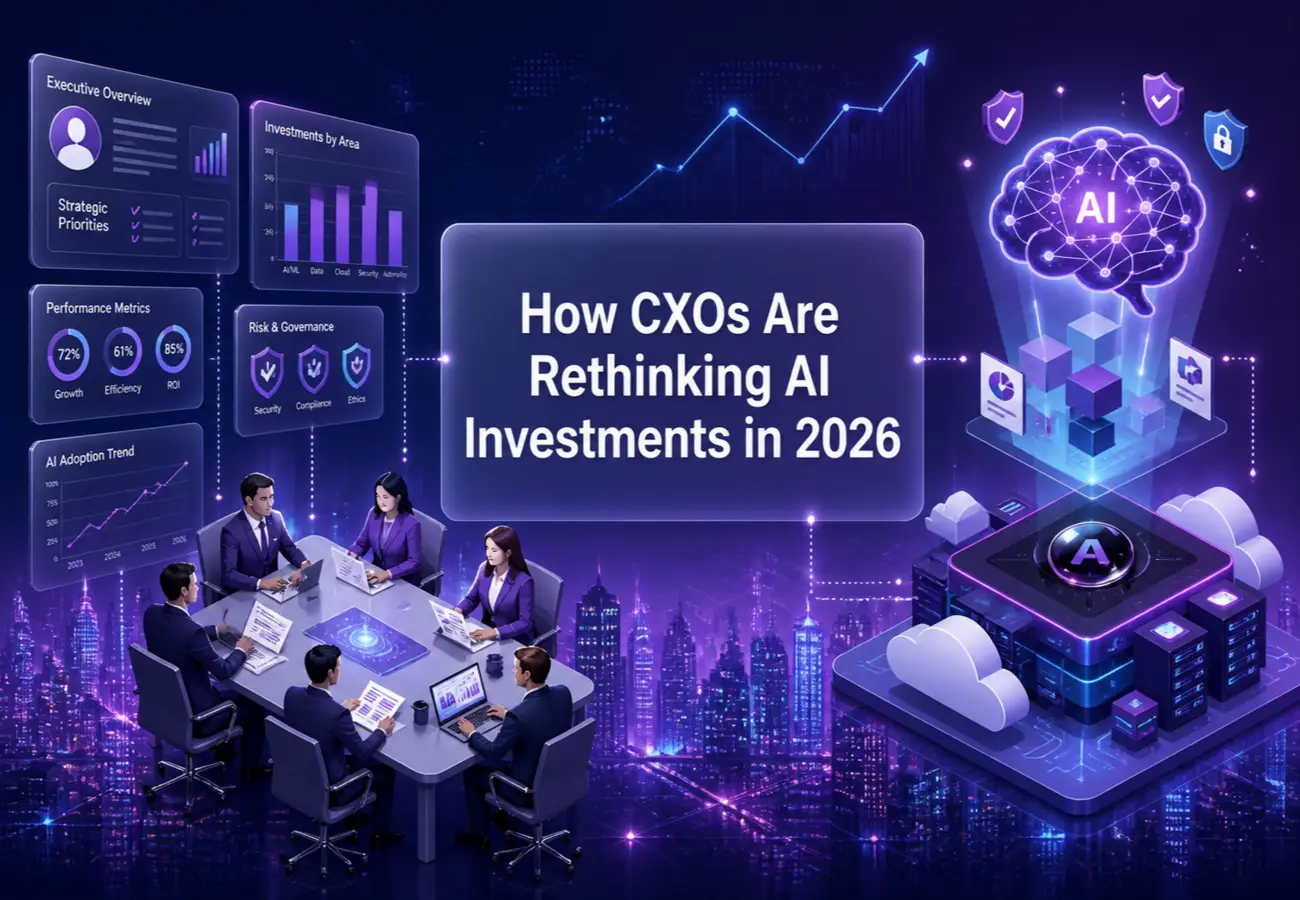
The AI Spending Paradox in 2026
Enterprise AI budgets are growing. But something unexpected is happening alongside that growth. 79% of organizations report AI adoption challenges in 2026, a double-digit jump from 2025. At the same time, spending on AI keeps rising even as seat counts fall. CXOs are investing more per initiative while funding fewer of them. That is not a contradiction. It is a strategy shift.
The era of “let’s try AI everywhere and see what sticks” is over. In 2026, enterprise leaders are making deliberate bets. They want AI initiatives that connect directly to business outcomes: reduced costs, faster decisions, and measurable revenue impact. If an AI project cannot prove its value, it does not get funded. Your AI investment strategy in 2026 is not just a budget decision; it is a statement about what your organization believes AI is actually for.
This piece breaks down how CXOs across the C-suite are rethinking AI investment strategy, what they prioritize, and what separates organizations that scale AI from those still stuck in pilot purgatory.
From Experimentation to Execution: The New AI Investment Mindset
CEOs with an AI-first mindset scale 10% more AI initiatives enterprise-wide than their peers, according to IBM’s 2026 CEO Study. The differentiator is not budget size. It is the organizational posture toward AI. Leaders who treat AI as a core operating model (not a technology experiment) move faster and extract more value.
The 2026 CXO AI Survey from Mayfield Fund confirms that agentic AI has moved decisively from experimentation to strategic priority. Enterprise leaders are no longer asking whether to adopt AI. They are asking which AI investments deserve capital, which teams own execution, and how success gets measured.
What AI-First Actually Means in Practice:
- AI is embedded in planning cycles, not bolted on as a separate initiative.
- Board-level AI governance strategy exists and is reviewed quarterly.
- Every major AI project has a named executive sponsor accountable for ROI.
- Infrastructure decisions (cloud, compute, data architecture) are evaluated through an AI lens.
- Teams have clear criteria for what makes an AI project production-ready versus still in pilot.
Leaders who build this kind of operating discipline around their AI investment strategy scale AI initiatives at 10x the rate of peers who treat AI as an add-on.
CXO AI Priorities: What Each Executive Actually Cares About
Every role in the C-suite approaches AI investment strategy from a different angle, and getting alignment across those angles is what separates organizations that scale from those that stall. The C-suite does not think about AI as a monolith. Each role brings a different set of pressures and a different definition of success. Understanding these distinctions helps you build an enterprise AI roadmap that earns buy-in across the organization.
| Role | Primary AI Focus | Success Metric |
|---|---|---|
| CEO | AI-driven business transformation and competitive positioning | Revenue growth, market share, strategic differentiation |
| CIO | AI infrastructure modernization, data strategy, and ROI measurement | Cost per AI workload, deployment speed, data quality scores |
| CTO | Cloud-native AI architecture, multi-model AI platforms, scalability | System uptime, latency, integration depth, engineering velocity |
| CFO | AI spending trends, budget discipline, total cost of ownership | Cost reduction from AI, payback period, OpEx vs CapEx balance |
| CISO | AI security and compliance, model risk, data governance | Audit trail completeness, incident rate, compliance certification |
| COO | Intelligent automation, operational efficiency, process AI | Process cycle time, error rates, headcount productivity ratio |
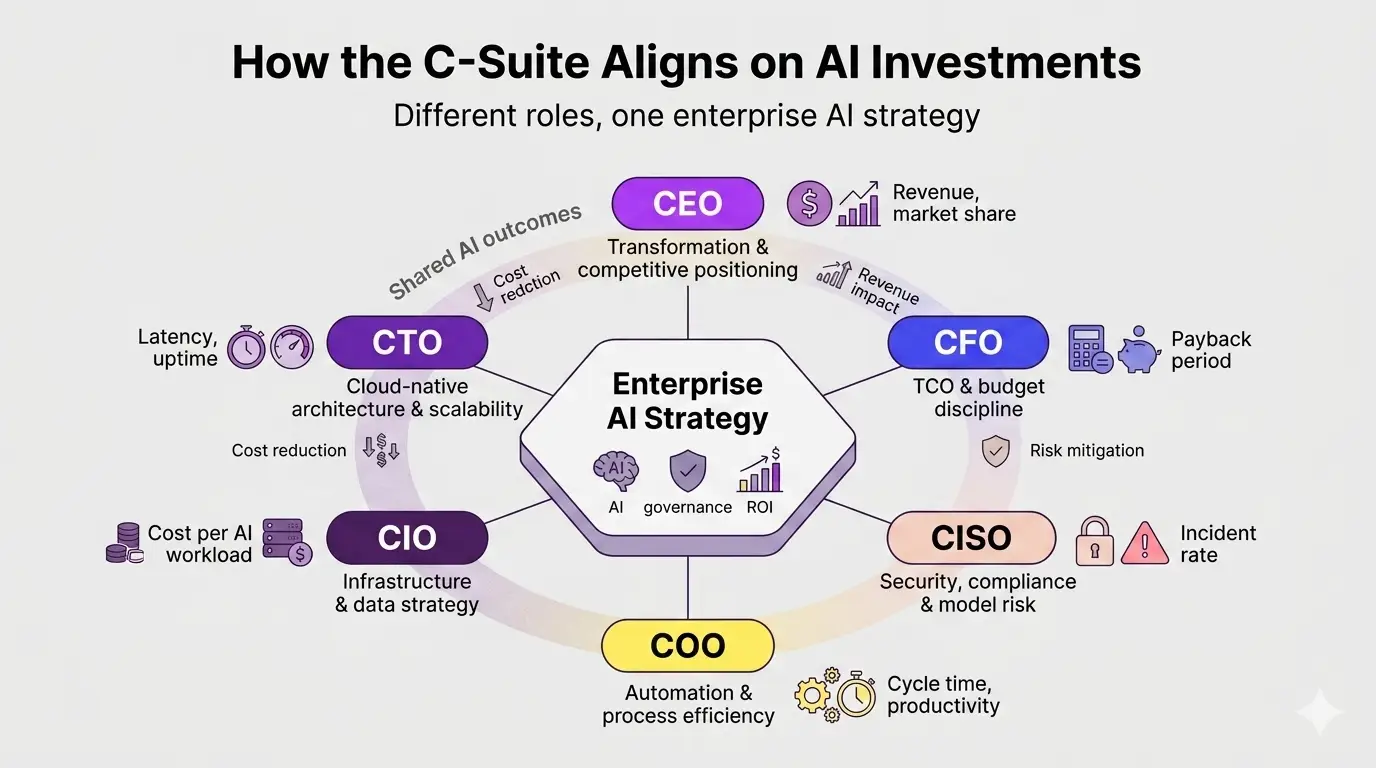
How the C-Suite Aligns on AI Infograph
These priorities do not always align naturally. A CTO pushing for a new multi-model AI platform and a CFO focused on AI spending discipline are both right from their vantage points. The organizations that scale AI fastest build a shared framework that satisfies all of these perspectives at once.
How CIOs Measure AI ROI in 2026
ROI of AI investments is the question every board asks and most AI teams struggle to answer clearly. CIOs in 2026 translate technical performance into business-level outcomes: revenue protection, improved customer experience, and faster time-to-market. Technical benchmarks like model accuracy or inference speed matter to engineers. They do not move CFOs.
The most credible AI ROI frameworks in 2026 connect AI outputs to three categories of business value:
- Cost reduction: Lower operational costs through intelligent automation, reduced manual processing, and fewer errors.
- Revenue impact: Faster product launches, improved customer retention, and new revenue streams enabled by AI capabilities.
- Risk mitigation: Fewer compliance failures, lower fraud losses, and reduced downtime through AI-powered monitoring.
Embedding these three outcome categories into your AI investment strategy gives every initiative a clear success condition before a single dollar gets committed. AI observability and governance tools are now core to this measurement discipline. 82% of enterprise data leaders say AI governance and observability are top priorities for the next three to five years. You cannot measure what you cannot see.
The Metrics CXOs Track in 2026:
| Metrics | What It Measures | Who Owns It |
|---|---|---|
| Cost per AI inference/task | Efficiency of AI workload execution | CTO / Engineering |
| AI-attributed revenue | Revenue linked to AI-enabled products or processes | CEO/CMO |
| Time-to-production | Speed from model development to live deployment | CIO / CTO |
| AI incident rate | Frequency of AI failures, bias events, or compliance breaches | CISO/CIO |
| Automation yield | Manual tasks eliminated or accelerated by AI | COO / CFO |
| Employee AI adoption rate | Percentage of staff actively using approved AI tools | CHRO / CIO |
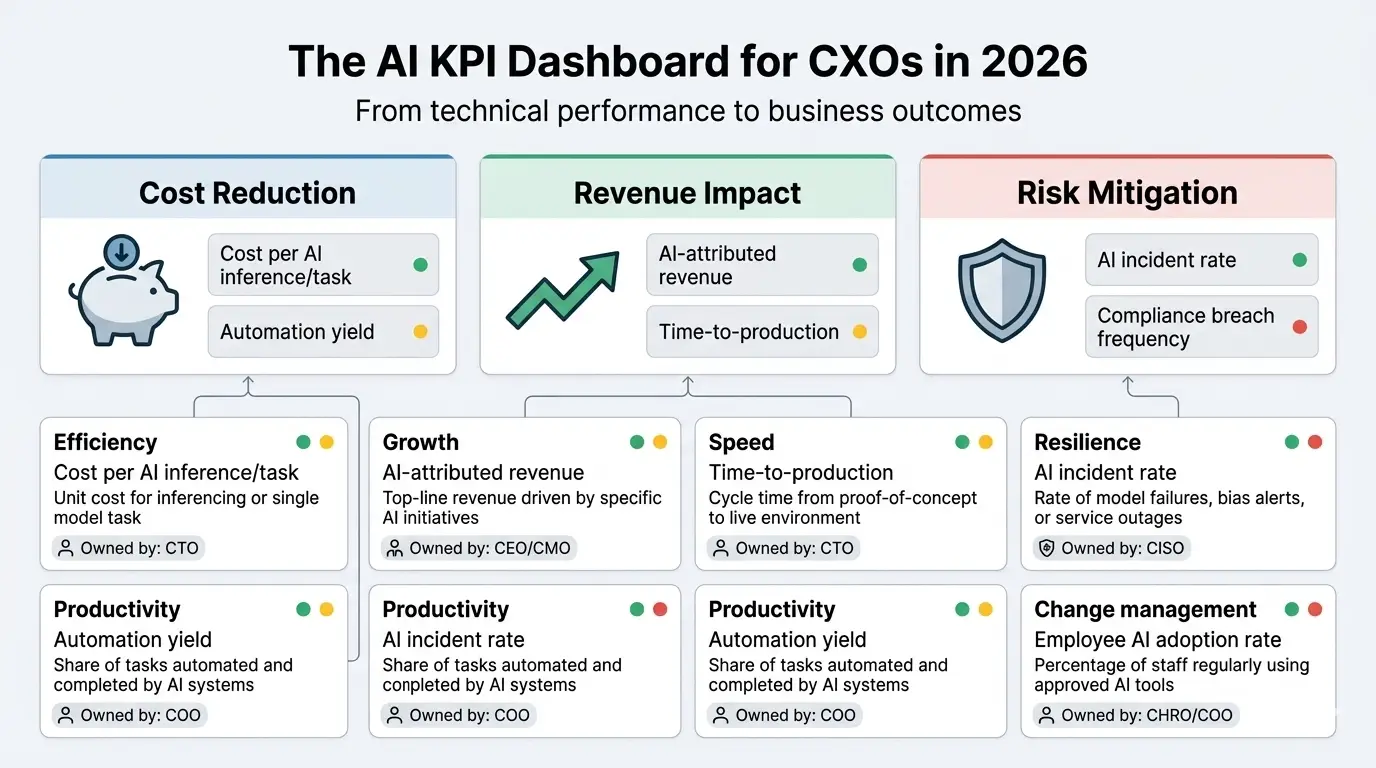
The AI KPI Dashboard
Generative AI Investment Trends for Large Enterprises
Generative AI for enterprises has completed its proof-of-concept phase. The question in 2026 is no longer “does it work?” but “how do we run it at scale without the costs spiraling?”
Enterprise AI adoption data from Codewave shows that organizations now demand audit trails for model decisions, risk thresholds, and escalation protocols as prerequisites for any production-grade generative AI deployment. These are not optional extras. They are table stakes. Organizations that treat governance as a foundational pillar of their AI investment strategy avoid the costly compliance retrofits that derail scale-up programs in their second year
The top generative AI investment areas CXOs are prioritizing in 2026:
- AI-assisted software development: Coding assistants and AI-generated test suites reduce engineering cycle times by 20 to 30% at scale.
- Customer-facing AI: Generative AI powers personalized customer support, product recommendations, and dynamic content at costs far below human equivalents.
- Internal knowledge management: Enterprise search and document synthesis tools reduce the time employees spend finding information by 40% in measured deployments.
- AI-powered business transformation in finance: Automated financial reporting, anomaly detection, and forecasting tools are reducing close cycle times and catching errors human teams miss.
AI Governance Challenges for Enterprise Leaders
54% of C-suite leaders cite security and compliance as their top AI concern in 2026. This is not surprising. Regulatory pressure on AI is mounting globally. The EU AI Act is in enforcement mode. US state-level AI legislation is expanding. And the reputational cost of a visible AI failure (a biased model, a data breach, a hallucinated decision) is high enough that boards are paying attention.
Effective AI governance strategy in 2026 covers four dimensions:
- Model transparency: Decision audit trails and explainability requirements for any AI system that affects customers or employees.
- Data governance: Clear policies on what data trains which models, where data is stored, and who has access.
- Risk classification: A tiered framework that applies more controls to high-stakes AI (hiring, lending, healthcare) than to low-stakes tools (email drafting, scheduling).
- AI security and compliance monitoring: Continuous scanning for model drift, adversarial inputs, and unauthorized data access.
AI scalability and observability platforms are now part of the standard enterprise AI stack for this reason. Organizations that build governance in from the start avoid the expensive retrofitting that slows down AI programs at scale. A governance-first AI investment strategy is not a constraint on speed; it is the reason enterprises sustain speed past the first twelve months.
How CTOs Are Prioritizing AI Infrastructure Modernization
AI infrastructure modernization is where strategy meets engineering. Every enterprise software decision in 2026 runs through the same question: what does agentic AI do to my stack, my costs, and my team’s capacity? CTOs who answer that question early build faster. Those who ignore it face expensive rearchitecting later.
The infrastructure priorities CXOs are funding in 2026:
- Cloud-native AI: Moving AI workloads to cloud-native architectures reduces time-to-deployment and improves cost elasticity for variable compute demands.
- Multi-model AI platforms: Enterprises are moving away from single-vendor AI lock-in. Multi-model platforms let teams pick the best model for each task while managing costs centrally.
- Enterprise data strategy: Clean, well-governed data infrastructure is the foundation every AI system runs on. Organizations investing in data quality see faster AI deployment timelines.
- AI-powered business transformation tooling: Workflow automation, intelligent process management, and AI orchestration layers are connecting AI outputs to operational systems.
Digital modernization initiatives now run in parallel with AI deployment programs at most large enterprises. You cannot run a sophisticated AI stack on top of legacy infrastructure without incurring significant technical debt and performance penalties.
AI Budget Allocation Trends Among CXOs
Global AI investment is projected to reach $200 billion by 2026, with enterprise spending comprising the largest share. But how that budget gets allocated inside organizations tells a more nuanced story.
The shift in 2026 is toward concentration over distribution. Instead of spreading budget across dozens of experimental AI tools, CXOs are concentrating spend on a smaller number of high-confidence initiatives with clear ownership and defined KPIs. The shift from distributed experimentation to concentrated, high-confidence bets is the defining feature of a mature AI investment strategy in 2026.
| Budget Category | 2025 Allocation | 2026 Trend | Driver |
|---|---|---|---|
| AI infrastructure (compute, cloud) | 35% | Increasing | Generative AI workload growth |
| AI software and platforms | 28% | Stable with consolidation | Vendor rationalization, license cuts |
| AI talent and training | 18% | Increasing | Skills gap widening across enterprises |
| AI governance and compliance | 9% | Increasing fast | Regulatory pressure, board scrutiny |
| Experimental / R&D AI projects | 10% | Decreasing | Shift to production-grade focus |
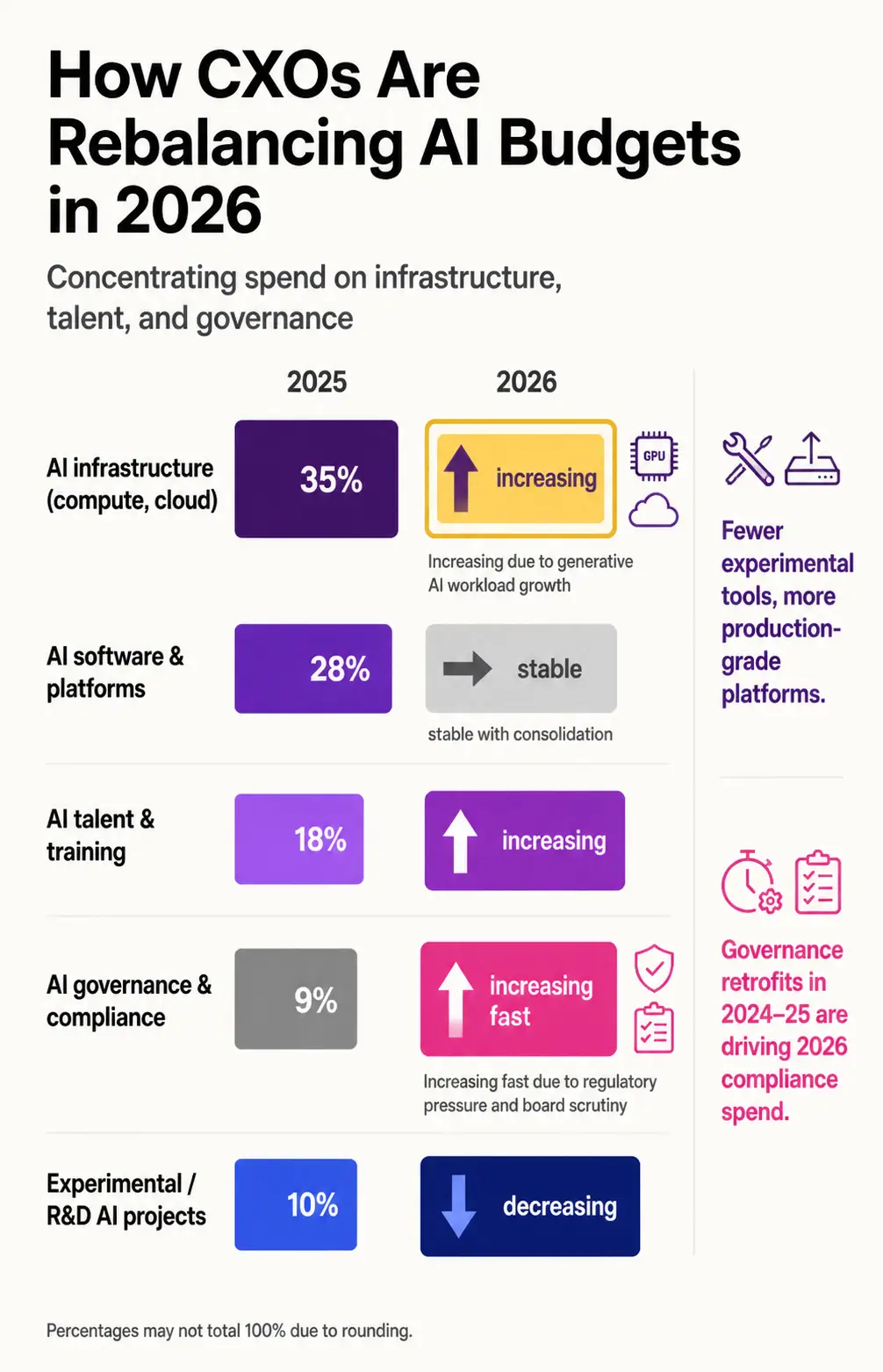
How CXOs Are Rebalancing AI Budgets in 2026
The governance and compliance line is the most notable mover. Organizations that under-invested in AI governance in 2024 and 2025 are now paying to retrofit controls they should have built from day one. That lesson is reshaping how new budgets get structured.
How Companies Scale AI Initiatives Successfully
Most enterprises have the budget and the ambition to scale AI. The gap is execution. Enterprise AI moves from pilots to production when leaders prioritize governance, cost discipline, and production-grade outcomes over broad experimentation. The organizations that do this well share a set of consistent practices.
What Makes AI Projects Successful in Enterprises:
- Define the business problem first, the AI solution second. Projects scoped around a specific operational pain point consistently outperform technology-first initiatives.
- Assign executive sponsorship before launch. AI programs without a named C-suite owner fail at disproportionately high rates.
- Build for AI scalability from day one. Architecture decisions made at the pilot stage often lock in constraints that make scaling expensive.
- Track AI operational efficiency continuously. Teams that monitor cost-per-task, latency, and model drift in production catch problems before they become costly failures.
- Establish a feedback loop between AI outputs and business metrics. The signal that an AI initiative is delivering value needs to reach decision-makers in a format they trust
How Business Leaders Evaluate AI Platforms in 2026
CXOs are applying tighter filters to AI platform selection in 2026. The days of adopting tools because they are new or impressive are over. Enterprise leaders want answers to five specific questions before committing budget.
- Does it integrate with our existing data and systems? Standalone AI tools that do not connect to core enterprise systems deliver limited value.
- What is the total cost of ownership over 3 years? License costs, compute costs, integration costs, and maintenance costs all need to be modeled.
- Can it scale to our production volume? AI scalability under real enterprise load is different from performance in a demo environment.
- How does it handle AI security and compliance requirements? Data residency, access controls, and audit trail capabilities are non-negotiable.
- Who internally owns this? Platform adoption without a clear internal owner fails. Full stop.
Conclusion: The Organizations That Get This Right Will Pull Ahead
The enterprises winning with AI in 2026 are not the ones with the largest AI budgets. They are the ones with the clearest strategy for where AI creates real business value and the governance discipline to run it responsibly at scale.
Your AI investment strategy does not need to cover every use case or every department. It needs to be specific, measurable, and connected to outcomes your board understands. Start with the two or three initiatives where AI demonstrably moves a business metric that matters. Build governance around them from day one. Measure relentlessly. Then scale what works.
Enterprise AI trends in 2026 make one thing clear: the gap between organizations that scale AI and those that stay stuck in pilots is not a technology gap. It is a decision-making and governance gap. CXOs who close that gap now will find their organizations operating with a structural advantage that compounds over time. The CXOs who close that gap now share one common starting point: they stopped treating AI investment strategy as a technology question and started treating it as a business leadership question.
That is exactly where Aptly Technology comes in. As a Microsoft Gold Certified Partner and a trusted AI infrastructure partner to Fortune 500 enterprises, Aptly gives CXOs a clear, structured path from AI ambition to measurable business performance. Our AI Infrastructure Readiness service helps enterprises modernize their IT stacks with GPU-optimized, scalable infrastructure built for real AI workloads, addressing the skill shortages and integration complexity that stall most AI programs before they generate returns.
For organizations already investing in AI but struggling to show results, Aptly’s AI Workload Deployment and Optimization service deploys, fine-tunes, and validates AI workloads across Azure, AWS, and hybrid environments, so your infrastructure spend translates directly into operational efficiency. With over 40 Microsoft service deployments delivered and deep ecosystem partnerships with NVIDIA, HPE, CoreWeave, and Nebius, Aptly gives your leadership team the technical depth and execution confidence to treat AI not as a cost center, but as a competitive asset.
FAQ: CXO AI Investment Strategy in 2026
- How are CXOs evaluating AI ROI today?
-
- CXOs measure AI ROI through business-level outcomes: cost reduction from automation, revenue attributed to AI-enabled products, and risk mitigation from AI-powered compliance tools. Technical benchmarks like accuracy scores matter to engineering teams. C-suite conversations center on operational efficiency gains, payback period, and impact on margin.
- What are the biggest enterprise AI challenges in 2026?
-
- 79% of organizations report AI adoption challenges this year. The top issues are: poor data quality that limits model performance, AI governance and compliance gaps that slow production deployment, shortage of skilled talent to build and maintain AI systems, and difficulty connecting AI outputs to measurable business outcomes.
- What do CIOs prioritize when investing in AI?
-
- CIOs prioritize AI infrastructure modernization, enterprise data strategy, and governance tooling above individual AI applications. Their job is to build the foundation that makes every AI initiative across the business work reliably at scale. That means investing in observability, integration architecture, and data quality before adding more AI tools.
- Which AI platforms are recommended for executive-level investment in 2026?
-
- Enterprise AI platform selection in 2026 centers on multi-model architectures that avoid vendor lock-in, cloud-native designs that scale with demand, built-in governance and compliance features, and integration depth with existing enterprise systems. The specific vendor matters less than whether the platform fits these criteria for your organization’s stack and regulatory environment.
- How do enterprises reduce AI operational costs?
-
- The most effective levers are: consolidating the AI tool portfolio to reduce licensing fragmentation, running workloads on right-sized compute instances rather than over-provisioning, implementing model distillation to deploy smaller models for high-frequency tasks, and using intelligent automation to reduce the human review burden on routine AI outputs.
Table of content
- TL; DR
- The AI Spending Paradox in 2026
- From Experimentation to Execution: The New AI Investment Mindset
- CXO AI Priorities: What Each Executive Actually Cares About
- How CIOs Measure AI ROI in 2026
- Generative AI Investment Trends for Large Enterprises
- AI Governance Challenges for Enterprise Leaders
- How CTOs Are Prioritizing AI Infrastructure Modernization
- AI Budget Allocation Trends Among CXOs
- How Companies Scale AI Initiatives Successfully
- How Business Leaders Evaluate AI Platforms in 2026
- Conclusion: The Organizations That Get This Right Will Pull Ahead
- FAQ: CXO AI Investment Strategy in 2026