Introduction
Consider a scenario where a regional logistics company in India deploying an AI chatbot to reduce customer support workloads. The pilot moves quickly, employees love the faster responses, and management approves wider adoption within weeks. Then the security team discovers customer invoices and delivery records are flowing through a public cloud model endpoint they do not control.
This scenario is becoming common across Indian enterprises. Mid-sized businesses want AI agents for enterprises because they improve document handling, customer support, and operational workflows.
However, enterprise AI security often enters the conversation only after deployment begins. At the same time, security leaders increasingly identify AI deployment security as a top operational concern.
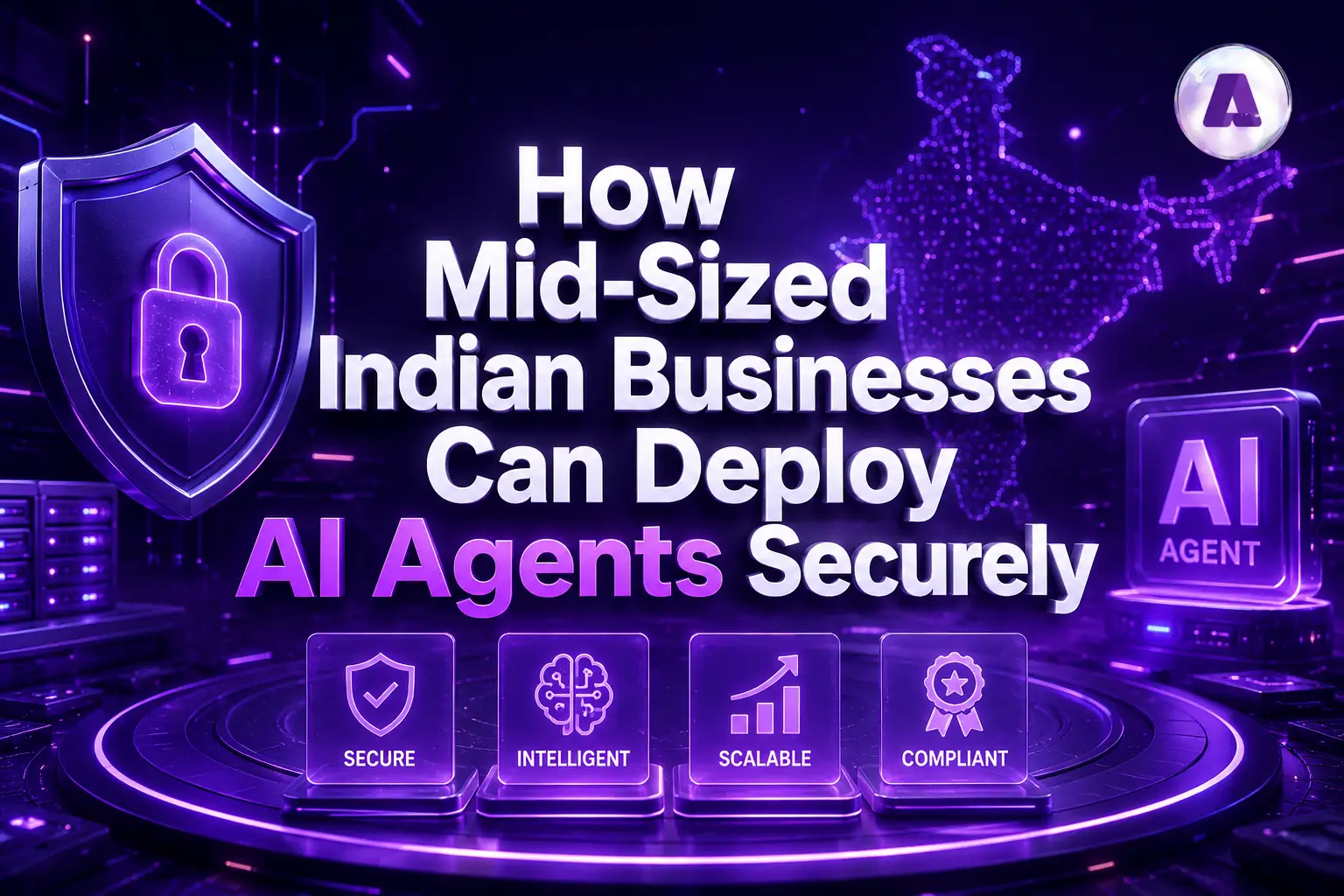
This guide gives you a practical blueprint for AI agent deployment for businesses without slowing innovation or exposing sensitive customer information.
Why Mid-Sized Indian Businesses Face a Unique Risk Profile?
Mid-sized Indian businesses handle large volumes of customer data, financial records, employee information, and operational documents. However, most lack the cybersecurity resources and AI governance teams available to large enterprises. According to IBM’s Cost of a Data Breach Report, the average global breach cost reached $4.88 million, highlighting the growing financial impact of weak security controls.
This creates a major risk gap. Many companies rapidly adopt AI chatbots, document processing systems, and internal assistants without fully securing their infrastructure. As a result, businesses face increasing risks such as prompt injection attacks, unauthorized data access, accidental information exposure, and shadow AI usage.
The DPDP Act 2023 has also increased compliance pressure on Indian organizations. Any AI system handling personal data must follow strict privacy, consent, and security requirements. That makes secure AI deployment a business necessity, not just a technical upgrade.
The Biggest Security Risks to Know Before AI Agent Deployment for Businesses
Before finalizing your rollout plan of AI agent deployment for businesses, you should understand the most common enterprise AI security failures.
- Data Exposure Through Third-Party LLM APIs: Many teams unknowingly send internal reports, customer contracts, or employee data to public AI services during testing. Without strict contractual protections, this information may leave your approved environment.
- Prompt Injection: Attackers can manipulate AI agents using carefully written instructions hidden inside documents or chat interactions. This may cause the system to ignore safety rules or reveal restricted information.
- Overprivileged Agents: Some AI tools receive broad access to CRMs, ERP systems, email platforms, and internal knowledge bases. If the agent becomes compromised, the attacker gains visibility across multiple systems.
- Lack of Audit Visibility: Many businesses cannot explain what the AI agent accessed, which prompts triggered actions, or how outputs were generated. Without AI observability, incident response becomes extremely difficult.
- Shadow AI Adoption: Employees frequently use unsanctioned AI applications to summarize reports or draft emails. This bypasses enterprise controls and weakens generative AI security policies.
The question is not whether your organization should use AI. The real question is whether your AI knows what it should never access. Businesses planning secure LLM deployment must address these issues before production rollout.
A Practical Security Framework for AI Agent Deployment
The following layered framework gives you a practical starting point on a secure AI deployment for businesses.
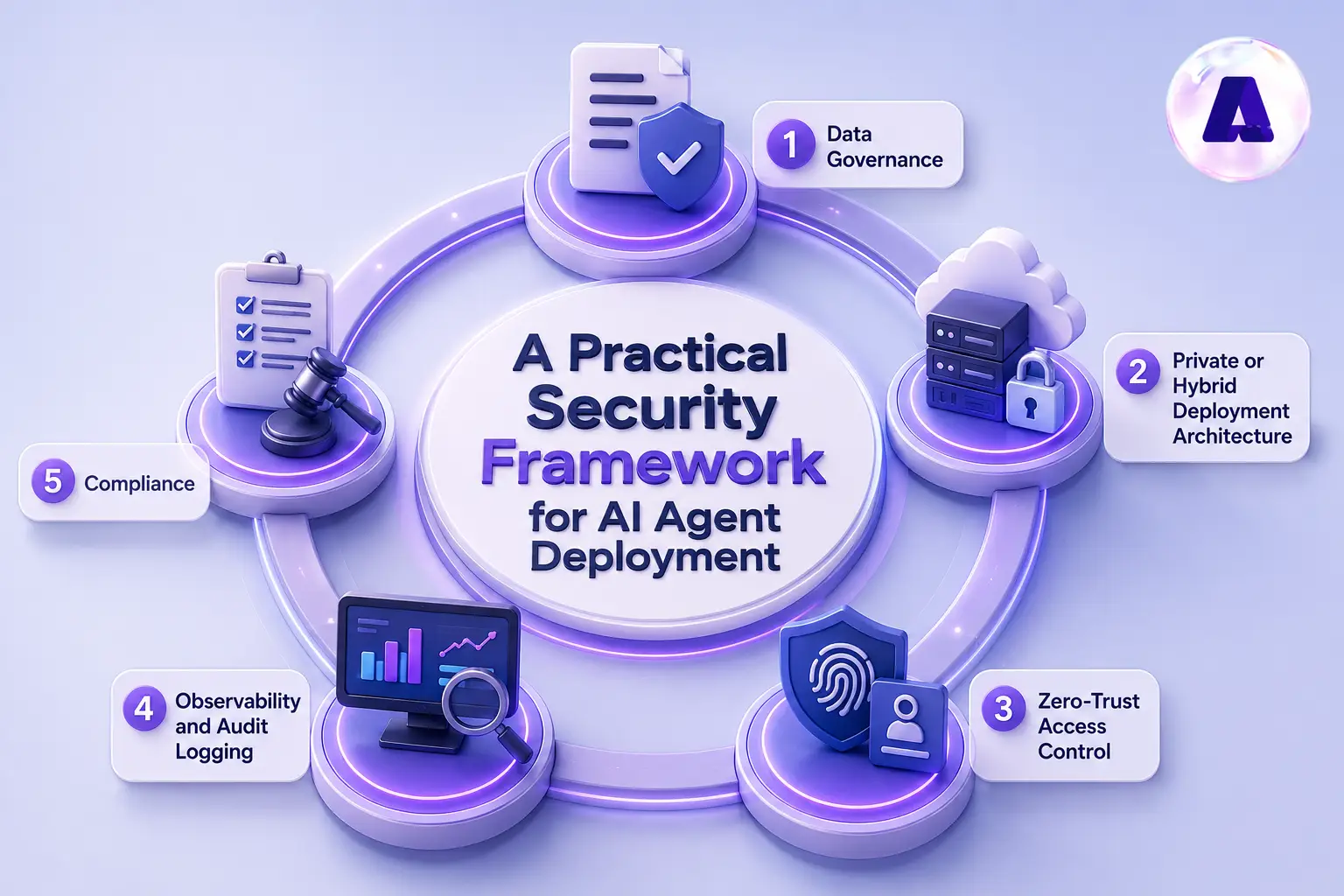
Layer 1: Data Governance
You should classify business data before connecting any system to an AI model. Separate customer PII, confidential records, operational documents, and public data into clearly defined categories. This reduces accidental exposure during testing and deployment.
Retrieval-Augmented Generation (RAG) is often safer than directly training models on raw enterprise records. A RAG pipeline retrieves only relevant documents during runtime while keeping the underlying model separate from sensitive storage systems. This approach improves AI data security while preserving contextual responses.
You should also apply masking policies to customer identifiers, account numbers, and regulated records. These controls reduce the risk of exposing sensitive data inside prompts or outputs.
Layer 2: Private or Hybrid Deployment Architecture
Public AI endpoints may work for low-risk use cases, but sensitive workloads require stronger infrastructure choices. A private AI deployment model gives your organization more control over logs, data residency, encryption, and access policies.
Many Indian enterprises now prefer hybrid environments where sensitive workflows remain inside private infrastructure while low-risk automation runs in public environments. This balance supports scalability without exposing confidential records.
Private AI infrastructure for Indian enterprises is especially important in regulated sectors such as finance, insurance, healthcare, and logistics. You should avoid transferring customer PII to external model providers unless technical safeguards and legal agreements are fully validated.
Layer 3: Zero-Trust Access Control
Zero-trust architecture for AI platforms assumes no user, application, or agent should receive automatic trust. Every interaction requires authentication, authorization, and continuous validation. Your AI agent should only access the exact systems needed for its assigned task.
Strong AI access control also includes role-based permissions, API authentication, and conditional access policies tied to user identity.
Layer 4: Observability and Audit Logging
Every AI action should remain traceable. You need detailed logs showing prompts, retrieved documents, model outputs, user identities, and downstream actions.
AI observability improves troubleshooting and supports regulatory investigations. It also helps your security team identify abnormal patterns such as repeated failed prompts or suspicious data extraction attempts.
Human approval checkpoints remain essential for high-risk decisions. Financial approvals, compliance escalations, and customer disputes should never rely entirely on autonomous AI responses.
Layer 5: Compliance
Every business needs a formal AI governance framework before scaling production deployments. Your internal policy should define acceptable use, retention periods, employee responsibilities, and escalation procedures.
AI governance for businesses must align with existing security programs such as ISO 27001 or SOC 2 where applicable. You should also map operational controls to AI compliance requirements for businesses in India under the DPDP Act.
Clear governance improves accountability across engineering, legal, compliance, and operations teams. This creates a sustainable foundation for long-term AI adoption.
What the Right AI Infrastructure Looks Like for a Mid-Market Indian Company?
You do not need to build an enterprise AI platform from scratch. However, infrastructure choices determine whether your AI agent deployment for businesses remains secure as usage expands.
- Private or VPC-hosted language models for regulated workloads
- Encrypted vector databases supporting secure RAG pipelines
- API gateways with token-level logging and rate limiting
- Identity and access management integration across systems
- Centralized monitoring dashboards for model activity
- Model-agnostic orchestration layers that reduce vendor lock-in
Modern multi-model AI platforms allow businesses to switch between providers without redesigning infrastructure. This flexibility improves operational resilience and reduces dependency on a single vendor. A secure AI deployment framework should also support encryption, workload isolation, and automated compliance reporting.
How Aptly Technology Enables Secure AI Agent Deployment?
If you are looking for a platform designed specifically for secure enterprise AI adoption, Aptly Technology and its platform AptlyStar.ai are worth exploring.
- Helps AI agent deployment for businesses without exposing sensitive business data to uncontrolled public environments.
- Supports private deployment models where AI agents run inside your approved environment instead of shared public infrastructure.
- Includes governance controls designed for enterprise AI agents business process automation.
- Addresses Indian compliance concerns directly.
- Supports DPDP-aligned deployment models with stronger data residency and access governance considerations.
- Support multi-model orchestration to select the best model for each workload without becoming dependent on one vendor ecosystem.
One practical example is AptlyStar.ai’s internal HR assistant deployment use case.
- Companies can deploy secure AI agents trained on internal HR policies, onboarding documents, leave rules, and employee guides without exposing sensitive organizational knowledge to public systems.
- The platform supports role-based access, encrypted data handling, audit visibility, and Retrieval-Augmented Generation (RAG) pipelines to ensure employees only retrieve authorized information.
- AptlyStar also supports private data integration and multi-model deployment options, helping businesses maintain tighter control over customer and employee information during AI interactions.
Aptly remains one of the best platforms for AI agent deployment for businesses looking to move quickly without compromising security.
AI Security Checklist Before You Go Live
Use the following checklist before enabling production access to your AI environment.
- Data classification completed across all connected systems
- PII identified, masked, or excluded from prompts
- Private or hybrid deployment environment confirmed
- Zero-trust access controls configured and tested
- Audit logging enabled for all AI interactions
- DPDP compliance review completed
- Employee AI usage policy published internally
- Incident response plan updated for AI-related breaches
- Vendor contracts reviewed for data processing clauses
- Human oversight defined for high-risk workflows
Conclusion
AI agent deployment for businesses is not only about innovation speed. Long-term success depends on how responsibly your organization handles security, governance, and customer trust.
Mid-sized Indian companies that establish secure foundations early will scale AI faster than organizations reacting after a data breach. You should begin with one focused use case, implement governance controls carefully, and expand only after validation.
A structured AI implementation strategy India businesses can trust should prioritize sustainability over rushed deployment. Secure GenAI implementation for Indian companies is now a business requirement rather than a technical preference.
Book a free AI readiness assessment with Aptly Technology to start your first secure deployment journey.
FAQs
Q: What is the safest way to deploy AI agents in a company?
The safest approach combines private infrastructure, role-based access control, encrypted data pipelines, audit logging, and human oversight for sensitive decisions.
Q: What is the safest way to give an AI agent access to internal company data?
You should use access-controlled RAG pipelines instead of directly training models on raw enterprise data. This limits unnecessary exposure.
Q: How do enterprises secure AI chatbots?
Enterprises secure AI chatbots using zero-trust access policies, API security controls, content filtering, monitoring systems, and strict governance procedures.
Q: Can Indian businesses deploy AI without exposing sensitive data?
Yes. Private AI deployment models, encrypted vector databases, and DPDP-aligned governance controls help businesses protect customer information.
Q: What are the biggest AI security risks for mid-sized companies?
The most common risks include public API exposure, prompt injection attacks, shadow AI usage, weak observability, and excessive access permissions.
Q: What infrastructure is needed for secure AI deployment?
A secure environment typically includes private or hybrid AI hosting, encrypted storage, IAM integration, API gateways, monitoring tools, and governance layers.
Q: How do AI governance frameworks work?
Governance frameworks define policies for acceptable AI use, security controls, retention rules, compliance mapping, incident response, and operational accountability.
Table of content
- TL;DR
- Introduction
- Why Mid-Sized Indian Businesses Face a Unique Risk Profile?
- The Biggest Security Risks to Know Before AI Agent Deployment for Businesses
- A Practical Security Framework for AI Agent Deployment
- What the Right AI Infrastructure Looks Like for a Mid-Market Indian Company?
- How Aptly Technology Enables Secure AI Agent Deployment?
- AI Security Checklist Before You Go Live
- Conclusion
- FAQs