AI Data Center Operations Challenges: Why 2026 Is the Turning Point
Your GPUs are not the bottleneck anymore. Power is. And, it is cooling those GPUs. So is the team keeping the lights on at 3 a.m. AI data center operations challenges have quietly replaced chip supply as the constraint deciding who ships AI products on schedule and who slips a quarter. Gartner expects data center systems spending to climb 56% in 2026, the fastest-growing segment in enterprise technology.
This money buys racks and accelerators fast. It does not buy the operational maturity to run them at scale. Aptly Technology has built and supported hyperscale GPU environments for Microsoft since day one, and the pattern holds across almost every enterprise deployment: the build rarely fails. The operations behind it do.
What Is Driving AI Data Center Operations Challenges in 2026?
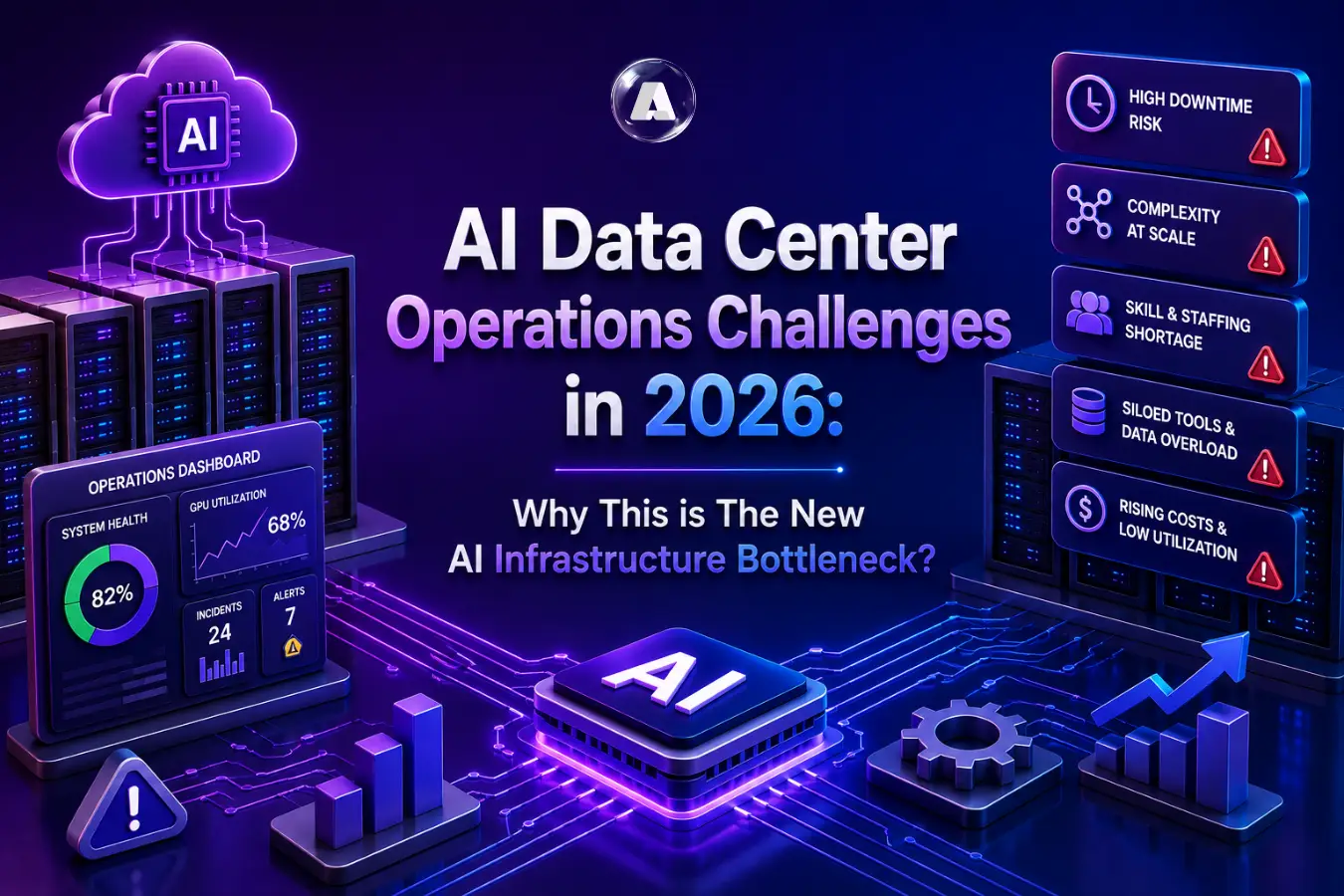
AI infrastructure bottlenecks in 2026
Three forces are converging at once, and money is not the constraint anymore. Execution is.
- AI infrastructure spending is at an all-time high. Gartner projects data center systems spending will grow 56% in 2026, the fastest-growing segment in enterprise technology. Total data center spending is on pace to surpass $650 billion this year, with server spending up almost 37% year over year. Worldwide IT spending is set to reach $6.15 trillion, up nearly 11% from 2025.
- The physical plant was not built for GPU density. Facilities designed years ago do not support today’s rack power and cooling loads without a redesign.
- Operations teams are stretched thinner every quarter, covering more infrastructure with the same headcount.
- Power demand is climbing fast. Global data center electricity consumption is set to grow 26% in 2026 alone, reaching roughly 565 terawatt hours, with AI-optimized servers responsible for 31% of that draw.
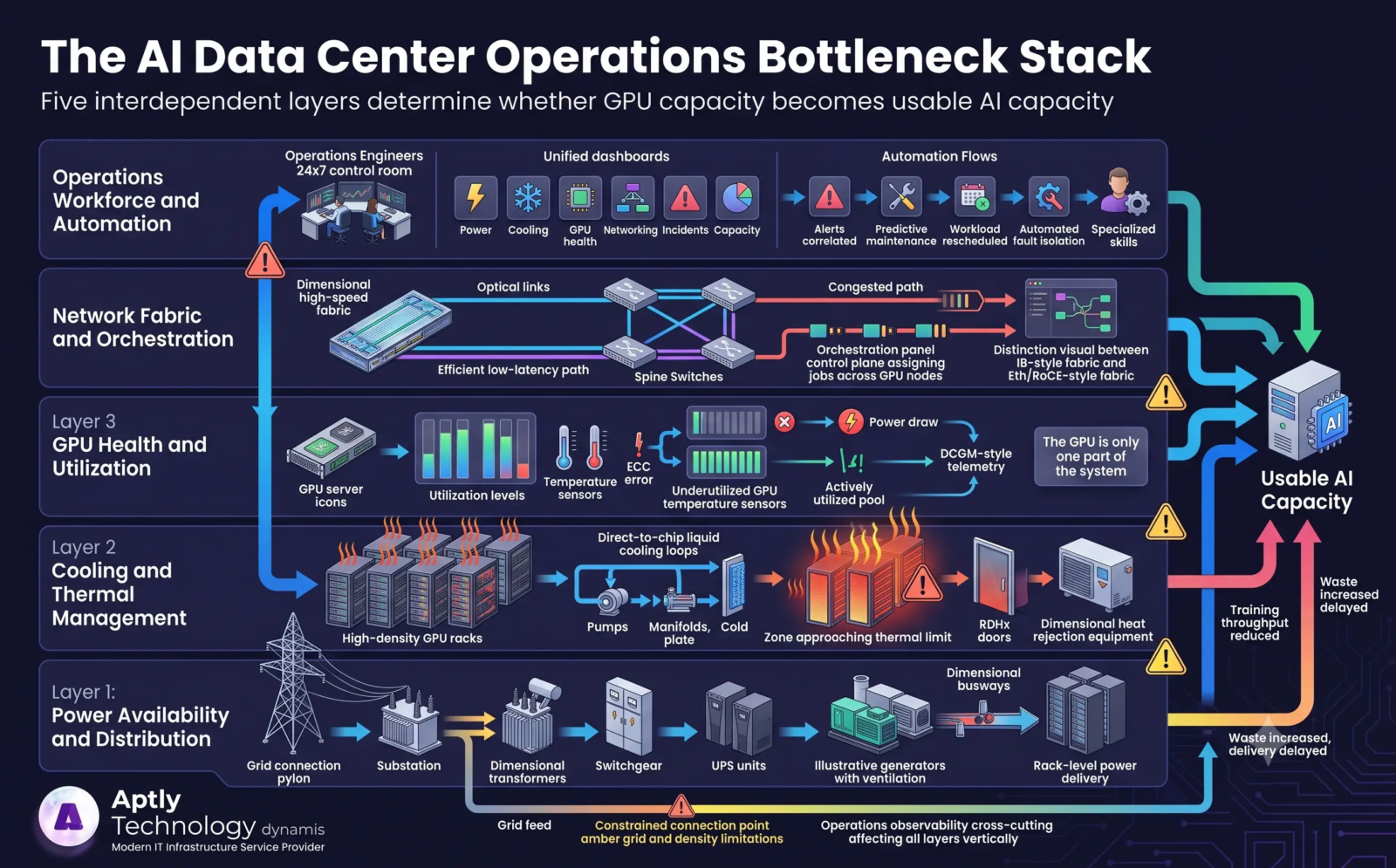
- A GPU rack needs four things at once to run: power delivered at the right density, cooling keeping pace with thermal load, a network fabric holding up under distributed training traffic, and a team ready to diagnose a failing node before it takes down a multi-week training run.
- Spending alone does not close the operational gap. This is the AI infrastructure scaling problem underneath the numbers, and it captures the real challenges scaling AI infrastructure in 2026 better than any budget line.
This is exactly where AI data center operations challenges live in 2026. Buying capacity used to be the hard part. Running it reliably, at density, under continuous AI workloads, is now the harder one. For a fuller breakdown of where those bottlenecks tend to surface first, see Aptly’s guide to AI infrastructure bottlenecks.
Power and Cooling: The Physical Limits Behind AI Data Center Operations Challenges
Power and cooling sit at the center of most AI data center operations challenges in 2026, because AI racks draw far more energy per square foot than the facilities most operators built five years ago.
Deloitte now estimates data center power demand will jump from 47 gigawatts in 2025 to more than 176 gigawatts by 2035, a trajectory steep enough to make power availability, not chip supply, the deciding factor in where new AI capacity gets built. Grid interconnection queues in major U.S. markets already stretch three to four years, longer than construction itself takes.
Enterprises planning a build today are effectively planning around a power timeline set years in advance, not a compute timeline set by quarterly budgets. These data center power constraints and data center cooling challenges define high-density computing in 2026, and high-density GPU racks need thermal management most legacy facilities were never built to deliver.
Rack density tells the same story from a different angle. Average density climbed from about 16 kW in 2025 to 27 kW in 2026, a 69% jump in twelve months, while NVIDIA’s Blackwell and Vera Rubin platforms push individual racks toward 130 kW and, in some configurations, past 246 kW. Air cooling served the industry for four decades, but it has no answer for this kind of density. Liquid cooling has moved from an experimental option to the default for AI-centric deployments, and Microsoft has already deployed hundreds of thousands of liquid-cooled Grace Blackwell GPUs across its global datacenter footprint, with next-generation Vera Rubin NVL72 systems rolling into the same liquid-cooled facilities.
The operational risk is not choosing liquid over air. It is retrofitting after the fact. Redesigning power distribution and cooling zones after GPUs are already racked costs far more than planning for 40 kW-plus densities from day one, and it stalls the AI training infrastructure timelines enterprises are under pressure to hit.
Aptly’s GPU Datacenter Buildout and Support service validates power distribution, power monitoring, PUE targets, and cooling zoning against the AI workload roadmap before a single rack goes in, which is where most of these AI data center operations challenges get solved or get expensive.
Why Is GPU Utilization the Biggest Blind Spot in AI Infrastructure Operations?
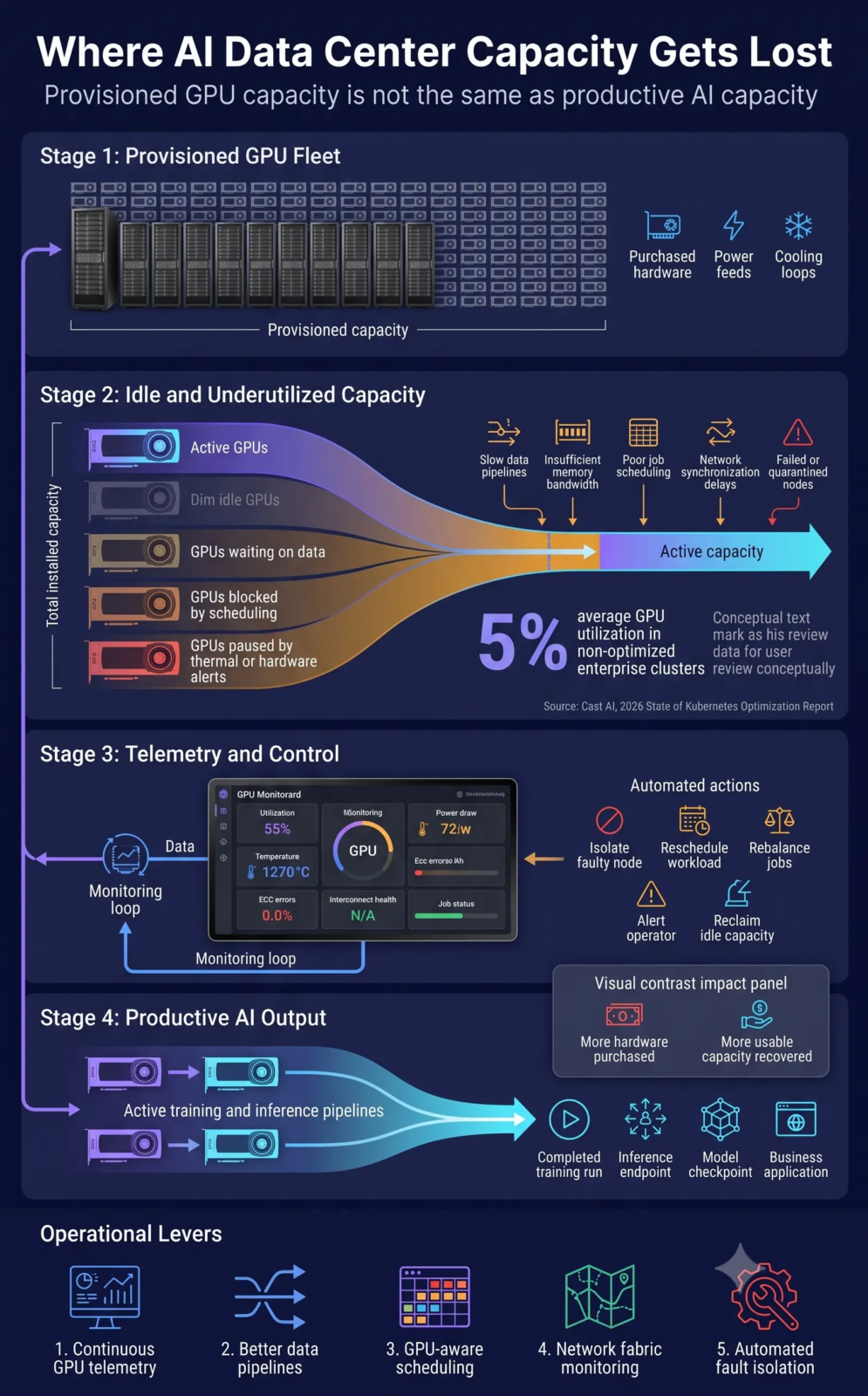
GPU utilization signals how well AI training infrastructure and AI inference infrastructure are running in practice. Most enterprises are not short on GPUs. They are short on GPU utilization, and this gap ranks among the most expensive AI data center operations challenges in 2026.
AI Infrastructure Challenges
Cast AI’s 2026 State of Kubernetes Optimization Report analyzed roughly 23,000 clusters across AWS, Azure, and Google Cloud and found average GPU utilization across non-optimized enterprise GPU clusters sitting at 5%. This means 95% of provisioned GPU capacity does nothing at any given moment, at a time when Gartner expects AI infrastructure spending to add $401 billion in new spend this year.
Other researchers put the number higher but still low: Kubernetes-based AI clusters commonly run at 15% to 25% utilization, according to infrastructure specialists cited by Data Center Knowledge, with idle GPU pools waiting on data pipelines, memory bandwidth, or scheduling rather than a lack of demand.
GPU health monitoring is the operational fix for GPU infrastructure operations, and it works. NVIDIA’s own engineering teams used internal telemetry tools, including its Data Center GPU Manager platform, to cut GPU waste from 5.5% down to 1% across large HPC fleets, a change freeing up meaningful GPU capacity without buying a single additional chip. DCGM-class tools handle GPU utilization monitoring and GPU interconnect monitoring alongside thermal thresholds, ECC error rates, and power draw, all in real time, which turns a GPU fleet from a black box into something a team manages, not guesses at.
This is where GPU cluster management stops being a nice-to-have and becomes core to AI infrastructure operations. A single undetected GPU fault during distributed training cascades into hours or days of lost compute as checkpoints restore and jobs restart.
Aptly builds continuous GPU telemetry, thermal monitoring, and automated fault detection into every GPU Datacenter Buildout and Support engagement, running clusters mixing NVIDIA H100, Blackwell, and AMD accelerators as one managed fleet rather than isolated boxes.
Networking and Orchestration: The Silent AI Infrastructure Bottlenecks
The network fabric, not the GPU itself, decides how much of your compute budget turns into finished training runs, which makes networking one of the least visible AI data center operations challenges on this list.
As distributed AI training workloads scale to hundreds or thousands of GPUs, data center networking becomes the dominant variable in training efficiency. Large-scale H100 and Blackwell clusters spend 15% to 30% of their cycles waiting on the network during large all-reduce operations, and a poorly configured fabric silently turns a $500,000 training run into a $600,000 one without touching a line of model code. InfiniBand remains the standard for high-speed networking with the lowest latency and most consistent throughput, though RoCE-based Ethernet fabrics are closing the gap for teams optimizing cost across large fleets.
Workload orchestration compounds the problem when it is not built for accelerated compute, and it is one of the clearest tests of AI infrastructure management maturity in 2026. Gartner predicts a real shift here for 2026: AI agents will take on more of the planning, execution, and continuous optimization once handled by infrastructure engineers, moving the infrastructure and operations role from doing the work to supervising the systems doing it.
Microsoft, working with OpenAI and NVIDIA, published research on power stabilization for AI training datacenters showing full-stack innovation across rack hardware, firmware, and predictive telemetry cuts power overshoot by 40%, smoothing exactly the kind of spikes engineers used to handle manually around the clock.
Infrastructure automation and infrastructure observability are converging into a single discipline in 2026, the backbone of operational resilience against growing operational complexity, and enterprises treating networking as a fixed cost rather than an operational variable are the ones absorbing the biggest AI infrastructure bottlenecks. Getting fabric topology and workload orchestration right at design time, not after a training run stalls, is where Aptly’s data center architects spend most of their validation work today.
The Workforce Gap Behind AI Data Center Operations Challenges
You buy every GPU, megawatt, and cooling loop you need and still miss your AI infrastructure timeline, because the people who operate all of it are in short supply.
The Planet Group’s 2026 data center hiring research finds 91% of employers cite talent availability, specialized skills, or compensation pressure as the primary source of hiring delays. The gap concentrates hardest in junior and mid-level operations roles, exactly the positions responsible for day-to-day GPU cluster management, thermal monitoring, and incident response. Deloitte reports 63% of data center executives name a shortage of skilled labor as their single greatest obstacle, and separate industry training programs are scrambling to build pipelines faster than universities and trade schools produce graduates.
This is not a hiring problem you solve with a bigger recruiting budget alone. AI-ready facilities need staff who understand GPU scheduling, liquid cooling systems, high-density power distribution, and InfiniBand fabrics at the same time, and this combination of skills barely existed as a job description three years ago. Every quarter an operations seat sits open is a quarter of degraded infrastructure reliability, slower incident response, and higher risk of the outages Uptime Institute tracks every year.
Aptly’s answer is 24×7 white-glove Global Operations Centers across North America, Europe, and Asia, staffed by teams who already run GPU Datacenter Buildout and Support at hyperscale for Microsoft. This model gives enterprises the specialized bench they cannot hire fast enough on their own, without adding headcount risk to their own balance sheet.
Physical Security and Cyber Risk: The AI Data Center Operations Challenge Few Are Ready For
Security is becoming as urgent an AI data center operations challenge as power or cooling, and most operators are not ready for it:
- Human threats now top the list. More than half of data center professionals cited human threats, internal or external, as the biggest security risk to their infrastructure in a 2026 AFCOM survey, and insider activity alone accounts for 55% of security incidents at data center facilities.
- Physical security risk jumped fast. 57% of data center leaders named physical security a top organizational risk in 2025, a 17-point increase year over year, as new AI sites pack hundreds of millions of dollars in accelerator hardware into a single building.
- Supply chain exposure is widening. Threat actors increasingly target the vendors and contractors who build and service GPU Datacenter facilities, since one compromised component creates persistent access long after a project closes out.
- Breach costs keep climbing. IBM puts the global average cost of a data breach at $4.4 million in 2025, rising to $10.22 million in the United States, numbers turning security into an operations line item, not only an IT one.
- New physical threats are emerging. Unauthorized drone activity over sensitive facilities is now a documented pattern, with the U.S. military detecting 350 unauthorized drone incidents across more than 100 installations in the past year.
Security now sits alongside power, cooling, and staffing as another discipline mature operators plan for on day one instead of bolting on after a breach. Aptly builds data center security controls, physical and cyber, into every GPU Datacenter Buildout and Support engagement from the start.
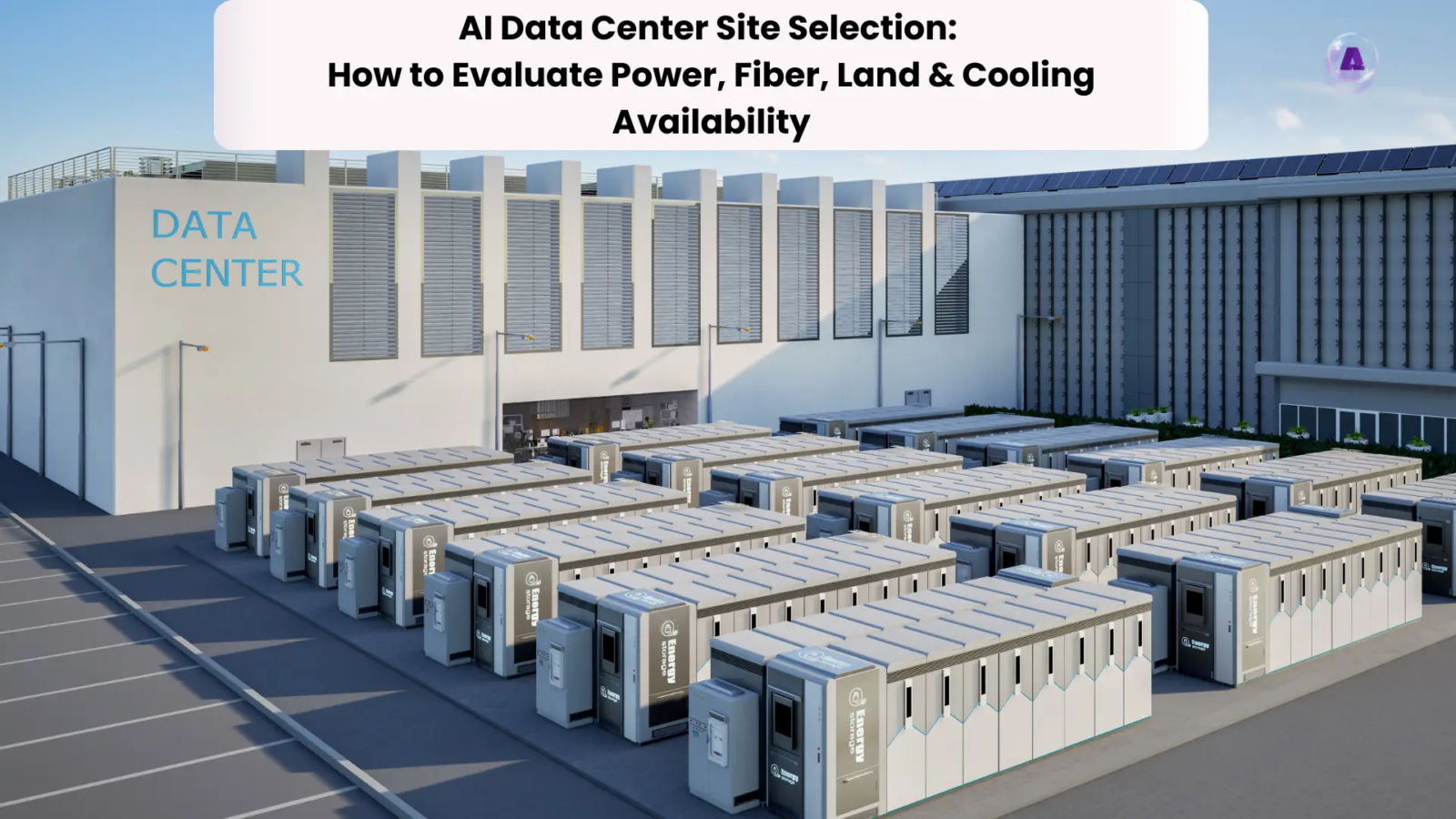
Site Selection, Water and Sustainability: A Fast-Growing AI Data Center Operations Challenge
Where you build now matters as much as how you build, and water has become one of the least discussed AI data center operations challenges in 2026.
- Community opposition is stalling projects at scale. At least 75 AI data center projects worth $130 billion were disrupted by local opposition in the first quarter of 2026 alone, according to Data Center Watch, and county-level moratoriums are becoming common.
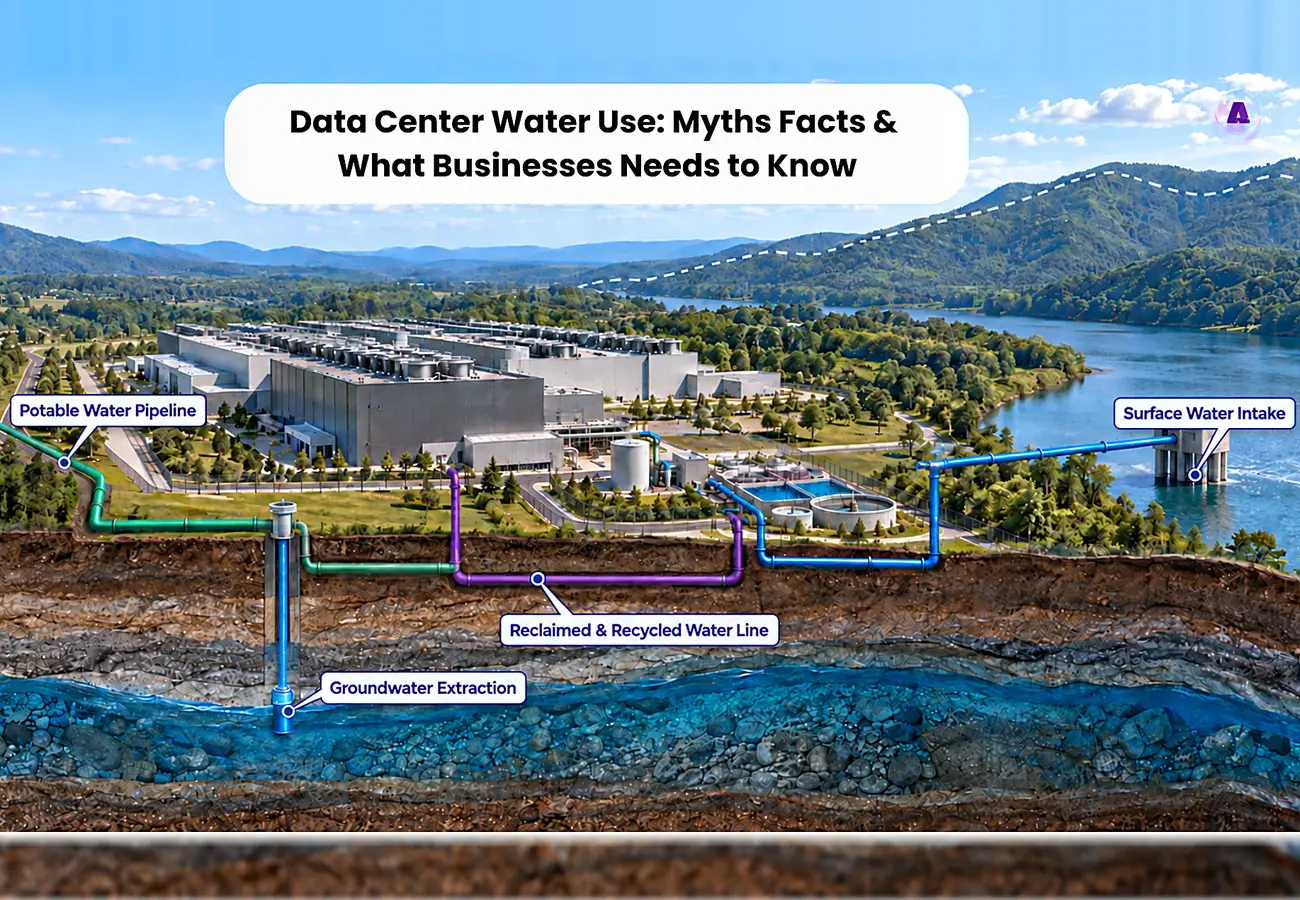
- Water is now a limiting resource, not an afterthought. US data centers directly consume 17 to 19 billion gallons of water a year, a figure projected to climb to 60 to 110 billion gallons by 2030.
- Permitting timelines now rival grid interconnection queues. Water rights reviews, groundwater management plans, and endangered species assessments often take as long to clear as the multi-year wait for grid power, delaying a site long before the first rack ships.
- Sustainability reporting is now a board-level expectation. Gartner expects 75% of organizations to have a data center infrastructure sustainability program in place by 2027, driven by cost pressure and stakeholder scrutiny as much as regulation.
- Transparency gaps make the problem worse. Most operators do not publish facility-level water and power trade-offs, and this gap fuels local resistance and slows permitting further in already-contested markets.
Site selection now carries the same planning weight as power and cooling. Aptly’s data center buildout checklist treats water rights, permitting timelines, and sustainability reporting as day-one buildout criteria, not a late-stage compliance exercise.
What Mature Organizations Do Differently to Solve AI Data Center Operations Challenges
AI infrastructure operations readiness checklist for 2026
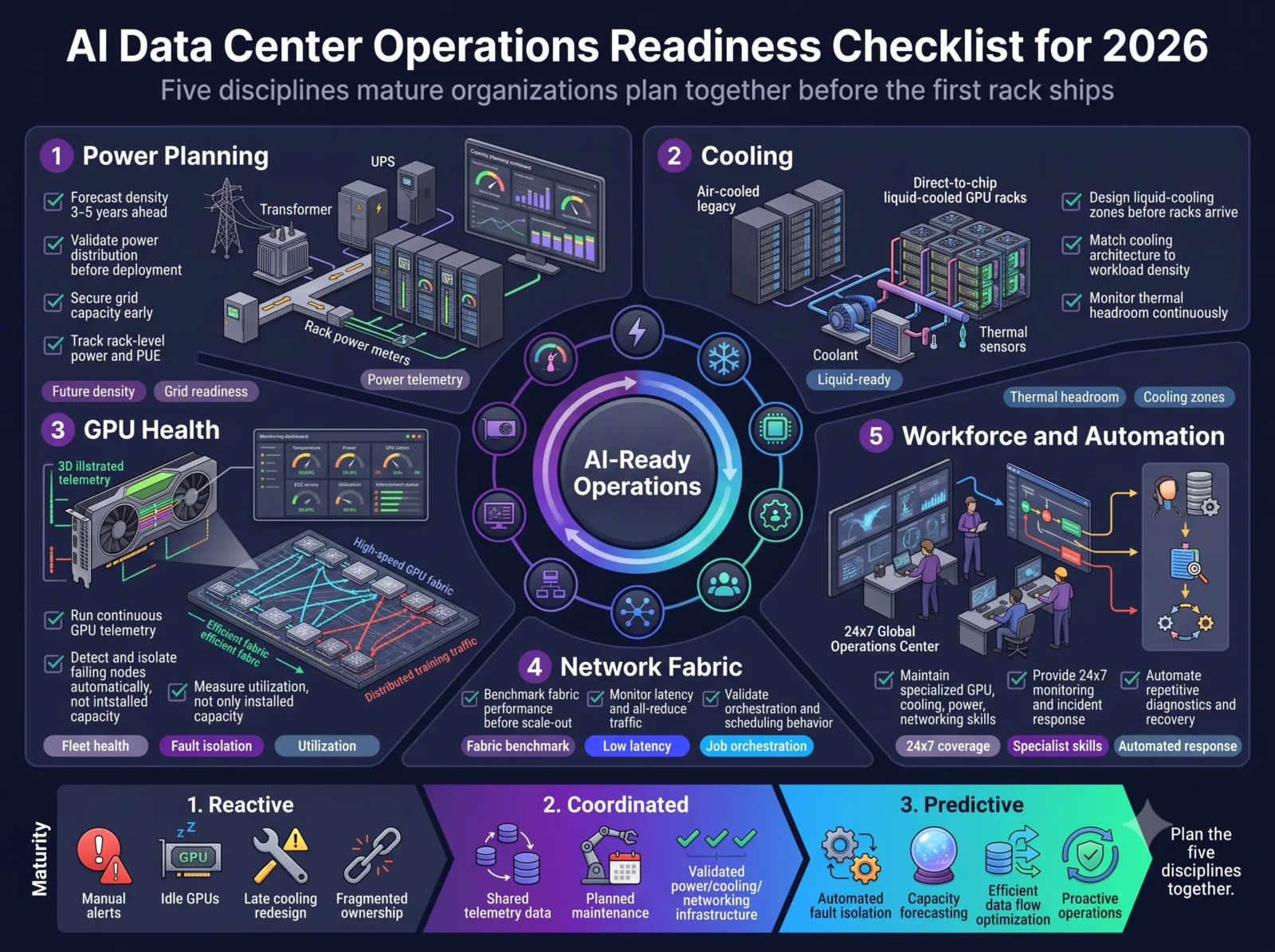
Mature organizations do not treat power, cooling, GPU health, networking, and staffing as five separate problems. They plan all five together, before the first rack ships, and this single habit explains most of the gap between operators who scale smoothly and operators who spend 2026 firefighting. Solving AI data center operations challenges together, rather than one at a time, is the single biggest lever available to an infrastructure team this year.
| Operational Area | Mature Practice | Common Pitfall | Aptly’s Role |
|---|---|---|---|
| Power Planning | Model rack density 3-5 years out and secure grid capacity early | Design for today’s kW and get stranded within 18 months | Validates power distribution and PUE targets during design |
| Cooling | Deploy liquid cooling ahead of density growth | Wait until air cooling fails above 30-40 kW | Plans liquid and air cooling zones before racks arrive |
| GPU Health | Run continuous DCGM-class telemetry with automated fault isolation | React to failures only after a training run dies | Operates 24×7 GPU cluster monitoring across GPU fleets |
| Networking | Benchmark InfiniBand or RoCE fabric before scaling past a handful of nodes | Discover fabric bottlenecks after committing to a topology | Validates network and fabric topology during buildout |
| Workforce | Build an internal and partner bench ahead of headcount gaps | Discover the skills gap mid-incident | Covers gaps through 24×7 Global Operations Centers |
Uptime Institute’s 2026 outage research backs this up directly. Outage rates per site are still declining, but the pace of improvement has slowed, and external infrastructure failures, fiber cuts, connectivity loss, and grid instability now make up a growing share of publicly reported incidents. Roughly one in ten operators say their last outage carried a serious or severe impact. The operators closing this gap are investing in automation and control systems rather than adding headcount to watch dashboards manually.
Hyperscalers show what advance planning looks like at full scale. Microsoft’s own engineering teams describe years of upgrade cycles at its Fairwater sites built before NVIDIA’s newest Rubin platform ever shipped, so power, cooling, and networking were ready the moment the hardware arrived instead of triggering a redesign. Enterprise GPU Datacenter operations rarely run at this scale, but the planning discipline behind it transfers directly.
Aptly is the only supplier trusted by Microsoft to build and support third-party hyperscale datacenters worldwide, certified to ISO/IEC 42001:2023, with direct NVIDIA and Supermicro partnerships and up to 99.9% uptime SLAs across its managed fleets. This combination of buildout expertise and round-the-clock operations is what turns AI data center operations challenges from a recurring fire drill into a managed, predictable part of running AI at scale.
Solving AI Data Center Operations Challenges Before They Cost You a Quarter
AI data center operations challenges are not going away in 2026. They are becoming the defining constraint on who scales AI successfully and who does not.
What you now know:
- Power and cooling decide site selection and buildout timelines years before the first GPU arrives.
- GPU utilization, not GPU count, is the metric deciding whether your AI infrastructure spend pays off.
- Networking and orchestration failures are silent until a training run stalls or a budget doubles.
- The workforce gap is now as tight a constraint as power or silicon.
- Mature organizations plan power, cooling, GPU health, networking, and staffing together, not in sequence.
Aptly built its reputation on AI data center infrastructure and AI-ready data center operations working under continuous load, and it remains the only supplier trusted by Microsoft to build and support third-party hyperscale datacenters worldwide, with direct NVIDIA and Supermicro partnerships, ISO/IEC 42001:2023 certification, and 24×7 white-glove Global Operations Centers spanning North America, Europe, and Asia. Enterprises partnering with Aptly get the operational depth to treat power, cooling, GPU health, networking, and staffing as one coordinated system instead of five separate fire drills. Contact Aptly to talk through your AI data center operations challenges before they show up in next quarter’s budget.
Frequently Asked Questions:
- What are the biggest bottlenecks in AI infrastructure?
- The biggest AI infrastructure bottlenecks in 2026 are power availability, cooling capacity at high rack density, GPU utilization, network fabric throughput, and the operations workforce needed to run all five at once. Power and staffing now cause more delays than chip supply.
- Why is AI infrastructure becoming difficult to scale?
- AI infrastructure is becoming difficult to scale because demand is growing faster than the physical systems and skilled teams needed to support it. Rack density, grid interconnection timelines, and the data center workforce shortage all move slower than compute demand, which is what turns AI data center operations challenges into a scaling constraint.
- What are the biggest AI infrastructure challenges in 2026?
- The biggest AI infrastructure challenges in 2026 combine physical limits, power, cooling, and networking, with operational ones: low GPU utilization, thin operations staffing, and outage risk from growing system complexity. Enterprises planning for all of these together scale faster than those solving them one at a time.
- Why are AI data center operations becoming a bottleneck?
- AI data center operations are becoming a bottleneck because infrastructure spending has outpaced the operational maturity needed to run it. Enterprises buy GPUs and racks quickly, but power delivery, cooling design, GPU health monitoring, and skilled staffing all take longer to build than a purchase order.
- How can enterprises overcome AI infrastructure bottlenecks?
- Enterprises overcome AI infrastructure bottlenecks by planning power, cooling, GPU health monitoring, network fabric, and staffing together during design, not after deployment. Continuous GPU telemetry and 24×7 operations support close most of the gap between provisioned capacity and usable capacity.
- What role does Aptly play in solving AI data center operations challenges?
- Aptly is the only supplier trusted by Microsoft to build and support third-party hyperscale datacenters worldwide, and it applies this same operational depth to enterprise AI infrastructure. Through GPU Datacenter Buildout and Support, AI Infrastructure Managed Services, and 24×7 Global Operations Centers, Aptly helps enterprises solve AI data center operations challenges across power, cooling, GPU health, networking, and staffing as one coordinated program instead of five separate problems.
Table of content
- TL; DR
- AI Data Center Operations Challenges: Why 2026 Is the Turning Point
- What Is Driving AI Data Center Operations Challenges in 2026?
- Power and Cooling: The Physical Limits Behind AI Data Center Operations Challenges
- Why Is GPU Utilization the Biggest Blind Spot in AI Infrastructure Operations?
- Networking and Orchestration: The Silent AI Infrastructure Bottlenecks
- The Workforce Gap Behind AI Data Center Operations Challenges
- Physical Security and Cyber Risk: The AI Data Center Operations Challenge Few Are Ready For
- Site Selection, Water and Sustainability: A Fast-Growing AI Data Center Operations Challenge
- What Mature Organizations Do Differently to Solve AI Data Center Operations Challenges
- Solving AI Data Center Operations Challenges Before They Cost You a Quarter
- Frequently Asked Questions: