Introduction: Data center water use needs measurement, not headlines
Data center water use has become a board-level infrastructure question as AI places more compute, power, and heat into each site. Water availability affects cooling design, permitting, operating cost, community acceptance, and expansion schedules. The mistake is assuming every facility follows one water ratio.
Precision matters. Berkeley Lab estimated direct U.S. data center water use at about 66 billion liters in 2023, roughly 48 million gallons per day across the national fleet. The report also estimated nearly 800 billion liters of indirect water consumption tied to electricity generation. Berkeley Lab’s national analysis separates those footprints because facility cooling and power generation affect different water systems.
For enterprises, the useful question is where, when, how, and from which source water is used. Data center water use belongs beside rack density, thermal design, Power Usage Effectiveness (PUE), watershed stress, workload efficiency, and business continuity.
How much water does a data center use per day? Data center water usage depends on design
How much water does a data center use? No universal daily figure is defensible. IT load, cooling architecture, climate, WUE, water source, utilization, and electricity source change the answer. Berkeley Lab found more than a 10,000-fold spread in workload-level water use across various modeled conditions. The 2025 workload-level review shows why single-number estimates fail.
A transparent estimate starts with IT energy and site WUE. Using 0.36 L/kWh, close to Berkeley Lab’s modeled U.S. fleet average around 2023, a 10 MW IT load running for full 24 hours implies about 86,400 liters, or 22,800 gallons of water, per day. A 100 MW load implies about 864,000 liters, or 228,000 gallons. These are arithmetic examples, not typical-facility benchmarks. Data center water use changes with weather and cooling mode.
The question how much water a data center use per day needs assumptions. Dry cooling might use little cooling water on a mild day, while cooling towers consume more during hot periods. Annual averages also hide peak-day demand, which often matters most to utilities.
AI data center water usage: Do AI data centers use more water than traditional data centers?
AI data center water usage starts with heat density. NVIDIA documents about 120 kW of rack power for a DGX GB200 NVL72 and liquid cooling manifolds within the rack-scale system. NVIDIA’s rack documentation shows why rack density / high-density racks need different thermal designs.
Do AI data centers use more water than regular data centers? Not automatically. AI raises thermal density, but water demand follows the cooling architecture. A GPU cluster using direct-to-chip liquid cooling with dry heat rejection might use less onsite water than a lower-density facility using evaporative cooling. Data center water use is not determined by the AI label alone.
The question does AI use a lot of water also depends on electricity. Berkeley Lab estimated nearly 800 billion liters of indirect water consumption from electricity serving U.S. data centers in 2023. Data center water use tied to AI workloads should separate facility consumption from electricity-related consumption.
Does AI/ChatGPT really use a lot of water? A 2023 academic study modeled roughly 500 mL for 20 to 50 questions and answers under specific energy, PUE, grid-water, and onsite-WUE assumptions. The paper notes strong variation by time and location. Treat the result as a scenario estimate, not a universal per-prompt fact.
Water withdrawal vs. water consumption: Define the data center water footprint correctly
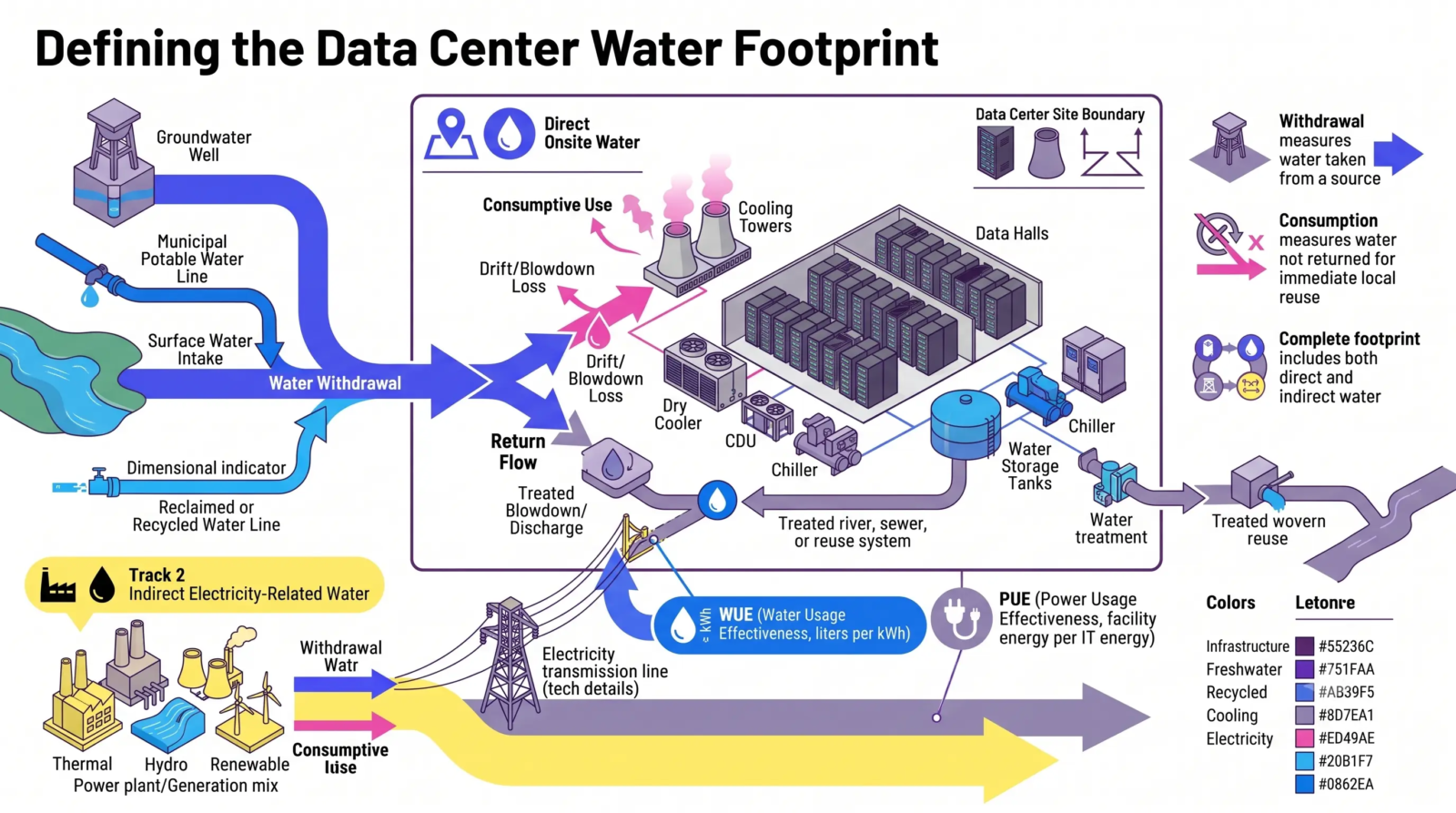
Water withdrawal vs. water consumption is a core distinction. The U.S. Geological Survey defines withdrawal as water removed from a groundwater or surface-water source. Consumptive use is the share no longer available for immediate local use after evaporation or other loss. USGS water-use terminology provides the reference definitions.
data center water consumption
For data center water use, cooling towers show the difference. Makeup water is withdrawn. Evaporation becomes consumption. Blowdown might later return through treatment. Withdrawal alone overstates permanent loss, while consumption alone hides utility capacity and treatment demand.
A complete data center water footprint separates direct onsite water from indirect electricity-related water. Some commentary loosely borrows Scope 1 and Scope 2 language, but those labels come from greenhouse-gas accounting. Direct and indirect water are clearer. Data center water use should also state whether hardware manufacturing sits inside the boundary.
Water usage effectiveness vs power usage effectiveness: What WUE and PUE reveal
What is data center water usage effectiveness (WUE)? Water usage effectiveness (WUE) is annual site water use divided by IT equipment energy, usually in liters per kWh. The Green Grid (WUE originator) introduced the metric in 2011 as a companion to Power Usage Effectiveness (PUE).
Water usage effectiveness vs power usage effectiveness answers two different questions. WUE shows water per unit of IT energy. PUE shows total facility energy per unit of IT energy. Neither metric reveals workload productivity, watershed stress, or water source.
The trade-off matters. Microsoft reports a closed-loop chip-level design intended to eliminate water evaporation for cooling, with a nominal annual energy increase versus evaporative designs. Microsoft’s engineering explanation shows why data center water use and energy efficiency need joint review.
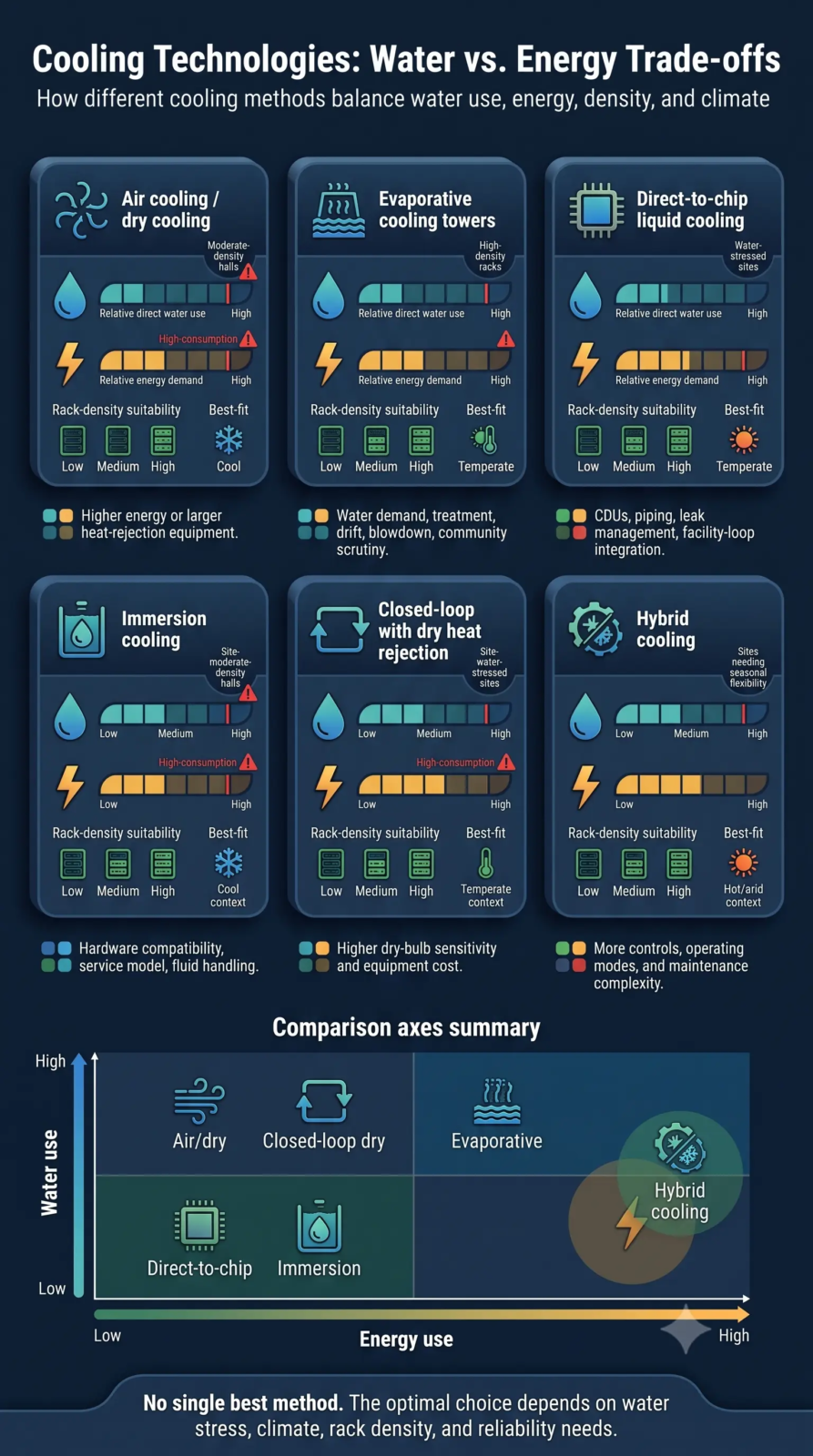
What cooling technologies reduce data center water use? Cooling technology comparison
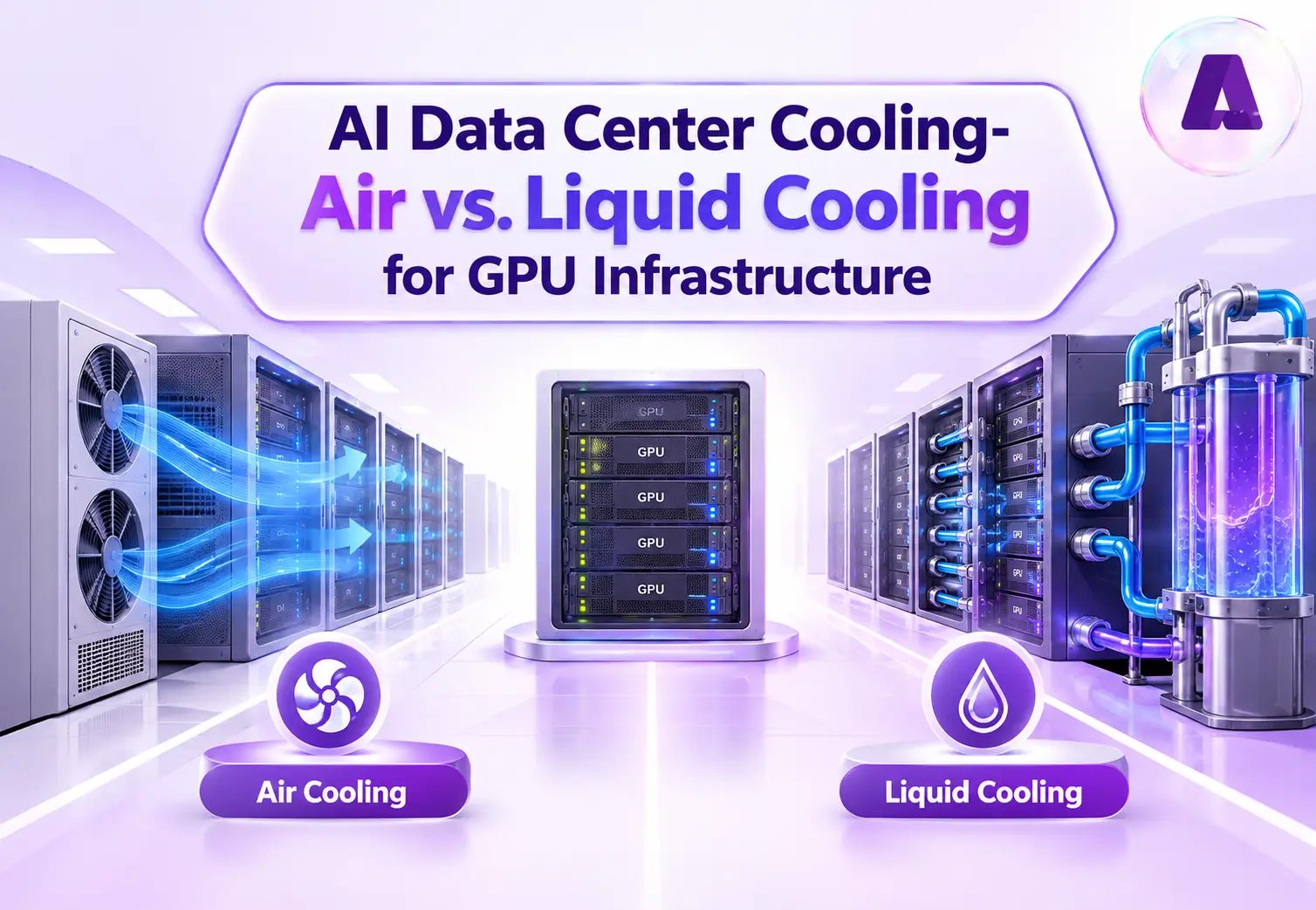
What cooling technologies reduce data center water use? Focus on the final heat-rejection step. Water circulating through a cold plate or immersion bath does not automatically mean high consumption. Evaporation at cooling towers or adiabatic equipment drives much of the direct loss.
| Cooling Technology | Typical Water Implication | Energy Implication | Best-fit Context | Main Trade-off |
|---|---|---|---|---|
| Air cooling / dry cooling | Low ongoing direct water use | Fan and compressor energy rises in hot weather | Moderate density, cool climates, water-stressed sites | Higher energy demand or larger heat-rejection equipment |
| Evaporative cooling / cooling towers | Direct water consumption through evaporation plus blowdown | Often lowers cooling energy | Large facilities with suitable water supply and climate | Water demand, treatment, drift, blowdown, community scrutiny |
| Direct-to-chip liquid cooling | Closed server loop itself has low ongoing loss. Final water use depends on heat rejection | Efficient heat capture at high density | GPU and AI racks | CDUs, piping, leak management, facility-loop integration |
| Immersion cooling | Dielectric fluid loop does not imply water consumption. Heat rejection determines site water demand | Potentially efficient at high heat flux | Purpose-built high-density deployments | Hardware compatibility, service model, fluid handling |
| Closed-loop cooling system with dry heat rejection | Minimal ongoing cooling-water consumption after fill | Potential energy penalty in hot conditions | Sites prioritizing water conservation | Higher dry-bulb sensitivity and equipment cost |
| Hybrid cooling | Water use varies by weather and operating model | Balances dry-mode energy with wet-mode efficiency | Sites needing seasonal flexibility | More controls, operating modes, and maintenance complexity |
Evaporative cooling and cooling towers: data center cooling water trade-offs
Evaporative cooling rejects heat efficiently. Cooling towers replace evaporated volume and drain blowdown to control minerals. DOE reports increasing cycles of concentration from three to six cuts makeup water about 20 percent and blowdown 50 percent. DOE cooling-water efficiency guidance This lowers data center water consumption without replacing the cooling plant.
Direct-to-chip liquid cooling, immersion cooling, and closed-loop cooling system design
Direct-to-chip liquid cooling moves processor heat into a liquid loop. Immersion cooling transfers heat into dielectric fluid. Neither method fixes the final water footprint. Dry heat rejection keeps ongoing consumption low. Evaporative rejection raises data center water use. Microsoft zero-water cooling design shows one closed-loop approach.
Which cooling method uses the least water? Air cooling, dry cooling, and hybrid cooling
Which cooling method uses the least water? Dry cooling or a closed liquid loop with dry heat rejection generally minimizes direct consumption. No method wins every site. Hybrid systems balance data center water use, PUE, climate, rack density, and reliability.
Myths vs facts about data center water usage
Data center water usage often attracts simplified claims when facility details are missing. Useful comparisons should identify the reporting boundary, water source, cooling architecture, location, and time-period.
| Myth | Common Claim | Facts |
|---|---|---|
| Myth 1: Data center water consumption always means drinking water | Every facility consumes large volumes of potable water. | Water source varies by facility and location. AWS and Google report recycled or reclaimed water use at selected sites. AWS recycled-water program and Google water stewardship provide examples. Data center water use should distinguish potable water from reclaimed, recycled, and other non-potable sources. |
| Myth 2: AI data center water usage is always higher | Every AI facility consumes more water than a traditional data center. | AI infrastructure raises heat density, but cooling architecture determines how much water is ultimately consumed. A liquid-cooled GPU facility using dry heat rejection might use less onsite water than a conventional site relying heavily on evaporative cooling. Data center water use depends on the full thermal path, not workload type alone. |
| Myth 3: Data centers cause water shortages everywhere | Data centers either cause water shortages everywhere or have no meaningful local impact. | Both extremes are misleading. Whether data centers contribute to local water stress depends on basin conditions, peak demand, water source resilience, drought, infrastructure capacity, and community needs. Data center water use becomes more significant where several of these constraints overlap. |
| Myth 4: Water withdrawal and water consumption are interchangeable | A gallon withdrawn from a water source equals a gallon permanently lost. | Water withdrawal measures water taken from a source. Water consumption measures the portion not returned for immediate local reuse. Data center water use reporting should distinguish both metrics where they are relevant. |
| Myth 5: Direct-to-chip liquid cooling always increases data center water consumption | Liquid cooling automatically means higher water demand. | Direct-to-chip liquid cooling transfers heat through a recirculating fluid loop. Most ongoing water loss depends on the final heat-rejection system. A closed-loop cooling system paired with dry coolers can use little ongoing cooling water, while evaporative heat rejection generally consumes more. |
| Myth 6: Data centers cannot operate without continuous water use | Every data center requires continuous cooling-water consumption. | Some cooling designs avoid water evaporation during normal cooling operations. A Microsoft engineering note describes a closed-loop approach designed to eliminate water use for cooling, with associated energy trade-offs. Data center water use can still include other facility requirements where applicable. |
| Myth 7: Water Usage Effectiveness (WUE) tells the whole sustainability story | A low WUE proves a data center is sustainable. | WUE measures one part of data center sustainability. A broader assessment should also consider Power Usage Effectiveness (PUE), energy source, compute efficiency, local water stress, absolute water consumption, peak demand, and community impact. Data center water use should be evaluated through both efficiency metrics and local impact measures. |
Data center water use by location: water-stressed regions, site selection, and community water impact
Data center water use by location matters because a liter has different consequences across watersheds. Google says its data center site selection process evaluates water-source health and favors air cooling or recycled water where risk is high. Google water stewardship framework Enterprise screening should include basin stress, drought, source resilience, utility capacity, and seasonal peaks.
Data center water use in drought-prone areas needs a stricter operating envelope. Model dry-year supply, utility restrictions, cooling derates, and backup modes before construction. Water-stressed regions also raise schedule risk when permits, pipelines, treatment plants, or community agreements become gates. A water risk assessment belongs beside power and network studies.
Community water impact is not captured by annual totals alone. Seasonal peaks often strain a system even when annual volume looks modest. Reclaimed-water infrastructure reduces pressure on freshwater supply. Data center water use planning should ask who shares the source, when demand peaks, and what happens during drought.
Can data centers use recycled water? Potable water / non-potable (reclaimed/greywater) water
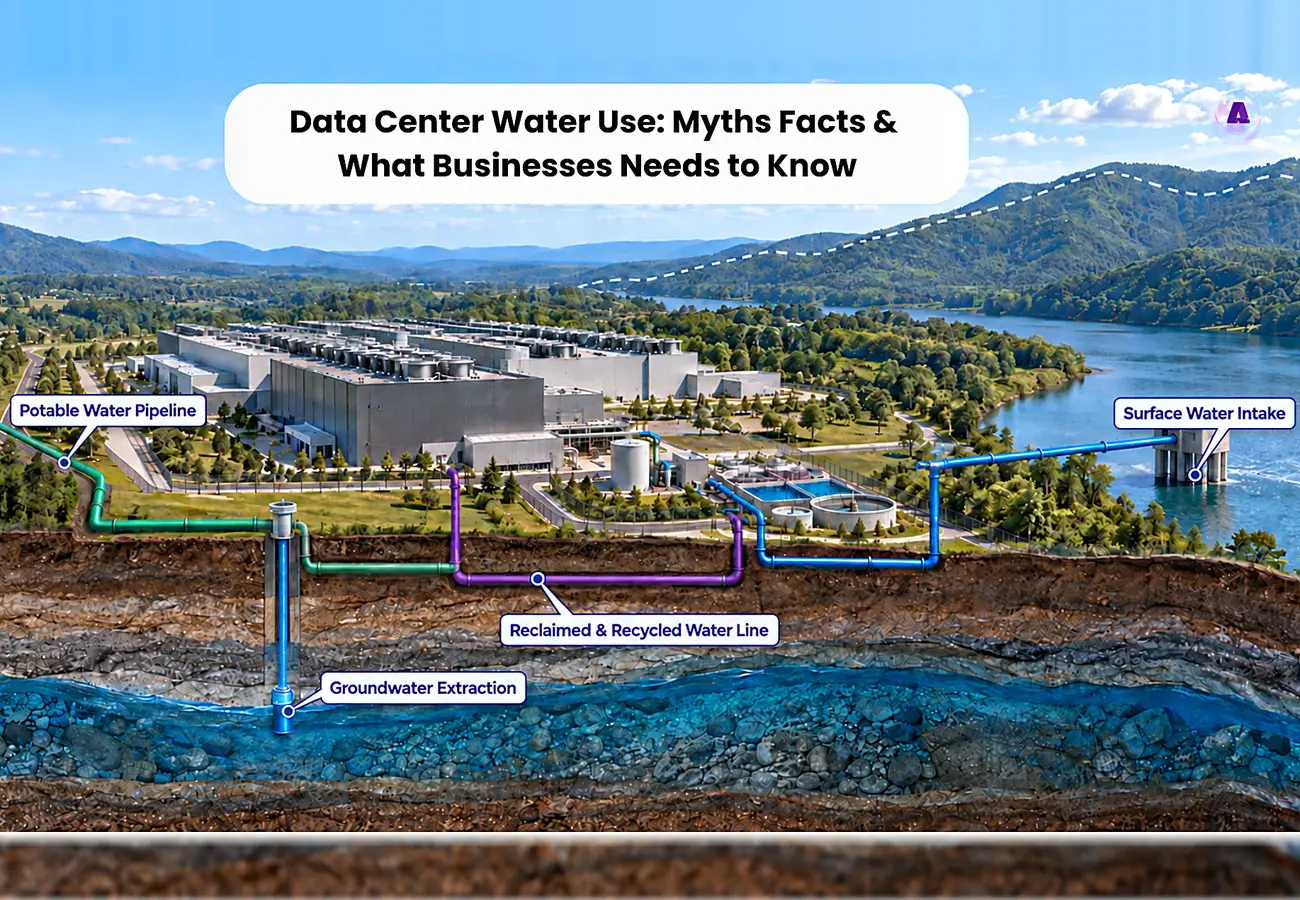
Can data centers use recycled water? Yes, where treatment, permits, materials, utility infrastructure, and health requirements support reuse. Amazon water stewardship reports recycled water for cooling. The phrase potable water / non-potable (reclaimed/greywater) water matters because source quality changes treatment, corrosion control, cost, and freshwater demand. Can data centers use recycled or non-potable water? In many locations, yes, subject to local engineering and regulatory limits.
How to reduce data center water consumption: water risk assessment and data center sustainability reporting
How to reduce data center water consumption starts with measurement. Track data center water use by source, cooling mode, season, IT load, WUE, peak-day demand, and boundary. Then improve controls, cooling-tower chemistry, economizers, coolant temperatures, leak detection, inactive compute, workload placement, and reclaimed-water supply.
water risk assessment
Workload efficiency matters. Berkeley Lab workload research ranks server efficiency and utilization among the strongest determinants of water demand per workload. Better utilization lowers direct and electricity-related water per unit of useful compute. Aptly’s AI Workload Deployment and Optimization service covers observability, utilization tracking, and performance tuning.
Data center sustainability and water risk assessment checklist
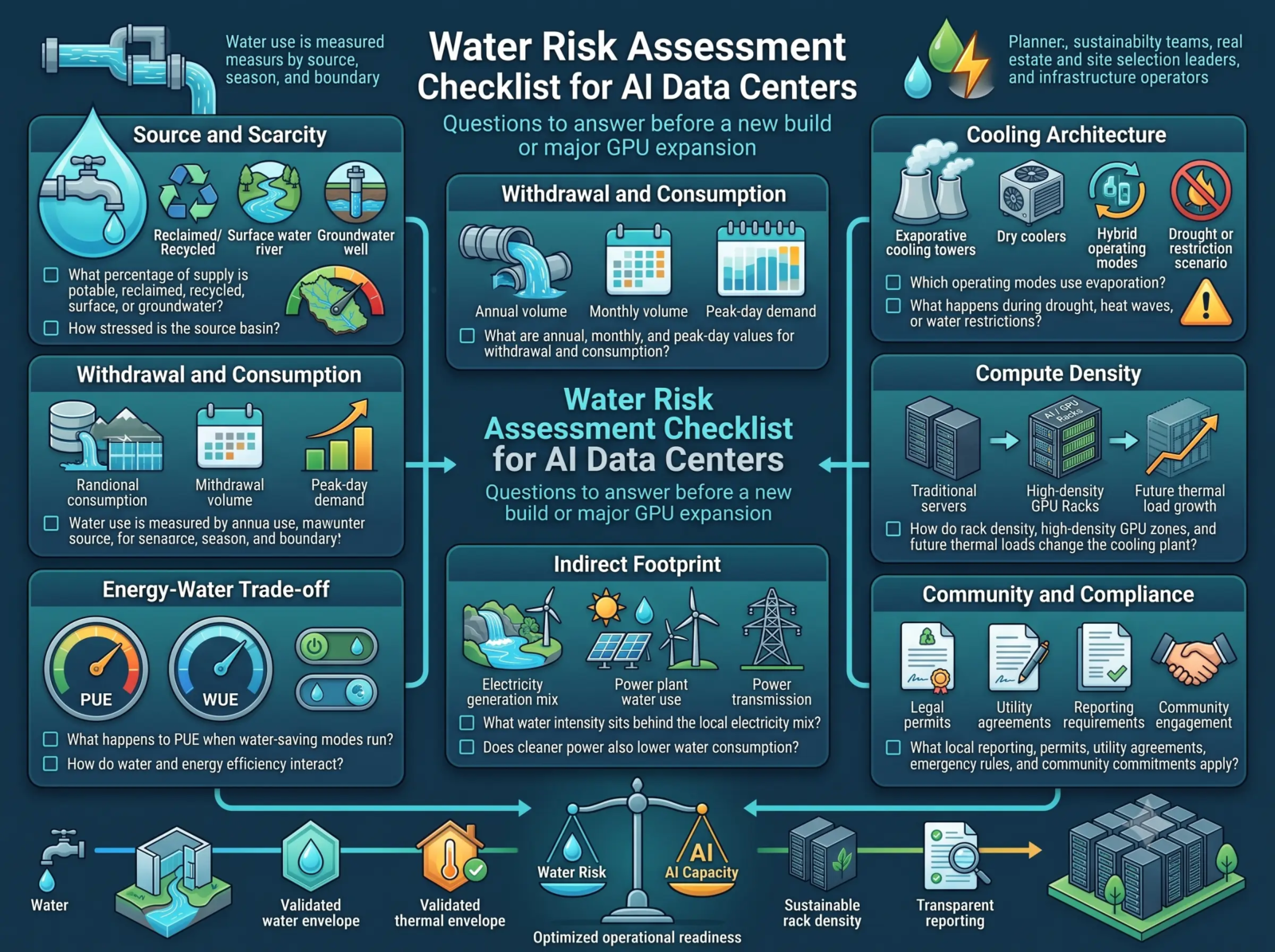
A practical water risk assessment should answer the following questions before a new build or major GPU expansion:
- Source and scarcity: What percentage of supply is potable, reclaimed, recycled, surface water, or groundwater, and how stressed is the source basin?
- Withdrawal and consumption: What are annual, monthly, and peak-day values for both measures?
- Cooling architecture: Which operating modes use evaporation, and what happens during drought, heat waves, or water restrictions?
- Compute density: How do rack density, high-density GPU zones, and future thermal loads change the cooling plant?
- Energy-water trade-off: What happens to Power Usage Effectiveness (PUE) when water-saving modes run?
- Indirect footprint: What water intensity sits behind the local electricity mix, and does cleaner power also lower water consumption?
- Community and compliance: What local reporting, permits, utility agreements, emergency rules, and community commitments apply?
This checklist turns data center water use into an engineering and continuity input. Capacity releases should follow validated cooling performance and thermal headroom. Aptly’s AI Infrastructure Managed Services includes monitoring, capacity management, troubleshooting, and 24×7 support.
Are data center water figures publicly reported or regulated? Data center sustainability reporting
Are data center water figures publicly reported or regulated? Coverage is uneven. EU Delegated Regulation 2024/1364 requires reporting data centers to submit total water input and potable water input. In the United States, requirements vary by jurisdiction. Texas moved in September 2026 to enforce water-use reporting for major users, including data centers. Texas reporting directive
Good data center sustainability reporting should publish withdrawal, consumption, potable and reclaimed shares, WUE, PUE, basin context, and the reporting boundary. Explain whether electricity-related water sits inside the data center water footprint. Consistent definitions improve trend and peer comparisons.
How does data center water use compare to other industries (agriculture, golf courses)?
How does data center water use compare to other industries (agriculture, golf courses)? Match metrics first. USGS estimates crop irrigation withdrew about 110,904 million gallons per day in the lower 48 states in 2020, with about 72 percent consumptive. Berkeley Lab’s 2023 direct U.S. data center water use estimate works out to roughly 48 million gallons per day. Different years and methods make this context, not a normalized benchmark.
Golf-course analogies also need context. Google compared its 2021 data center water footprint with irrigation and maintenance for 29 golf courses in the U.S. Southwest. Climate, recycled-water use, course size, and facility design change both sides. Compare local source, consumption, timing, and basin stress instead of relying on one equivalence.
Aptly Technology and data center water use: cooling, capacity, and AI infrastructure planning
Aptly does not position its published services as municipal water planning or water-treatment engineering. Its role starts where data center water use intersects with AI infrastructure readiness. Aptly’s AI Datacenter Buildout and Support covers power and cooling assessment, thermal zoning, rack integration, liquid-cooling readiness where applicable, energization, networking, cluster burn-in, and production validation.
Cooling limits change sustainable rack density, and workload efficiency changes heat per unit of useful output. Aptly’s AI data center infrastructure guidance connects deployment, cooling, monitoring, and capacity planning. The business goal is reliable AI capacity inside a defensible water, power, thermal, and operating envelope.
Data center water use: plan cooling and capacity together
Data center water use is neither trivial nor a universal crisis. Good assessment separates withdrawal from consumption, direct from indirect water, potable from reclaimed supply, and efficiency from local impact. AI adds heat density, while cooling architecture, workload efficiency, climate, and site selection shape the final requirement.
For a new AI build or expansion, validate the water and thermal envelope before GPU capacity is committed. Measure WUE and PUE together, model drought and peak-day conditions, confirm cooling modes, and connect telemetry to workload operations. Contact Aptly Technology to review an AI infrastructure plan against existing power, cooling, networking, and capacity limits.
FAQ: data center water use, AI data center water usage, and WUE
- What is data center water usage effectiveness (WUE)?
- The metric divides annual site water use by IT equipment energy, normally in liters per kWh. Lower WUE means less site water per unit of IT energy within the same boundary. Data center water use still needs absolute volume, source, and water-stress context.
- How much water does a typical data center use per day?
- No single figure represents the industry. Start with IT load, operating hours, and WUE, then adjust for weather, cooling mode, utilization, and peak demand. Data center water use varies from small enterprise sites to hyperscale data center campuses.
- Do AI data centers use more water than traditional data centers?
- AI raises power density, but direct water use follows cooling design. High-density liquid-cooled racks with dry heat rejection might consume less onsite water than evaporatively cooled halls. AI data center water usage should be measured, not inferred from GPU count.
- Is data center water use a real problem or overstated?
- Risk is real where large demand overlaps with scarce freshwater supply, drought, constrained infrastructure, or weak transparency. Broad claims overstate impact when they ignore reclaimed water, dry cooling, return flows, or location. Are data centers causing water shortages / competing with residents for water? The answer is site-specific.
- How do data centers avoid competing with local drinking water supplies?
- Recycled or reclaimed water, dry or hybrid cooling, leak control, higher cycles of concentration, and lower-risk site selection reduce pressure on drinking-water systems. Data center water use should reserve potable supply for processes requiring potable quality when safe alternatives exist.
- What cooling technologies reduce data center water use?
- Dry cooling, air-side economization, and closed liquid loops with dry heat rejection minimize direct evaporative demand in suitable climates. What cooling technologies reduce data center water use? Hybrid systems also reduce water use by favoring dry mode when conditions allow.
- Are data center water impacts different by location?
- Climate changes cooling hours, watershed stress changes local impact, and electricity mix changes indirect consumption. Data center water use by location belongs in site selection, capacity planning, and sustainability review from the first feasibility study.