Introduction
Enterprises now expect AI models to respond within milliseconds and support thousands of users at once. Meeting that bar is reshaping how organizations design and operate infrastructure from the ground up.
Conventional data centers still have their place, but they struggle to keep up with the computational demands of LLMs, recommendation engines, generative AI, and real-time inference. Modern AI workloads call for dense GPU clusters, ultra-fast networking, intelligent storage, and constant monitoring, none of which a general-purpose facility was built to handle.
That gap is exactly why the AI data center exists: a facility built specifically for AI model training, inference, and enterprise-scale deployment. IDC projects worldwide spending on AI-centric infrastructure will top 200 billion dollars by 2028. This figure shows just how fast organizations are modernizing to support AI initiatives.
In this article, you will learn:
- What makes an AI data center different.
- The trends shaping enterprise infrastructure in 2026
- The architecture modern organizations require
- Common implementation challenges
- How can the right AI infrastructure solutions prepare your business for the next generation of AI.
Why AI Data Centers Matter in 2026?
Legacy infrastructure was designed to host web apps, databases, and business software with predictable workloads. An AI data center operates very differently. Training large AI models can require thousands of GPUs running continuously for days or weeks. This shift changes how data centers are built, from computing resources to networking and storage.
Gartner reports that global data center systems spending rose from $506 billion in 2025 to $822 billion in 2026. This represents a remarkable 62.5% year-over-year increase and highlights why AI in data centers has become a strategic priority for enterprises
An AI-ready data center is built around several key capabilities:
- GPU-First Infrastructure: Provides the parallel computing power needed for AI model training and high-speed inference.
- High-Performance Networking: Transfers large datasets between GPU clusters with minimal latency to prevent compute resources from sitting idle.
- AI-Optimized Storage: Delivers the high read and write throughput required for continuous AI training and inference workloads.
- Hybrid Cloud Support: Distribute workloads across on-premises infrastructure and public cloud environments using cloud replication strategies to control costs while maintaining performance
Top AI Data Center Trends in 2026
The following trends illustrate how enterprise infrastructure continues to evolve to support larger AI models, distributed computing, and operational resilience.
AI Infrastructure Automation
Manual provisioning cannot keep pace with rapidly growing GPU clusters. Data center automation now handles capacity planning, workload scheduling, resource allocation, and failure recovery. This allows infrastructure teams to spend less time on repetitive operational tasks.
As AI deployments scale, governance has lagged behind. The 2026 State of Infrastructure Automation report found that 89% of organizations plan to adopt agentic AI for infrastructure, yet only 19% have established the governance foundations needed for AI readiness. This gap is driving greater investment in infrastructure automation and orchestration platforms.
Hybrid Cloud Environment
Few organizations operate AI entirely in one environment. Instead, enterprises distribute workloads across public cloud providers, private infrastructure, and colocation facilities.
Roughly 73% of enterprises now run hybrid cloud estates, according to Flexera’s 2026 State of the Cloud report.
AI Observability
AI observability has become an essential component of enterprise AI infrastructure services. It helps you track GPU utilization, model drift, latency, and pipeline health in real time. Without that visibility, infrastructure teams may discover a failed training job only after it has consumed days of expensive GPU resources.
The growing importance of AI observability is reflected in recent industry research:
- Datadog’s State of AI Engineering 2026: Nearly 1 in 20 AI requests fail in production because of operational capacity constraints.
- Gartner Prediction: By 2028, 40% of organizations deploying AI are expected to adopt dedicated AI observability tools to monitor model performance, outputs, and risk.
These findings highlight the need for continuous observability across AI infrastructure.
Sustainable and Energy-Efficient Data Centers
Power consumption is one of the AI industry’s biggest concerns. High-density GPU clusters consume substantially more electricity than conventional enterprise workloads. The International Energy Agency (IEA) estimates that global electricity demand from data centers will more than double by 2030, reaching around 945 TWh.
To address this challenge, enterprises must invest in:
- Liquid cooling systems
- Intelligent workload scheduling
- Renewable energy integration
- AI-based cooling optimization
- Data center energy efficiency initiatives
These investments reduce operational costs while supporting broader data center sustainability goals.
Edge AI Computing
Many AI apps require decisions within milliseconds. Manufacturing, healthcare, autonomous systems, and retail process AI closer to where data originates. As enterprises deploy AI across these sectors, inference is increasingly shifting to the edge. IDC forecasts that global spending on edge computing will exceed US$380 billion by 2028.
Adoption of edge computing for AI helps you:
- Reduce latency by executing inference locally while synchronizing models with centralized AI infrastructure
- Minimizes bandwidth consumption
- Supports applications that require continuous real-time processing
AI-Powered Security with Zero Trust
Security strategies continue to evolve alongside AI infrastructure. Gartner predicts that by 2028, 25% of enterprise GenAI applications will experience at least five minor security incidents.
Organizations are now implementing zero trust security models to reduce the risk of unauthorized access and data exposure across hybrid environments. According to Gartner, 50% of organizations are expected to implement a zero-trust approach for data governance by 2028 because AI-generated data becomes difficult to verify.
With zero trust security services, you can continuously verify every user, device, workload, and AI agent before granting access.
AI Data Center Architecture: What Modern Enterprises Need
Building an AI data center means stacking several layers of technology. Each layer needs to communicate with the others without becoming a bottleneck. The table below breaks down the core building blocks enterprises need to get right.
| Layer | Purpose |
|---|---|
| Compute | Utilizing GPU clusters for dense, parallel processing across training and inference |
| Networking | Using InfiniBand or high-bandwidth Ethernet that keeps GPU nodes fed with data, not waiting on it |
| Storage | Optimizing AI storage for high-throughput data access |
| Orchestration | Orchestrating Kubernetes and containers for scheduling and scaling AI workloads |
| Governance | Controlling access and maintaining security, data lineage, and compliance |
| AI Observability | Monitoring infrastructure performance, utilization, and model drift |
| Security | Implementing zero trust and data center security solutions with continuous verification |
| Automation | Automating infrastructure for provisioning, scaling, and capacity management |
An illustration of a simple AI data center architecture is given below:
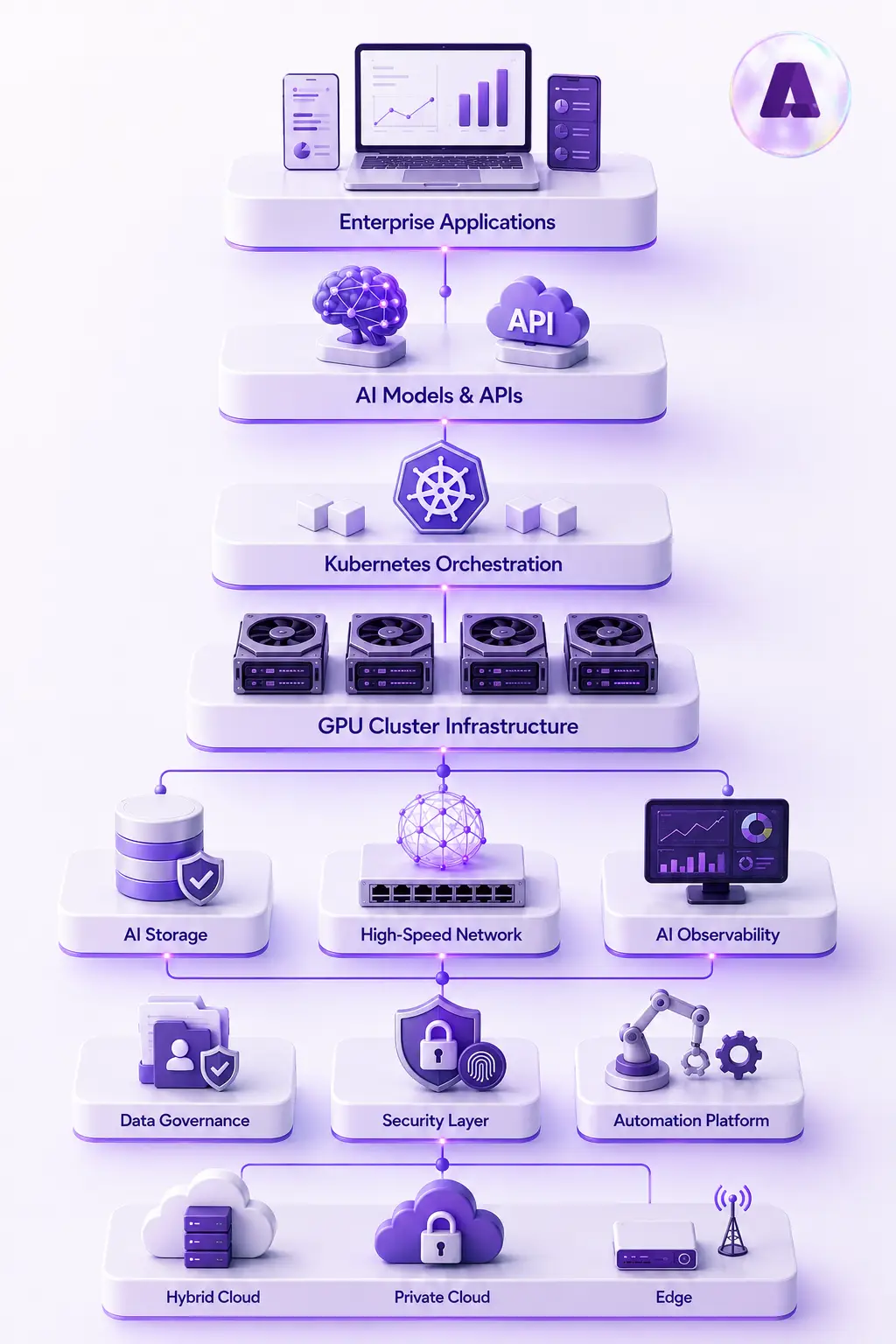
Every layer in an AI data center works together.
- GPU clusters need high-speed networking to move data quickly.
- Kubernetes depends on observability tools to monitor and manage AI workloads effectively.
- Data governance connects the entire architecture by ensuring the data used for training and inference remains accurate, secure, and compliant.
When you treat these components as a unified system, AI workload optimization becomes easier.
Steps to Build an AI Data Center Strategy
Deploying an AI data center is not simply about purchasing more GPUs. The following phased approach helps you avoid unnecessary spending while building a platform that scales with demand.
Assess Your AI Workloads First
Before investing in new infrastructure:
- Identify the workloads your organization plans to support.
- Create an inventory of existing apps, expected model sizes, data volumes, latency requirements, and compliance obligations.
This assessment forms the foundation for selecting the right AI infrastructure solutions rather than overprovisioning hardware.
Modernize Infrastructure Incrementally
Many enterprises do not need a complete data center replacement. Instead, modernize critical components that directly impact AI performance.
Prioritize upgrades such as:
- Deploy GPU-enabled compute clusters
- Replace legacy storage with high-throughput parallel storage
- Upgrade networking to 100-400 Gbps fabrics
- Introduce Kubernetes for container orchestration
- Adopt infrastructure automation for provisioning and scaling
This staged approach reduces disruption while preparing your environment for future AI expansion.
Choose the Right Cloud Strategy
Different AI workloads have different infrastructure requirements. Large-scale model training benefits from the scalability of the public cloud, while inference workloads may be better suited to on-premises or private cloud environments. So, decide where each workload performs best based on performance, compliance, and cost.
Two strategies can help:
- Cloud Rebalancing: Move AI jobs between environments based on GPU availability, latency, compliance, and cost.
- Cloud Replication: Keep datasets synchronized across private infrastructure, edge locations, and cloud platforms.
Optimize AI Workloads Continuously
Infrastructure optimization should continue long after deployment. Monitor GPU utilization, storage throughput, inference latency, and network congestion to identify bottlenecks before they affect production.
Strengthen Governance and Observability
Enterprise AI depends on trusted data.
- Establish governance policies before deploying production models.
- Deploy AI observability tools for continuous visibility to resolve issues before they become business problems.
Challenges Enterprise Still Face and How to Fix It
Enterprise AI keeps maturing. Infrastructure teams still hit real roadblocks. According to Gartner’s April 2026 survey of infrastructure and operations leaders, only 28% of AI projects fully deliver their expected return on investment (ROI), while 20% fail completely.
Let’s check out a few infrastructure challenges:
GPU Availability and Rising Costs
- GPU demand outpaces supply.
- Procurement costs keep climbing.
- Deployment timelines stretch out.
Solution: Optimize GPU utilization through intelligent workload scheduling and hybrid cloud deployment instead of purchasing additional hardware.
Infrastructure Complications
AI platforms combine GPUs, high-speed networking, distributed storage, Kubernetes, automation, and observability tools. Each layer needs planning and the right expertise. Without a unified architecture, teams end up with isolated AI environments nobody can maintain.
Solution: Build a standardized AI platform using Kubernetes and Infrastructure as Code (IaC) to simplify deployment and management.
Energy Consumption
Large GPU clusters require significantly more electricity than traditional enterprise applications. Cooling systems, power distribution, and rack density have become major infrastructure considerations.
Solution: Improve energy efficiency by monitoring GPU utilization and using modern cooling technologies.
Security and Data Governance
Security risk grows alongside AI usage too. AI systems process large volumes of sensitive data, making them attractive targets for cyberattacks. At the same time, weak data governance can affect model accuracy, regulatory compliance, and business trust.
Solution: Implement strong security and governance policies, including encryption, access controls, and continuous monitoring.
Skills Shortage
AI-ready infrastructure needs skills across cloud, networking, storage, Kubernetes, data engineering, security, and MLOps. Few candidates cover all of it. Most enterprises feel that gap directly.
Solution: Partner with experienced AI infrastructure experts to bridge skill gaps and accelerate AI deployment.
2026 Real-World AI Data Center Case Studies
The following examples demonstrate how leading technology companies are redesigning infrastructure to support enterprise-scale AI workloads in 2026.
Lockheed Martin Builds an AI Factory with NVIDIA DGX SuperPOD
Lockheed Martin develops AI apps across aerospace, defense, cybersecurity, and space exploration. However, its AI teams faced several infrastructure challenges, including fragmented GPU resources, isolated machine learning workflows, inconsistent development practices, and strict data governance requirements.
Solution
To address these challenges, Lockheed Martin built an AI Factory powered by NVIDIA DGX SuperPOD. The company centralized GPU infrastructure, MLOps tools, and AI best practices into a single on-premises platform.
Business Outcome
- The AI Factory significantly improved developer productivity and infrastructure utilization.
- Development environments that previously took weeks to provision are now available in minutes.
- AI model training times have been reduced from weeks to days.
- The platform processes more than one billion tokens every week, supporting large-scale model fine-tuning, RAG, and inference.
- More than 7,000 engineers and developers use the AI Factory to build AI applications, generating millions of API requests and thousands of automated pipelines every week.
Google Cloud Reinvents AI Data Center Networking with Virgo Network
Large-scale AI workloads require thousands of accelerators to exchange massive volumes of data with predictable latency. Conventional network architectures struggle to provide the bandwidth, resilience, and scalability needed for distributed AI. This leads to congestion and slower model training.
Solution
To address these challenges, Google Cloud introduced Virgo Network, a megascale AI data center fabric designed specifically for its AI Hypercomputer platform. Virgo adopts a “campus-as-a-computer” architecture that connects AI accelerators across multiple data centers into a unified compute environment.
Business Outcome
- Connects up to 134,000 TPU chips within a single AI fabric, delivering 47 petabits per second of non-blocking bandwidth.
- Provides up to four times more bandwidth per accelerator than the previous generation, helping large AI models train more quickly.
- Reduces unloaded network latency by 40%, improving the performance and predictability of latency-sensitive AI inference workloads.
- Supports AI infrastructure at a massive scale, including up to 80,000 NVIDIA GPUs within a single data center and up to 960,000 GPUs across multiple sites.
How Aptly Technology Helps Build AI-Ready Infrastructure?
Building an AI data center requires expertise across infrastructure design, AI workload deployment, cloud modernization, security, and operations. Aptly Technology provides end-to-end AI infrastructure services that help enterprises design, deploy, optimize, and operate AI-ready environments. Here are Aptly’s key capabilities:
1. GPU Data Center Buildout & Support
Aptly helps enterprises design and deploy AI-ready data centers capable of supporting large-scale AI training and inference workloads.
Key services include:
- AI data center design validation
- GPU cluster planning and deployment
- Rack installation, cabling, power-up, and hardware burn-in
- High-performance networking using InfiniBand and Ethernet
- Benchmarking, upgrades, and 24×7 infrastructure support
These services establish the physical foundation required for scalable AI model training infrastructure and high-performance computing environments.
2. AI Workload Deployment & Optimization
Deploying AI infrastructure is only the first step. Aptly helps organizations maximize GPU utilization and improve production performance through AI workload optimization services.
These capabilities include:
- AI training and inference deployment
- GPU workload scheduling
- Resource utilization monitoring
- Performance tuning
- Automation and orchestration
- Cost optimization
3. AI Application Development
Beyond infrastructure, Aptly supports organizations in building enterprise AI applications that deliver measurable business outcomes.
Its AI application services include:
- Custom AI application development
- Enterprise AI integration
- MLOps and CI/CD implementation
- AI governance and compliance
- Model deployment and lifecycle management
- Improving model accuracy while reducing hallucinations
4. Enterprise IT Infrastructure & Cloud Modernization
Many enterprises operate hybrid environments where legacy infrastructure coexists with modern AI platforms. Aptly helps modernize these environments through comprehensive IT infrastructure services.
Core capabilities include:
- Server hardware and virtualization
- Networking infrastructure
- Storage and compute strategy
- Backup and disaster recovery
- Monitoring and management tools
- Hybrid cloud architecture
- Cloud migration and modernization
5. Cloud Security and AI Infrastructure Protection
As AI systems handle sensitive enterprise data, security becomes an integral part of infrastructure planning.
Aptly’s security capabilities include:
- Identity and Access Management (IAM)
- End-to-end network security
- Security policies and access controls
- Logging and monitoring
- Data Loss Prevention (DLP)
- Data governance and compliance
- Cloud data encryption
- AI infrastructure security
Conclusion
AI data centers have moved from experimental builds to the foundation enterprise AI runs on. Getting this right depends on architecture, strategy, automation, governance, and observability working together. Enterprises that modernize their infrastructure now will be far better positioned to handle whatever AI workloads show up next.
This AI-driven transformation shows no sign of slowing, and neither does the pressure on IT teams to keep pace. Aptly Tech has spent years helping enterprises design and implement AI-ready infrastructure, from initial assessment through ongoing operations.
If your AI data center strategy still feels more reactive than planned, that is exactly where a conversation with Aptly’s team tends to start.
FAQs
Q1: How is AI transforming data centers in 2026?
AI is transforming data centers by shifting design priorities toward:
- GPU-first compute
- High-speed networking
- Storage built for constant training and inference cycles.
Q2: What are the best AI infrastructure services for enterprises?
The strongest AI infrastructure services combine assessment, hybrid cloud architecture, data governance, and ongoing AI observability. So, infrastructure investment lines up with actual workload needs instead of guesswork.
Q3: What role does AI play in data center security and observability?
AI plays a growing role in data center security and observability by flagging unusual access patterns in real time and tracking GPU performance. Hence, issues surface before they affect production workloads.
Q4: What does an AI-based energy-efficient data center look like?
An AI-based energy-efficient data center uses machine learning to adjust cooling and power distribution in real time. This cuts down energy consumption without sacrificing the performance AI workloads need.
Q5: What are effective cloud rebalancing strategies for AI workloads?
Effective cloud rebalancing strategies place sensitive AI workloads on premises while bursting training jobs to public cloud capacity during peak demand. This keeps both cost and compliance under control.