
Introduction
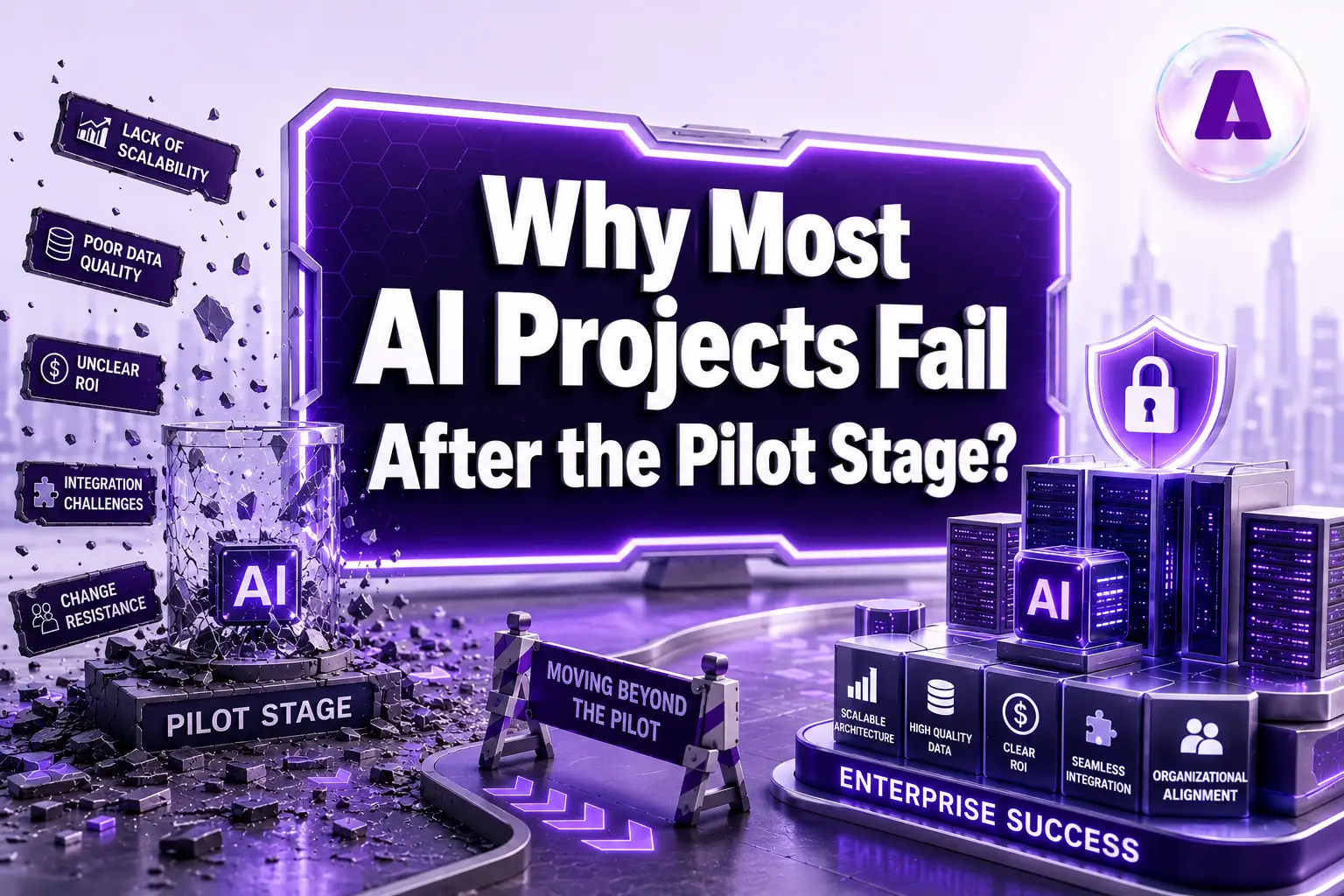
Enterprise enthusiasm around AI has never been higher, but most initiatives never move beyond the pilot stage. According to NTT DATA, nearly 85% of AI projects fail to reach sustained production. Many organizations achieve promising pilot results, only to see progress stall due to unclear ownership, governance gaps, infrastructure limitations, cultural resistance, and weak long-term planning.
The real issue is rarely the pilot itself. Most enterprises focus on proving technical feasibility but overlook the operational and business realities required for scaling AI successfully. This blog explores why AI projects fail after pilot stage and what organizations must do differently for a successful AI deployment strategy.
The Pilot Illusion: Why a Successful POC Doesn’t Guarantee Scale
Pilots are designed to prove an idea, not to survive real-world complexity. During a POC, teams usually work with clean data, limited users, strong internal support, and a controlled environment. But enterprise AI at scale is far messier.
This creates a pilot bubble. Inside it, AI models are protected from challenges like legacy systems, compliance requirements, unpredictable user behavior, and poor-quality live data. Problems begin when the solution moves into production.
Consider two scenarios that repeat themselves across industries.
- A fraud detection model may work perfectly on historical data but struggle with inconsistent live transactions.
- An AI chatbot may impress executives in demos but fail when thousands of employees start asking unexpected questions.
The main reason why AI projects fail after pilot stage is that companies confuse a successful demo with true readiness for scale. A pilot only proves the technology can work — not that the organization is prepared to run it successfully in the real world.
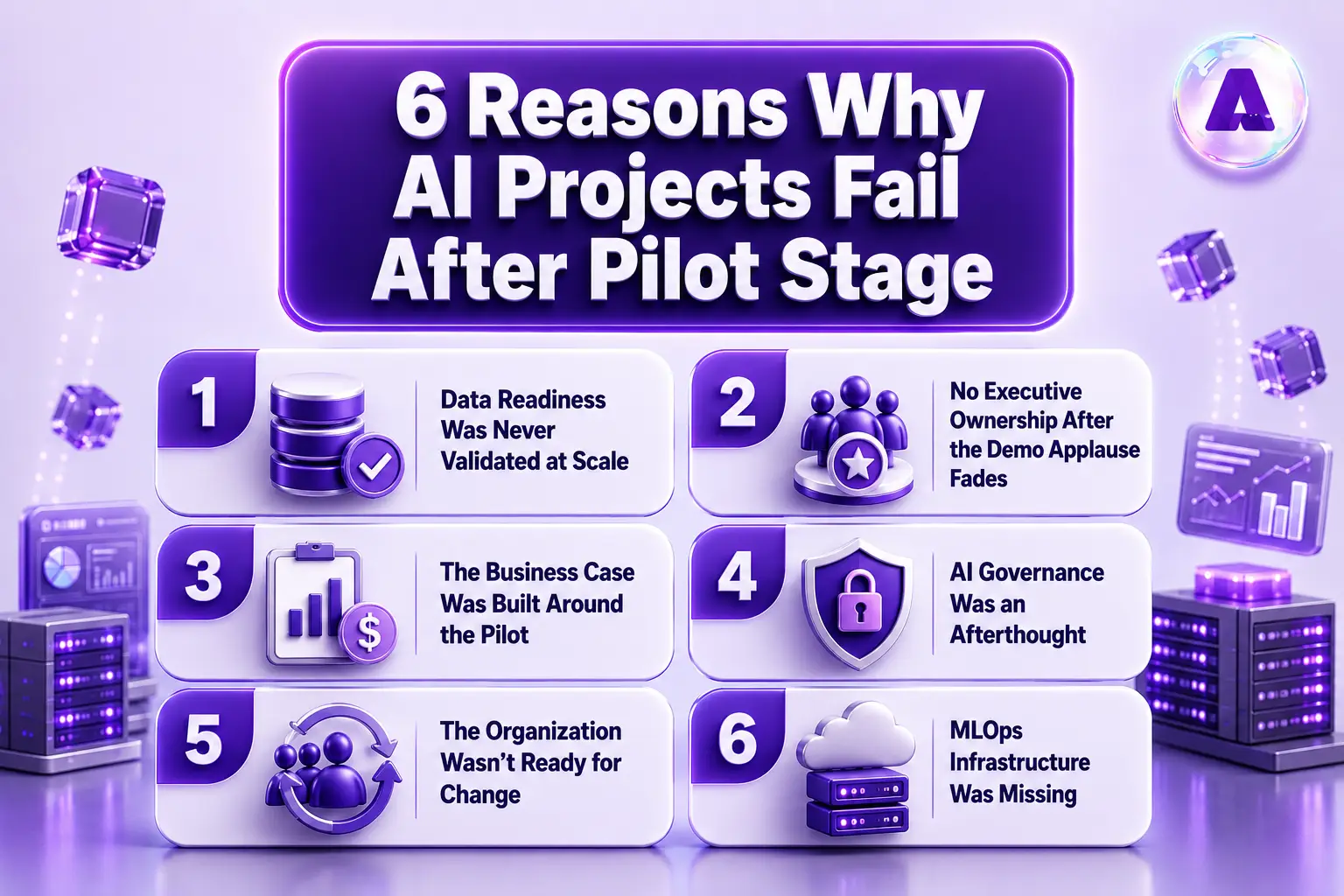
6 Reasons Why AI Projects Fail After Pilot Stage
The following reasons why AI projects fail after pilot stage are not theoretical. They are the patterns that show up repeatedly in stalled enterprise AI transformation programs. Understanding them is the first step toward avoiding them. Here is what typically goes wrong.
1. Data Readiness Was Never Validated at Scale
Pilots use clean, controlled datasets. Production exposes data silos, inconsistent schemas, missing labels, and governance gaps that nobody thought to address during the POC phase. Data readiness for AI is a one-time preparation task you check off before a demo.
When teams try to scale, they discover that the data infrastructure is not AI-ready. This is where you should assess your AI-ready infrastructure before committing to a production timeline. Models degrade against real-world data quality. Trust collapses. Teams quietly revert to spreadsheets, and the AI initiative loses credibility it rarely recovers.
2. No Executive Ownership After the Demo Applause Fades
Every successful pilot has a champion. Scaling requires something different: an owner. Someone accountable for cross-functional alignment, sustained budget, and organization-wide adoption. Without a clear program sponsor at the C-suite level — ideally a CIO or CDO with real authority — AI initiatives drift between IT, data teams, and business units, with no single person driving the agenda forward.
How CIOs scale AI across organizations almost always traces back to this question of ownership. Budget gets reallocated at the next planning cycle not because the technology failed, but because nobody had the organizational standing to defend it. Momentum dies quietly, not dramatically.
3. The Business Case Was Built Around the Pilot
ROI projections tied to controlled pilot conditions do not survive contact with real operational costs. The cost of scaling AI models is systematically underestimated. Compute costs multiply. Integration work takes months, not weeks. Model maintenance, retraining cycles, human oversight, and monitoring tooling all carry costs that never appeared in the pilot budget.
As a result, rising costs derail AI initiatives even when the technology itself is working. What looked affordable and impactful during the pilot phase often becomes difficult to justify once enterprise-scale infrastructure, integration, governance, and operational expenses are added.
Many organizations build their financial expectations around the cost of the POC instead of the realities of full-scale deployment. As the project expands, the business case weakens, budgets come under scrutiny, and momentum slows during planning and review cycles.
4. AI Governance Was an Afterthought
Regulatory compliance, model explainability, audit trails, and bias monitoring are not pilot concerns. They are enterprise blockers. In finance, healthcare, and government, compliance requirements create hard walls that were simply never considered during POC design.
An AI governance strategy needs to exist before production as a structural requirement. Legal and compliance teams should not be discovering governance gaps at the production launch meeting. When they do, they become unexpected vetoes. Initiatives that could have launched with proper preparation instead stall for months in review cycles that nobody planned for.
5. The Organization Wasn’t Ready for Change
Technology readiness and organizational readiness are not the same thing. Most enterprises significantly underinvest in the latter.
Employees resist AI tools when they feel surveilled, replaced, or undertrained. Middle managers deprioritize adoption when their KPIs do not actually reflect it. ROI never materializes even when the model is technically sound. Enterprise AI adoption best practices consistently identify change management as the most underfunded workstream in any AI program.
6. MLOps Infrastructure Was Missing
A pilot does not need CI/CD pipelines, model registries, drift detection, or retraining workflows. Production AI absolutely does. Without MLOps scaffolding, models stagnate, drift silently, and fail without warning signals that anyone can act on.
This is where enterprise AI deployment gets its real test. A model that performed at 92% accuracy at launch can quietly decay to 71% over twelve months.
Hence, productionizing AI systems requires operational infrastructure that most pilot teams never build and most enterprises never fund until after the first failure.
From Pilot Theater to Real Transformation: What Leaders Must Do Differently
Understanding why AI projects fail after pilot stage is only the first step. The bigger challenge is changing how organizations plan, manage, and scale AI from the beginning. Here are a few key actions IT leaders should focus on:
Reframe the Pilot as a Learning Exercise
The goal of a pilot should not just be proving that AI works. It should be identifying what could fail at scale.
Instead of asking, “Did the pilot succeed?”, leaders should ask:
“What challenges will appear when this is deployed across the organization?”
Successful pilots should help uncover risks early before they become expensive problems later.
Assign a Dedicated AI Program Owner
Enterprise AI transformation requires a long-horizon owner with genuine cross-functional authority. This is not a project manager whose job ends when the pilot ships. It is a program owner whose mandate is building an AI-capable organization over a multi-year horizon.
Organizations should appoint a leader with cross-functional authority to manage AI initiatives beyond the pilot phase.
Build the Enterprise AI Roadmap Early
Do not let a successful pilot spawn a random series of new POCs. Consolidate learnings into an enterprise AI roadmap that prioritizes use cases by strategic impact and organizational readiness. An AI transformation roadmap for enterprises should exist at the program level, not the project level. Without it, you accumulate disconnected pilots rather than building compounding organizational capability.
Treat Data Readiness as a Priority
AI systems are only as strong as the data behind them. Before scaling AI initiatives, organizations must ensure their data is clean, accessible, reliable, and properly governed.
Poor data quality often becomes one of the biggest barriers to successful AI adoption.
Build Governance From Day One
AI governance should not be treated as a late-stage requirement.
Organizations that establish explainability, security, compliance, and bias monitoring early can scale AI much faster and more confidently. Strong governance is not a barrier to AI adoption — it is an enabler of sustainable growth.
Stop Measuring Pilots. Start Measuring Programs.
Most enterprises measure AI success at the pilot level:
- Accuracy scores
- Demo satisfaction ratings
- Limited A/B tests.
These metrics feel meaningful in the moment but tell you almost nothing about enterprise AI success.
The right measure is program-level ROI:
- Business outcomes delivered at scale
- Adoption rates across the organization
- Cost-per-insight across the full AI portfolio.
AI maturity is a strategic asset — organizations that operationalize AI successfully treat it as a long-term capability to grow, not a one-time project to ship.
The difference between why AI projects after pilot stage and those that do not comes down to this: how mature is the organization around the model, not how good the model itself is. Successful enterprise AI adoption is ultimately an organizational achievement.
Here is a practical framework for thinking about where your organization sits on the maturity curve.
| Stage | Characteristics | Common Risks |
|---|---|---|
| Experimentation | Isolated pilots | No business ownership |
| Operationalization | Initial production systems | Scaling bottlenecks |
| Standardization | Governance + MLOps in place | Organizational silos |
| Enterprise Transformation | AI embedded across workflows | Change resistance |
Understanding your current stage shapes every investment decision. Organizations that try to skip from Experimentation to Enterprise Transformation without building the middle stages invariably create the failures this blog describes.
The Future of Enterprise AI: From Experiments to Sustainable Programs
The future of enterprise AI is shifting from isolated experiments to long-term, scalable programs. Organizations are realizing that successful AI adoption requires more than just building models.
Key trends shaping the next phase of enterprise AI include:
- Stronger AI governance and compliance requirements across industries
- Greater focus on responsible and secure Generative AI adoption
- AI-native operating models becoming a competitive advantage
- Platform-based AI approaches replacing one-off projects
- Reusable AI capabilities helping reduce cost and deployment time
- Increased investment in infrastructure, data quality, and operational readiness
The companies that succeed with AI will not be the ones running the most pilots. They will be the ones with strong governance, scalable systems, and clear business processes. In the coming years, the biggest challenge for enterprise leaders will not be building AI models. It will be scaling and managing AI effectively across the organization.
This is where Aptly Technology helps enterprises move beyond experimentation. By focusing on scalable infrastructure, operational readiness, and enterprise-grade technology solutions, Aptly enables organizations to build AI environments that are secure, reliable, and ready for long-term growth.
Conclusion
Most AI failures are organizational. The technical problems — deployment, infrastructure, MLOps — are solvable. What breaks enterprises is the absence of ownership, the governance gaps, the underestimated costs, the change management work that never gets funded.
The question is not whether your pilot worked. The question is whether your organization is ready to scale what comes next.
Not sure where your AI program stands? Talk to Aptly’s team about an AI readiness assessment.
FAQs
Q: Why do most AI projects fail after the pilot phase?
Enterprises underestimate the operational complexity, governance requirements, data readiness gaps, and organizational adoption challenges that surface at scale. Pilots succeed under controlled conditions that do not reflect enterprise reality.
Q: What prevents AI projects from reaching production?
Common blockers include fragmented data systems that were never assessed for production readiness, absence of MLOps infrastructure, unclear business ownership at the program level, and scaling costs that exceed what the original business case projected.
Q: How can companies scale AI successfully beyond experimentation?
Successful enterprises build governance frameworks early, invest in operational AI platforms and MLOps tooling, assign cross-functional ownership at the C-suite level, and treat data readiness as a prerequisite.
Q: What is the biggest challenge in enterprise AI adoption?
The biggest challenge is operationalizing AI consistently across teams, systems, and workflows while maintaining regulatory compliance and delivering measurable ROI at the program level.
Q: How do CIOs operationalize AI successfully?
- Aligning AI initiatives directly with business goals
- Investing in MLOps and governance infrastructure before scaling
- Assigning long-horizon program owners and treating enterprise-wide change management as a first-class workstream
Table of content
- TL;DR
- Introduction
- The Pilot Illusion: Why a Successful POC Doesn’t Guarantee Scale
- 6 Reasons Why AI Projects Fail After Pilot Stage
- From Pilot Theater to Real Transformation: What Leaders Must Do Differently
- Stop Measuring Pilots. Start Measuring Programs.
- The Future of Enterprise AI: From Experiments to Sustainable Programs
- Conclusion
- FAQs