Introduction
AI agents are no longer experimental tools running inside isolated innovation labs. Today, they automate workflows, access databases, interact with APIs, and support operational decision-making across enterprise environments.
Many organizations already use agentic AI systems powered by Large Language Models (LLMs) to improve productivity, customer support, analytics, and internal operations. At the same time, enterprise leaders face a growing challenge. AI systems move quickly, but governance requirements move carefully.
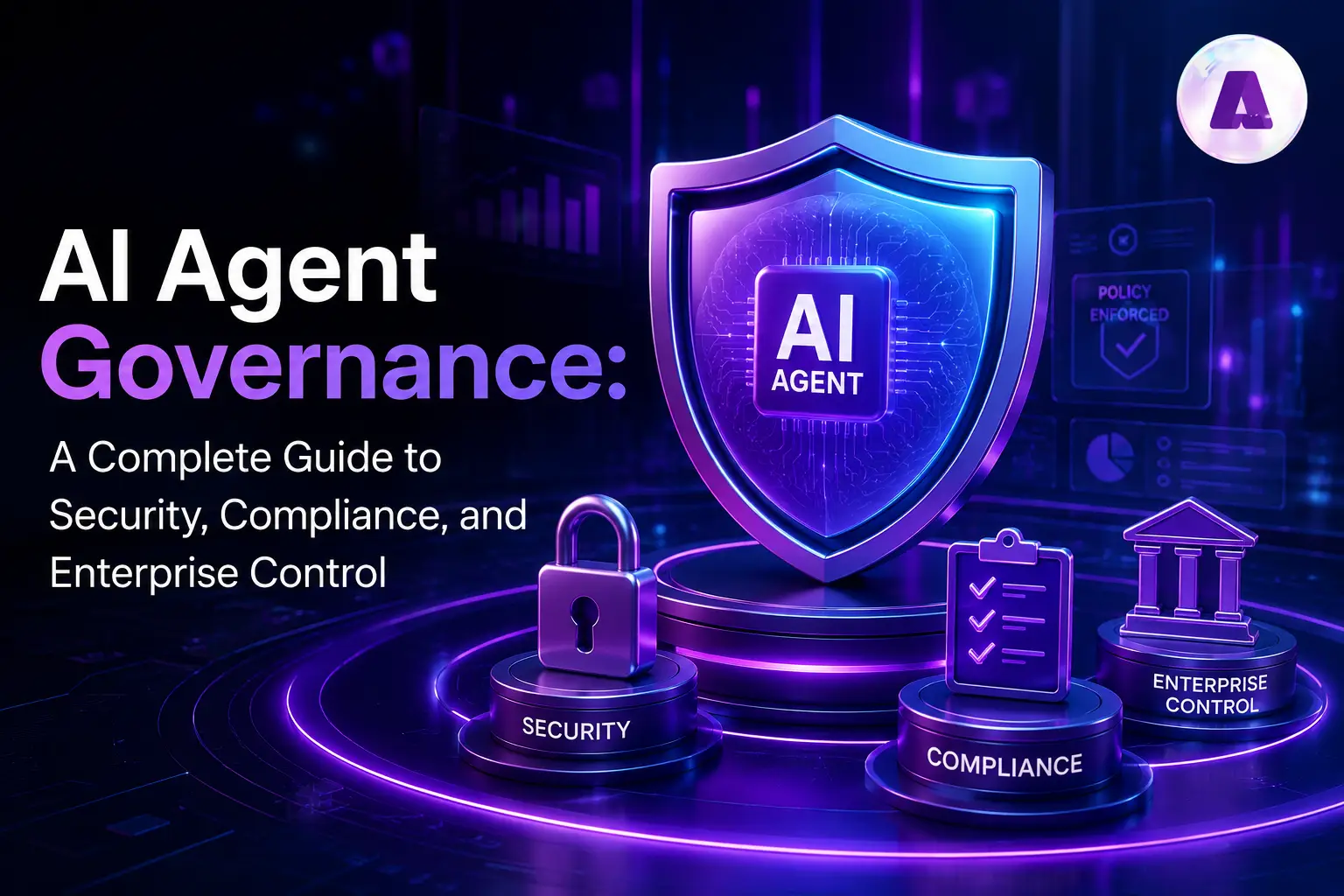
This is why AI agent governance is becoming a non-negotiable capability for modern enterprises. Your organization needs an AI governance framework that balances innovation with accountability. In this guide, you will learn how enterprises govern AI agents through security controls, compliance management, observability practices, and operational oversight.
What Is AI Agent Governance?
AI agent governance is a set of policies, processes, technologies, and operational controls that ensure AI agents behave safely, ethically, and within organizational requirements. Traditional AI governance focused mainly on static models producing predictions while modern AI agents autonomously take different actions like:
- Retrieve data
- Send messages
- Execute workflows
- Call APIs
- Interact with enterprise infrastructure
Therefore, Governance must address real-time decisions instead of only reviewing model outputs. Alongside, responsible AI governance should include a proper AI agent lifecycle management. Your organization must establish oversight throughout the entire life cycle involving:
- Development
- Testing
- Deployment
- Monitoring
- Retraining
- Decommissioning
This becomes especially important as agentic AI systems expand across critical business functions.
Why AI Governance Matters in the Enterprise?
Enterprise AI governance is now directly connected to regulatory compliance, cybersecurity, operational resilience, and corporate accountability. So, rapid AI agent adoption is accelerating quickly. According to Gartner’s best-case scenario projection, agentic AI could account for nearly 30% of enterprise application software revenue by 2035, exceeding $450 billion, compared to just 2% in 2025.
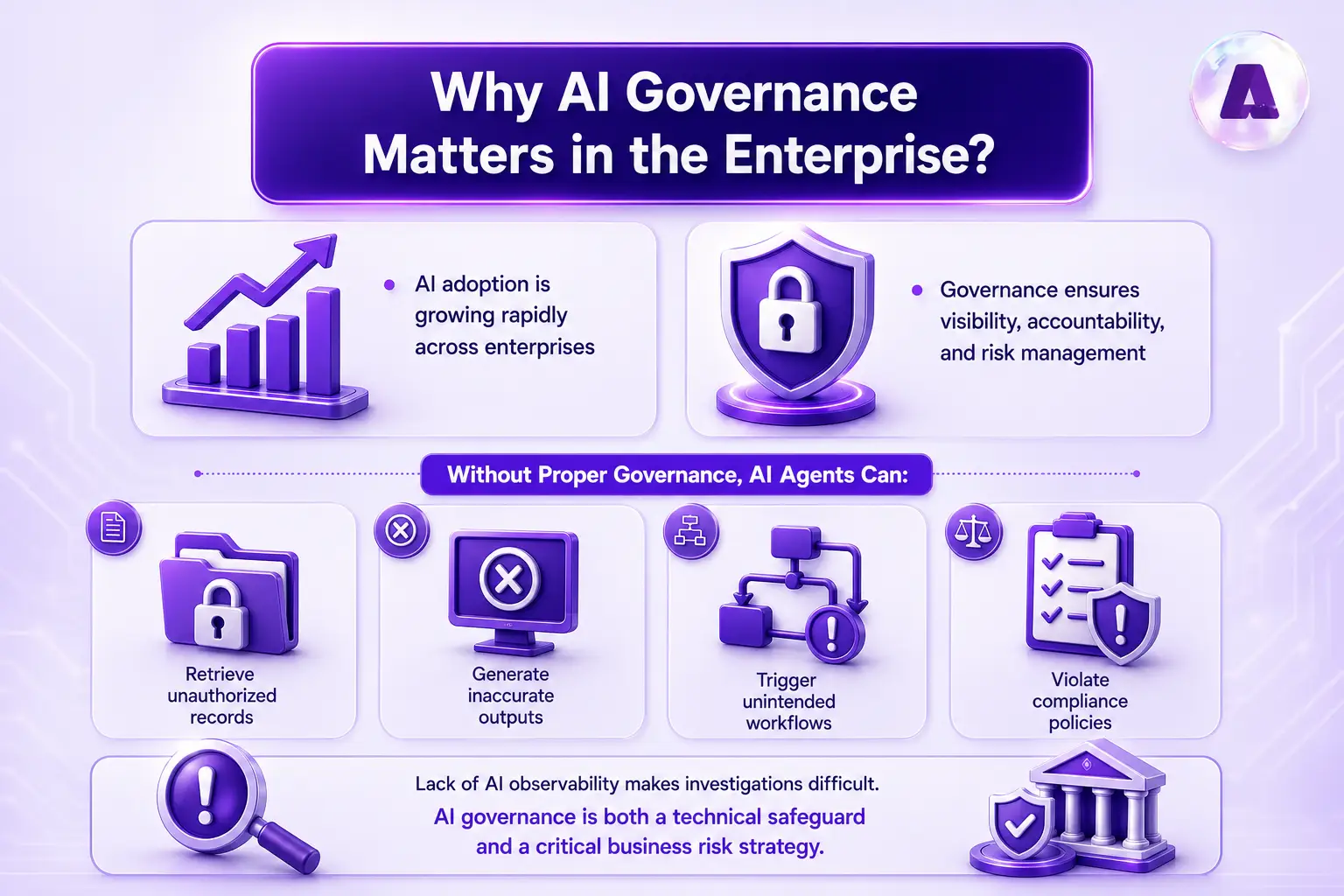
As autonomous AI systems become embedded into core business operations, organizations face increasing pressure to implement governance controls that ensure visibility, accountability, and risk management.
Without proper governance, AI agents can create the following significant operational exposure at scale.
- Retrieve unauthorized records
- Generate inaccurate outputs
- Trigger unintended workflows
- Violate compliance policies
If your organization lacks AI observability, post-incident investigations become extremely difficult. AI governance therefore serves as both technical safeguard and a critical business risk management strategy for modern enterprises.
Core Pillars of an AI Governance Framework
A practical AI governance framework should provide operational controls that security, compliance, and engineering teams can implement consistently. The following pillars form the foundation of responsible enterprise AI governance.
Identity and Access Control
AI agents should never inherit unrestricted administrative permissions.
- The first step is following the principle of least privilege. Every AI agent should have a defined identity and access only the systems, applications, and data required for its tasks.
- As the next step, you should integrate AI agents into enterprise Identity and Access Management (IAM) systems.
- Role-based access control, token rotation, authentication policies, and network segmentation reduce the likelihood of unauthorized access.
AI Agent Monitoring and Observability
The next step is establishing continuous monitoring across AI systems, APIs, and workflows.
- Before implementing monitoring controls, define how AI agent activities will be tracked throughout production environments.
- Then, use monitoring platforms to capture prompts, inputs, outputs, API interactions, and workflow decisions.
- Implement real-time anomaly detection to identify suspicious activities, unusual access patterns, or unexpected behavioral changes.
- Leveraging strong AI observability tools further improves incident investigations, compliance reporting, and operational accountability.
Data Privacy and Compliance Controls
AI systems frequently process customer records, financial information, operational data, and internal documentation. Governance policies must therefore align with data privacy obligations and AI compliance management requirements.
- Map where AI agents interact with regulated or sensitive information before defining privacy controls.
- Retrieval-Augmented Generation (RAG) architectures should include strict authorization controls that prevent agents from exposing unauthorized information.
- Apply data classification policies, encryption standards, and retention rules consistently across AI workloads.
- Document data lineage to support auditability and regulatory reviews.
AI Policy Management
AI policy management establishes operational rules governing agent behavior.
- Clearly define acceptable AI usage boundaries.
- Define what agents can access, which actions require approval, and when human escalation becomes mandatory.
Many enterprises now implement policy-as-code approaches that automate rule enforcement programmatically. This improves consistency across distributed AI deployments while reducing manual governance overhead.
Auditability and Explainability
Immutable logging is essential for enterprise AI governance. Every significant agent action should generate audit records that capture decision context, timestamps, user interactions, and triggered workflows. So, ensure all AI activities generate structured evidence records.
Explainable AI capabilities become especially important when agents support financial, healthcare, legal, or operational decisions. Regulators and auditors increasingly expect organizations to justify automated outcomes. Structured evidence packs also simplify SOC 2 and ISO 27001 audit preparation.
AI Agent Security: Key Risks and Mitigations
Autonomous AI systems introduce security risks that traditional applications rarely encounter. Organizations must therefore build an AI security framework specifically designed for dynamic agent behavior. Check out a few security risks:
- Prompt Injection Attacks: Malicious prompts can manipulate AI agents into ignoring safety instructions or exposing restricted information. Attackers may hide harmful commands inside documents, websites, or external data sources processed by agents.
- Privilege Escalation: AI agents sometimes accumulate excessive permissions during development. Without strict governance, agents may gain unintended access to infrastructure systems or administrative functions.
- Data Exfiltration: AI agents can inadvertently expose confidential information through generated responses, API calls, or external integrations. Sensitive data leakage creates both security and regulatory exposure.
- Supply Chain Risks: Many enterprises rely on third-party LLM providers, plugins, and external AI tools. Vulnerabilities within these dependencies can introduce hidden security risks into production environments.
- Insecure Tool Usage: AI agents increasingly interact with web browsers, code execution tools, and external systems. Without sandboxing controls, agents may perform unsafe operations or interact with malicious resources.
Before implementing mitigation controls, organizations should evaluate how AI agents interact with users, infrastructure, and external services.
How to fix it?
- Apply layered defenses across the AI environment
- Validate inputs, filter outputs, segment networks, and leverage sandboxing
- Define strict authentication policies
- Conduct regular red-team exercises
- Integrate with Security Information and Event Management (SIEM) platforms for real-time monitoring and threat detection
- Use content moderation systems to prevent harmful or toxic outputs from reaching users.
- Align security practices with the NIST AI Risk Management Framework and ISO 27001
Navigating AI Regulatory Compliance
AI regulatory compliance is becoming a major operational priority for enterprises deploying autonomous AI systems. Many enterprises now adopt ISO 42001 as a governance baseline for AI management systems. Beyond ISO 42001, organizations must navigate several major regulatory frameworks:
- The EU AI Act uses a risk-based classification system for AI. Enterprise AI agents often fall into limited-risk or high-risk categories because they handle sensitive operations, customer data, and automated decision-making.
- General Data Protection Regulation (GDPR) directly impacts AI systems that process personal data or support automated decision-making. Organizations must ensure lawful data usage, maintain transparency around AI-driven decisions, support user rights, and implement safeguards against bias or unlawful profiling.
- In healthcare environments, compliance with Health Insurance Portability and Accountability Act (HIPAA) is essential when AI agents access or process protected health information (PHI).
- Financial institutions deploying AI-driven automation must address Payment Card Industry Data Security Standard (PCI DSS) requirements to protect payment systems, customer financial data, and transaction integrity.
- Operators within energy, telecom, transportation, and other critical sectors increasingly assess AI deployments against NIS2 Directive cybersecurity obligations.
Before building compliance workflows, organizations should classify each AI agent according to operational risk and regulatory exposure. A practical recommendation involves building a compliance matrix that maps each AI agent to applicable regulations, required controls, and available audit evidence. This becomes the operational backbone of your AI compliance management strategy.
How Aptly Technology Supports AI Governance?
Securing AI infrastructure requires robust measures to protect the systems, data, models, and underlying technologies that power AI operations from cyber threats such as breaches, adversarial attacks, and unauthorized access.
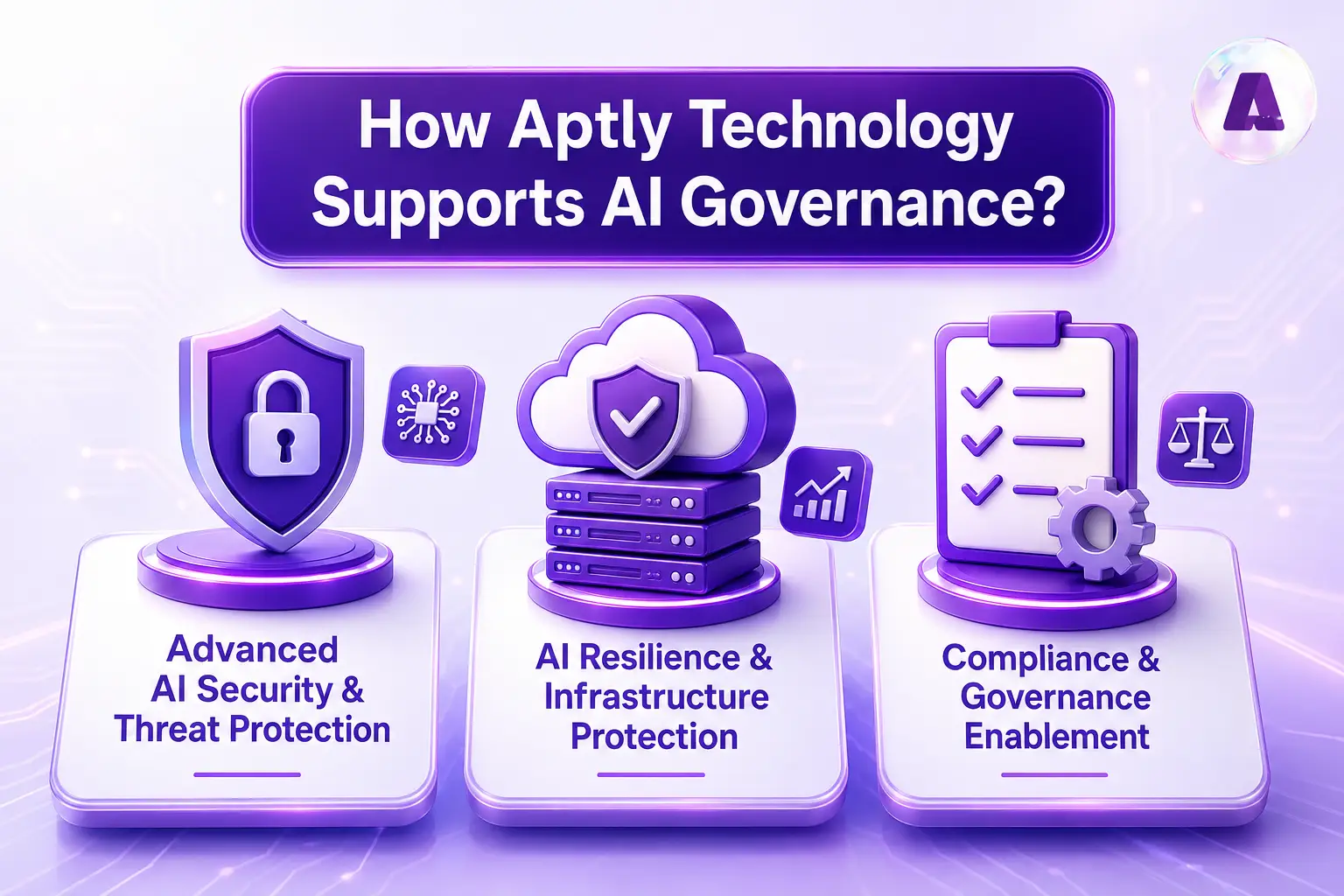
To address these risks, Aptly Tech delivers:
Advanced AI Security & Threat Protection
Aptly helps secure AI infrastructure through machine learning-based threat detection, real-time anomaly monitoring, intelligent incident response, and proactive security controls that protect AI systems from breaches, adversarial attacks, and unauthorized access.
AI Resilience & Infrastructure Protection
The company supports backup and disaster recovery strategies for AI environments, including protection for model weights, agent configurations, and Retrieval-Augmented Generation (RAG) knowledge bases. Secure network segmentation further reduces the risk of unauthorized AI access across enterprise systems.
Compliance & Governance Enablement
Aptly aligns AI deployments with standards such as ISO/IEC 42001 and emerging AI governance frameworks. Its consulting services also help organizations establish AI governance policies, lifecycle management strategies, and enterprise-wide compliance procedures.
Conclusion
AI agent governance is critical for enterprises deploying autonomous AI systems. Organizations now operate in an environment where AI security, regulatory compliance, observability, and accountability directly affect operational risk. With a mature governance strategy, your organization scale AI confidently while reducing security exposure and compliance uncertainty.
Schedule a governance readiness assessment with Aptly Technology to evaluate your enterprise AI governance strategy and infrastructure controls.
FAQs
Q: What is AI agent governance?
AI agent governance refers to the policies, technologies, and operational controls that ensure AI agents operate safely, ethically, and within regulatory requirements.
Q: How do enterprises govern AI agents?
Enterprises govern AI agents through identity controls, monitoring systems, audit logging, policy management, AI observability, and regulatory compliance frameworks.
Q: What are the security risks of AI agents?
Common risks include prompt injection attacks, privilege escalation, data leakage, insecure integrations, and third-party supply chain vulnerabilities.
Q: How do organizations monitor AI agent behavior?
Organizations use AI observability platforms, logging systems, anomaly detection tools, and Security Information and Event Management integrations to track AI activity.
Q: What is the best AI governance framework for enterprises?
Many organizations combine the NIST AI Risk Management Framework, ISO 42001, GDPR requirements, SOC 2 controls, and ISO 27001 practices into a unified enterprise AI governance framework.
Q: How can organizations build trustworthy AI agents?
Organizations build trustworthy AI agents by implementing explainability, human oversight, access controls, monitoring, security testing, and compliance-focused governance processes.