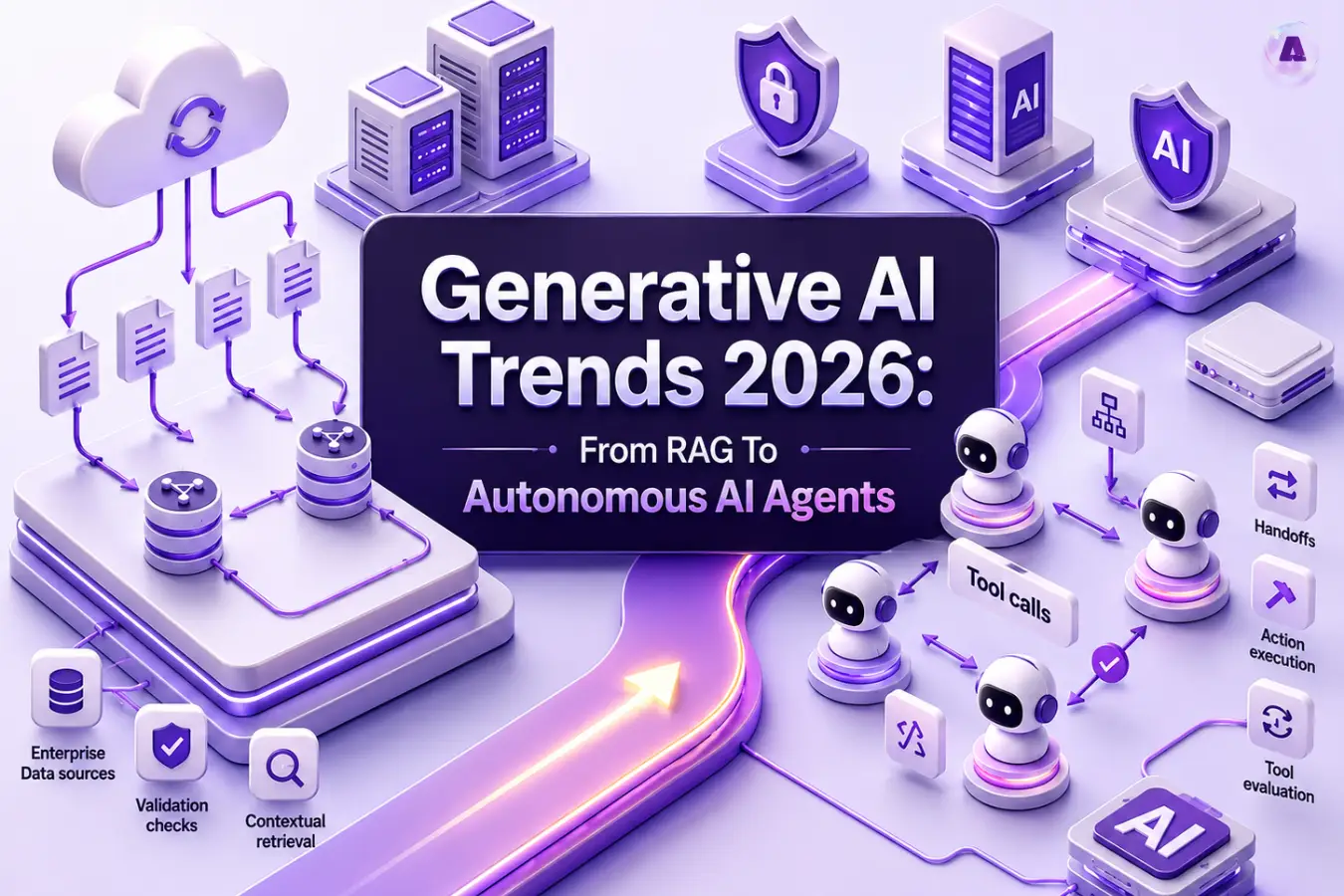
If your 2025 AI roadmap stopped at a chatbot and a retrieval pipeline, 2026 already looks different. Generative AI trends 2026 pointed toward one destination: software that acts on your behalf instead of waiting on a prompt. That destination arrived faster than most planning cycles expected.
Gartner names multiagent systems among its Top Strategic Technology Trends for 2026, and Google Cloud found 70% of enterprises already run AI agents in production. The adoption curve is real. So is the governance gap behind it.
This guide covers the Generative AI trends 2026 already in motion, what changed by 2026, and what your infrastructure, governance, and engineering teams build next. Aptly Technology, the only Microsoft-trusted supplier authorized to build and support third-party hyperscale datacenters worldwide, works on exactly this shift, from agent architecture down to the GPU racks running it.
What do the Generative AI Trends 2026 Mean for Enterprises?
Generative AI trends 2026 tracked five shifts: AI-first software, agentic execution, real-time voice interaction, adaptive interfaces, and RAG systems built to act instead of only retrieve. By 2026, four of five moved from prediction to standard architecture. The fifth, adaptive interfaces, is closing the gap fast.
Gartner groups its 2026 trend list into themes. “The Architect” covers AI-native development platforms and AI supercomputing. “The Synthesist” covers multiagent systems, domain-specific language models, and physical AI. Both describe the same shift. Intelligence is no longer a feature added to an application. It is the application.
The adoption numbers back this reading. Google Cloud’s 2026 AI Agent Trends Report, built on a survey of 3,466 executives, found 70% of enterprises run agents in production today. For a closer look at how these systems split work across specialized roles, see Aptly’s breakdown of single-agent vs multi-agent AI systems.
From AI-Infused To AI-First: Applications Built Around Intelligence
AI-first applications build reasoning into the product from day one instead of adding a chatbot after launch. That distinction, first flagged among the Generative AI trends 2026, now separates category leaders from legacy tools with a copilot bolted on.
Enterprise software vendors spent 2024 and 2025 wiring large language models into existing menus and buttons. 2026 looks different. Development platforms like Cursor and Windsurf, and low-code agent builders inside CRM and ERP suites, treat the model as the runtime, not a feature flag. Gartner’s AI-native development platforms trend names this shift directly: engineering teams now design applications around what a model reasons through, not only what a form captures.
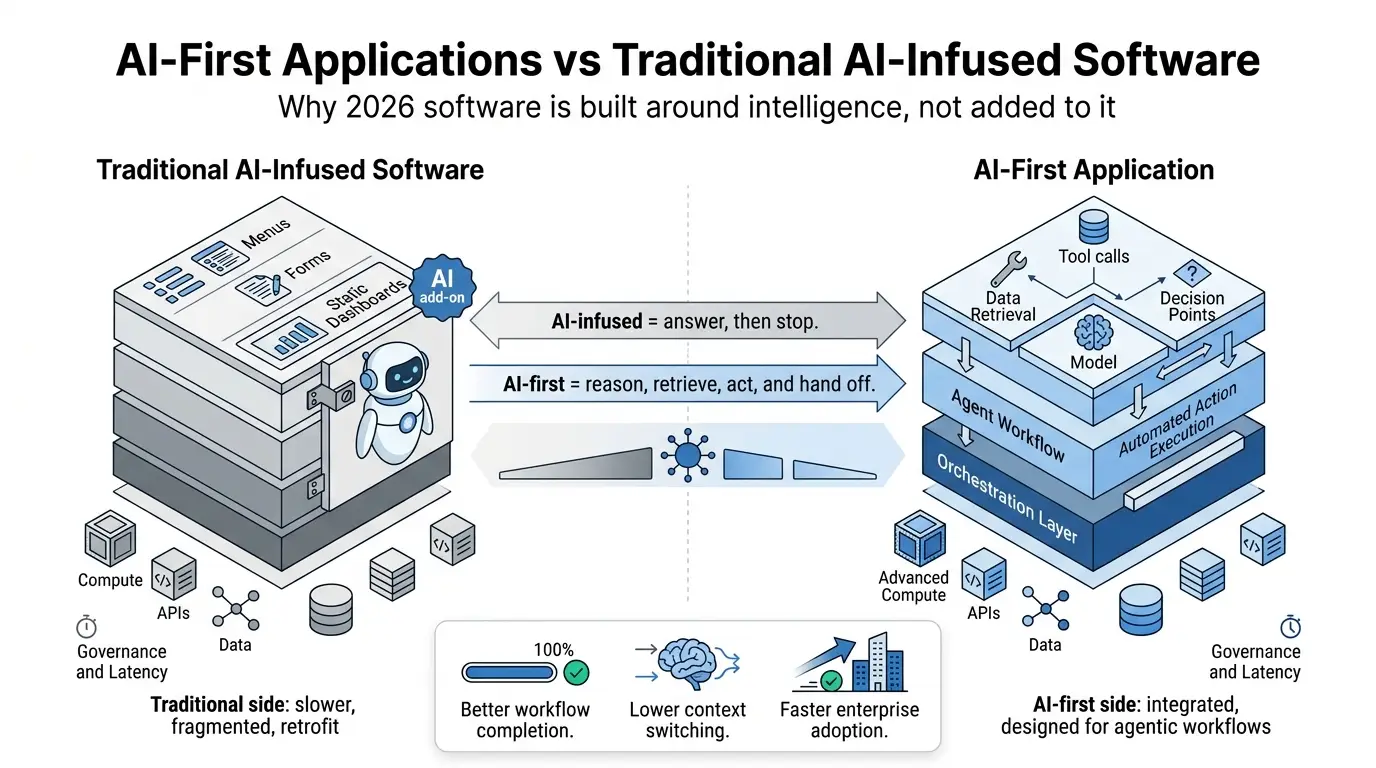
For enterprise IT leaders, this shows up in procurement. Buying decisions increasingly hinge on whether a platform was built AI-first or retrofitted, since retrofitted tools tend to hit context and latency limits agentic workflows do not tolerate. Aptly’s earlier look at how generative AI applications are increasing productivity covers this shift, and teams rebuilding around AI-native tools often start with AI Workload Deployment & Optimization to size compute and orchestration correctly before the application layer catches up.
Generative AI Trends 2026: Agents That Act, Not Just Analyze
Agentic AI turns software from an assistant that answers questions into a system that finishes the task. This is the Generative AI trends 2026 storyline that scaled fastest, and by 2026 it sets the default bar for new enterprise deployments.
The “Service as Software” model Salesforce and other platforms popularized in 2025 is now standard. A CRM agent does not stop at summarizing a lead. It drafts the follow-up, sends it, updates the pipeline, and flags the deal for a person only when judgment matters more than execution. Deloitte’s 2026 State of AI in the Enterprise survey, which reached 3,235 leaders, found agentic AI use cases in customer support, supply chain, R&D, and cybersecurity carry the highest expected impact.
Accenture’s research tells a similar story from a different angle. Its Pulse of Change survey found only 32% of leaders report sustained, enterprise-wide AI impact, even though most executives expect AI to lift revenue. The gap is delivery, not ambition, and closing it is the job of forward-deployed engineering. Aptly’s Forward-Deployed AI Engineering Services build agent architecture, enterprise data integration, and governance into the first sprint instead of adding them after a pilot succeeds.
From RAG To Agentic RAG: Retrieval Becomes A Decision Engine
Agentic RAG pairs retrieval-augmented generation with specialized agents that break a query into steps, retrieve from multiple sources, check confidence, and act on the answer. This is the technical core of the Generative AI trends 2026 shift from search to execution, and it is now the standard enterprise architecture.
| Capability | RAG (2024-2025) | Agentic RAG (2026) |
|---|---|---|
| Retrieval scope | Single knowledge base, one query | Multiple sources, multi-step, self-correcting |
| Validation | Model trusts the retrieved chunk | Agent checks confidence, re-queries weak evidence |
| Output | Answer returned to a person | Triggers a workflow or transaction |
| Governance | Access control at the interface | Enforced at retrieval, tied to identity |
| Standard | Custom connector per data source | MCP and Agent2Agent handle the connection |
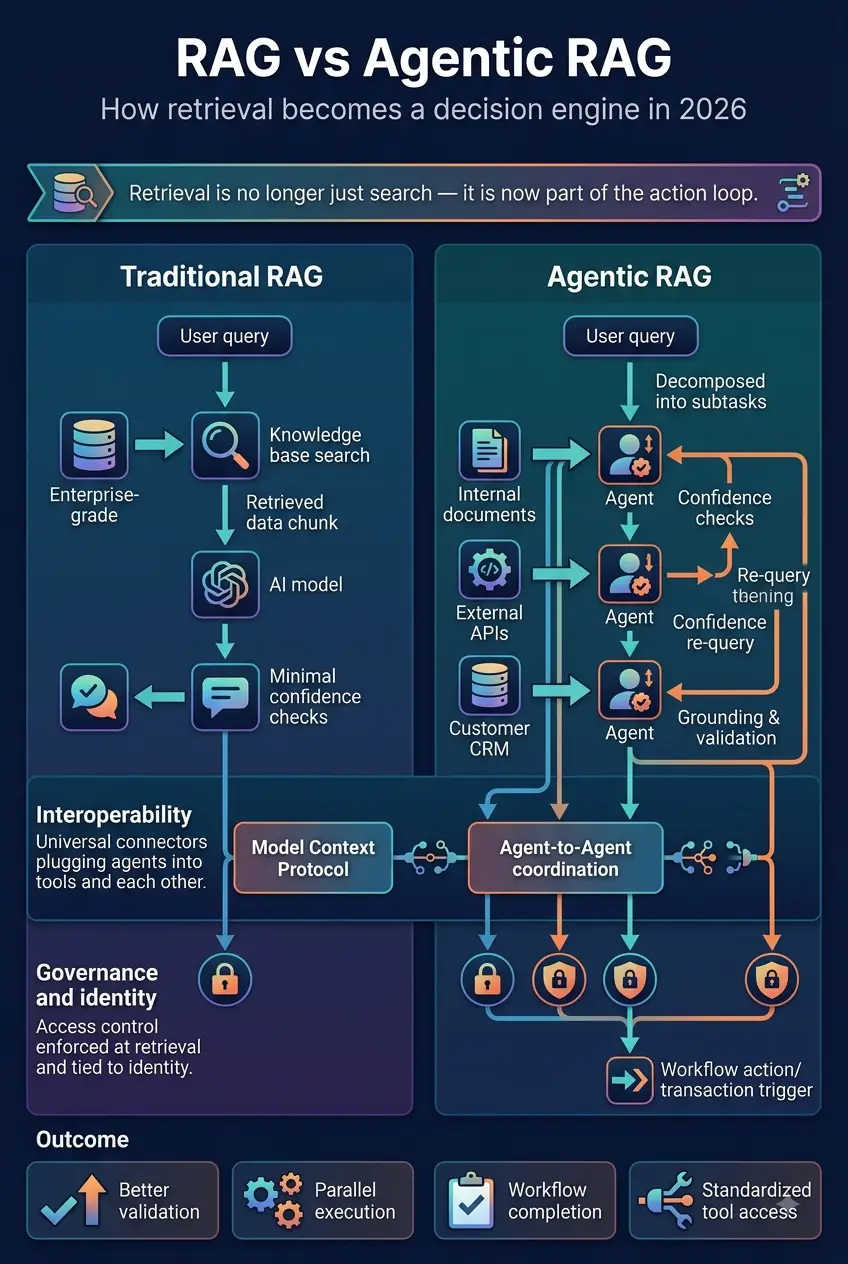
Interoperability standards made this shift practical. Model Context Protocol, introduced by Anthropic and now paired with Agent2Agent under the Linux Foundation, gives agents one way to reach enterprise tools and each other. A recent survey of agent interoperability protocols puts the Model Context Protocol ecosystem at over 110 million monthly downloads, with Agent2Agent counting more than 150 supporting organizations. Enterprises no longer need a custom connector for every data source an agent touches.
Multi-agent coordination is the part most teams underestimate. A single agent that retrieves and answers well is not the same as a system of agents dividing a workflow, handing off tasks, and recovering when one step fails. Enterprises building this kind of fabric need retrieval infrastructure and vector search capacity planned in advance, core to Aptly’s AI Infrastructure Readiness work.
For example, a global logistics enterprise learned this the hard way. Its first agent handled shipment delay queries well: it retrieved tracking data, checked weather feeds, and answered “where’s my container” in seconds. Leadership assumed scaling meant adding more agents like it.
It didn’t work that way. A customer asked why a shipment was delayed and what it would cost to expedite. That single question needed four agents: one to pull tracking data, one to check carrier contracts, one to calculate rebooking costs against current freight rates, and one to draft the response. The first agent, built for lookups, had no way to hand off a pricing question or recover when the contracts agent timed out.
The fix wasn’t a smarter model. It was infrastructure. The team rebuilt around a shared retrieval layer with vector search sized for concurrent multi-agent queries, plus a coordination layer that reassigned failed steps instead of failing the whole workflow. Query latency dropped by half, and the system stopped stalling when one data source lagged.
The lesson holds across industries: a helpful agent and a working agent fabric are different engineering problems, and the second one gets planned, not improvised.
Real-Time, Multimodal Interfaces Redefine How Teams Work With AI
Real-time speech and multimodal interaction remove the keyboard as the only way to work with AI. Employees talk to a system the way they would brief a colleague, and the system responds, adjusts, and acts inside the same exchange.
This Generative AI trends 2026 prediction held up well. Voice-native interfaces no longer need a perfectly typed prompt or a technical operator. A sales rep describes a deal update out loud between calls. Nearly half of organizations running agents in production already use them for customer service, and grounding those agents in real enterprise data separates a useful agent from a generic chatbot.
Generative interfaces are the other half of this trend. Instead of a static dashboard, the interface builds itself around the task and the role, showing a support agent different fields than it shows a finance analyst working the same system. Real-time speech and adaptive interfaces together make enterprise software less like a form to fill out and more like a colleague to brief, a different design target for the AI Application Deployment work most enterprise teams are only starting.
AI Governance In Enterprises: Why Responsible AI Is Now A Deployment Requirement
AI governance in enterprises stopped being optional on August 2, 2026, the day the EU AI Act’s transparency rules for generative AI content became enforceable. Responsible AI implementation is now the deployment requirement behind every Generative AI trends 2026 rollout, not a policy document sitting next to the roadmap.
The European Commission’s AI Office started enforcing Article 50 rules this month, requiring clear labeling on AI systems and AI-generated content. High-risk rules under Annex III were pushed to December 2027, but the direction is set. Regulators expect audit trails, human oversight, and documented risk management. Agentic systems acting without a paper trail will not clear procurement in regulated industries.
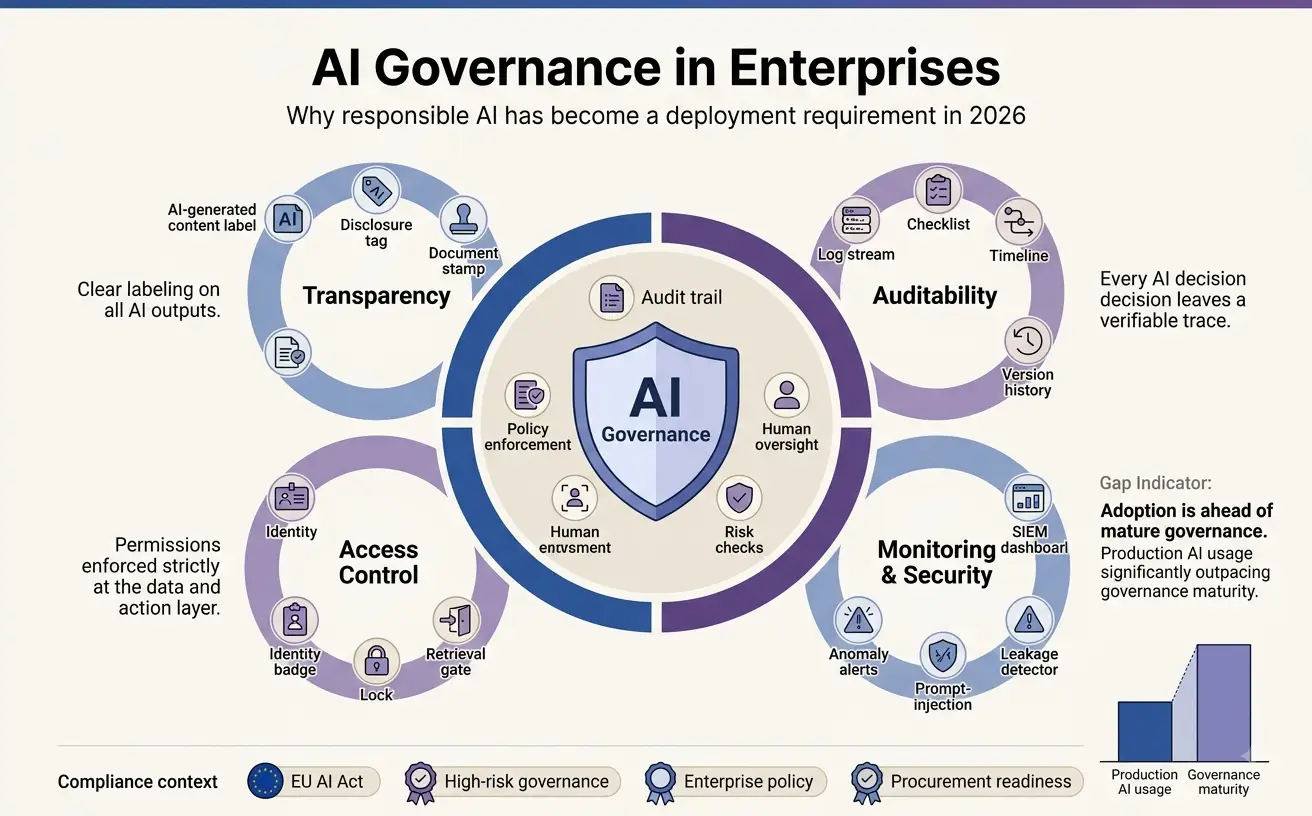
The enterprise data backs the urgency. Only 21% of organizations run a mature agent governance model even as agentic AI usage scales fast across functions. Gartner’s AI Security Platforms trend addresses the same gap from a technical angle: centralized platforms that enforce usage policies, watch for prompt injection and data leakage, and guardrail every agent an enterprise runs.
AI-driven decision-making holds up under review only when the decision trail is complete: what data the agent touched, why it chose an action, and who can override it. Building that trail is security, engineering, and compliance work together, the exact scope Aptly folds into every Forward-Deployed AI Engineering and Cloud Security Services engagement instead of treating governance as a separate project.
Aptly’s AI Governance: ISO Certified, GCC Compliant
Aptly holds its own AI governance work to the same standard it asks of clients. The company is certified to ISO/IEC 42001:2023, the international standard for AI management systems, alongside ISO 27001 for information security and SOC 2 for operational controls. Compliance extends to Microsoft Government Community Cloud (GCC) requirements, giving public sector and defense-adjacent clients a path to deploy agentic AI without a separate compliance track. These certifications set the audit trail, access control, and risk management practices every Aptly engagement runs on, from a single retrieval pipeline to a multi-agent fleet running on Aptly-built GPU infrastructure.
Domain-Specific Language Models: Precision Over Scale
Domain-specific language models trade general knowledge for accuracy on a narrow task, and enterprises are making that trade at scale. This is one of the Generative AI trends 2026 that moved faster than most roadmaps accounted for.
Gartner projects organizations will run small, task-specific AI models three times more than general-purpose LLMs by 2027, and domain-specific variants carry up to 50% lower development costs alongside more consistent accuracy on business-critical workflows. The logic is straightforward. A claims-processing agent does not need a model built to write poetry too. It needs one tuned on claims language, policy terms, and historical adjustments, running at a fraction of the token cost of a frontier model.
The shift changes procurement conversations more than technology roadmaps. IT leaders now route routine, high-frequency tasks to smaller fine-tuned models and reserve expensive frontier-scale inference for complex reasoning, the kind of workload orchestration Aptly builds into every AI Workload Deployment & Optimization engagement. Smaller models also run on-premises or in a private cloud more easily than a frontier LLM, which keeps sensitive data inside the perimeter, a governance benefit most CXOs were not expecting from a cost-cutting move.
Physical AI: Agentic Systems Move Off The Screen And Onto The Floor
Physical AI pairs agentic reasoning with robots, forklifts, and industrial equipment, extending Generative AI trends 2026 past software and into warehouses, factories, and datacenters.
NVIDIA framed this shift directly at its 2026 GTC keynote: every industrial company becomes a robotics company. The company’s Cosmos world models and Isaac GR00T foundation models train robots in synthetic environments before they touch a real floor, and partners including KION Group, working with NVIDIA and Accenture, now run physics-accurate warehouse digital twins to test autonomous forklift fleets before deployment.
The infrastructure implications land closer to home for most enterprise IT teams than robotics itself does. Physical AI workloads run continuous simulation and inference at the edge, alongside the training clusters that build the underlying world models, which raises the same GPU capacity and rack density questions covered earlier in this piece.
What Mature Organizations Do Differently In 2026
Mature organizations treat Generative AI trends 2026 as an operating change, not a tools rollout. They fund governance and infrastructure alongside the agent, not as later phases.
| Practice | Stuck In Pilot Mode | Scaling Production Agents |
|---|---|---|
| Governance | Added after an incident | Built in from day one |
| Infrastructure | Provisioned per project | Planned ahead for GPU demand |
| Ownership | Split across vendors | Forward-deployed teams owns delivery |
| Measurement | Usage logs only | ROI tracked against preset baselines |
Every one of these practices touches infrastructure before it touches the model. Agentic workloads run inference continuously instead of in short bursts, which changes GPU utilization, power draw, and rack density planning. Aptly’s guide on planning on-prem infrastructure for generative AI covers this in depth, and enterprises scaling GPU-heavy agent fleets often pair that planning with GPU Datacenter Buildout & Support built specifically for AI-first workloads rather than resized legacy capacity.
Organizations pulling ahead also treat forward-deployed engineering as a distinct discipline from AI consulting. A strategy deck does not deploy an agent into production. Aptly’s own breakdown of forward deployed engineer vs AI consultant work explains why the two roles solve different problems, and why enterprises scaling past their first agent tend to need both.
Preparing For The Next Phase Of Generative AI Trends 2026
Generative AI trends 2026 promised a shift from AI-infused software to AI-first, agent-driven operations. That shift is no longer a prediction. It is the baseline enterprise IT and business leaders plan against for the rest of 2026.
Four things hold true now. Agentic AI already runs in production at most large enterprises. Agentic RAG, not simple retrieval, is the technical foundation underneath it. Governance has not kept pace with adoption, the single biggest risk on the table. And the infrastructure question, GPU capacity, inference cost, rack density, decides which of these deployments scale and which stall.
Aptly Technology is the only Microsoft-trusted supplier authorized to build and support third-party hyperscale datacenters worldwide, with direct partnerships across NVIDIA and Supermicro and certification to ISO/IEC 42001:2023. Agent engineering through AptlyStar and Forward-Deployed AI Engineering, backed by GPU datacenter infrastructure built for AI-first workloads, turns a Generative AI trends 2026 roadmap into a production system your CFO can defend and your compliance team can audit.
Talk to Aptly about your agentic AI roadmap, infrastructure plan, and governance model at aptlytech.com, or contact the team directly.
Frequently Asked Questions (FAQ)
- What are the Generative AI trends 2026 that carried into 2026?
- The five Generative AI trends 2026 named were AI-first applications, agentic AI that takes action, real-time voice interaction, generative interfaces, and RAG systems built to execute instead of only retrieve. By 2026, agentic AI and agentic RAG moved fastest, with Google Cloud reporting 70% of enterprises running agents in production.
- How is agentic AI different from earlier generative AI applications?
- Earlier generative AI applications answer a question and stop there. Agentic AI plans a sequence of steps, calls tools and systems, and finishes the task, escalating to a person only when judgment is required. This distinction sits at the center of the Generative AI trends 2026 conversation and changes how enterprises measure ROI.
- What role does RAG play in enterprise AI in 2026?
- RAG still grounds enterprise AI in trusted data, but the architecture shifted. Agentic RAG, where specialized agents decompose a query, retrieve from multiple sources, and re-query when evidence is weak, is now the dominant pattern. RAG was the retrieval layer that made the agentic side of Generative AI trends 2026 trustworthy enough to deploy.
- Why does AI governance in enterprises matter more in 2026?
- AI governance in enterprises became a legal requirement once the EU AI Act’s transparency rules for generative AI content took effect on August 2, 2026. Deloitte found only 21% of organizations run a mature agent governance model despite agentic AI scaling fast across functions. Responsible AI implementation and access controls at retrieval now decide which Generative AI trends 2026 deployments survive compliance review.
- What infrastructure do enterprises need to support Generative AI trends 2026 and beyond?
- Agentic workloads run inference continuously, raising GPU utilization, power draw, and rack density needs well beyond a typical pilot. Enterprises scaling agent fleets need AI-ready GPU capacity and infrastructure planned around inference demand, not resized legacy data center space.
- What role does Aptly play in helping enterprises act on Generative AI trends 2026?
- Aptly Technology pairs AptlyStar, its RAG-powered GenAI agent platform, with Forward-Deployed AI Engineering Services that carry agents from architecture through production. Aptly also builds and operates the GPU datacenter infrastructure agentic workloads run on, backed by partnerships with NVIDIA and Supermicro and certification to ISO/IEC 42001:2023, so enterprises get the agent strategy and the infrastructure behind Generative AI trends 2026 from one accountable partner.
Related Articles:
More on the infrastructure and governance side of Generative AI trends 2026:
- Single-Agent vs Multi-Agent AI Systems: Which One Powers the Future of Enterprise Intelligence? (GenAI)
- How to Plan On-Prem Infrastructure for Generative AI: A Practical Guide for I&O Leaders (GenAI)
- Forward Deployed Engineer vs. AI Consultant: Which One Actually Gets AI Into Production? (AI Infrastructure)
Table of content
- TL; DR
- What do the Generative AI Trends 2026 Mean for Enterprises?
- From AI-Infused To AI-First: Applications Built Around Intelligence
- Generative AI Trends 2026: Agents That Act, Not Just Analyze
- From RAG To Agentic RAG: Retrieval Becomes A Decision Engine
- Real-Time, Multimodal Interfaces Redefine How Teams Work With AI
- AI Governance In Enterprises: Why Responsible AI Is Now A Deployment Requirement
- Domain-Specific Language Models: Precision Over Scale
- Physical AI: Agentic Systems Move Off The Screen And Onto The Floor
- What Mature Organizations Do Differently In 2026
- Preparing For The Next Phase Of Generative AI Trends 2026
- Frequently Asked Questions (FAQ)
- Related Articles: