Introduction
Enterprises have never invested more in AI capabilities. Every firm explores GenAI, intelligent automation, AI agents, RAG, and LLMs to enhance business operations and customer experiences. Despite increasing investments, many AI initiatives did not progress beyond PoC stages or internal demos.
The biggest obstacle is not the quality of the AI model, but the delivery model is chosen to implement that solution. Most of the technical leaders hire an AI consultant expecting a product-ready system. These efforts end up with strategy documents, disconnected architecture recommendations, and a roadmap to nowhere. Industry experts call this trap “Pilot Purgatory” or “AI Theater.”
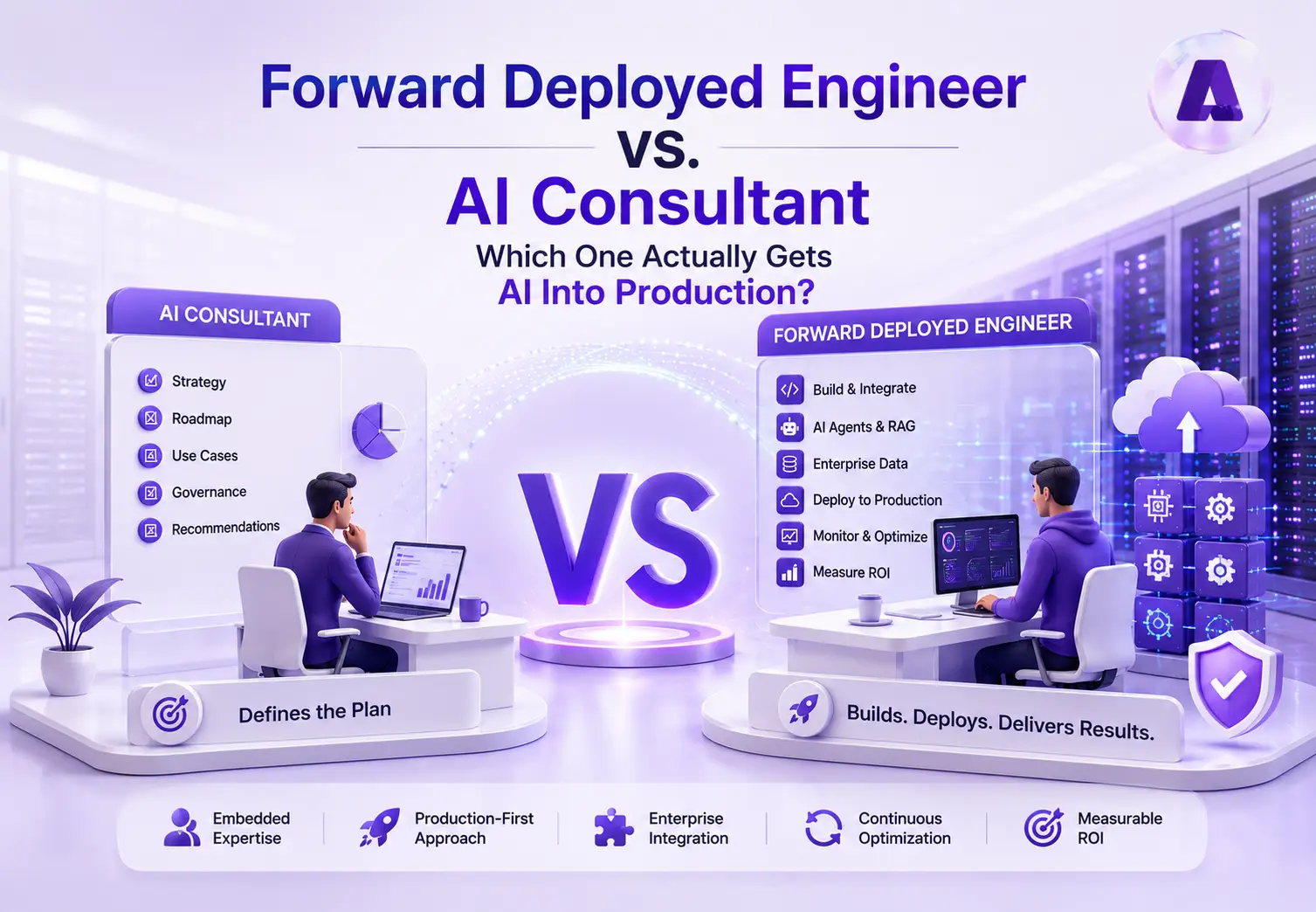
This is where the discussion around forward deployed engineer vs AI consultant becomes important. The right choice can determine whether your AI project reaches production or stalls before delivering value. While AI consultants focus on defining the strategy, FDEs help turn that strategy into productive systems.
So, when it comes to getting AI into production, which approach delivers better results? Let’s jump into technical realities.
Why Most AI Projects Fail After the Pilot Stage?
According to NTT DATA, nearly 85% of AI projects fail to reach sustained production, despite successful pilots. Let’s check out why most AI projects fail after the pilot stage:
- The data was not prepared or tested for real-world, large-scale use.
- No leader took responsibility for driving the AI project beyond the pilot.
- The focus was on proving the AI worked rather than delivering long-term business value.
- Security, compliance, and AI governance were addressed too late.
- Employees were not prepared to adopt and use the AI solution.
- The systems needed to deploy, monitor, and maintain AI models were not in place.
Overcoming these challenges requires more than strategy. It demands hands-on execution, which is where the difference between a forward deployed engineer vs AI consultant becomes clear.
What Does an AI Consultant Do?
An AI consultant helps organizations define their AI strategy. Engagements begin with business assessments, stakeholder interviews, technical workshops, and use-case discovery sessions. The objective is to identify opportunities where AI can create measurable results while aligning initiatives with enterprise priorities.
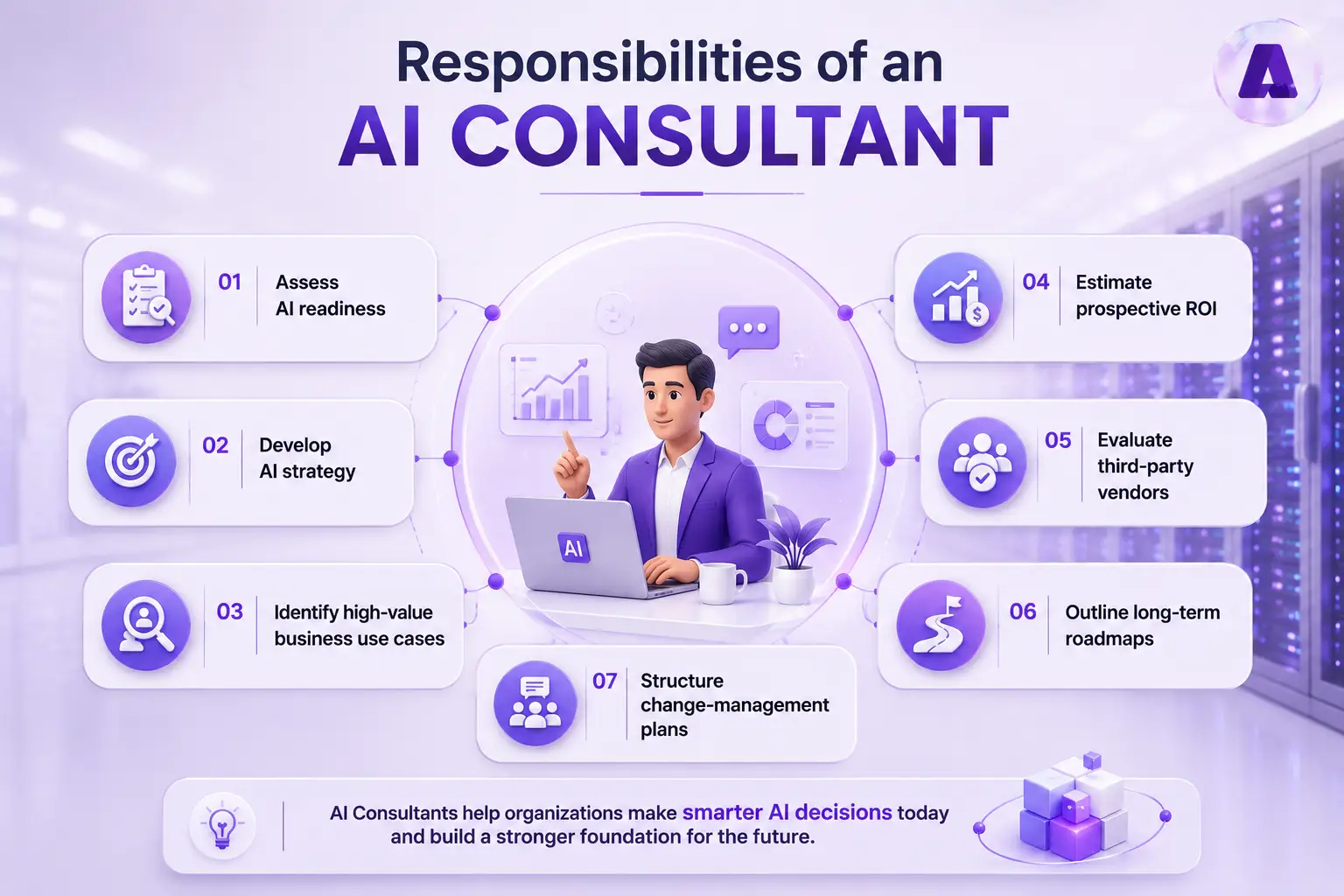
AI advisory services usually end with strategy and recommendations. After the engagement, execution is handed over to internal teams. When they encounter challenges like real-time streaming bottlenecks, API rate limits, or vector database latency, consultants rarely stay involved to resolve them. This is where a forward deployed engineer provides hands-on support, working alongside the team to overcome technical roadblocks and keep AI projects moving toward production.
What Does a Forward Deployed Engineer Do?
A forward deployed engineer is an enterprise embedded AI engineer who works directly with your technical team to build, deploy, and improve AI solutions. Instead of only providing recommendations, FDEs take a hands-on approach by solving technical challenges and helping bring AI projects into production.
Here is the technical stack managed by an embedded specialist:
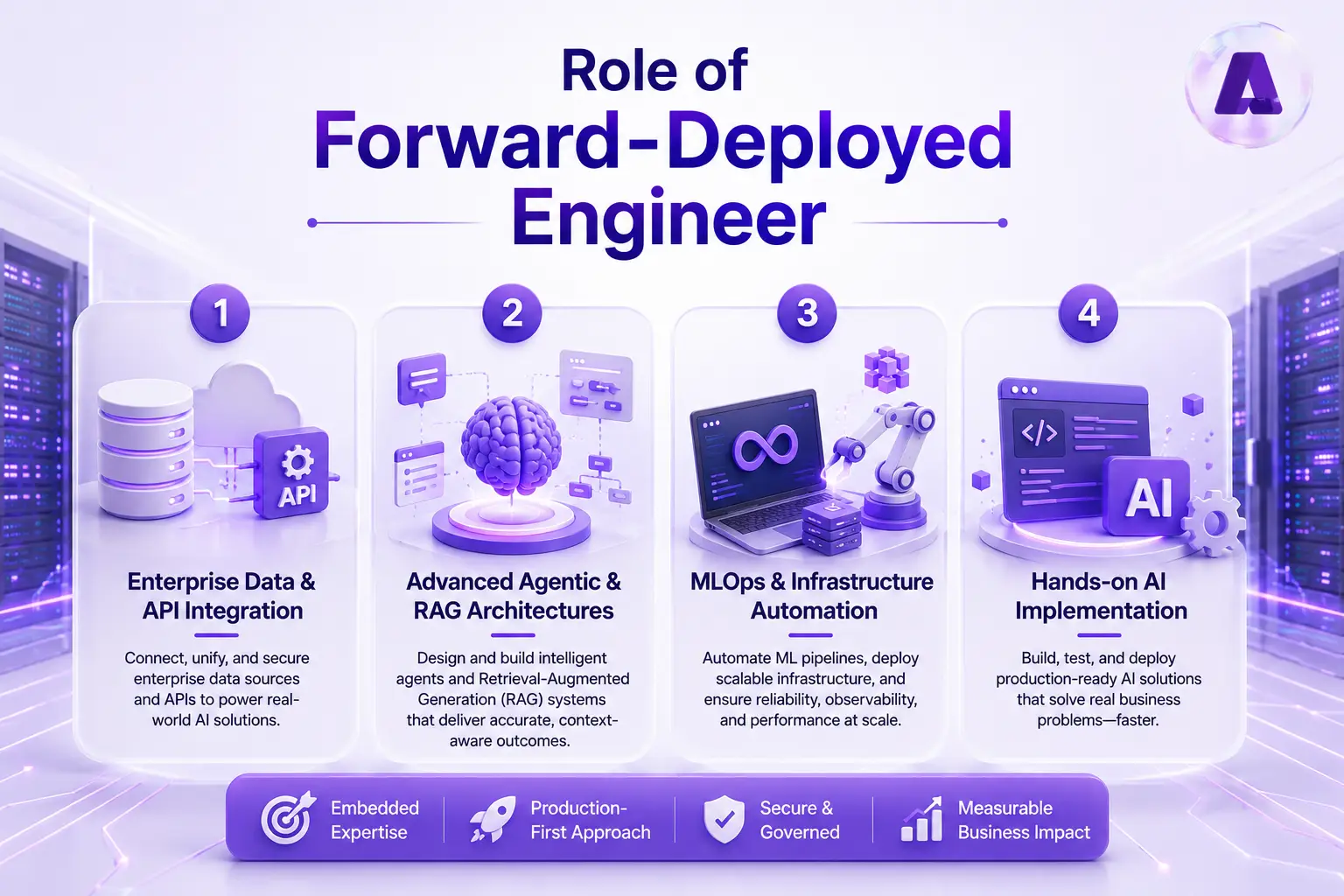
By working alongside your engineers, FDEs build production-ready AI solutions and help your team gain the skills needed to maintain and improve them over time.
Benefits of the Forward Deployed Engineering Model
The growing adoption of forward deployed engineering reflects the following practical advantages:
Accelerates Time to Production
Embedded engineers resolve implementation challenges as they arise. This reduces delays between PoC and enterprise deployment.
Improves Cross-Functional Collaboration
Daily collaboration between business leaders, software developers, infrastructure teams, and AI engineers improves alignment throughout implementation.
Reduces Deployment Risk
Security, governance, infrastructure, and operational considerations are addressed continuously rather than after development is complete.
Enables Better Knowledge Transfer
Instead of handing over documentation at project completion, FDEs share expertise throughout the engagement, helping internal teams become self-sufficient over time.
Delivers Measurable Business Outcomes
The success of forward deployed engineering is measured by operational AI systems, user adoption, and business impact rather than project milestones or completed reports.
Forward Deployed Engineering Model Use Cases
The forward deployed engineering model gained prominence through Palantir Technologies. These engineers collaborated with users, domain experts, and IT teams to build, refine, and deploy software that addresses real-world business needs. Some notable use cases include:
Supply Chain: Optimizing Production with ERP Data
Challenge: ERP data was spread across different systems, making profitability analysis slow and manual. Teams lacked visibility into raw material costs, production efficiency, and SKU-level profitability.
FDE Model Solution
- Integrated 7+ ERP data sources into a unified digital twin of the supply chain.
- Built a no-code operational view, enabling teams to analyze plants, SKUs, costs, and production in real time.
- Created SKU-level COGS and profitability models to support better production and purchasing decisions.
Impact
- Up to $100 million in annual savings from a 1–2% improvement in production efficiency.
- Seven ERP systems are integrated within 5 days.
- Raw material optimization that previously took weeks can now be completed in minutes.
Financial Services: Improving Collections and Merchant Retention
Challenge: A payments processor requires incrementing the revenue from small-to-medium merchants by optimizing collections, repricing fewer sensitive merchants, and retaining high-value customers at risk of churning. With disconnected customer and transaction data at scale, analyses to prioritize collections and optimize merchant pricing necessary becomes difficult.
FDE Solution
- Unified customer, payment, fraud, billing, and pricing data into a single operational view.
- Built predictive models to identify merchants most likely to repay. High-priority accounts were assigned to internal collections teams, while low accounts were routed to third-party agencies.
- Analyzed merchant behavior and pricing data to identify optimal fee structures. Sales teams used these insights to price new merchants and reprice existing accounts.
Impact
- Improved account prioritization generated millions in additional annual collections.
- Optimized merchant repricing increased customer retention and delivered millions in additional revenue.
A Common Pattern Across Successful Deployments
Across industries, successful forward deployed engineering engagements share several characteristics:
- Engineers work directly with business and technical stakeholders.
- AI solutions are integrated into existing enterprise systems rather than built in isolation.
- Continuous feedback drives rapid iteration and improvement.
- Deployment, monitoring, and optimization continue after launch.
These examples demonstrate that the value of the FDE model lies in technical expertise and its ability to bridge the gap between business strategy and production execution.
Challenges and Risks of the Forward Deployed Engineering Model
While forward deployed engineering offers significant advantages, organizations should also recognize potential implementation risks. Common considerations include:
- Ensuring appropriate governance for embedded external engineers.
- Defining intellectual property ownership before project initiation.
- Managing access to sensitive enterprise systems and data.
- Preventing long-term dependency through structured knowledge transfer.
- Establishing clear exit plans and operational handover processes.
These risks require careful planning and governance to ensure sustainable long-term success. Gartner recommends clear engagement models, strong governance practices, and deliberate knowledge transfer to maximize the value of embedded engineering teams.
How to Successfully Execute Forward Deployed Engineering Engagement?
The success of a FDE engagement depends on choosing the right business problem, embedding engineers with domain experts, maintaining rapid delivery cycles, and establishing clear ownership throughout the implementation lifecycle. Gartner highlights several practices that helps organizations maximize the value of embedded engineering teams.
1. Choose Problems That OnlyForwardDeployed Engineers Can Solve
Forward deployed engineering should be reserved for high-value problems where operational complexity is the primary obstacle.
Successful FDE engagements typically focus on initiatives that:
- Have executive sponsorship and clearly defined business ownership.
- Require deep integration with legacy systems, enterprise applications, or complex workflows.
- Cannot be solved using off-the-shelf AI products or standard implementations.
- Are constrained by operational complexity rather than missing data or unclear business ownership.
Conversely, FDEs should not be assigned to routine AI deployments, unresolved data quality issues, or projects where organizational alignment has not yet been established. Before an engagement begins, organizations should also evaluate the integration effort required. If access approvals, security reviews, and provisioning activities consume most of the planned engagement window, reconsider the project’s scope.
2. Embed FDEs With Domain Experts
One of the defining characteristics of the FDE model is that engineers learn by observing how work happens. Rather than relying solely on requirements documents or working primarily through IT teams, FDEs works directly with the domain experts. So, FDEs can possess tacit knowledge, workarounds, and decision-making practices that are rarely documented but are essential for building effective AI solutions.
3. Deliver Working Software Every Week
Forward Deployed Engineering relies on rapid validation rather than lengthy implementation cycles. It is recommended to maintain a weekly cadence where each sprint produces:
- Working code connected to production data rather than isolated test environments.
- Hands-on evaluation by domain experts.
- Updates to the product requirements document to reflect new discoveries and evolving requirements.
This iterative approach allows organizations to identify misalignment early. If an AI solution is solving the wrong problem, adjustments can be made within weeks instead of after months of development.
4. Define Clear Ownership and a Structured Handoff
An FDE engagement should leave the organization with lasting capabilities instead of long-term dependence on external engineers. Before implementation begins, define:
- Intellectual property ownership
- Expected deliverables
- Handoff criteria that describe what internal independence looks like
- Service-level agreements for provisioning and system access
By the final sprint, FDE should be able to operate, troubleshoot, and deploy updates independently. Production runbooks, architecture documentation, and operational procedures should be treated as mandatory deliverables.
5. Prevent Coordination Drift in Multi-Partner Engagements
A FDE may build functionality that a systems integrator was expected to implement, while the consulting partner documents workflows that the FDE is already engineering. Although everyone appears busy, effort is duplicated and progress slows. It is a good practice of assigning every deliverable to a named individual and maintaining weekly joint reviews across all participating teams to identify and fix issues early.
Forward Deployed Engineer vs AI Consultant: Side-by-Side Comparison
Selecting an AI implementation partner requires evaluating how each engagement model affects day-to-day operations and project timelines.
To compare how these two models operate across technical and operational dimensions, review the table below:
| Feature | AI Consultant | Forward Deployed Engineer | Example |
|---|---|---|---|
| Major Goal | High-level AI strategy and planning | Production AI delivery | Production AI delivery |
| Engagement Model | Deliverable-based | Embedded engagement | Consultant delivers recommendations; FDE works alongside your engineering team throughout implementation. 2 |
| Primary Output | Reports, audits, roadmaps, and architecture diagrams | Production code and configured infrastructure | Consultant creates an AI roadmap; FDE develops and deploys the AI solution. |
| Hands-On Coding | Minimal to none | Extensive | Consultant reviews architecture; FDE writes code, test APIs, and deploys apps. |
| Enterprise Integration | Architectural recommendations | Hands-on pipeline and API engineering | Consultant suggests integrating Salesforce with an AI assistant; FDE builds the API integrations and data pipelines. |
| MLOps and Monitoring | Optional | Core operational responsibility | Consultant recommends monitoring practices; FDE implements model monitoring, logging, and alerts. |
| Production Support | Rare after project completion | Continuous and iterative optimization | Consultant completes the engagement after delivery; FDE continuously improves model performance after launch. |
| Ownership | Single advisory | Shared execution | Consultant advises on implementation; FDE shares responsibility for delivering production-ready AI. |
| Internal Team Collaboration | Periodic meetings | Daily standups and co-development | Consultant conducts weekly stakeholder reviews; FDE collaborates daily with developers, data engineers, and business users. |
| Success Metric | Project completed and document acceptance | AI successfully running in production | Consultant delivers an approved AI strategy; FDE delivers an AI app actively used by end-users. |
The above comparison illustrates why the discussion around forward deployed engineer vs AI consultant has become increasingly important.
Both engagement models provide value, but they solve different organizational challenges.
An AI consultant helps answer “What should we build?”
A forward deployed engineer helps answer “How do we successfully deploy, operate, and scale it?”
Enterprises selecting between hiring AI engineers vs consultants or AI consulting vs in-house engineering are no longer evaluating technical expertise alone. They are deciding which delivery model is more likely to produce measurable business outcomes. If your goal is moving AI from pilot to production, FDE is often the better choice. If you need strategic planning and executive guidance, an AI consultant is the right fit.
Forward Deployed Engineer vs AI Consultant: Which One Fits Your AI Strategy?
Determining whether to leverage fractional AI consulting or hire an embedded engineering resource depends entirely on your team’s current technical maturity and immediate business goals.
The decision matrix below outlines the optimal engagement model based on organizational needs:
| Hire an AI consultant if you need: | Hire a FDE if you need: |
|---|---|
| AI strategy and roadmap creation | AI deployment into production |
| Executive alignment on AI vision and budget allocations | Complex RAG apps implementation and scaling |
| Enterprise compliance and governance frameworks | Autonomous agent development |
| Vendor-neutral tool comparison and audits | Enterprise data integration into legacy system APIs |
| Business case validation | Production MLOps and ongoing deployment support |
Beyond FDEs and AI Consultants: Alternative AI Engagement Models
Enterprises in the early stages of AI adoption may benefit from AI consulting. As AI initiatives move toward production, the focus shifts from strategy to execution. Some organizations choose fractional AI consulting, where experienced advisors provide strategic guidance on a flexible, part-time basis. This model is well suited for executive decision-making, architecture reviews, and implementation planning.
Another effective option is a hybrid engagement, where AI consultants define the strategy while FDEs handle implementation. This approach combines strategic planning with hands-on engineering to accelerate production-ready AI deployments.
Ultimately, the best engagement model depends on your organization’s AI maturity and business objectives. In many cases, combining AI consulting with FDE provides the right mix of strategic direction and execution to accelerate AI deployment.
How Aptly’s Forward-Deployed AI Engineering Services Accelerate Enterprise AI?
Many enterprises already understand where AI can create value. Their biggest challenge is transforming promising ideas into enterprise-scale solutions.
Aptly’s Forward-Deployed AI Engineering Services are designed to bridge this gap. Rather than providing recommendations, Aptly’s engineers collaborate with business leaders, software developers, infrastructure teams, and security specialists throughout the AI implementation lifecycle. This embedded engagement enables enterprises to move beyond PoC projects and deliver production-ready AI systems.
Why Enterprises Choose Aptly’s FDE Model?
Organizations partner with Aptly Tech because its forward-deployed AI engineering services combine strategic thinking with hands-on engineering execution. Key differentiators include:
- Embedded delivery model that integrates with business and technical teams.
- Production-first approach focused on operational AI rather than prototypes.
- Expertise in enterprise AI, including AI agents, RAG, LLMs, and intelligent automation.
- Secure enterprise integration across applications, data platforms, and APIs.
- Responsible AI and governance embedded throughout implementation.
- Continuous optimization through monitoring, observability, and performance improvements.
- Knowledge transfer that empowers internal teams to manage and scale AI solutions.
- ROI measurement to demonstrate business value from day one.
Whether organizations are launching their first AI initiative or scaling AI across multiple business functions, Aptly’s FDE approach helps transform AI strategies into AI-ready enterprise solutions.
Conclusion
When evaluating Forward Deployed Engineer vs AI consultant, the right choice depends on where your organization is in its AI journey. AI consultants help define strategy and governance, while Forward Deployed Engineers turn that strategy into AI deployment solutions through hands-on implementation. Together, they enable organizations to move from planning to measurable business outcomes.
For enterprises ready to operationalize AI at scale, Aptly’s Forward Deployed AI Engineering Services provide the embedded engineering expertise needed to accelerate deployment, optimize performance, and deliver lasting business value.
Ready for your enterprise transformation journey? Connect with Aptly Tech’s FDE team.
FAQs
Q1. What is a Forward Deployed Engineer (FDE)?
A Forward Deployed Engineer is an experienced technical professional who works directly with customer teams to design, build, integrate, deploy, and optimize enterprise AI solutions. Unlike traditional advisory roles, FDEs remain involved throughout implementation and production operations.
Q2. How is a Forward Deployed Engineer different from an AI consultant?
AI consultants primarily focus on strategy, governance, planning, and technology recommendations. Forward Deployed Engineers focus on implementation, enterprise integration, deployment, and continuous optimization.
Q3. Does every AI project need a Forward Deployed Engineer?
Not necessarily. Organizations in the early stages of AI adoption may benefit from consulting engagements first. FDEs become most valuable when organizations are ready to implement and operationalize AI solutions.
Q4. Can Forward Deployed Engineers build AI agents and RAG applications?
Yes. Depending on the engagement, FDEs can design AI agents, implement Retrieval-Augmented Generation (RAG) systems, integrate enterprise data, and deploy production-ready AI applications.
Q5. Can AI consulting and FDE work together?
Yes. Many organizations use AI consultants to define strategy and governance before engaging Forward Deployed Engineers to execute, deploy, and optimize AI solutions.
Q6. How does Aptly help organizations move AI into production?
Aptly provides embedded Forward-Deployed AI Engineering Services that span AI strategy support, solution architecture, enterprise integration, AI agents, governance, production deployment, observability, continuous optimization, and ROI measurement.
Table of content
- TL;DR
- Introduction
- Why Most AI Projects Fail After the Pilot Stage?
- What Does an AI Consultant Do?
- What Does a Forward Deployed Engineer Do?
- Benefits of the Forward Deployed Engineering Model
- Forward Deployed Engineering Model Use Cases
- Challenges and Risks of the Forward Deployed Engineering Model
- How to Successfully Execute Forward Deployed Engineering Engagement?
- Forward Deployed Engineer vs AI Consultant: Side-by-Side Comparison
- Forward Deployed Engineer vs AI Consultant: Which One Fits Your AI Strategy?
- Beyond FDEs and AI Consultants: Alternative AI Engagement Models
- How Aptly’s Forward-Deployed AI Engineering Services Accelerate Enterprise AI?
- Conclusion
- FAQs