Introduction
In 2024, IBM reported that the average cost of a data breach reached $4.45 million globally. Now imagine feeding sensitive financial or healthcare data into an external AI model without control. That risk is exactly why many enterprises hesitate to move forward with AI.
You want the productivity benefits of automation and generative AI. But at the same time, exposing proprietary or customer data to third-party systems is not acceptable. This tension defines modern enterprise decision-making around AI.
Secure AI adoption is no longer optional. It is the foundation for scaling AI without compromising data sovereignty or enterprise data security. Organizations must rethink how they approach sensitive data protection when integrating AI into workflows.
This guide walks you through practical strategies, architectures, and governance models that allow you to use AI confidently. You will learn how to deploy AI systems that protect your data while still delivering value.
What Is AI Security? Why Every Enterprise Needs to Get This Right
AI security is a set of practices, controls, and frameworks that protect your data, AI models, and inference pipelines from unauthorized access, misuse, or leakage. Unlike traditional cybersecurity, it deals with risks unique to AI systems.
- Model inversion attacks can reconstruct training data from model outputs.
- Prompt injection can trick an AI system into executing unintended instructions.
- Data poisoning can corrupt model behavior at the training stage.
In a standard IT system, you mainly protect infrastructure and endpoints. With AI, you must also secure training data, model behavior, and outputs.
For enterprises, the stakes are higher. Industries such as banking, healthcare, legal, and government handle highly sensitive information. A single leak can lead to regulatory penalties and reputational damage.
This is where an AI governance framework becomes essential. It provides structured control over how AI systems are built, deployed, and monitored.
Remember: AI security isn’t just about firewalls — it’s about ensuring your model never becomes a liability.
What Are the Risks of AI Adoption for Enterprises?
Before you implement controls, you need to understand what can go wrong. A staggering 97% of organizations that experienced an AI-related breach lacked proper AI access controls. 63% had no AI governance policies in place to manage AI or prevent workers from using shadow AI.
Samsung famously banned ChatGPT after engineers leaked proprietary source code, and a 2024 Cyberhaven study found that 11% of data employees paste into ChatGPT is confidential — exposing trade secrets, PII, and internal IP at scale. When employees paste internal data into public tools, you lose control immediately. This creates serious AI data privacy issues.
Below is a quick breakdown of common risks and their impact:
| Risk | Impact |
|---|---|
| Data leakage to third-party LLM providers | Proprietary data, customer PII, or trade secrets exit your perimeter and may be used in model training |
| Model memorization | LLMs retain and reproduce fragments of training data, exposing sensitive records |
| Shadow AI | Employees using unauthorized AI tools bypass IT controls entirely — IBM found organizations with high shadow AI usage face $670,000 higher breach costs on average |
| Vendor lock-in and data residency violations | Cross-border data transfers may violate GDPR, India’s DPDP Act, or sector-specific mandates |
| Compliance exposure | HIPAA, SOC 2, and DPDP Act violations carry financial penalties and can disrupt operations |
Without proper AI compliance and security, enterprises risk fines, lawsuits, and loss of trust.
The Core Pillars of Secure Enterprise AI
To build a resilient system, you need a layered approach. These pillars form the foundation of secure enterprise AI.
Data Privacy and Protection in AI
- Start with strong data protection strategies. Encrypt data both in transit and at rest to reduce exposure.
- Use anonymization and tokenization to remove sensitive identifiers. This ensures that even if data is accessed, it cannot be traced back.
- Data minimization is equally important. Only feed necessary data into AI systems to maintain data sovereignty.
Access Control and Zero Trust Security
- Implement role-based access control (RBAC) to limit who can access data and models. Not every user needs full visibility.
- Adopt zero trust security principles. Verify every request, even within internal systems.
Secure AI Infrastructure
- Choose a private AI infrastructure to get greater control over sensitive data.
- Use on-premise AI deployment for maximum security.
- For flexibility, choose hybrid cloud AI balances scalability with control.
AI Model Governance and Monitoring
- Strong AI model governance ensures accountability. Track model versions, monitor performance, and detect bias.
- Maintain detailed AI audit trails for compliance and debugging. These logs help during regulatory reviews.
- Continuous monitoring allows you to identify anomalies early and respond quickly.
AI Security Frameworks Every Enterprise Should Know in 2026
Building a secure AI program without a framework is like constructing a building without blueprints. For a secure AI adoption, you need to leverage the following structured frameworks.
The NIST AI Risk Management Framework (AI RMF)
AI RMF provides a structured approach to identifying, assessing, and managing AI-specific risks. Its four core functions:
- Govern
- Map
- Measure
- Manage
They map directly to enterprise risk workflows. It is framework-agnostic, meaning you can adapt it to your existing risk management processes without starting from scratch.
ISO/IEC 42001
The international standard for AI management systems. For enterprises that already operate under ISO 27001, this standard extends naturally into AI governance. It addresses accountability, transparency, and AI system lifecycle management in a way that satisfies both internal audit teams and external regulators.
MITRE ATLAS
ATLAS documents adversarial tactics and techniques specific to machine learning systems. It is especially useful for red-teaming exercises and threat modeling AI-specific attack paths.
Many of these mature frameworks now exist specifically for AI environments.
Should Enterprises Use Public or Private AI Models?
The choice of AI deployment model is one of the most consequential decisions your team will make. Each option has a distinct security profile.
Here is how the three primary options compare:
| Deployment Model | Data Control | Best For | Key Trade-Off |
|---|---|---|---|
| Public Cloud AI (OpenAI, Gemini APIs) | Low — data leaves your perimeter | Startups, non-sensitive tasks | Fast time-to-value, but poor for regulated data |
| Private AI Infrastructure | High — data stays on-premise or in your VPC | BFSI, healthcare, legal, government | Full control, higher operational overhead |
| Hybrid Cloud AI | Medium to high — sensitive data stays in-house | Enterprises balancing scale and compliance | Requires careful data classification and routing |
For regulated industries, private setups are often preferred. They minimize external exposure and support compliance. On-premise deployments also reduce latency and improve data control. However, they require strong internal expertise.
For many enterprises, the real question is not whether to use private AI, but how quickly to implement it.
Neither Public Nor Fully On-Prem: The Case for Hybrid AI in the Enterprise
Many enterprises are excited about AI, but remain cautious about exposing sensitive internal data, proprietary knowledge, patents, and trade secrets to general public LLM environments. For organizations with large volumes of intellectual property, the right path is often not “public cloud only” or “fully on-prem only,” but a carefully designed hybrid AI infrastructure that protects critical data while still enabling scalable AI innovation.
Aptly Tech helps enterprises evaluate, design, and implement the right IT infrastructure for secure AI use cases, including hybrid environments that connect on-prem systems with public cloud infrastructure for RAG, model refinement, and enterprise AI applications.
- We work with customers to define the right architecture, data boundaries, security controls, compute strategy, and operational model based on their risk profile and business goals.
- Beyond implementation, We also provides 24×7 IT support to help ensure the environment remains stable, secure, and ready for production-scale AI operations.
Best Practices for Responsible AI Implementation
To make your AI systems secure, follow these practical steps:
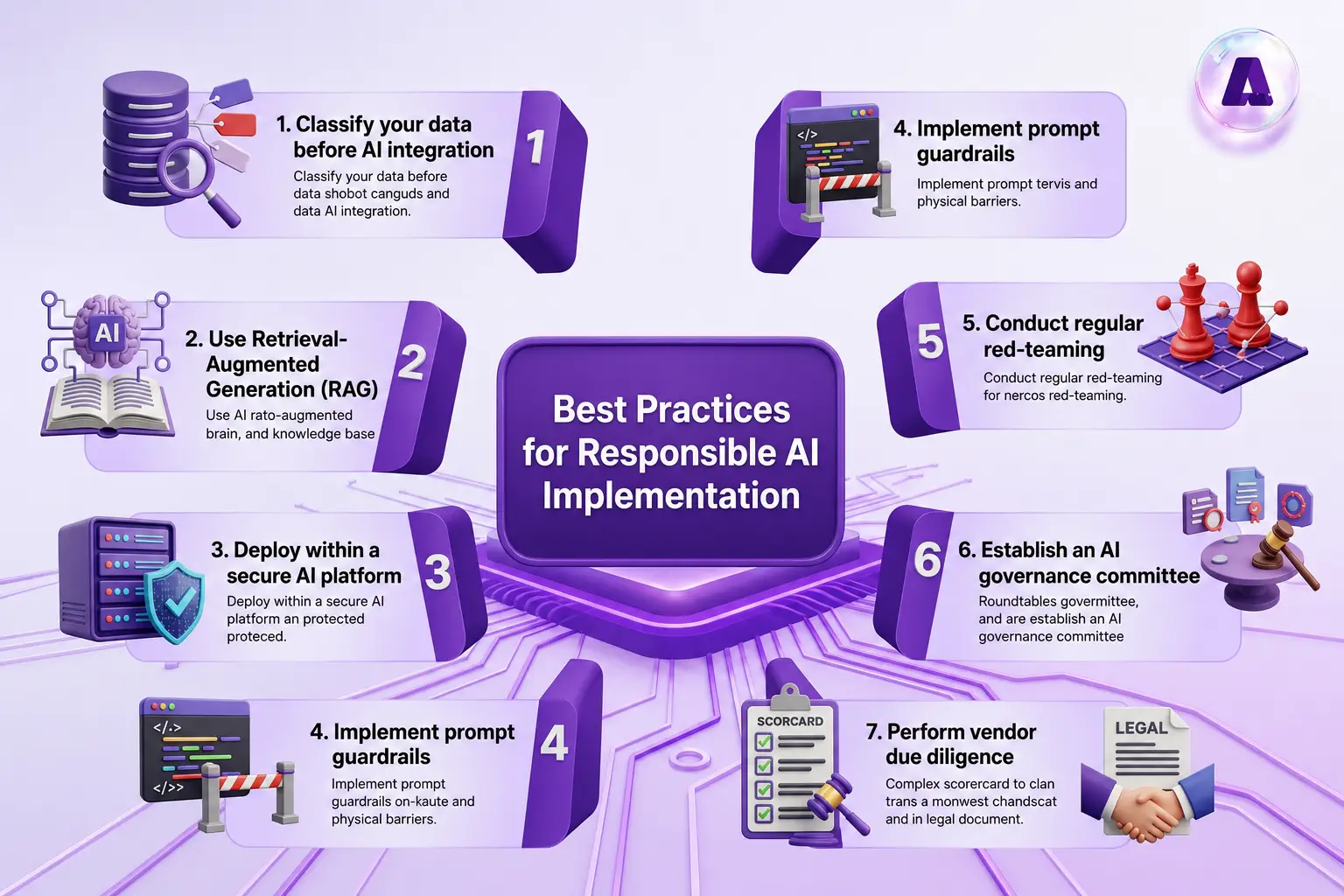
- Classify your data before AI integration: Identify sensitive and non-sensitive data. Apply masking or tokenization where needed.
- Use Retrieval-Augmented Generation (RAG): Serve only authorized data using strict access controls.
- Deploy within a secure AI platform: Ensure encryption at rest and in transit.
- Implement prompt guardrails: Prevent users from extracting sensitive information through prompts.
- Conduct regular red-teaming: Test models against adversarial attacks to identify weaknesses.
- Establish an AI governance committee: Include IT, legal, and compliance teams for oversight.
- Perform vendor due diligence: Review data handling policies, sub-processors, and retention terms.
These steps strengthen enterprise data security and reduce risks associated with AI systems. They also support responsible AI implementation and ensure compliance across regions.
How Can Regulated Industries Use AI Without Compliance Risk?
Regulated industries must follow strict compliance requirements. However, they can still benefit from AI with the right approach.
- Banks use AI for fraud detection without exposing customer data.
- Healthcare providers automate clinical documentation while maintaining patient confidentiality.
- Legal firms analyze contracts using AI without sharing sensitive case details externally.
Compliance frameworks guide these implementations. HIPAA protects healthcare data, while GDPR and India’s DPDP Act govern broader data privacy.
Getting Secure AI Adoption Right: How Aptly Tech Helps Enterprises Move Forward With Confidence
Enterprises may struggle to balance innovation with security. This is where Aptly Tech provides practical solutions.
- We help you design and deploy private AI infrastructure tailored to your business needs, ensuring sensitive data remains protected.
- We build customized AI governance frameworks to align with regulatory requirements such as GDPR, HIPAA, and DPDP.
- You also get support for compliance-ready AI integration from us including monitoring, audit trails, and continuous risk assessment.
- We conducts regular AI security audits and adversarial testing to identify vulnerabilities before they become threats.
If you are planning secure AI adoption, Aptly offers consultation services to guide your journey. You can start with an AI security assessment or request a customized roadmap for your organization.
FAQs
Q. Can enterprises use AI without sharing sensitive data externally?
Yes. Private AI infrastructure processes all queries within your own environment. No data leaves your perimeter. This is the standard approach for regulated industries where external data transfer is tightly restricted.
Q. What is the safest way for companies to adopt AI?
Start with data classification, then deploy within a secure AI platform that enforces encryption, RBAC, and audit logging. Establish an AI governance committee, run adversarial testing before going live, and conduct vendor due diligence on every AI tool you onboard.
Q. How do enterprises secure generative AI applications?
Key controls include prompt injection prevention, output filtering, RBAC-enforced retrieval, regular red-teaming, and AI audit trails. Enterprise generative AI security also requires monitoring for model drift and data leakage in real time.
Q. What are the risks of AI adoption for enterprises?
The primary risks are data leakage to third-party providers, model memorization of training data, shadow AI usage by employees, compliance violations under GDPR or HIPAA, and prompt injection attacks. AI risk management requires addressing all of these proactively.
Q. How can regulated industries use AI securely?
By deploying within compliance-ready AI environments that satisfy sector-specific requirements (HIPAA, DPDP Act, GDPR), maintaining AI audit trails for regulatory reporting, and using AI governance frameworks like NIST AI RMF or ISO/IEC 42001 to structure oversight.
Q. How do CIOs prevent AI data leaks?
Enforce data classification before any AI integration, deploy RBAC across all AI systems, implement prompt guardrails and output filters, block unauthorized AI tools through endpoint controls, and run regular audits of AI data flows. Eliminating shadow AI is critical because organizations with high shadow AI usage face significantly higher breach costs.
Q. What security measures are required for enterprise AI?
Core requirements include encryption in transit and at rest, zero trust architecture, role-based access control, prompt injection prevention, output filtering, AI audit trails, model versioning, and regular red-teaming. An AI governance framework ties all of these controls together.
Q. How can businesses stay compliant while using AI?
Map your AI use cases to applicable regulations before deployment. Use compliance-ready AI tools with documented data processing agreements. Build AI audit trails into your architecture from day one. Assign compliance ownership to your AI governance committee.
Q. What is the best enterprise AI security strategy in 2026?
The most effective strategy in 2026 combines private or hybrid AI infrastructure, an AI governance framework anchored to NIST AI RMF or ISO/IEC 42001, zero trust access controls, continuous monitoring, and regular adversarial testing.
Table of content
- TL;DR
- Introduction
- What Is AI Security? Why Every Enterprise Needs to Get This Right
- What Are the Risks of AI Adoption for Enterprises?
- The Core Pillars of Secure Enterprise AI
- AI Security Frameworks Every Enterprise Should Know in 2026
- Should Enterprises Use Public or Private AI Models?
- Neither Public Nor Fully On-Prem: The Case for Hybrid AI in the Enterprise
- Best Practices for Responsible AI Implementation
- How Can Regulated Industries Use AI Without Compliance Risk?
- Getting Secure AI Adoption Right: How Aptly Tech Helps Enterprises Move Forward With Confidence
- FAQs