Introduction
Enterprise IT teams are rethinking their data center partnerships. Traditional hyperscale data center infrastructure integrators served a purpose, but today’s AI-driven, hybrid cloud operations in 2026 demand something different.
You now need partners who move quickly, adapt to your workloads, and keep costs predictable without long procurement cycles or rigid service contracts. That gap between what big integrators offer and what you actually need has grown wide enough to notice.
Choosing an alternative to big integrators, such as Aptly, allows you to scale your technical assets with much greater precision. These agile data center integrators bring cost-efficient GPU and AI infrastructure, modular deployments, and hands-on operational support at a fraction of the overhead.
This guide breaks down who these partners are, what they deliver, and how you can make a smarter infrastructure decision in 2026.
Traditional Data Center Integrators vs. Agile Providers
You can clearly see the difference when comparing traditional data center integration companies with agile providers like Aptly. The table below compares traditional data center integrators against agile, specialized providers across the criteria that matter most to your business.
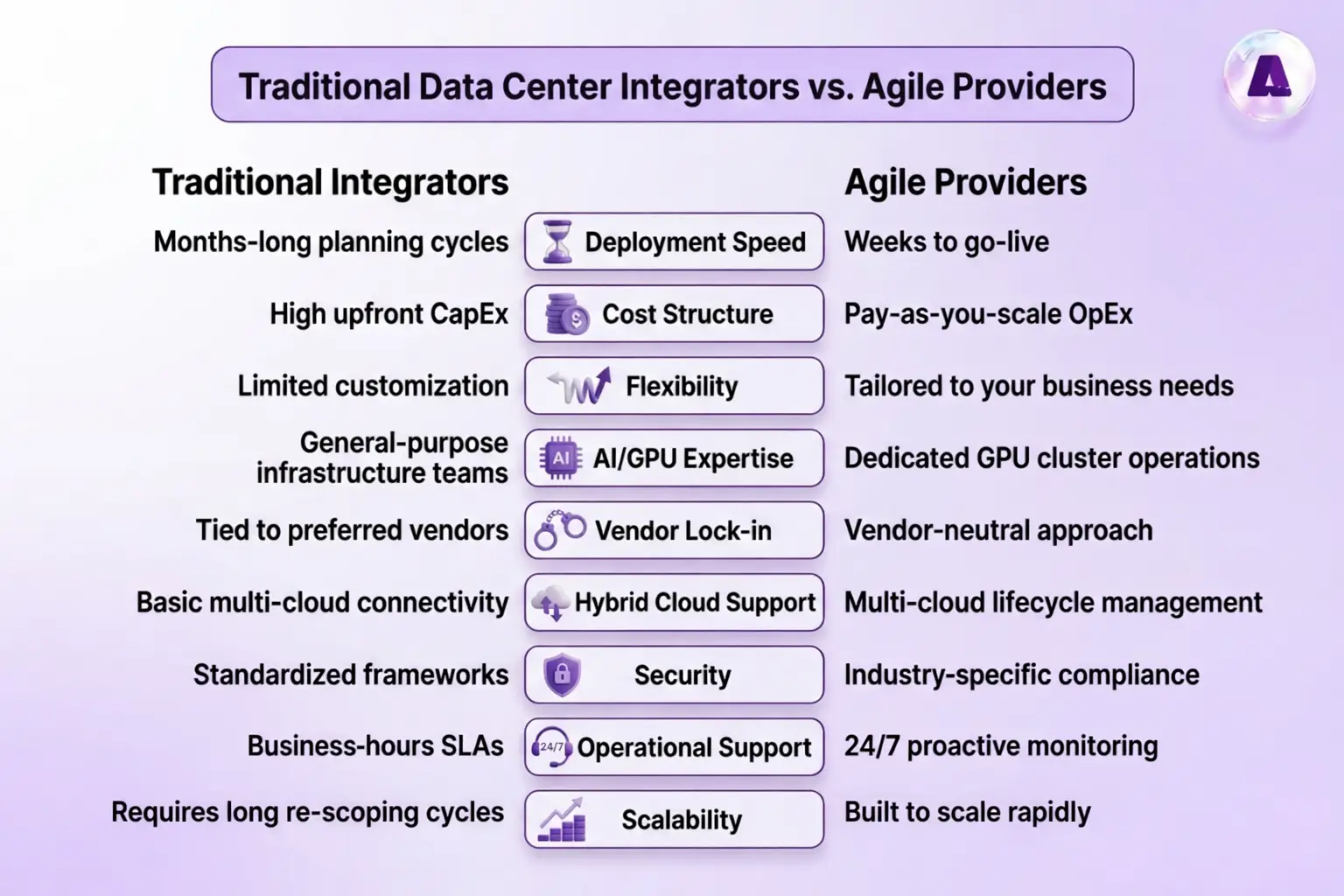
| Criteria | Traditional Integrators | Agile Partners (e.g., Aptly) |
|---|---|---|
| Deployment Speed | Months-long planning cycles; rigid timelines | Weeks to go-live; modular, milestone-based rollouts |
| Cost Structure | High upfront CapEx; bundled service contracts | Pay-as-you-scale OpEx; transparent pricing |
| Flexibility | Standardized blueprints; limited customization | Tailored to your workload, cloud mix, rack density |
| AI/GPU Expertise | General-purpose infrastructure teams | Dedicated GPU cluster operations and AI workload tuning |
| Vendor Lock-in | Tied to preferred vendors; limited substitution | Vendor-neutral approach; best-fit hardware selection |
| Hybrid Cloud Support | Basic multi-cloud connectivity | Full hybrid and multi-cloud lifecycle management |
| Compliance & Security | Standardized frameworks, may need add-ons | Industry-specific compliance built into every deployment |
| Operational Support | Business-hours SLAs; escalation queues | 24/7 proactive monitoring, rapid incident response |
| Scalability | Requires long re-scoping cycles | Built to scale rapidly as AI workloads evolve |
You notice that agile providers simplify decision-making while improving performance across enterprise data center integrators use cases. This comparison also highlights why many businesses now evaluate vendor neutral data center integrators for better control.
Where Agile Data Center Integrators Win: Real-World Use Cases
Talking about agility is easy. Seeing it in action is more useful. Below are the specific scenarios where companies are choosing agile data center integration companies over traditional providers and getting better outcomes.
Enterprise-Grade GPU Operations for AI Workloads
Your AI and ML teams need compute that keeps up with model training cycles, not shared infrastructure that throttles under pressure. Enterprise-grade GPU operations require dedicated provisioning, thermal management, and workload-aware scheduling.
Aptly handles the full lifecycle of GPU cluster management, from initial rack design to day-two operations. Your data scientists get consistent performance without filing tickets every time a training job spikes.
This is where data center integrators for AI workloads becomes a real infrastructure requirement. GPU clusters running LLMs or computer vision pipelines need purpose-built oversight, not a generalist team checking in weekly.
Hybrid and Multi-Cloud Lifecycle Management
Most enterprise environments are not purely cloud or on-premises. You are probably managing a mix of AWS or Azure, a private data center, and a handful of legacy systems that no one wants to touch. Keeping that hybrid environment healthy requires constant attention.
Agile providers like Aptly take on hybrid and multi-cloud lifecycle management as a core offering. They monitor performance, manage patching, handle vendor coordination, and flag issues before they become outages.
Rapid Scaling During AI Adoption
When your organization commits to an AI initiative, the infrastructure ask comes fast. You need GPU compute, low-latency networking, and storage that can handle unstructured data, all within weeks. Traditional data center integration companies rarely operate at that time.
Modular data center integrators like Aptly build deployments that expand incrementally. You bring new racks online as your workload grows, which means your capital expenditure stays aligned with actual usage instead of projected future demand.
Infrastructure Modernization Without Disruption
Legacy systems do not have to hold your business back, but they can if your migration partner is not careful. You need to move from outdated environments into modern infrastructure without taking services offline or risking data integrity across platforms.
Leveraging Aptly’s services can help streamline infrastructure modernization using automation and modular deployment strategies. Instead of a big-bang cutover that stresses your team, Aptly stages the migration in controlled phases, validating each step before moving to the next.
Why Choosing Agile Data Center Integrators Matters in 2026
Switching from a legacy provider to an agile data center partner is not just an IT decision. It has direct implications for your budget, your team’s productivity, and how quickly you can move on new initiatives. Here is what businesses consistently report after making the switch.
Faster Return on Infrastructure Investment
When deployments take months, your AI projects will wait. Every week of delay is a week your competitors are running experiments you cannot. Faster deployment cycles from agile providers translate directly into faster ROI on the infrastructure you are already paying for.
Companies using Aptly’s services have reported faster deployment timelines and lower operational expenditure compared to traditional integrators. The difference shows in your quarterly reviews, not just in your data center logs.
Lower Operational Cost and Complexity
Big integrators often bundle services in ways that make costs opaque. You pay for account management layers, third-party vendor markups, and generic support tiers that may not match your actual needs. Agile providers offer cleaner pricing tied to specific outcomes.
With Aptly, you work with a team that understands your environment in detail. There is no escalation queue of five levels before someone with real knowledge picks up your case. That directness reduces the operational overhead your internal team carries every day.
Key benefits enterprises report after moving to agile data center partners:
- Deployment cycles reduced from 6-9 months to 4-8 weeks for modular builds
- Modular builds save initial CapEx by 20-25%.
- AI project starts times cut by up to 60% with pre-validated GPU cluster configurations
- Compliance gaps reduced through purpose-built security controls, not generic add-ons
- Internal IT teams freed from vendor coordination tasks to focus on core business projects
Infrastructure That Grows with Your Workloads
Your needs in Q1 will look different from your needs in Q4, especially if you are scaling AI adoption across business units. Locking into a fixed infrastructure contract with a big integrator means you pay for capacity you do not use or scramble to re-scope agreements mid-year.
Agile data center migration integrators design systems to scale. You add what you need, when you need it, without renegotiating a multi-year deal every time your architecture evolves.
Future Trends Pushing Enterprises Toward Agile Providers
The infrastructure landscape in 2026 rewards speed and specialization. Several converging trends are making it harder if your business is investing in AI or cloud operations.
| Trend | What It Means | Urgency in 2026 | How Aptly Helps |
|---|---|---|---|
| AI and ML Workload Growth | Demand for dedicated GPU clusters and low-latency compute is accelerating fast | High | Provisions and manages enterprise GPU clusters with dedicated thermal management and workload-aware scheduling |
| Hybrid and Multi-Cloud Adoption | Enterprises want unified management across private, public, and edge environments | High | Full lifecycle management across hybrid and multi-cloud with unified monitoring and proactive incident response |
| Modular Data Centers | Prefabricated, scalable deployments cut build timelines from months to weeks | Growing | Milestone-based rollouts that go live in weeks and expand incrementally as workloads grow |
| Liquid Cooling at Scale | High rack density from GPU servers demands advanced thermal management | Growing | Integrates liquid cooling into every high-density GPU deployment to keep rack temps in spec long-term |
| Sustainability and PUE Targets | Regulatory pressure and carbon goals push companies to optimize PUE | Increasing | Builds PUE optimization and energy-aware cooling into every design, meeting carbon goals without retrofitting |
How to Choose the Right Data Center Integrator: A Practical Checklist
When you start evaluating data center integration companies, it helps to have a structured set of questions ready before your first call. The goal is to separate marketing language from actual delivery capability.
Here is the data center integrator RFP checklist:
- Do they have hands-on experience with enterprise GPU clusters and AI workloads, or is it a recent addition to their pitch?
- Can they provide references from companies with hybrid and multi-cloud environments similar to yours?
- What does their deployment timeline look like for a mid-size build, and what milestones do they commit to?
- Are they vendor-neutral, or do they have preferred hardware partnerships that influence their recommendations?
- How do they handle compliance requirements specific to your industry, such as HIPAA, SOC 2, or ISO 27001?
- What does their operational support model look like after go-live, and how is it structured?
- Can they scale incrementally, or does every expansion require a new scoping engagement?
- What is their track record with modular data center deployments or edge compute rollouts?
If a provider struggles to answer any of these directly, that hesitation tells you something important. Experienced integrators—such as Aptly Technology, which delivers end-to-end data center buildout, cloud integration, and ongoing operations for AI and enterprise workloads—are typically able to answer these questions with clear timelines, architectural depth, and measurable outcomes rather than high-level assurances.
Conclusion
You no longer need to rely on legacy data center integrators that limit agility and increase operational complexity. Agile data center integrators provide a practical alternative to big data center integrators in modern environments. They help you build scalable, cost-efficient, and AI-ready infrastructure without unnecessary delays.
You should explore how providers like Aptly Tech support managed GPU data center operations and agile AI infrastructure. This approach helps you stay competitive while adapting to rapid changes in technology and business demands.
Ready to find a smarter data center integration partner?
Talk to Aptly today and see what agile partners look like for your business.
FAQs
Q: What does a data center integrator do?
A data center integrator designs, builds, and connects the various hardware and software components of your facility into one unified system. They manage the complex relationship between your servers, storage, power, and cooling to ensure everything works together.
Q: Who are the top data center integrators?
Global leaders in 2026 include major players like Equinix, Digital Realty, and Black Box, alongside specialized agile providers like Aptly. These firms are recognized for their ability to manage large-scale deployments and high-density AI infrastructure across multiple continents.
Q: How to choose a data center integrator?
You should evaluate an integrator based on their specific experience with liquid cooling and high-density power requirements. It is vital to select a partner who can demonstrate a track record of meeting strict 2026 deployment timelines.
Q: Who builds enterprise data centers?
Enterprise facilities are typically built by specialized construction and integration firms like DPR Construction, Holder Construction, and AECOM. These companies focus on creating private, secure environments tailored to the specific operational needs of a single large corporation.
Q: What are the alternatives to big-name data center integrators?
Enterprises can consider specialized and mid-sized providers like Aptly Technology, which often deliver more flexible, cost-effective, and customized solutions—especially AI infrastructure, hybrid environments, and end-to-end data center buildouts.
Q: What’s the difference: data center integrator vs colocation provider?
A colocation provider essentially acts as a landlord, renting out space, power, and cooling within their own facility. A data center integrator is a technical partner who helps you design, install, and manage your specific equipment regardless of where it is physically located.
Q: How much does a data center integrator cost?
In 2026, the cost for integration services is often bundled into a project fee ranging from $11 million to $20 million per Megawatt (MW). Pricing fluctuates based on the complexity of your liquid cooling systems and the total number of GPU racks being deployed.
Q: Who are alternatives to large data center integrators?
Agile partners like Aptly and regional specialists serve as excellent alternatives to the big global integrators. These smaller firms provide more personalized support and pivot faster to accommodate emerging technologies like the NVIDIA Blackwell architecture.
Q: Which data center integrator is best for enterprises?
The best integrator for your enterprise is one that balances global reach with the flexibility to handle hybrid cloud migrations. You should prioritize partners like Aptly who specialize in managing the TCO for legacy and modern AI-ready assets.
Q: Can a data center integrator help with AI infrastructure?
Yes, modern integrators are essential for deploying the specialized power distribution and thermal management systems that AI requires. They ensure your facility can support the extreme 100kW+ rack densities common in 2026 AI model training environments.
Q: What are the top data center integrators in the United States and India?
In the U.S., top firms include Equinix and Aligned Data Centers, while India sees leadership from AdaniConneX and Netweb Technologies. Firms like Aptly bridge these markets by providing agile, managed operations across both North America and the Asia-Pacific region.
Q: What are the key considerations when selecting a data center integrator?
You must prioritize power availability, long-term scalability, and the integrator’s ability to minimize latency for your specific user base. Additionally, verify their compliance with local regulations and their commitment to sustainable, low-PUE operations.
Q: Name the companies specializing in colocation data center deployment.
Major players like Iron Mountain, Flexential, and NTT Global Data Centers specialize in rapidly deploying equipment within shared colocation spaces. These companies provide the physical shell and core infrastructure, allowing you to scale your footprint without building a private facility from scratch.
Table of content
- TL;DR
- Introduction
- Traditional Data Center Integrators vs. Agile Providers
- Where Agile Data Center Integrators Win: Real-World Use Cases
- Why Choosing Agile Data Center Integrators Matters in 2026
- Future Trends Pushing Enterprises Toward Agile Providers
- How to Choose the Right Data Center Integrator: A Practical Checklist
- Conclusion
- FAQs