Introduction
Managing an in-house data center eventually becomes a costly drain on time, budget, and talent. At a certain point, maintaining your own hardware slows you down more than it supports you. While shifting to a third-party facility is the logical move, the real challenge lies in identifying a collaborator that matches your strategic pace.
With the global data center GPU market projected by Precedence Research to reach USD 226.87 billion by 2035, it’s clear that the infrastructure decisions you make today will define your competitive edge for years to come. The right partner manages the heavy lifting from industry-specific compliance to the high-density power required for AI.
This guide outlines how to choose a data center partner in 2026 to ensure your AI-ready data center infrastructure becomes a true engine for enterprise growth.
What Is a Data Center Partner?
Multi-agent systems in AI are systems where you can design scalable and adaptive intelligent systems by enabling multiple autonomous agents within a shared environment. Each agent observes, decides, and interacts with others to collaborate, coordinate, or compete toward individual or collective goals.
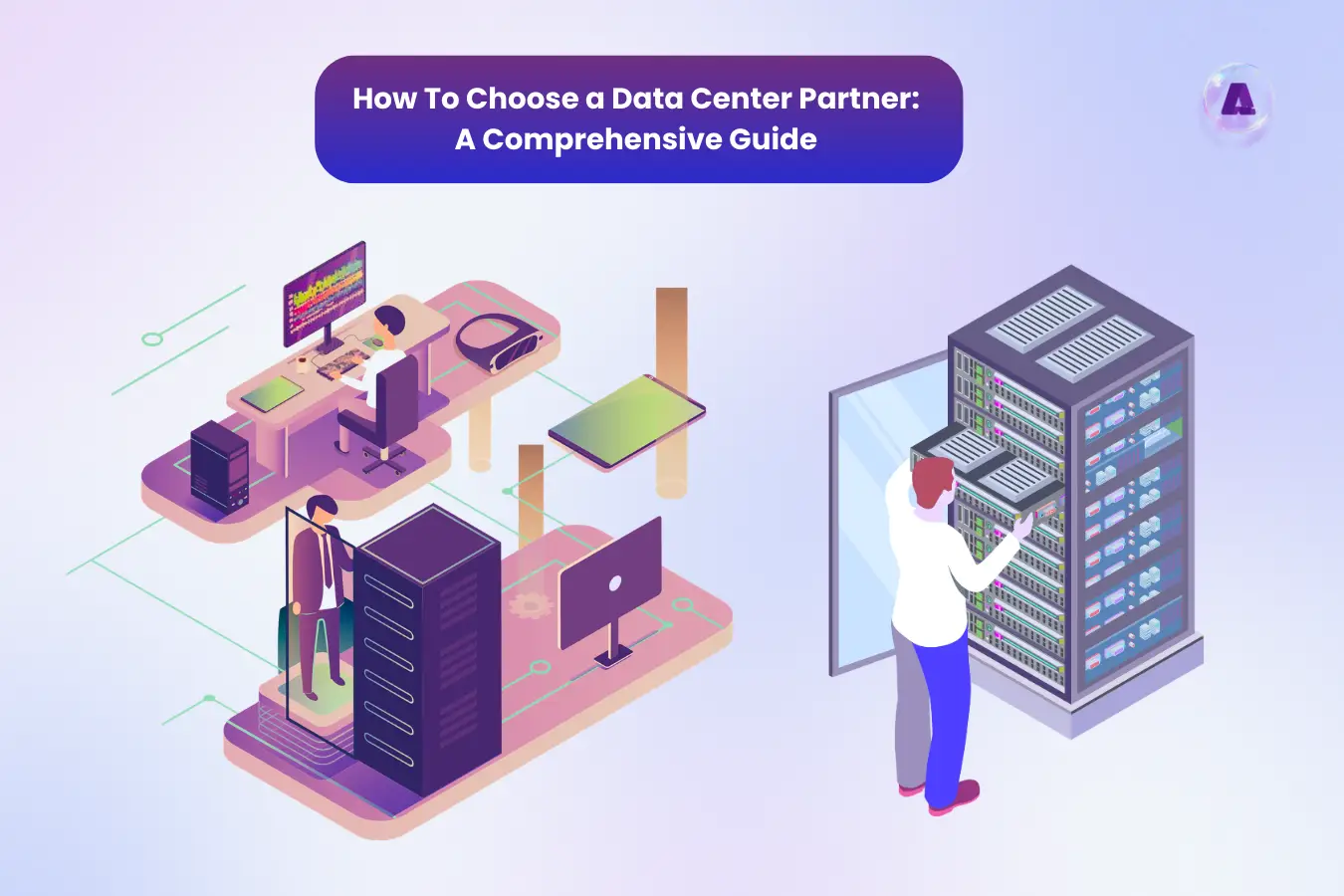
A data center partner is a strategic collaborator that provides the physical infrastructure, security, and connectivity required to run your digital operations. While a traditional provider might simply rent you space and power, a partner works with your IT team to ensure your hardware is optimized, compliant, and scalable.
Many enterprises get confused about how to choose a data center partner over a provider
Here’s a quick comparison:
| Feature | Provider | Partner |
|---|---|---|
| Relationship Model | Transactional | Collaborative |
| Response Nature | Ticket-based | Dedicated architecture team |
| AI Readiness | Offers basic power and cooling | Invests in high-density liquid cooling and GPU-optimized fabrics |
| SLA Focus | Uptime and availability | Business Outcomes |
| Multi-cloud Support | Own platform only | Cross-platform |
| Workload Migration | Limited guidance | End-to-end support |
| Pricing Model | Fixed or pay-as-you-go | Optimized or negotiated tiers |
| Innovation | Standard solutions | AI-ready |
| Technical Support | Basic remote hands for simple tasks | Expert smart hands capable of complex hardware orchestration |
| Scalability | Limited to offerings | Tailored to growth needs |
How To Choose a Data Center Partner: Ten Key Factors to Consider
Selecting a managed infrastructure partner is one of the most consequential decisions your organization will make. To navigate this complexity, CIO or IT leaders must adopt a strategic enterprise data center partner selection criteria that accounts for both immediate performance and long-term scalability.
The following factors form the foundation on how to choose a data center partner:
1. Infrastructure Reliability and Tier Certification
The Uptime Institute’s Tier Classification System remains the gold standard for evaluating data center reliability. Tier III facilities offer N+1 redundancy and concurrent maintainability, supporting uptime of 99.982%. Tier IV facilities provide fault-tolerant infrastructure and 2N+1 redundancy, targeting 99.995% uptime.
When evaluating a partner, ask for their Uptime Institute certification, their historical uptime data, and their redundancy architecture for power, cooling, and networking.
2. Security, Compliance, and Governance
For enterprise workloads, compliance is non-negotiable. The certifications that matter most include SOC 2 Type II (operational controls and data handling), ISO 27001 certification (information security management systems), PCI-DSS (payment card data), HIPAA (healthcare information), and FedRAMP (U.S. federal systems).
Beyond certifications, evaluate the partner’s zero-trust security architecture, identity and access management (IAM) practices, network segmentation, and audit logging capabilities.
3. AI-Ready Data Center Infrastructure
This is the defining infrastructure criterion of 2026. AI training now requires 80 to 160 kW per cabinet, demanding liquid cooling and specialized power. According to JLL’s 2026 Global Data Center Outlook, AI inference workloads will overtake training as the dominant AI requirement by 2027. This makes low-latency AI-ready infrastructure crucial today.
When choosing a partner, verify that they have deployed GPU clusters at scale. They should offer pre-validated GPU rack solutions, and can manage AI lifecycle operations including firmware updates, benchmarking, and telemetry.
4. Hybrid Cloud and Multi-Cloud Infrastructure
According to the CoreSite 2025 State of the Data Center report, organizations are increasingly shifting AI workloads to colocation environments for maintaining hybrid flexibility and avoid architectural silos.
- 47% of recommendation systems have moved off premises.
- 45% of generative AI applications are now hosted in colocation environments.
- 44% of augmented AI workloads relied on hybrid clouds.
When selecting an enterprise hybrid cloud infrastructure partner, focus your evaluation on these three technical pillars:
- Multi-Cloud Orchestration: Assess the partner’s capability to manage resources across different cloud providers through a single pane of glass.
- Cloud Bursting: Verify the infrastructure’s ability to offload peak AI workloads to the public cloud when on-premise capacity is reached.
- Hyperscaler Interconnects: Evaluate the density and latency of direct physical connections to major cloud providers. High-speed interconnects are vital for data-heavy AI training and real-time inference.
5. Data Center SLA Agreement
Violating data center SLA agreement can cost businesses up to 20% of their annual contract value. When reviewing an agreement, ensure the SLA covers:
- Performance-Based Uptime: Guarantees should apply to your actual workload performance, not just the building’s lights staying on.
- Response Metrics: Clearly defined MTTR and response times based on incident severity.
- Comprehensive Redundancy: Guarantees for power, cooling, network stability, and physical security.
- Financial Remedies: Real-world penalties and credits that hold the provider accountable for breaches.
6. Scalability and Workload Optimization
Your infrastructure needs will be unrecognizable 18 months from now. Enterprise AI adoption is moving so fast that BCG reports enterprises plan to double their 2026 AI investments from the prior year. If your partner can’t rapidly scale your GPU clusters or right-size your resources, they’ll be an infrastructure bottleneck.
To ensure your growth remains frictionless, evaluate a partner’s ability to deliver:
- Modular Expansion: Check whether they can add capacity in weeks using modular infrastructure
- Automated Provisioning: Look for software-defined pipelines that deploy resources instantly.
- Workload Optimization: They should offer strategies for throughput tuning and cost efficiency.
- Proven Track Record: Demand data on their historical expansion timelines to see if they meet their deadlines.
7. Geographic Reach and Data Sovereignty
Global enterprises require data center partners with multinational delivery capabilities. The choice of data center location affects latency optimization, regulatory compliance, tax structures, and disaster recovery strategy. In fact, EMEA data center capacity is growing at a 10% CAGR, fueled by the rise of sovereign AI clouds and strict privacy laws.
When assessing a partner’s footprint, look for:
- Regional Presence: Do they have delivery centers in your specific key markets?
- Data Sovereignty: Can they guarantee data residency under frameworks like GDPR or India’s DPDPA?
- Regulatory Alignment: Their ability to navigate local laws can be the difference between a smooth operation and a legal nightmare.
8. ESG Considerations
ESG considerations in data center selection have shifted from corporate greenwashing to a critical business requirement. The gold standard in 2026 is partnering with carbon-neutral data centers. These facilities are actively eliminating their carbon footprint through renewable energy sourcing, high-efficiency cooling, and carbon offset programs.
Three Pillars of ESG-powered Data Center:
- Environmental: Look for a low Power Usage Effectiveness (PUE). While the global average is 1.56, best-in-class centers achieve 1.2 or below. You should also evaluate their Water Usage Effectiveness (WUE) and circular waste management practices.
- Social: A partner’s value is also measured by their labor practices, employee safety, and DEI (Diversity, Equity, and Inclusion) initiatives, alongside their commitment to data privacy and local community relations.
- Governance: Review their audit structures, executive compensation, and anti-corruption policies to ensure they meet your corporate integrity standards.
9. Total Cost of Ownership (TCO)
The days of colocation vs. cloud being a simple price comparison are over. In 2026, the cost comparison: data center vs. cloud has become a sophisticated deep dive into TCO.
As AI demands explode, many enterprises are shifting from Cloud First to Repatriation. According to Barclays CIO survey, 83% of firms plan to move workloads from the public cloud back to colocated infrastructure to regain budget control. When comparing colocation vs. hyperscale cloud for power-hungry AI, the long-term cloud costs can be staggered over a 3 to 5-year period.
To get a clear TCO, you must factor in:
- Data Egress Fees: The exit toll for moving your data out of the cloud.
- Power & Cooling: The high-cost of 24/7 GPU operations.
- Operational Overhead: Staffing, licensing, and compliance costs.
- Latency Penalties: The hidden business cost of slow data processing.
10. Resilience and Reliability
Disaster recovery planning and business continuity strategy have become inseparable from data center partner selection. Direct or indirect human error accounts for two-thirds to four-fifths of all downtime incidents over a 25-year analysis period, per Uptime Institute. Misconfigurations during maintenance account for 48% of major human error-related outages. So, rigorously evaluate the partner’s data recovery capabilities.
What Is the Checklist for Selecting a Data Center Partner?
Use the following checklist to assess whether your infrastructure modernization partner can support your enterprise workloads and future growth.
1. Infrastructure Reliability
2. Physical Security
3. Compliance Certifications
4. Power Delivery
5. Network Connectivity
6. Future Expansion
7. Disaster Resilience
8. Pricing and Contract Terms
9. AI Workload Support
Common Pitfalls in Data Center Partner Selection
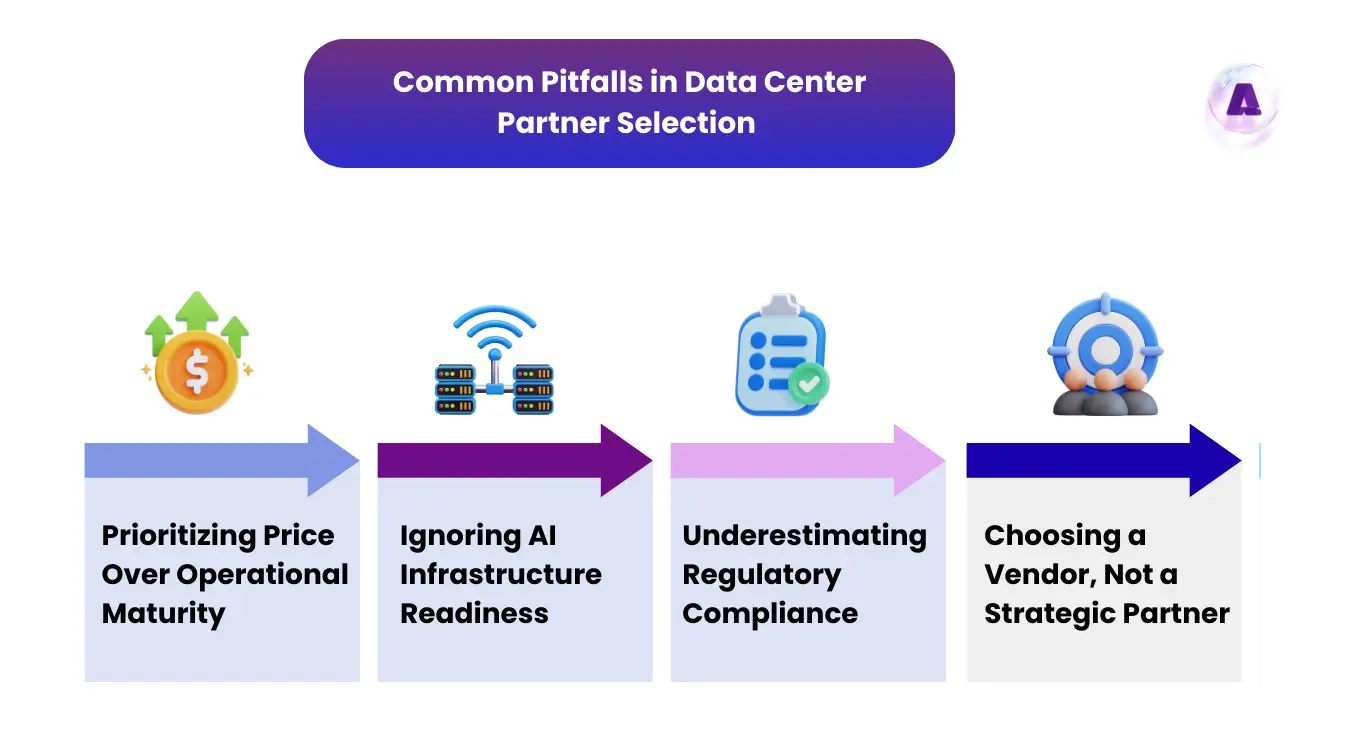
- Prioritizing Price Over Operational Maturity: The cheapest bid hides the highest risks. A partner with immature processes can lead to downtime or an increased management burden on your internal team.
- Ignoring AI Infrastructure Readiness: Many legacy facilities cannot handle the extreme cooling and power demands of modern AI hardware. Moving a GPU cluster mid-deployment is a high-risk, high-cost maneuver.
- Underestimating Regulatory Compliance: A partner without local presence in required jurisdictions can trigger massive legal headaches that no Service Level Agreement (SLA) credit can fix.
- Choosing a Vendor, Not a Strategic Partner: A vendor simply fulfills a transaction while a partner invests in your roadmap. Lack of poor account management can stall your technical evolution.
Why Aptly Tech Stands Apart as an Enterprise Data Center Partner?
In a market crowded with colocation providers, managed service companies, and cloud consultants, Aptly Technology Corporation occupies a genuinely unique position. Let’s see how:
Microsoft-Trusted Supplier for Third-Party Hyperscale Datacenter Buildouts
Aptly is the only supplier trusted by Microsoft to build and support third-party hyperscale datacenters worldwide. Aptly has delivered and operated tens of thousands of GPU nodes, InfiniBand fabrics, and AI-optimized clusters across multiple Azure regions and enterprise data center solutions.
Deep Partnerships for High-Performance
Through direct partnerships with NVIDIA and Supermicro, Aptly offers integrated, ready-to-deploy high-density racks. Relationships with HPE, CoreWeave, Lambda, and Nebius extend Aptly’s capabilities across the full spectrum of GPU cluster configurations and AI pipeline architectures. These partnerships allow Aptly to deploy GPU infrastructure with a speed, reliability, and performance level.
Full-Stack AI Service Model
Aptly Technology simplify AI adoption by delivering end-to-end full-stack services:
- AI Development & ROI Benchmarking: We help enterprises identify the right use cases, launch PoCs, measure ROI, and scale AI initiatives to ensure compliance, data privacy, and responsible governance.
- AI Deployment & Optimization: From training to inference, we optimize AI workloads across public cloud, hybrid, and on-prem environments, including deep expertise in Microsoft Azure. The result: better performance, lower costs, and measurable business impact.
- GPU Infrastructure Buildout: We design, deploy, and support hyperscale GPU-enabled data centers with 24×7 operational oversight to reduce deployment time.
Zero-trust Security
Aptly’s security capabilities include IAM, security groups, logging and monitoring, data loss prevention (DLP), data encryption, compliance and governance. Their zero-trust architecture implementation ensures that no user, device, or application is implicitly trusted, regardless of whether traffic originates inside or outside the network perimeter.
Global Delivery with Local Expertise
Aptly Technology Corporation is headquartered in Seattle/Bellevue, Washington, with delivery centers across the United States, India, China, and Canada. This global delivery model provides enterprises with access to a broad spectrum of infrastructure technologies, time-zone coverage for 24×7 operations, and the ability to address data sovereignty requirements across multiple jurisdictions.
Pre-Validated Playbooks That Compress Months into Weeks
One of Aptly’s most operationally distinctive capabilities is their library of pre-validated deployment playbooks. It has standardized, automation-driven infrastructure methodologies developed through years of hyperscale datacenter operations for Microsoft and Fortune 500 enterprises.
Conclusion
Knowing how to choose a data center partner in 2026 is critical. It requires evaluating key factors like scalability, security, compliance, and AI readiness. In a crowded market of top data center companies, Aptly Technology Corporation stands out with proven, verifiable capabilities. For CIOs and enterprise leaders, it remains a strong partner for AI-driven infrastructure needs.
Ready to Start? Aptly’s team of infrastructure and AI engineers are ready to help. Get in Touch with Aptly Tech and begin your infrastructure transformation today.
FAQs
Q. How to choose a data center partner for enterprises?
Enterprises should evaluate providers based on uptime guarantees, security standards, compliance certifications, scalability, network performance, and support capabilities. It’s also important to assess their experience with enterprise workloads and future readiness for technologies like AI.
Q. What is the most important factor when choosing a data center partner for AI workloads?
The significance of a factor depends on your organization’s specific requirements. Infrastructure scalability, security and compliance, and SLA robustness are foundational requirements that should clear the minimum bar for any shortlisted partner.
Q. What is an Enterprise Infrastructure Decision Checklist?
It is a comprehensive data center partner evaluation framework used by IT leaders and CIOs to evaluate, select, and implement technology foundations. It covers everything from hardware and networking to cloud services and security protocols. The goal is to ensure that any new infrastructure aligns with both business objectives and technical requirements.
Q. What is the CIO Infrastructure Strategy 2026 and why does it matter to IT teams?
The CIO Infrastructure Strategy 2026 is a forward-looking framework that defines how the organization will architect, secure, and scale its technology infrastructure over the next 1-2 years. For IT staff, it sets out the direction for technology investments, platform decisions, and operational priorities.
Q. How is Aptly Tech different from traditional colocation providers?
Traditional colocation providers offer physical space, power, and connectivity and stop there. Aptly is a full-stack AI lifecycle infrastructure modernization partner with AI workload optimization capabilities and end-to-end managed services.
Q. What Are the AI Infrastructure Requirementsfor data centers?
- The best data center providers for enterprises support 80 kW to 160 kW per cabinet to accommodate high-density GPU clusters.
- Look for facilities engineered for Direct-to-Chip or Immersion Cooling to improve cooling efficiency by up to 90% and lower your PUE.
- Ensure the partner supports InfiniBand or 800G Ethernet with non-blocking, lossless architecture to prevent compute bottlenecks.
Q. How to evaluate a data center provider?
To evaluate a data center provider, assess key factors such as uptime guarantees, security measures, compliance certifications, scalability, network performance, location, and customer support.It is also important to review their track record, SLAs, and ability to support your future growth and technology needs.