Introduction
As enterprises scale digital operations, AI systems must function across scattered data, interconnected applications, and evolving business rules. Traditional AI models, built for isolated and centralized execution, struggle to support complex, end-to-end enterprise workflows.
To address these constraints, enterprises are increasingly exploring distributed AI agents that can mirror real-world scenarios. Multi-agent systems in AI introduce a way to decompose complex problems into smaller, autonomous units that can plan independently while coordinating toward shared objectives. This approach aligns well with enterprise architectures such as microservices, event-driven systems, and modular workflows.
Adoption is already accelerating across healthcare, cybersecurity, business process automation, and consumer services. Gartner reports a 1,445% rise in MAS-related inquiries between 2024 and 2025, signaling strong enterprise demand.
This guide explains the role of multi-agent systems in AI, along with key concepts, benefits, and practical examples.
What Are Multi-Agent AI Systems?
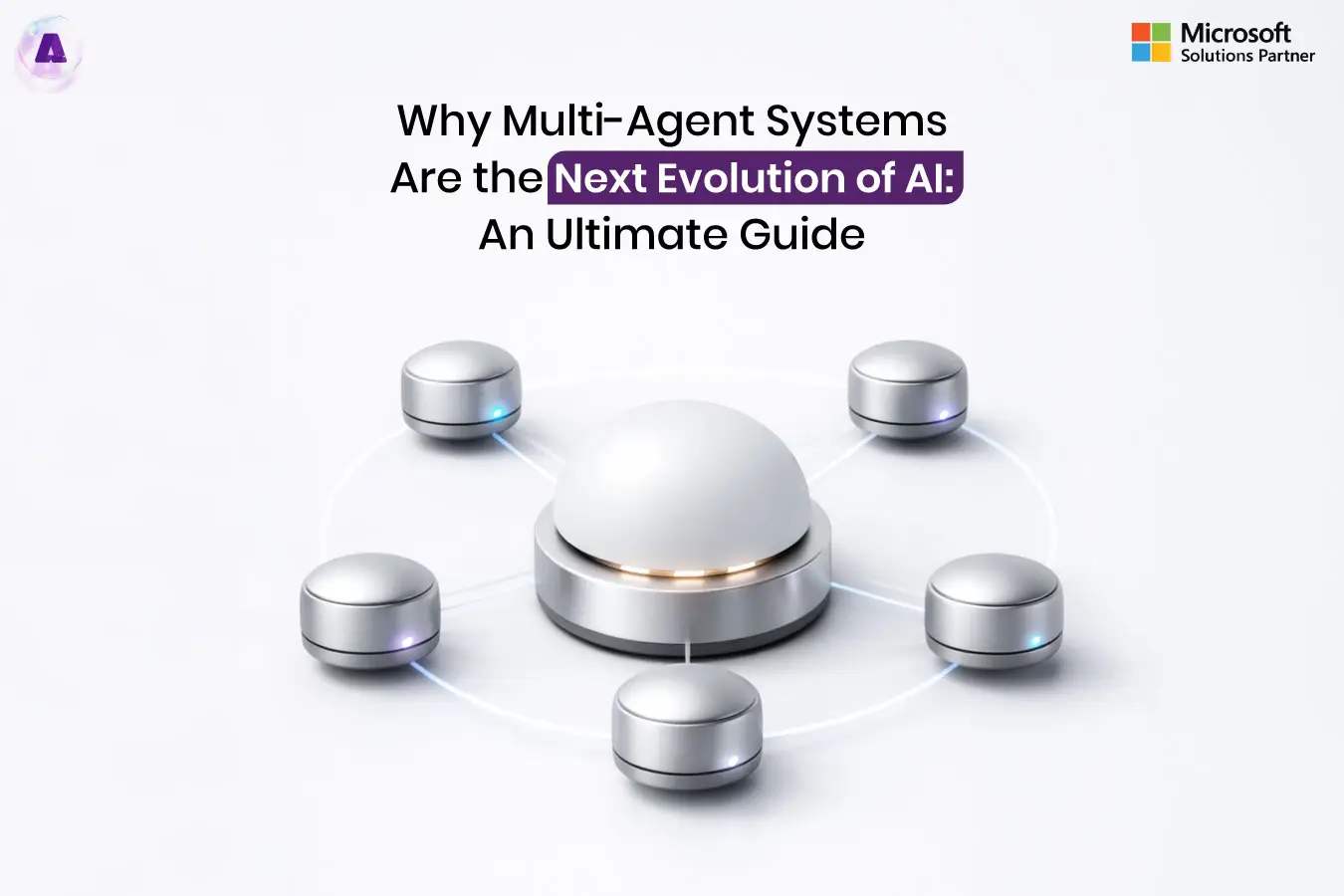
Multi-agent systems in AI are systems where you can design scalable and adaptive intelligent systems by enabling multiple autonomous agents within a shared environment. Each agent observes, decides, and interacts with others to collaborate, coordinate, or compete toward individual or collective goals.
Core Components of Multi-Agent Systems in AI
Every multi-agent setup relies on the following core building blocks:
Agents
In multi-agent systems in AI, each agent operates independently with a specific set of skills, knowledge, and goals. An agent typically uses a large language model (LLM) or a task-specific reasoning engine. Hence, these multi-LLM agent systems can:
- Accepts inputs
- Store data
- Recall memory
- Call APIs or tools
- Take actions that align with the business objectives
Internally, agents combine planning, reasoning, and execution loops, such as ReAct or Plan-and-Execute patterns, to decide the next best action. Memory within agents can be short-term context memory or long-term memory backed by vector databases or state stores.
To integrate with enterprise platforms such as CRMs, data warehouses, and workflow engines, tool invocation is required. It enables AI agents to fetch data and execute actions through function calls, REST APIs, or event-driven triggers.
Agents in MAS behave in different ways:
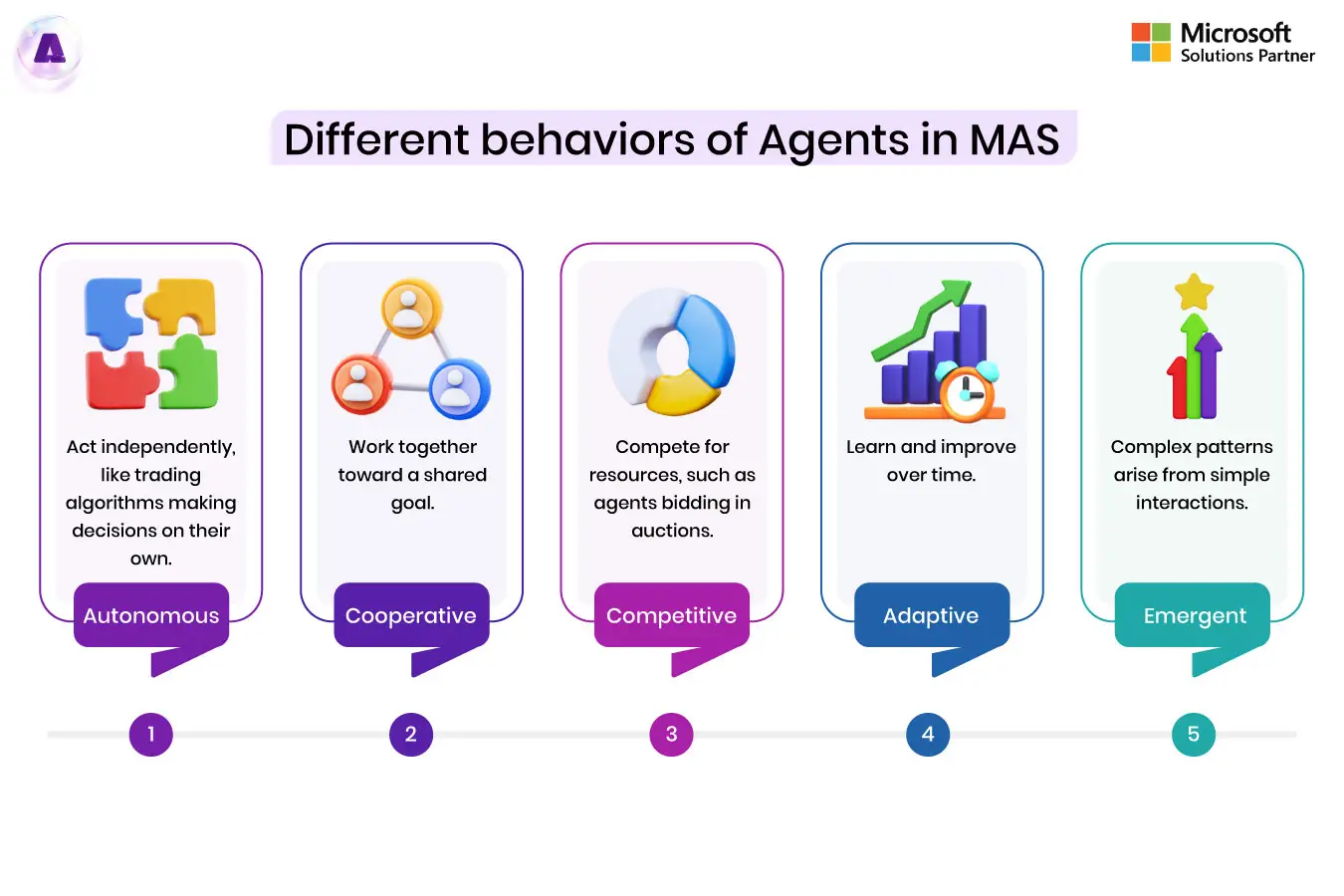
- Autonomous: Act independently, like trading algorithms making decisions on their own.
- Cooperative: Work together toward a shared goal.
- Competitive: Compete for resources, such as agents bidding in auctions.
- Adaptive: Learn and improve over time.
- Emergent: Complex patterns arise from simple interactions.
Policies, reward mechanisms, RBAC, and guardrails govern agent behavior to prevent conflicts and uncontrolled execution.
Environment
The environment is the shared operational space where agents operate and react. It can be physical, such as robots interacting with the real world, or digital, like databases, message queues, cloud platforms, and APIs.
Modern implementations use cloud-native infrastructure such as event streams, distributed state stores, and orchestration platforms. The environment enables scalability, fault tolerance, and real-time coordination while triggering agent actions and persisting execution results for optimization.
Communication
Effective communication lets agents coordinate and share information. Key methods include:
- Direct: Agents send messages to each other, like autonomous cars sharing routes.
- Indirect: Agents communicate via the environment, such as swarm robots leaving digital markers.
- Broadcast: One agent informs all others at once, useful for emergency updates.
Communication is implemented using message brokers, event-driven architectures, or shared memory systems. Protocols include metadata such as agent roles, task priority, confidence scores, and timestamps to avoid ambiguity.
Types of Multi-Agent Systems in AI
Multi-agent systems in AI are organized based on how agents interact:
- Cooperative: Agents work together toward a shared goal, like warehouse robots moving packages.
- Competitive: Agents pursue individual goals that may conflict, common in games or economic simulations.
- Hierarchical: Leader-follower setup, where a central agent directs others; efficient but risky if the leader fails.
- Heterogeneous: Agents with different skills collaborate, like drones scouting while ground robots handle rescue.
How Multiagent System in AI Works?
Multi-agent systems work by splitting work across multiple AI agents that operate in the same environment and cooperate to complete a task. Each agent has a clear role, and together they achieve a shared goal.
Here is the process explained in simple steps.
1. Perception
Each agent first looks at what is happening around it. This could be reading user input, system data, messages from other agents, or noticing changes in the environment. Some agents also learn by seeing changes made by others, without direct communication.
2. Reasoning and Decision-Making
Every agent decides what to do next based on what it is observed. In modern systems, this thinking is handled by a LLM, which helps the agent:
- Understand the task
- Break the problem into smaller steps
- Choose the best action to take
Each agent focuses only on their own responsibility.
3. Action
After deciding, the agent performs an action. This could be generating a response, calling an API, updating data, or triggering another process in the system.
4. Interaction
Agents exchange messages, share results, or update shared data so other agents can continue their work. Sometimes agents adjust their actions based on what others are doing.
5. Orchestration
For complex tasks, the system follows a structured workflow. It decides:
- Which agent runs first
- What information is passed between agents
- When the task is complete
This keeps the system organized and goal-focused, instead of letting agents act randomly.
6. Achieve Goal
By repeating these steps, agents adapt to changes, correct mistakes, and work together until the goal is achieved.
From Single AI Agent to Collaborative AI Systems
Expecting one AI agent to handle development, execution, and scaling rarely works. The AI workload distribution is simply too broad and interconnected. The same limitation applies to a single AI system, no matter how advanced.
Multi-agent systems in AI address this by distributing intelligence across specialized agents. The real value lies not in running multiple models, but AI agent orchestration helps to solve problems collectively.
To highlight this shift, here is a comparison of single-agent AI, agentic AI, multi-agent systems, and AI system orchestration.
Single-Agent AI vs Agentic AI vs Multi-Agent Systems vs AI System Orchestration
| Aspect | Single-Agent | Agentic AI | Multi-Agent AI | AI Orchestration |
|---|---|---|---|---|
| Purpose | One AI model performs a task | One AI agent plans, reasons, and acts | Multiple AI agents collaborate | System that coordinates agents, models, and tools |
| Number of Agents | One | One with autonomy | Many | Manages many, but not an agent itself |
| Decision-making | Static | Dynamic | Distributed across agents | Centralized control layer |
| Task Handling | Single task at a time | multi-step tasks | Parallel and specialized tasks | Task routing and execution control |
| Autonomy Level | Low | Medium to High | High | Not Autonomous |
| Communication | None | Internal reasoning loop | Inter-agent communication | Controls communication flows |
| Scalability | Limited | Moderate | High | Very high |
| Fault Tolerance | Low | Low to Moderate | High | High if well-designed |
| Enterprise Readiness | Low | Medium | High | Essential |
| Use Cases | Chatbot, Classifier | Research agent, coding agent | Fraud detection, simulations | Enterprise AI platforms |
Benefits of Multi-Agent Systems in AI
Here is why relying on multi-agent systems in AI matters:
1. Problems are multi-dimensional
Modern challenges involve data, systems, people, and timing all at once. A single AI struggles to manage everything, while multiple agents can divide responsibilities and work in parallel. This can help reduce decision latency.
2. Fault tolerance
If one agent fails, others continue operating. This removes the single point of failure common in single agent systems.
3. Faster adaptation to change
Local agents can respond immediately to new inputs or anomalies. In contrast, higher-level agents refine strategy to make the system more responsive in dynamic environments.
4. Specialization leads to better outcomes
Each agent is optimized for a specific function such as prediction, coordination, execution, or validation. This results in higher overall accuracy and efficiency.
5. Scales with complexity, not effort
You can add or remove agents as the system grows, without redesigning everything. This makes multi-agent AI suitable for large-scale enterprise AI transformation.
Challenges of Multi-Agent Systems in AI (MAS)
While multi-agent systems in AI offer powerful capabilities, implementing them comes with challenges:
- Managing interactions between multiple agents can lead to conflicts or inefficiencies.
- As the number of agents grows, systems can become difficult to scale without performance bottlenecks.
- Connecting MAS to databases, CRMs, APIs, and other tools can be complex.
- Agents must learn from experiences and adapt, which can be hard to coordinate across the system.
Best Practices of Multi-Agent Systems in AI for Enterprises
- Ensure AI observability for agents to monitor their inputs, decisions, and outputs independently.
- Scale agents dynamically using workload metrics rather than fixed capacity to support long-term cost optimization for AI agents.
- Align reinforcement learning rewards with overall system goals to prevent unintended behavior.
- Track utilization, memory consumption, and latency per agent to identify inefficiencies and continuously improve GPU utilization for agent systems.
- Establish role-based AI governance to define what each agent is allowed to do.
Real-World Applications of Multi-Agent Systems in AI
MAS has moved well beyond theory and is actively used across several real-world domains.
Sepsis Management with Multi-Agent Systems
A article published by National Centre Biotechnology Information (NCBI) highlight the importance of multi-agent AI systems in healthcare. It outlines a hypothetical sepsis management system composed of seven specialized AI agents, each handling a distinct part of patient care:
- One agent gathers and cleans patient data from EHRs and vital signs
- Another identifies early signs of sepsis using lab results and medical imaging
- A risk assessment agent prioritizes patients based on severity
- A treatment agent suggests personalized interventions
- An AI agent monitoring tracks patient response in real time and triggers alerts
Working together, these agents coordinate continuously to enable faster clinical decisions, improve treatment accuracy, and support broader public health analysis.
Threat Mitigation in Machine Learning Systems
A research paper, “Multi-Agent AI Framework for Threat Mitigation and Resilience in Machine Learning Systems” in the ACM Digital Library, addresses the growing need to secure machine learning (ML) systems used in high-stakes domains such as finance, healthcare, and critical infrastructure. The study highlights that these systems face advanced adversarial threats that traditional cybersecurity frameworks fail to fully mitigate.
The study uses a multi-agent reasoning system with Retrieval-Augmented Generation (RAG) to analyze 93 threats from incident databases (MITRE ATLAS, AI Incident Database), literature, and 854 ML repositories.
The system detects previously unreported risks, including model-stealing attacks on LLM APIs, data leakage via parameter memorization, and preference-guided text-only jailbreaks.
How to Build Multi-Agent AI System: Step-by-Step Guide
Here is a detailed tutorial on generating a multi-agent AI system:
Step 1: Define the purpose and goals
Start by identifying the problem you want the system to solve.
- Speak with stakeholders, review existing AI workflows, and pinpoint gaps.
- Break the main goal into smaller tasks, each handled by a separate agent.
- Set clear boundaries and success metrics such as response accuracy, latency reduction, or cost savings.
Step 2: Choose the system structure
This defines how agents are organised internally.
- Flat structure: All agents operate at the same level and make decisions independently. Simple and flexible, but AI agent coordination becomes harder as the system grows.
- Hierarchical structure: Agents are arranged in layers, with higher-level agents guiding lower-level ones. Streamlines decisions but can limit flexibility and create bottlenecks.
- Holonic structure: Agents act as independent units or holons while also forming part of a larger system. Adaptable and resilient, can be reconfigured when agents fail or are added.
- Organizational (network) structure: Agents are grouped into teams or clusters with specialized roles. Great for complex collaboration but needs careful design to avoid communication overload.
Step 3: Choose the architecture
Decide how to coordinate and control AI agents.
- Centralized architecture: One central agent controls all others. Best for systems needing strict control and shared data. Examples include logistics or order management.
- Decentralized architecture: Aents act independently and communicate only when required. Suitable for dynamic, real-time systems. Examples include autonomous vehicles or games.
- Hybrid architecture: A central agent sets high-level goals while other agents act autonomously. Common in enterprise and supply-chain systems.
Step 4: Design individual agents
Select agent types based on tasks:
- Reactive, learning, deliberative, specialised, or collaborative agents
Choose suitable models:
- NLP models (GPT, Claude) for language
- Vision models (YOLO) for image/video
- Reinforcement learning for optimisation
- Time-series or audio models for specialised use cases
Agents interact using APIs or messaging systems.
Step 5: Define communication and coordination
Agents communicate via:
- Message passing
- APIs
- Shared memory
For coordination:
- Use standard protocols (REST, WebSockets, FIPA-ACL) and formats (JSON, Protobuf).
- Apply strategies such as task sharing, result sharing, and consensus-based decisions.
Step 6: Test, deploy, and maintain
- Test at multiple levels: unit, integration, system, and stress testing.
- Track metrics like accuracy, latency, scalability, and resource usage.
- Deploy using containers and orchestration tools
- Monitor continuously and update models with feedback loops.
Why Multi-Agent Systems Are the Next Evolution of AI?
- Tackle complex problems: MAS can handle large-scale tasks that single AI models struggle with.
- Collaborative intelligence: Multiple agents share knowledge, communicate, and make coordinated decisions.
- Scalable and resilient: Systems continue functioning even if individual agents fail.
- Adaptable and flexible: Agents learn from experience and adjust strategies in real time.
- Industry-ready applications: Used in supply chain optimization, healthcare, cybersecurity, and business automation.
- Accelerated innovation: MAS frameworks streamline AI workflow orchestration.
How to Build a Production-Ready Agentic AI Workflow Using AptlyStar
Managing an AI agent system manually can quickly become overwhelming. Without a proper framework, coordinating multiple agents, ensuring smooth AI agent communication, and integrating with existing tools is time-consuming and error prone.
Here, AptlyStar offers a solution: a no-code, AI Development Partner platform to create and deploy AI agents within minutes.
Key Features:
- Pre-built AI agent library to build AI agents for business workflows
- Integrates multiple LLMs (OpenAI, Azure, Anthropic)
- Connects agents to documents, databases, cloud storage, and APIs
- Secure collaboration with role-based access
- Automated data sync and retraining for accurate, up-to-date results
Case Study: How Mayra Technologies Built Conversational AI Using AptlyStar
Mayra Technologies needed scalable conversational AI for websites and applications without the overhead of building custom NLP models for each client.
Using AptlyStar’s single-agent, agentic AI platform, Mayra quickly deployed autonomous conversational agents that handled end-to-end customer interactions, integrated with business APIs, and delivered enterprise-grade responses.
Results:
- Faster AI agents’ development and deployment
- Scalable conversational AI across multiple clients
- Reduced operational complexity
What’s Next:
AptlyStar is actively implementing native multi-agent orchestration, enabling customers to evolve from single autonomous agents to collaborative multi-agent systems as business workflows grow more complex.
Read More:
Mayra Technologies Scales Conversational AI Capabilities Using AptlyStar.ai APIs – AptlyStar.ai
Conclusion
With multi-agent AI for enterprise automation, you can orchestrate complex IT operations, optimize workflows, and respond to challenges in real time. Multi-agent systems for customer support further improve response times, personalize interactions, and deliver consistent, high-quality service.
Ready to launch your own custom AI agents?
From idea to production, AptlyStar is your AI development partner to build and scale intelligent agents.
FAQs
Q: What are multi-agent systems?
Multi-Agent Systems (MAS) are networks of autonomous AI agents that interact, collaborate, or compete to solve complex problems.
Q: How do multi-agent AI systems work?
Multi-agent AI systems work by dividing tasks among specialized agents. Agents communicate through protocols, share information, coordinate actions, and adapt based on the environment or behavior. These distributed AI agents handle dynamic, large-scale problems efficiently.
Q: Single-agent vs multi-agent AI – what is the difference?
Single-agent AI relies on one model to make decisions, which can create bottlenecks. Multi-agent AI distributes tasks across specialized agents, improving flexibility, fault tolerance, and performance for complex enterprise applications.
Q: Why multi-agent systems are important for enterprises?
Enterprises face complex workflows, distributed IT systems, and dynamic customer demands. MAS enables business process automation, improves scalability, optimizes Multi-agent AI decision-making, and supports real-time collaboration across departments. This leads to faster and more accurate results.
Q: What is the future of multi-agent AI systems?
The future of multi-agent systems lies in self-organizing networks of enterprise AI agents. Enterprises will use Multi-agent AI in IT operations, decision-making, supply chain optimization, and customer support, with improved collaboration, adaptability, and integration with business systems.
Q: What are the limitations of single LLM systems?
Large language models (LLMs) can struggle with scalability, real-time collaboration, multi-step workflows, and context management across tasks.
Q: How do multi-agent AI systems impact ROI for businesses?
Multi-agent AI systems improve business ROI by distributing complex tasks across multiple specialized AI agents that work together in parallel. This approach reduces processing time, minimizes errors, and improves decision quality compared to single-model systems.