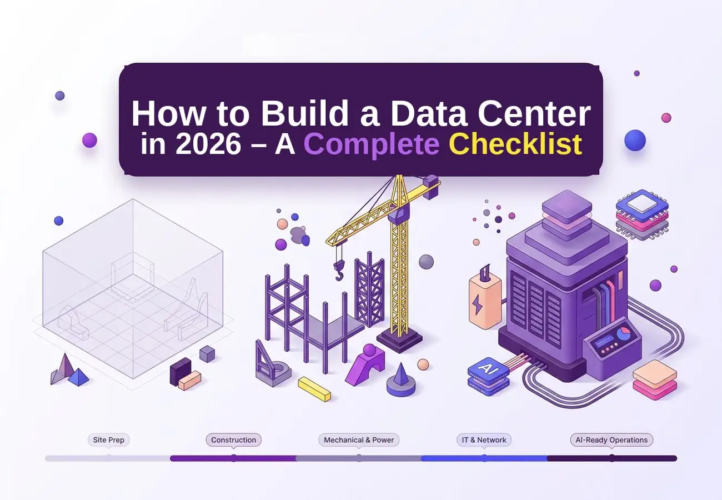
Introduction: Why Data Center Buildouts in 2026 Are Different
In 2026, how to build a data center is no longer a question about square footage and chilled water; it’s a question about whether your infrastructure can support AI, extreme rack densities, and volatile demand without blowing your power budget or uptime targets.
AI and GPU‑heavy workloads are pushing many designs toward 100kW+ per rack, with direct‑to‑chip liquid cooling moving from edge case to norm in high‑end facilities. At the same time, power‑related issues remain the leading cause of impactful outages, and the majority of serious incidents now cost more than 100,000 dollars, according to Uptime Institute’s Annual Outage Analysis 2024. Sustainability expectations, grid constraints, and tightening data center security standards and compliance regimes only raise the bar.
By “building a data center from scratch,” we’ll mean the full lifecycle:
- What is required to build a data center: business case, capacity, tier and resilience targets.
- Data center construction and data center construction phases explained: site selection, design, build, and commissioning.
- Data center infrastructure setup guide: power, cooling, network, racks, and security.
- Operations readiness: staffing, tooling, and DCIM tools for AI‑ready operations.
By the end, you’ll have:
- A data center buildout checklist that mirrors how a real program is run.
- A view of what infrastructure is needed for a data center that supports AI and GPU growth.
A framework to decide whether you should build or lease a data center (or blend colocation and cloud).
What Does “Building a Data Center from Scratch” Really Mean?
At a CXO level, what are the steps to build a data center? You’re orchestrating a program that goes from idea to stable operations across a set of predictable phases.
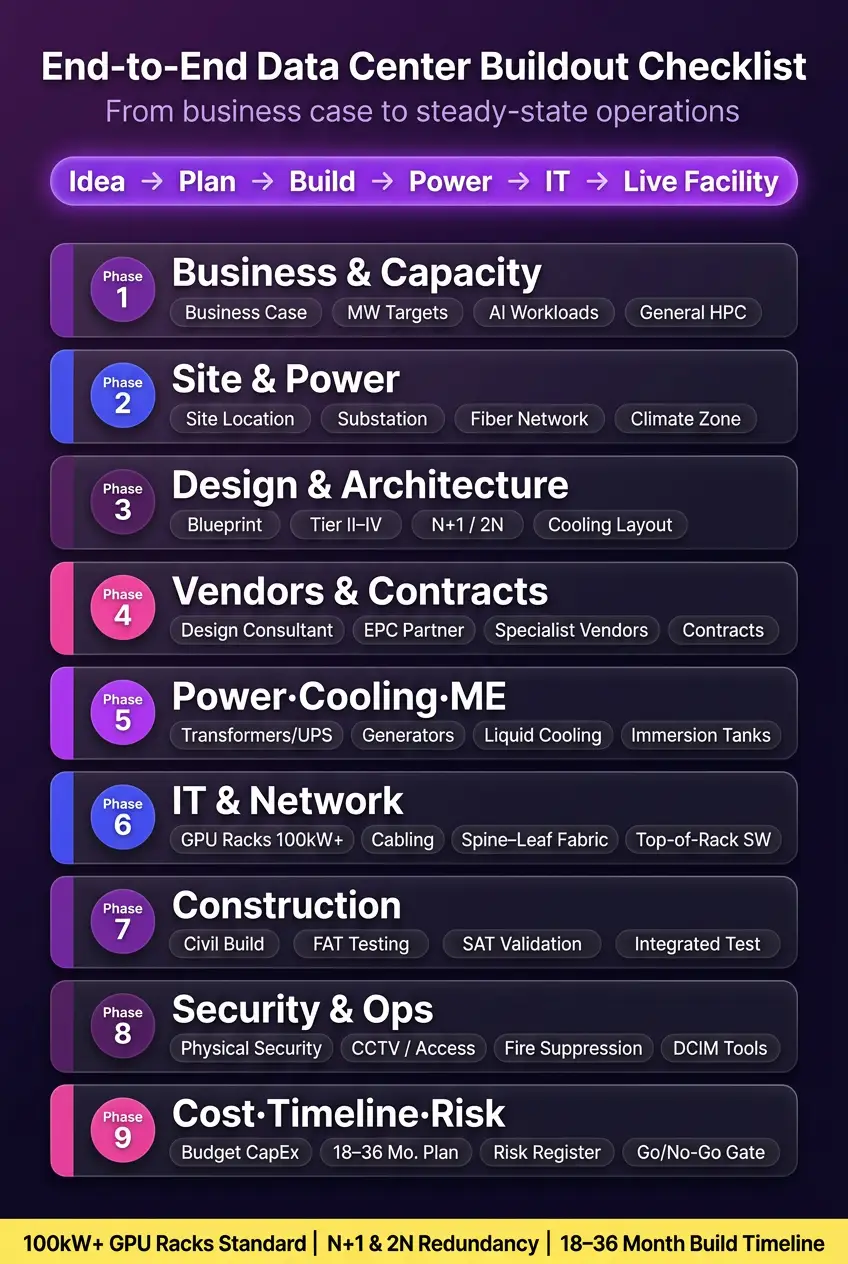
Uptime Institute recommends a design‑build process with pre‑construction, design, construction, commissioning, and turnover. For our data center construction guide, we’ll align to:
- Pre‑construction – business case, data center project planning, and concept design.
- Detailed design – data center design and build process, tiers, topology, and network architecture for data centers.
- Build and integration – civil works, MEP, and vendor installation (data center build services).
- Testing and commissioning – FAT, SAT, integrated systems testing (data center commissioning checklist).
- Turnover and steady state – operations, SLAs, and continuous optimization.
Think of this as your checklist for building a data center facility; each step has specific decisions, artifacts, and risks.
Step 1: Define Business Requirements and Capacity Targets
Before discussing data center construction phases, you need clear answers on why this facility should exist.
Quick answer: Treat this like any major capital program with a 10–15-year horizon, but with faster technology churn.
Key questions:
- What services will run here—core SaaS, analytics, GPU data center setup for AI training, edge workloads?
- Target capacity in MW and IT load in kW, including rack density and layout assumptions (for example, 10–20kW general racks and high‑density GPU racks at 50–100kW).
- Availability targets: do you need Tier II, III, or IV uptime tiers (Tier I–IV)? The Uptime Institute Tier Classification System remains the industry reference.
- Regulatory and data center security standards you must meet (PCI, HIPAA, GDPR, local data residency).
This is also where you frame how much does a data center cost and the cost to build a data center in 2026 under different scope options: single facility, edge vs hyperscale data centers, or hybrid with colocation.
Step 2: Site Selection, Power, and Network
Quick answer: your biggest constraints are usually power, fiber, and politics—not concrete.
Use a data center setup checklist for site selection:
- Power: proximity to substations, grid reliability, and ability to secure long‑term capacity with room for growth. Power issues remain the root cause of most severe outages.
- Power redundancy (N+1, 2N): define your philosophy early; N+1, 2N, and 2N+1 redundancy levels drive both cost and tier.
- Network architecture for data centers: multiple carrier‑neutral paths, metro diversity, and latency targets for key users.
- Climate and water: these affect your long‑term cooling systems (liquid cooling, HVAC) strategy and sustainability in data centers.
- Local incentives, zoning, and risk (floods, seismic, political).
This is where colocation vs on‑premise data center and colocation vs building your own data center should be modeled explicitly, using TCO assumptions instead of emotion.
Step 3: Data Center Design – Architecture, Tiers, & Redundancy
Quick answer: “How to design and build a data center” means translating business targets into topology and resilience.
Your data center design consultants and data center engineering services team formalize:
- Tier target (Tier II vs Tier III vs Tier IV) using Uptime Institute’s tier standards.
- Electrical one‑line, UPS topology, and data center power and cooling requirements.
- Mechanical: chilled water vs direct‑to‑chip liquid cooling; free‑air options depending on climate.
- Space planning: rack density and layout, hot/cold aisle, containment, and future pods for hyperscale data center design or modular data center build.
- Security layers: perimeter, building, room, rack, and fire suppression systems.
At this stage, you should document a formal data center infrastructure planning package and a living data center buildout checklist that stays with the program.
Step 4: Vendor Strategy – Design Firms, EPC, and Build Partners
Quick answer: treat your data center construction company and EPC partners as long‑term allies, not commodity bidders.
A mature data center design and build process will typically involve:
- Data center design consultants – specialized firms that understand AI, GPU, and AI-ready data center infrastructure patterns; Aptly Technology works alongside these firms to ensure designs are operationally sound/perfect for AI, GPU, and high-density workloads from day one.
- EPC contractors – accountable for data center construction phases, procurement, and integration, while Aptly provides architecture validation and future-state operations input ensuring that the build is capable of supporting long-term AI and cloud computing objectives.mbcz
- Specialist vendors for data center infrastructure solutions, data center deployment services, and data center engineering services (power, cooling, network, security), orchestrated by Aptly through its GPU Datacenter Buildout & Support, AI Infra buildout services, and managed data center services to keep the entire stack aligned from design through operations.
This is also where you decide whether to lean on hyperscale data center providers, regional integrators, or a more boutique data center build partner for a complex enterprise data center setup – with Aptly Technology acting as the long-term operations and integration layer across whichever vendors you choose.
Step 5: Power, Cooling, and Mechanical–Electrical Infrastructure
Quick answer: AI changes everything; air‑only facilities won’t carry you through the next decade.
When you ask what infrastructure is needed for a data center in 2026, the mechanical‑electrical layer dominates:
- Power train: transformers, switchgear, UPS, generators sized for your growth curve and resilience objectives.
- Redundancy: N, N+1, 2N or 2N+1, consistent with your uptime and cost appetite.
- Cooling: a mix of cooling systems (liquid cooling, HVAC), rear‑door heat exchangers, or immersion for high-density GPU racks.
- Monitoring and DCIM tools that can see power, thermal, and capacity in one pane of glass and increasingly support AI‑driven operations.
For AI‑heavy environments, leading vendors already treat AI-ready data center infrastructure and AI data center infrastructure design as distinct offerings, with direct‑to‑chip liquid cooling and higher voltage distribution as defaults rather than options.
Step 6: IT and Network Architecture – Racks, Cabling, and Fabric
Quick answer: your GPU data center setup, storage, and fabric design will determine both performance and operating cost.
Here your team designs:
- Rack elevations and cabling standards so data center deployment steps produce consistent, repeatable builds.
- Spine‑leaf or other modern network architecture for data centers, with careful latency and throughput optimization for east‑west traffic.
- Segmentation between management, storage, and tenant networks, especially if you blend edge vs hyperscale data centers or mix internal and external consumers.
This becomes the technical backbone for your data center infrastructure setup guide and any internal data center deployment checklist PDF you maintain.
Step 7: Construction, Commissioning & Testing
Quick answer: the build is where small design ambiguities turn into big change orders if you aren’t disciplined.
From a CXO perspective, you monitor:
- Civil and structural works against schedule and budget.
- Installation quality from your data center construction company and specialist vendors.
- Formal testing and commissioning. A typical data center commissioning checklist covers factory acceptance tests (FAT), site acceptance tests (SAT), pre‑functional tests, integrated systems testing, and final sign‑off, as outlined in many specialist data center testing and commissioning guides.
This phase is where you answer “how to build a data center step by step” in the physical sense—and where good documentation prevents operational surprises later.
Step 8: Security, Compliance, and Operations Readiness
Quick answer: you are not done when the lights turn on; you are done when operations can run safely on their own.
Key elements:
- Physical and logical data center security standards: access control, cameras, logging, and integration with corporate SOC.
- Fire life safety: detection, fire suppression systems, and run‑book integration with facilities teams.
- Operational processes: runbooks, change management, incident handling, and staffing plans aligned to your chosen uptime tiers (Tier I–IV).
- Tooling: modern DCIM tools and observability platforms that support AI‑based anomaly detection and optimization.
For many teams, sustaining this level of vigilance 24/7 is hard to do alone, which is where Aptly comes in: Aptly delivers 24/7 data center monitoring services, around-the-clock AI Infrastructure monitoring and support, and 24×7 white-glove GPU datacenter operations, combining continuous telemetry, proactive incident response, capacity planning, and lifecycle management so security, compliance, and operations stay aligned day and night.
At this point, your team should also finalize a practical data center deployment checklist and data center deployment steps documentation for every new rack or pod.
Step 9: Cost Modeling, Timeline, and Risk Management
Quick answer: the cost to build a data center in 2026 depends heavily on tier, density, and location—but poor planning will always make it more expensive than it needs to be.
Board‑level considerations:
- Budget modeling for construction, IT, and multi‑year OPEX, including energy, staffing, and maintenance.
- Timeline expectations: many greenfield builds take 18–36 months end‑to‑end, so how long does it take to build a data center depends on power, permitting, and whether you adopt a modular data center build strategy.
- Scenario analysis for traditional vs modular data center construction and hyperscale vs enterprise data center build, plus the option to keep some workloads in colocation vs on‑premise data center environments.
This is also where you step back and decide whether it makes more sense to build your own data center or lease capacity through collocation, based on capital, control, and timeline tradeoffs. In many cases, you’ll end up orchestrating a hybrid of cloud, colocation, and owned capacity, so critical workloads sit in the right place while you keep flexibility & cost under control.
Data Center Buildout Checklist
| Stage | Example Decisions | Stakeholders | Typical Pitfalls | Success Indicators |
|---|---|---|---|---|
| Business & Capacity | Tier level, MW target, AI vs general workloads | CIO, CFO, Head of Infra | Operations, facilities, SRE | Clear data center infrastructure planning doc signed off |
| Site & Power | Region, grid capacity, network diversity | Real estate, facilities, network | Underestimating power and fiber lead times | Long‑term power contract; diverse fiber in LOIs |
| Design | Topology, redundancy, data center design best practices 2026 | CTO, design consultants, security | Ignoring future AI-ready data center infrastructure | Design supports 2–3x density increase |
| Build & Vendors | Choice of data center construction company, EPC, and hyperscale data center providers | Procurement, legal, EPC, OEMs | Over‑indexing on lowest bid, weak contracts | Milestones hit; minimal redesign during build |
| Commissioning & Ops | Final data center commissioning checklist, runbooks, tools | Operations, facilities, SRE | Rushing handover, incomplete documentation | Clean handover; stable first 90 days of ops |
* This checklist becomes your living data center buildout checklist for enterprises as the program evolves.
Conclusion: Build for AI, Resilience, and Optionality
In 2026, how to build a data center is fundamentally about risk reduction and strategic flexibility. You’re not just pouring concrete; you’re committing to a platform that must support AI, regulatory change, and business pivots for a decade or more.
By following a structured data center construction guide, investing in sound data center design best practices 2026, and validating partners across design, build, and operations, you reduce the likelihood of costly outages and stranded assets. You also create a foundation for building AI‑ready data center infrastructure that can scale as GPU, storage, and connectivity demands rise.
A practical next step is to map your current program against this data center infrastructure setup guide and identify gaps in power, cooling, commissioning, or operations. From there, refine your data center project planning and, where needed, bring in specialized data center deployment services and design partners.
Frequently Asked Questions (FAQ) – How to Build a Data Center
- What is required to build a data center?
- At minimum, you need a clear business case, a site with reliable power and network, a robust data center design and build process, trusted vendors, and an operations plan. For AI‑heavy workloads, that also means planning for AI-ready data center infrastructure, including higher‑density power and advanced cooling.
- How long does it take to build a data center from scratch?
- A full greenfield build typically takes 18–36 months from data center project planning to commissioning, depending on power availability, permitting, and whether you use prefabricated or modular designs. Data center construction phases explained up front help avoid delays during design and commissioning.
- How much does a data center buildout cost in 2026?
- The cost to build a data center in 2026 varies widely by tier, density, and region, but total program costs routinely reach tens to hundreds of millions of dollars, with power and mechanical–electrical infrastructure driving a large share. High resilience (2N) and extreme densities increase both CapEx and OPEX.
- Should you build or lease a data center?
- If your workloads are stable, highly regulated, or need custom AI data center infrastructure design, building can make sense. If flexibility is more important, colocation vs building your own data center and cloud can be attractive, especially for variable or bursty demand. Many enterprises now adopt a mixed model to balance control and agility.
- What are the best practices for data center construction?
- Best practices for data center construction include involving operations teams early, using proven data center engineering services, adhering to data center security standards, and treating commissioning as a first‑class phase, not an afterthought. Modern builds also lean on modular approaches and strong data center construction guide documentation to reduce risk and compress timelines.