Introduction
Two managed service providers can quote very different prices for what appears to be the same data-center scope. One quote may include monitoring, routine administration, and remote hands, while another bills those services separately. That difference makes the headline monthly number a poor basis for comparison.
Data center managed services pricing reflects the infrastructure you place under management, the support coverage you require, and the work included in the service. Device counts, racks, SLA requirements, remote or smart hands, monitoring, security controls, automation, and contract terms can all change the fee. Project work such as migration or hardware deployment usually sits outside the recurring managed data center services cost.
So, how much do data center managed services cost per month? There is no useful universal figure. The better question is: what are you actually paying for, and what work will still generate a separate charge?
How Data Center Managed Services Providers Structure Their Pricing?
Before comparing individual models, separate the recurring service from one-time work and usage-based charges. This gives you a managed services contract pricing overview.
Recurring, One-Time, and Out-of-Scope Charges: What Will You Actually Pay?
| Charge Type | What It Covers | Examples |
|---|---|---|
| Recurring Charges | Ongoing services provided throughout the contract term | Monitoring, administration, technical support, agreed SLA coverage term |
| One-Time / Project Charges | Specific work performed outside routine managed services | Onboarding, infrastructure migration, major configuration changes, defined SOW projects |
| Out-of-Scope Charges | Work not covered by the agreed service scope | Emergency support, unplanned work, or tasks outside the contracted scope |
What Determines the Monthly Fee?
A provider typically builds the baseline around infrastructure scope, support coverage, SLA, service complexity, management tools, and contract terms. Your quote should clearly separate recurring charges, one-time charges, optional services, usage-based fees, and any minimum monthly commitment.
5 Common Data Center Managed Services Pricing Models
Each pricing model fits a different operating pattern. The right choice depends less on the label and more on how closely the charging method matches your actual workload.
1. Per-Device Pricing
With per-device pricing, data center environments are charged according to the number and type of managed assets. Servers, network switches, firewalls, storage systems, and other defined devices can each carry a monthly fee. This model is straightforward to budget and can work well for smaller environments.
However, costs can rise as device counts grow, so your contract should define exactly what qualifies as a managed device and which activities are covered.
2. Per-Server or Per-Rack Pricing
Per-server pricing works when compute infrastructure is the main unit of management. Per-rack or per-cabinet pricing can make more sense when a rack represents a predictable bundle of equipment and operational work.
Per-device charging provides granular visibility, while per-rack pricing can simplify billing when infrastructure remains stable.
3. Tiered Pricing
Tiered pricing managed services arrangements group support into service levels rather than charging only for asset counts. A typical structure may look like this:
| Tier | Typical Scope |
| Basic | Monitoring and standard support |
| Standard | Monitoring, administration, and incident response |
| Premium | 24/7 NOC, higher SLA, advanced support |
This model helps buyers compare service levels rather than simply counting devices. It can be useful when response requirements vary across infrastructure groups.
4. All-Inclusive Pricing
All-inclusive managed services pricing can bundle monitoring, incident management, routine administration, patch management, backup monitoring, network management, and remote hands.
All-inclusive does not automatically mean everything is included. Check exclusions, fair-use limits, response boundaries, hardware costs, project work, and after-hours conditions before comparing quotes.
5. Usage-Based and Project-Based Pricing
Usage-based pricing can apply to support hours, remote hands, incidents, or specific operational activities. On the other hand, project-based charges commonly cover migrations, hardware deployment, data-center moves, and configuration projects.
This model may appear alongside a recurring contract. The recurring fee covers defined operations, while variable charges account for work that cannot be estimated reliably from asset count alone.
What’s Included in Managed Data Center Services?
A useful quote should make the operational boundary visible. The following categories are common areas to examine when reviewing what is included.
Infrastructure Monitoring
- Server health and network availability
- Storage and capacity monitoring
- Environmental monitoring
Routine Operations
- Configuration changes and patch deployment
- Backup checks and user/access administration
- Hardware health checks
Network Operations
- Switch and router monitoring
- Firewall administration and network configuration
- Incident response and NOC coverage
Remote Hands / Smart Hands
Remote hands usually cover defined physical tasks such as checking equipment, cabling, or replacing components. Smart hands can extend into more technical troubleshooting, device installation, and hardware intervention.
The remote hands/smart hands scope of work should be written into the contract. Otherwise, a task that looks routine to you may become a billable service to the provider.
What’s Usually Billed as an Add-On?
The base service rarely covers every operational request. Review these items carefully because frequent add-ons can change your actual data center outsourcing cost.
- After-hours work and emergency response
- Hardware replacement and major configuration changes
- Data-center migration and new device onboarding
- Cross-connect fees and additional cabling
- Additional remote hands or smart hands
- Security and compliance-related projects
- Major software upgrades
- Custom automation development
This is the practical difference between bundled vs add-on services. A cheaper base quote can become more expensive when tasks you regularly need are excluded from the bundle.
How SLAs Affect Data Center Managed Services Pricing?
SLA requirements directly affect provider staffing, monitoring, escalation, and response commitments. Business-hours coverage costs less than a service that requires 24/7 monitoring, rapid incident response, and dedicated escalation.
NOC coverage tiers may include business-hours monitoring, 24/7 monitoring, 24/7 incident response, and dedicated support or escalation. Premium contracts may also specify service credits and tighter response or resolution targets.
A 99.99% SLA uptime guarantee is one example of a high availability commitment, but facility uptime and managed-service performance can be measured differently. Always define the measurement method before comparing providers.
The Hidden Costs in Managed Services Quote
Enterprises that shift to managed services partnerships can achieve 30-50% reductions in IT operational costs. This freed up internal capacity that can be redirected from routine maintenance toward strategic initiatives.
The cost of delayed strategic opportunities rarely appears in the budget, but it can have a significant impact on competitiveness. While organizations typically budget for the resources they have today, they often overlook what they need to execute their strategy effectively. Here are some hidden costs in a managed service quote:
Onboarding and Transition Fees
Onboarding can include discovery, infrastructure assessment, documentation, monitoring setup, tool integration, migration, and knowledge transfer. Ask for an explicit onboarding/transition timeline and migration scope so the initial cost is visible.
Contract and Minimum Commitments
Review contract term length, minimum monthly commitment, early termination fees, annual price increases, and scope-change charges. These terms can matter as much as the monthly service rate.
Connectivity and Infrastructure Charges
Check cross-connect fees, rack or cabinet charges, hardware costs, third-party licenses, and additional circuits. These charges may sit outside the managed service even when the provider manages the related infrastructure.
A Practical 2026 Buyer Benchmark
The examples below show how some companies publicly structure remote hands, managed colocation, rack space, and infrastructure monitoring. These are representative pricing models, not standardized market rates. Region, currency, SLA, workload, response time, and contract scope can materially change the final quote.
| Service | Useful benchmark from public examples | Typical pricing structure |
|---|---|---|
| Remote Hands | $50-$150/hour for standard work; higher for urgent/emergency requests | Hourly, time block, incident or retainer |
| Smart Hands | $150-$300/hour in enterprise range | Hourly or retained hours |
| Managed Colocation | Pricing starts from $99 CAD/month per server or network node to EUR249/server/month | Per node or per server + setup where applicable |
| Rack Colocation | $850/month half racks to $1,700/month full rack | Per rack/half rack + separate support charges |
| Monitoring/NOC-style | Around $2,500/month entry point in published monitoring examples; more complex environments can reach $8,000/month | Monthly package or custom quote |
Note: Pricing examples were researched from publicly available provider pricing pages and service documents in 2026. Prices can change, and some providers use regional or customer-specific pricing.
What Makes Data Center Managed Services Cost More or Less?
The main pricing factors are operational rather than cosmetic. Use this framework to understand why two environments with similar device counts can receive different quotes.
| Pricing Factor | Impact |
| Number of devices | Higher infrastructure count can increase fees |
| 24/7 support | Increases operational cost |
| SLA requirements | Premium SLAs generally cost more |
| Remote hands | Depends on frequency and scope |
| Automation | Can reduce repetitive operational effort |
| Compliance | Additional controls and reporting may increase scope |
| Contract length | Longer commitments may affect pricing |
| Infrastructure complexity | Hybrid or multi-vendor environments require more expertise |
AI workload pricing impact can also affect infrastructure scope when GPU-heavy environments require specialized support, monitoring, and capacity planning. This is a market-context consideration rather than a separate pricing model.
Automation-driven pricing efficiency can reduce repetitive operational effort when the provider has the tools and workflows to automate routine tasks. The value depends on what is actually automated and how the service is priced.
How Automation Changes Managed Services Pricing?
Automation does not simply mean AI. Traditional infrastructure automation can handle many repeatable operations. This reduces manual steps and makes service scope easier to define.
Tasks That Can Be Automated
- Server provisioning and network configuration
- Device discovery and configuration backups
- Patch deployment and health checks
- Capacity alerts and incident ticket creation
- Routine remediation and compliance checks
- Backup verification
How the Workflow Works
A practical workflow can follow this sequence:
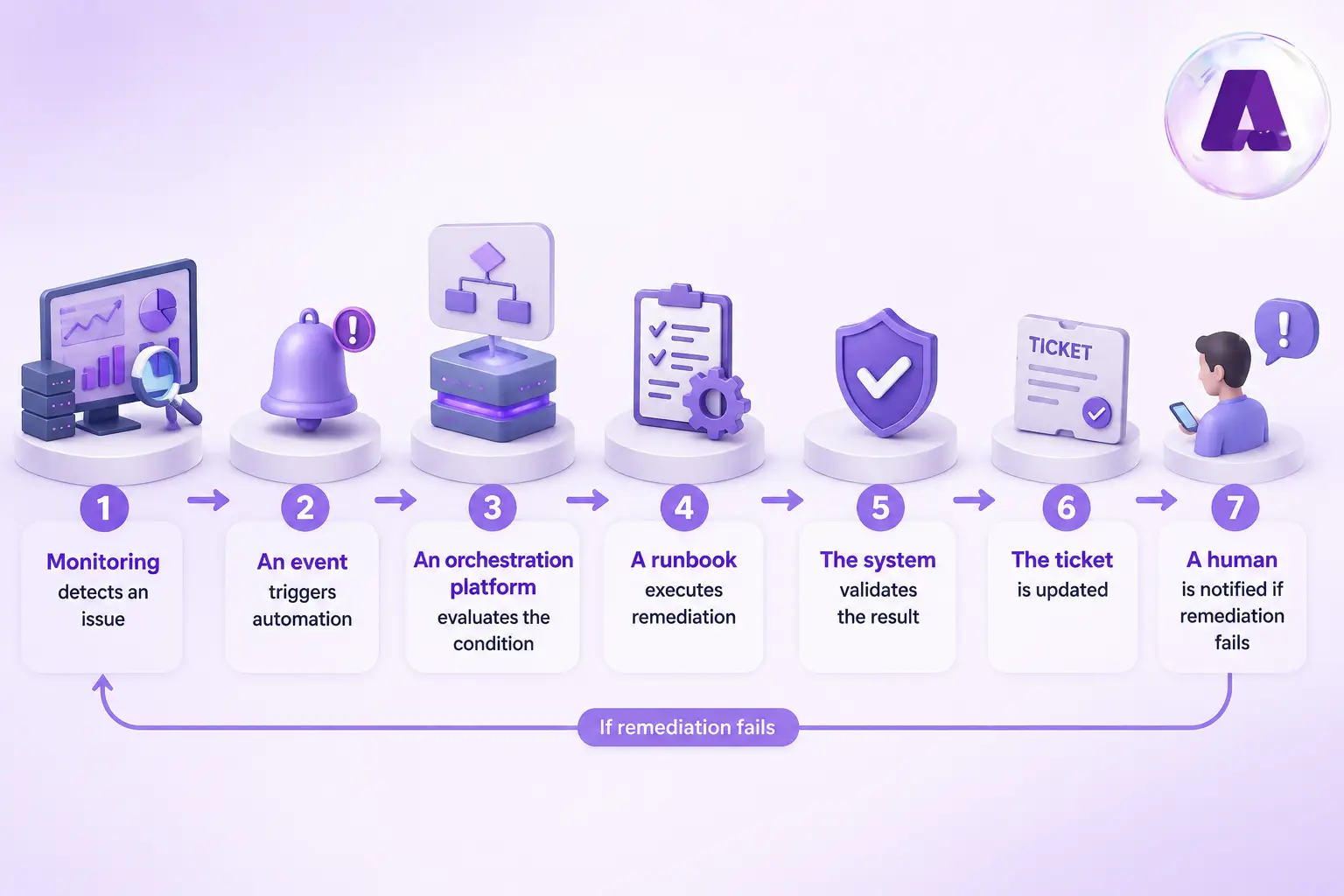
Runbook automation handles defined actions, while workflow automation coordinates multiple steps. Infrastructure-as-code, APIs, orchestration platforms, monitoring systems, and ITSM integrations connect these actions into repeatable operating processes.
Where Humans Still Matter
Automation should not be treated as a replacement for operational teams. Human intervention remains important for major incidents, hardware failures, architectural changes, security exceptions, high-risk configuration changes, unplanned infrastructure events, and approval-based workflows.
A useful managed service combines automated routine work with clear escalation paths. This approach supports automation-driven pricing efficiency without assuming that every operational decision can be automated.
How to Compare Managed Data Center Providers by Price?
Do not compare monthly prices in isolation. Compare the total scope, expected usage, exclusions, SLA, transition costs, and operational model under the same baseline SOW.
Ask Every Provider for the Same Scope
Request a common SOW covering devices, servers, racks, monitoring, NOC coverage, remote hands, incident response, patch management, network management, automation, reporting, and SLA commitments.
Compare These 8 Pricing Elements
- Monthly recurring fee
- One-time onboarding cost
- Per-device or per-server charges
- Remote hands rates
- Add-on services
- Cross-connect and third-party charges
- Minimum monthly commitment
- Contract escalation terms
Compare Effective Cost, Not Headline Price
Use a simple calculation when comparing quotes:
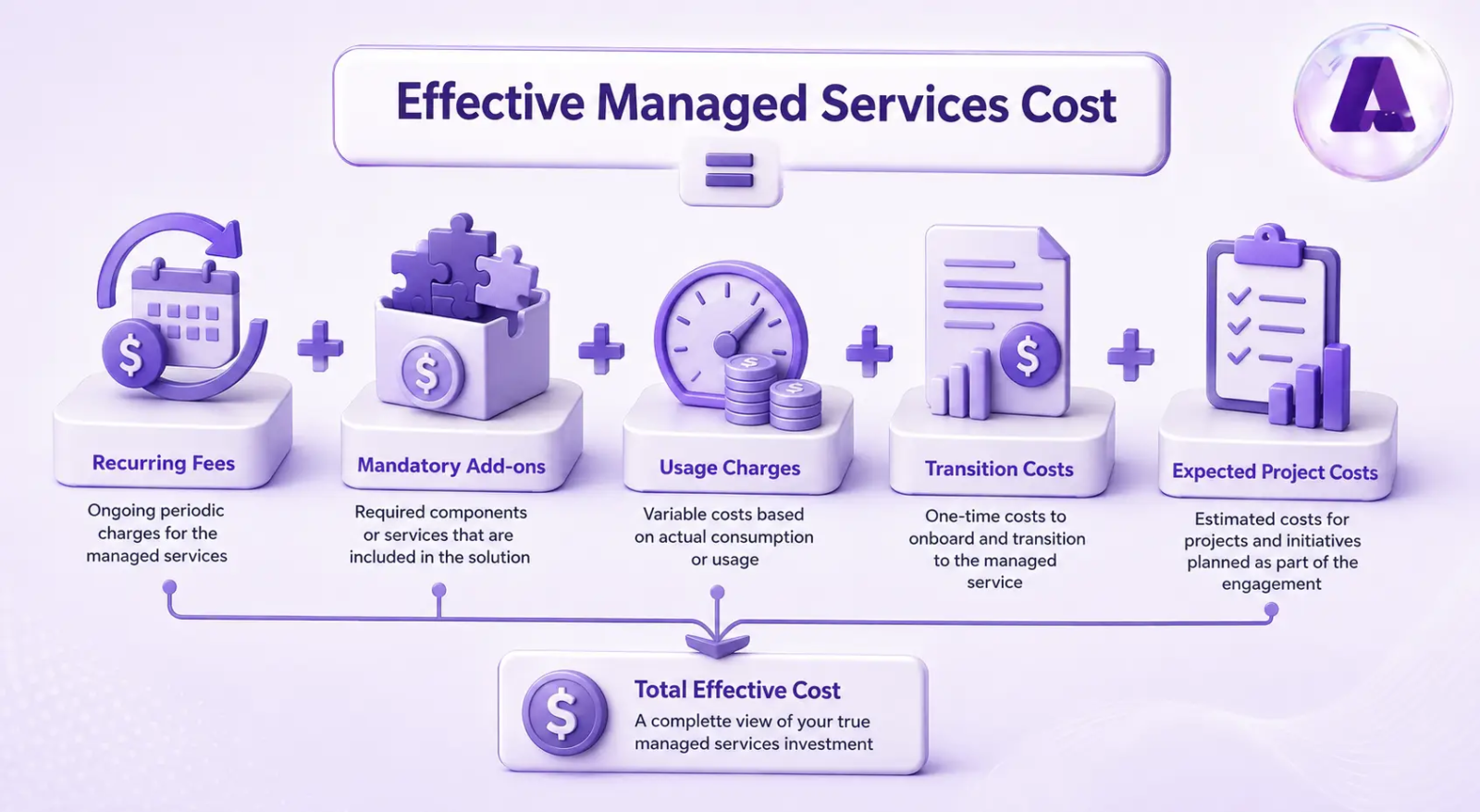
This gives you a practical basis for how to compare managed service provider pricing and how to compare managed data center providers by price.
What Does a Typical Managed Data Center Services Contract Include?
A typical managed data center services contract should define both the operational boundary and the commercial rules. Use the following checklist before signing:
- Scope of managed infrastructure and included services
- Excluded services and SLA uptime or response commitments
- NOC coverage and remote hands scope
- Escalation process and monitoring responsibilities
- Change management and security responsibilities
- Compliance framework support
- Reporting, pricing, and billing
- Contract term, renewal, and termination
- SOW and change-order process
For Aptly Technology’s evidence-backed capabilities, ISO 27001 and SOC 2 can be considered when evaluating compliance-related requirements and service practices.
Aptly Technology: Managed Infrastructure Built for Automation
A managed service should not only maintain infrastructure. It should make day-to-day operations more predictable, measurable, and easier to automate. That starts with defining what your team manages today and where repetitive operational work creates unnecessary effort.
Aptly Technology brings together data-center infrastructure management, enterprise IT infrastructure services, AI-ready infrastructure, GPU data-center buildout and support, AI workload deployment and optimization, infrastructure monitoring, automation, orchestration, and operational support. It can also integrate with existing enterprise tools rather than requiring every workflow to start from scratch.
For buyers reviewing managed services pricing, the useful starting point is a structured assessment on:
- Current infrastructure
- Operational workload
- Support requirements
- Appropriate managed-services scope.
This helps connect the service model to actual operational needs.
Conclusion
The cheapest managed-services quote is not necessarily the lowest-cost option. When reviewing data center managed services pricing, compare what is managed, what is automated, what needs human intervention, what is included, and what becomes an add-on.
Also review the SLA, change process, and likely cost when your infrastructure changes. A well-defined SOW, transparent pricing model, measurable SLA, and practical automation strategy provide a better basis for vendor selection than headline monthly pricing alone.
If you are evaluating a managed infrastructure requirement, Aptly Technology can help you before comparing provider quotes.
FAQs
Q1: How much do data center managed services cost per month?
Pricing varies by infrastructure size, support coverage, SLA, service scope, and pricing model. Providers may charge recurring fees alongside usage-based or project charges, so a universal monthly figure can be misleading.
Q2: What pricing models do data center managed service providers use?
Common models include per-device, per-server, per-rack, tiered, all-inclusive, usage-based, and project-based pricing. Providers may combine several models within one managed-services contract.
Q3: Is per-device or tiered pricing better for managed services?
Per-device pricing works well when asset counts are clear and predictable. Tiered pricing is useful when service levels, support coverage, and response requirements matter more than simple device volume.
Q4: What’s typically included vs billed as an add-on in a managed services contract?
Monitoring, routine administration, incident support, and defined remote hands may be included. Migration, hardware replacement, special projects, major upgrades, cross-connects, and custom automation are often billed separately.
Q5: What’s the difference between per-device and all-inclusive pricing?
Per-device pricing assigns a charge to each managed asset, making unit costs visible. All-inclusive pricing bundles a broader service scope, but you still need to review exclusions and fair-use limits.
Q6: How much does 24/7 data center support cost from a managed provider?
24/7 support generally costs more because it requires broader NOC coverage, escalation processes, staffing, and tighter SLA commitments. The final fee depends on infrastructure scope and response requirements.
Table of content
- TL; DR
- Introduction
- How Data Center Managed Services Providers Structure Their Pricing?
- 5 Common Data Center Managed Services Pricing Models
- What’s Included in Managed Data Center Services?
- What’s Usually Billed as an Add-On?
- How SLAs Affect Data Center Managed Services Pricing?
- The Hidden Costs in Managed Services Quote
- A Practical 2026 Buyer Benchmark
- What Makes Data Center Managed Services Cost More or Less?
- How Automation Changes Managed Services Pricing?
- How to Compare Managed Data Center Providers by Price?
- What Does a Typical Managed Data Center Services Contract Include?
- Aptly Technology: Managed Infrastructure Built for Automation
- Conclusion
- FAQs