Introduction
Thinking about data center buildout? It’s a massive financial move that can surprise even the pros. Whether it’s your first site or a big expansion, you need to know exactly where your money is going before you spend a single cent.
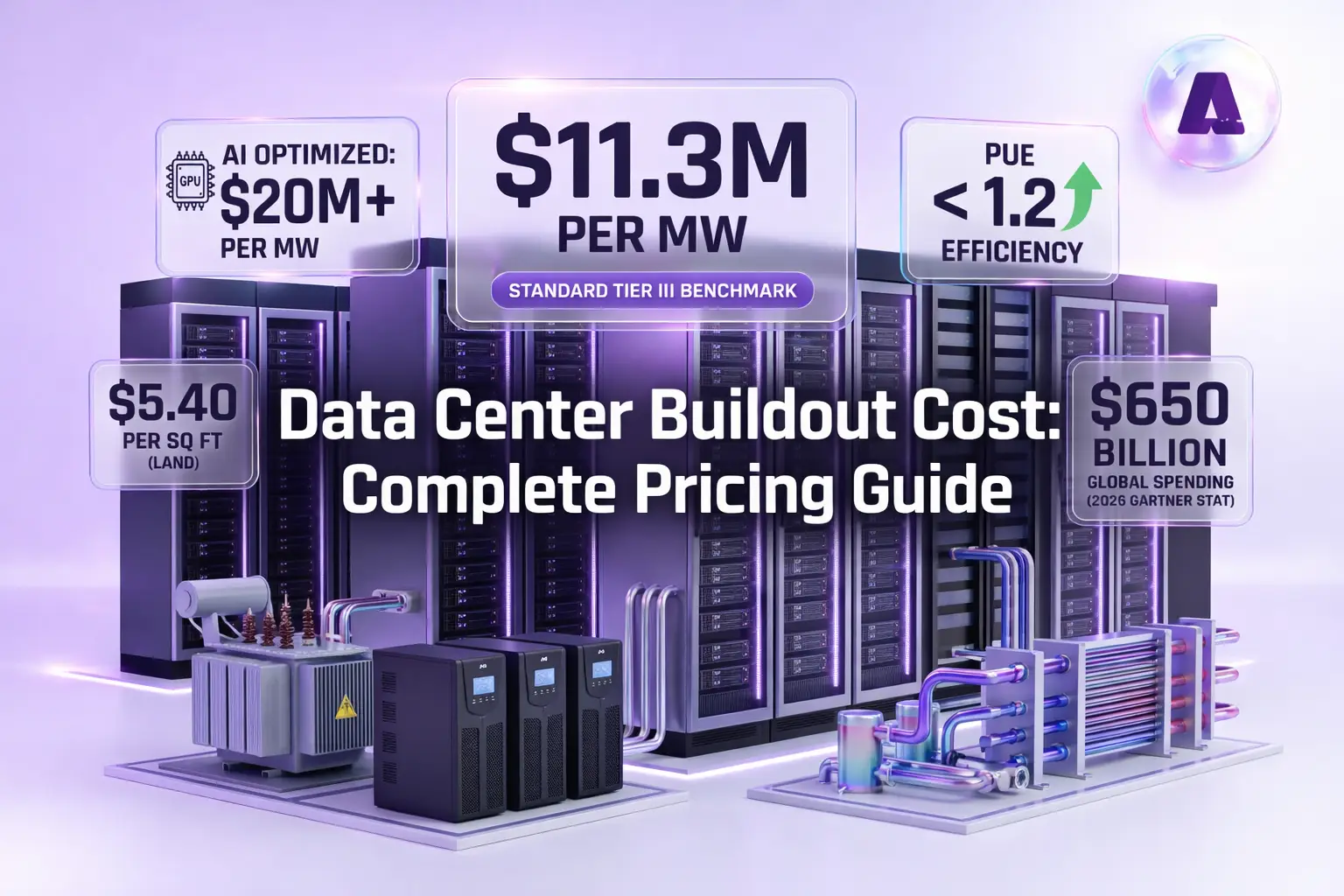
Gartner predicts that global data center spending will exceed over $650 billion in 2026—up 31.7% from the prior year. This explosion shows how much the world is investing in digital infrastructure.
To stay ahead, you have to get your numbers right from day one. This guide explains the breakdown of data center buildout costs. So, you can go into your project with your eyes open and your budget intact.
Which Data Center Fits Your Budget?
Not all data centers are built the same. The type you choose will have a direct impact on your total buildout cost. Here is what each one will cost to deploy.
- Hyperscale Data Center: Built by tech giants like AWS, Azure, and Google Cloud, hyperscale facilities are the largest and most capital-intensive builds in the industry. It exceeds 100 MW and covers millions of square feet.
-
- Best For: Large cloud providers with massive computing demands
-
- Hyperscale Data Center Cost per MW: $12M to $20M+
- Enterprise Data Center: Built and operated by a single organization for its own internal use. These facilities are designed around the specific business needs and offer full control over data center infrastructure components.
-
- Best For: Mid-to-large businesses needing dedicated private infrastructure
-
- Enterprise Data Center Cost per MW: $10M to $14M
- Colocation Data Center: Rather than building your own facility, you rent space, power, and connectivity inside a third-party data center. It is faster to get started, requires no construction, and significantly reduces upfront costs.
-
- Best For: Enterprise-grade infrastructure without the build commitment
-
- Colocation Data Centers Cost per Cabinet: $500 to $2,500+ per month
- AI Data Center: Designed for high-density GPU workloads, AI data centers require advanced liquid cooling, reinforced power systems, and specialized infrastructure. This makes them the most expensive type to build.
-
- Best For: Running AI, machine learning, and GPU compute workloads
-
- AI Data Center Build Cost per MW: $20M to $30M+
- Modular Data Center: Pre-built off-site in standard units and delivered ready to deploy. Modular facilities are quicker to set up and easier to expand as your needs grow without the long timelines of traditional construction.
-
- Best For: Needing fast deployment and flexible scaling
-
- Modular Data Center Cost per MW: $8M to $14M
-
- Deployment Time: 6 to 12 months
- Turnkey Data Center: A single vendor manages initial design and all the way through to final handover. No juggling multiple contractors or workstreams.
-
- Best For: Simplicity and a single point of accountability
-
- Turnkey Data Center Cost per MW: $11M to $18M
-
- Deployment Time: 12 to 24 months
What Is the Average Data Center Buildout Cost in 2026?
Data center buildout costs depend heavily on factors like facility size, geographic location, tier classification, and the workload type. Every project is different, but the industry has reliable cost benchmarks you can use as a starting point for your budget planning.
- Data center cost per MW in 2026: JLL’s 2026 Global Data Center Outlook reports the average global construction cost is forecast to reach $11.3 million per MW in 2026. For AI-optimized facilities, costs can exceed $20 million per MW due to advanced liquid cooling and higher power density requirements.
- Data center cost per square foot: Construction costs now range from $600 to $1,100 per square foot for standard facilities. AI-ready data centers can push well beyond that. According to Cushman & Wakefield, the average cost per square foot has surged to nearly $1,000 — up roughly 50% year over year.
- Data center cost per rack: Rack-level costs vary significantly by density and cooling method. AI-centric facilities with 200kW+ per rack require advanced liquid cooling infrastructure. This increases liquid cooling data center cost compared to legacy air-cooled deployments.
Here is a quick look at how data center buildout costs vary by facility type:
| Facility Type | Cost per MW | Cost per Sq Ft | Typical Scale |
|---|---|---|---|
| Small Enterprise | $8M – $10M | $600 – $800 | 1 – 5 MW |
| Mid-Size Enterprise | $10M – $12M | $800 – $1,000 | 5 – 20 MW |
| Large/Colocation | $11M – $14M | $900 – $1,100 | 20 – 100 MW |
| Hyperscale | $12M – $20M+ | $1,000 – $2,000+ | 100 MW+ |
| AI-Optimized | $20M – $30M+ | $1,500 – $3,000+ | Varies |
What Are the Major Cost Components of a Data Center Buildout?
Understanding how much does a data center cost to build in 2026 is crucial.
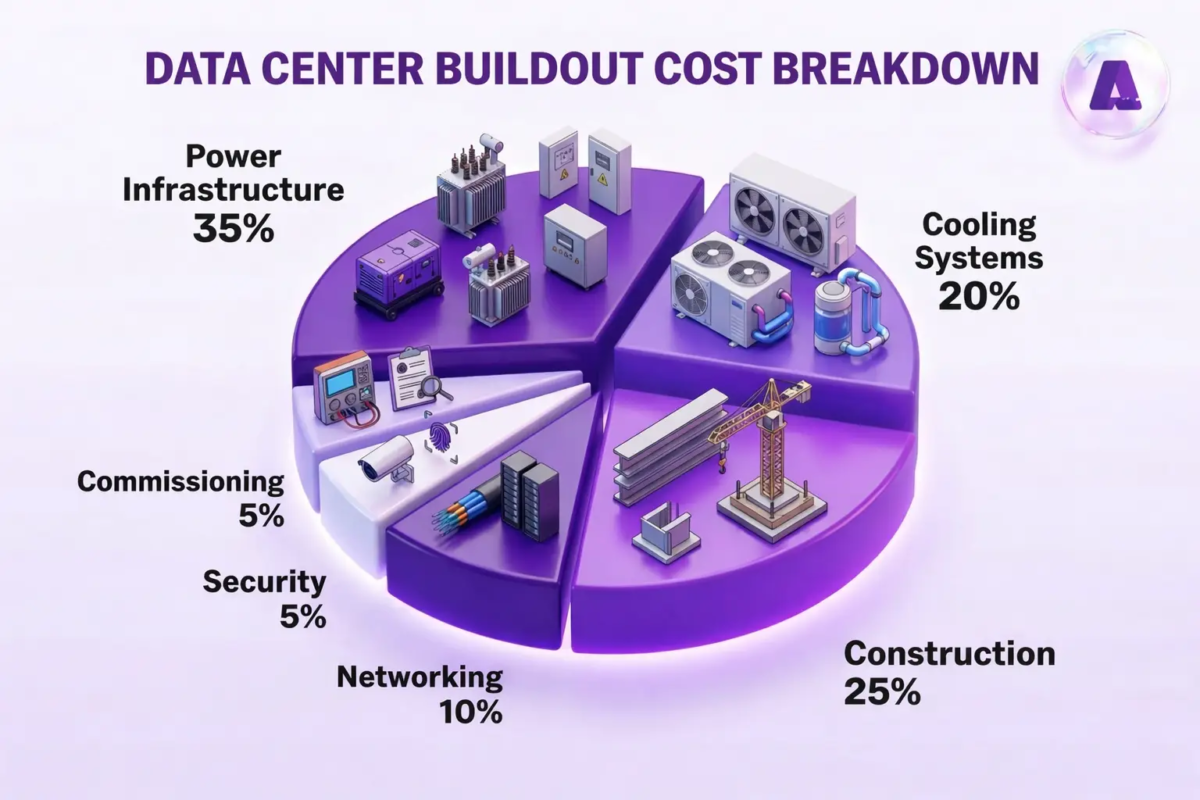
Here is the complete data center build cost breakdown:
Land Acquisition & Site Selection
Land costs vary widely depending on location, land size, and proximity to power infrastructure. U.S. data center land prices for large parcels rose 23% between 2023 and 2024. This reflects how competitive the market has become, according to Cushman & Wakefield.
When comparing data center build cost in India vs the U.S., India offers substantially lower land and labor costs, making it a more cost-effective and increasingly attractive option for large-scale data center development.
Construction & Civil Works
The basic structure of a data center including the foundation, walls, flooring, and roof makes up a large portion of the total construction cost. There are two ways to build: start fresh on empty land or convert an existing building. Repurposing an existing building can save 10–15% on construction costs, according to Dgtl Infra.
Construction costs have also risen steadily in recent years. Generators, transformers, cooling units, and power systems have all become more expensive since 2021 — putting real pressure on overall project budgets.
Power Infrastructure
Power infrastructure is consistently the single largest cost driver in any data center buildout, often accounting for 30-40% of the total budget. Key components include UPS systems, backup generators, power distribution units (PDUs), and transformers.
Mechanical, electrical, and plumbing (MEP) systems consume half of the total data center construction budgets. In many markets, power availability is now the primary constraint on data center development.
Cooling Systems
Data center cooling systems cost is always high. Traditional air cooling works well for standard setups but uses a large amount of power. As AI workloads demand more from each server’s rack, liquid cooling has quickly become the preferred choice. The table below compares the most common data center cooling types:
| Cooling Type | Upfront Cost | Energy Savings | Best For |
|---|---|---|---|
| Air Cooling (CRAC/CRAH) | Low ($300–$600/kW) | Baseline | Standard enterprise workloads |
| Evaporative Cooling | Low-Medium | High (up to 70% vs chiller) | Dry climate regions |
| Direct-to-Chip Liquid Cooling | $1,000–$2,000/kW | 10–21% | AI/HPC workloads |
| Immersion Cooling | $1,000–$1,500/kW | Up to 40% | Ultra-high density AI |
Networking & IT Infrastructure
Data center network infrastructure costs include cabling, structured cabling systems, top-of-rack switches, core and distribution switches, and optical transceivers. These costs scale directly with capacity. For AI workloads, server rack density cost increases significantly due to higher-bandwidth networking requirements and the need for low-latency GPU interconnects.
Retail colocation facilities serve multiple tenants under one roof. Because each tenant has different needs, per-unit networking costs tend to be higher than in wholesale builds.
Physical Security & Fire Suppression
Security and compliance are non-negotiable in any serious data center development project. Key costs include:
- Access control systems
- Surveillance infrastructure
- Fire detection systems
- Perimeter fencing and security lighting
- Compliance certifications
These costs affect both upfront and ongoing budgets, since certifications and audits need to be renewed every year.
Data Center Planning and Design
Data center architecture design cost is underestimated. This includes engineering feasibility studies, architectural design, structural and civil engineering, MEP engineering, project management, and data center capacity planning costs. These soft costs represent 8-15% of the total project value and are essential to getting the build right the first time.
Data Center Commissioning
Data center commissioning is the systematic process of verifying that all systems perform according to design specifications before the facility goes live. Commissioning is the final safeguard against costly failures in production.
Commissioning specialists are now being locked into builds 12-18 months in advance. The projects that delay this step face both schedule risk and cost overruns. 1-3% of the total project cost is needed for commissioning, but it can save you multiples of that in avoided downtime and costly rework.
Data Center CAPEX Costs vs OPEX Cost
When budgeting, costs fall into two categories:
- CAPEX (capital expenditure): One-time costs of building and equipping the facility
- OPEX (operational expenditure): Ongoing expenses of running it day to day
Getting this balance right from the start is key to the long-term financial health of your facility.
| Category | CAPEX | OPEX |
|---|---|---|
| Construction & Civil | Land, shell, core | Maintenance & repairs |
| Power Infrastructure | UPS, generators, PDUs | Energy bills, utility contracts |
| Cooling | CRAC/CRAH, chillers, CDUs | CRAC/CRAH, chillers, CDUs |
| IT Equipment | Servers, switches, cabling | Hardware refresh, licensing |
| Security | Access control, CCTV install | Monitoring, staffing, audits |
| Commissioning | Initial testing & verification | Periodic re-commissioning |
| Staffing | Recruitment & training | Salaries, ongoing training |
| Column 1 Value 8 | Column 2 Value 8 | Column 3 Value 8 |
Build vs Colocation vs Cloud: Which Is More Cost-Effective?
This is one of the most important strategic decisions any organization faces when planning its infrastructure. The best choice depends on your scale, growth trajectory, compliance requirements, and financial strategy.
| Option | Upfront Cost | Long-Term Cost | Control | Best For |
|---|---|---|---|---|
| Build Own | $10M–$30M+ per MW | Lowest at scale | Full | Large enterprise (10+ MW) |
| Colocation | $500–$2,500 per rack/month | Medium | Partial | Mid-size (1–10 MW) |
| Cloud | $0 upfront | Can exceed 2–3x over 5 years | Low Value 3 | Startups / variable workloads |
How to Reduce Data Center Buildout Costs?
While data center buildout costs are rising, experienced developers have identified several proven strategies to manage total project investment:
- Phased Buildout Approach: Start with what you need today and expand as demand grows, helping you avoid overspending upfront.
- Repurpose an Existing Building: Converting a warehouse into a data center can save 10–15% compared to building from scratch. It is faster, more affordable, and reduces the complexity of starting from an empty land.
- Use Modular Design: Pre-built modular units are cheaper to assemble, faster to deploy, and easier to budget. They work well for organizations that need to get up and run quickly without a long construction timeline.
- Improve Your PUE: PUE (Power Usage Effectiveness) measures how efficiently your facility uses energy. Improving it from 1.55 to 1.3 cuts data center energy consumption costs.
- Choose the Right Location: Sites with reliable power supply, lower land costs, and permitting processes reduce your total project cost.
- Order Equipment Early: Key IT equipment takes 12-18 months to deliver. Ordering early protects your schedule and helps you avoid costly delays.
Why Partner with Aptly Tech for Your Data Center Buildout?
Reducing data center buildout costs requires right expertise, the right team, and a partner who has done it before at scale. Aptly’s data center specialists work with organizations of all sizes to design cost-efficient, scalable, and future-ready facilities.
Here is what Aptly brings:
- Lifecycle Management: Aptly covers the full data center lifecycle from hardware planning and infrastructure modernization to upgrades, migrations, and proactive capacity planning.
- High Availability: Aptly ensures up to 99.9% uptime, so your operations run reliably without interruption.
- Trusted by Microsoft: Aptly is the only provider trusted by Microsoft to design, build, and support third-party hyperscale data centers. Now, bringing that same proven expertise to enterprise clients.
- 24/7 Monitoring and Support: Aptly’s Command Center provides round-the-clock monitoring, incident management, smart hands support, and Tier 2/3 technical assistance for routine operations.
With Aptly managing your data center environment, your team can stay focused on core business operations.
Conclusion
Data center buildout costs in 2026 are at an all-time high and investment is only growing. Understanding where the money goes is the most important first step before committing to any project.
Power and cooling cost in data center eats up more than half your budget. Tier level and location choices can add or save tens of millions of dollars.
The good news is that smart planning, phased buildouts, and early supplier engagement can go a long way in keeping costs under control. The organizations that get it right are those that treat a data center as a long-term investment.
Building a data center is a big investment. Connect with the Aptly data center experts for a buildout strategy around your budget.
FAQs
Q. Should you build or lease a data center?
Building gives you total control and lower long-term costs, while leasing is faster and saves you from a massive upfront payment. The choice depends on whether you want to own the house or just rent the rooms.
Q. How much does it cost to build a data center?
In 2026, a standard facility costs roughly $11 million to $12 million per Megawatt (MW). For a medium-sized center, this usually means a total starting budget of at least $100 million.
Q. What is the biggest expense in a data center?
The electrical system is the king of costs, taking up about 45% of your total budget. This includes massive backup batteries, high-voltage transformers, and generators to ensure the power never blinks.
Q. What factors affect data center cost?
The three biggest drivers are location (land and power access), Tier level (how many backup systems you need), and density (whether you are running basic apps or high-powered AI).
Q. What is cost per MW in data centers?
Standard business centers average $11.3 million per MW.
- Cost to build 1 MW data center can be $11 million – $15 million. This is common for smaller edge locations.
- Cost to build 5 MW data center can expect to spend $55 million – $60 million. This mid-size range is where you begin to save money through bulk buying.
- Cost to build 10 MW data center starts at $110 million – $120 million. If fully designed for AI, this can jump to over $200 million.
Q. Why are AI data centers more expensive?
AI chips run incredibly hot. They require expensive liquid cooling systems and much heavier electrical wiring to handle ten times the power of a normal server.
Q. What is Tier 3 vs Tier 4 cost difference?
Tier 4 data center costs are higher than Tier 3 data center costs. The extra investment pays for two fully independent power and cooling paths. This helps stay online even during major maintenance or unexpected failures. For most enterprises, Tier 3 data center costs offer the right balance between reliability and budget. Tier 4 data center costs are justified for organizations where even a few minutes of downtime is not an option.
Q. Is cloud cheaper than a data center?
In a data center vs cloud cost comparison, cloud wins on flexibility and zero upfront cost. You pay only for what you use. Conversely, a data center delivers a lower cost per workload over the long term for predictable, high-volume operations. Many organizations today use a hybrid approach to get the best of both.
Q. Is colocation cheaper than building your own data center?
When doing a build vs colocation cost comparison, colocation eliminates construction costs, reduces staffing needs, and gives access to Tier III or IV infrastructure without owning it.