Introduction
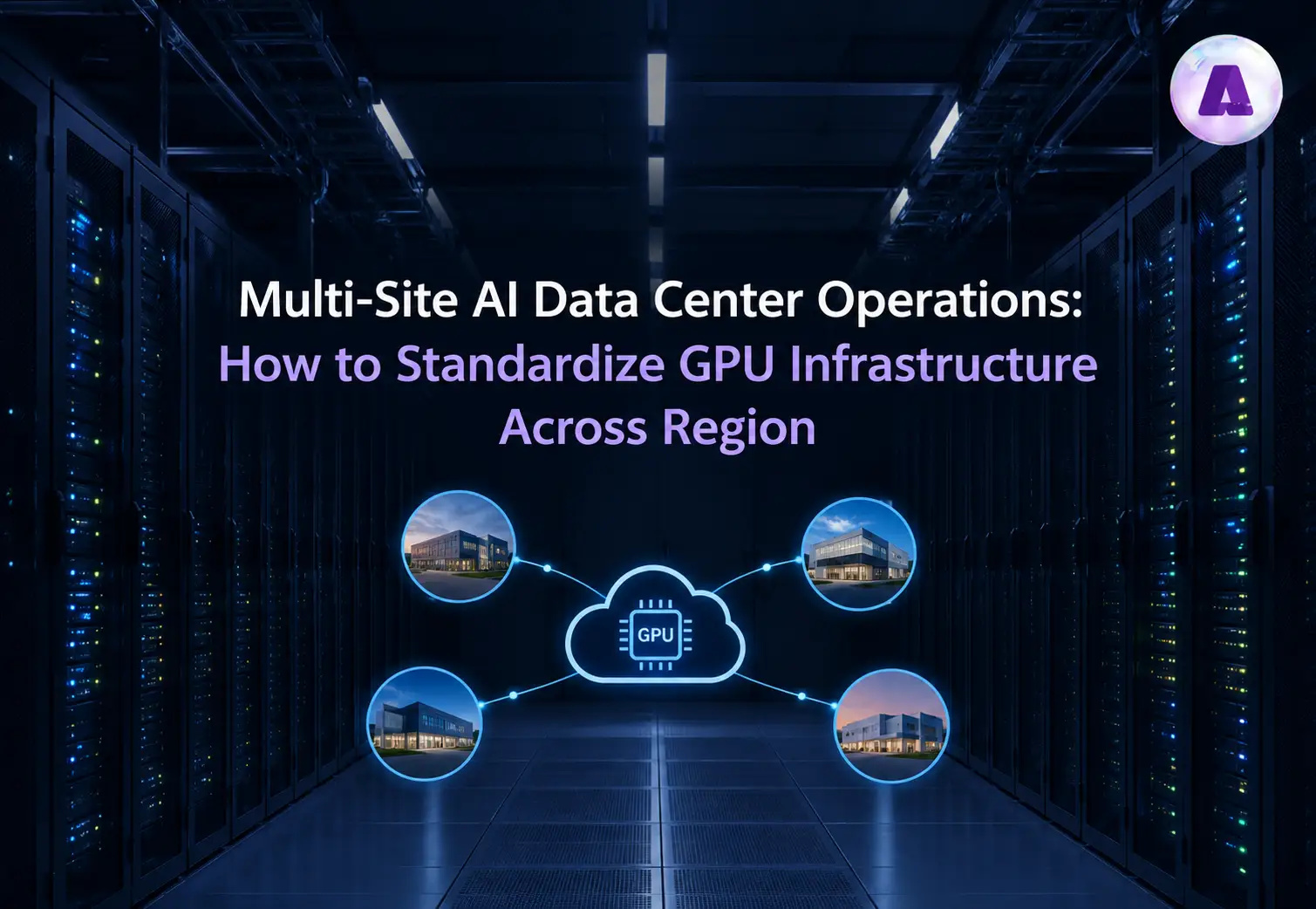
As AI infrastructure expands across regions, multi-site AI data center operations become harder to manage consistently. GPU clusters may use different hardware generations, network fabrics, software stacks, and facility designs. Without shared operating procedures, these differences can create inconsistent incident classifications, delayed escalations, configuration drift, and unreliable performance reporting.
Consider a GPU cluster experiencing recurring training-job failures. The local team classifies the problem as a hardware incident, while another region treats similar symptoms as a network issue. Both teams investigate independently, delaying resolution and producing conflicting reports.
Uptime Institute reports that failure to follow established procedures remains the leading driver of human-error outages in 2026. Multi-site operations need a shared operational framework. Hence, the goal is consistent outcomes across regions, even when the infrastructure differs.
Why Multi-Site AI Data Center Operations Become Difficult at Scale?
Operating one GPU cluster is different from coordinating infrastructure across multiple regions. As sites grow independently, differences in technology, procedures, and reporting can create gaps that affect reliability and workload performance.
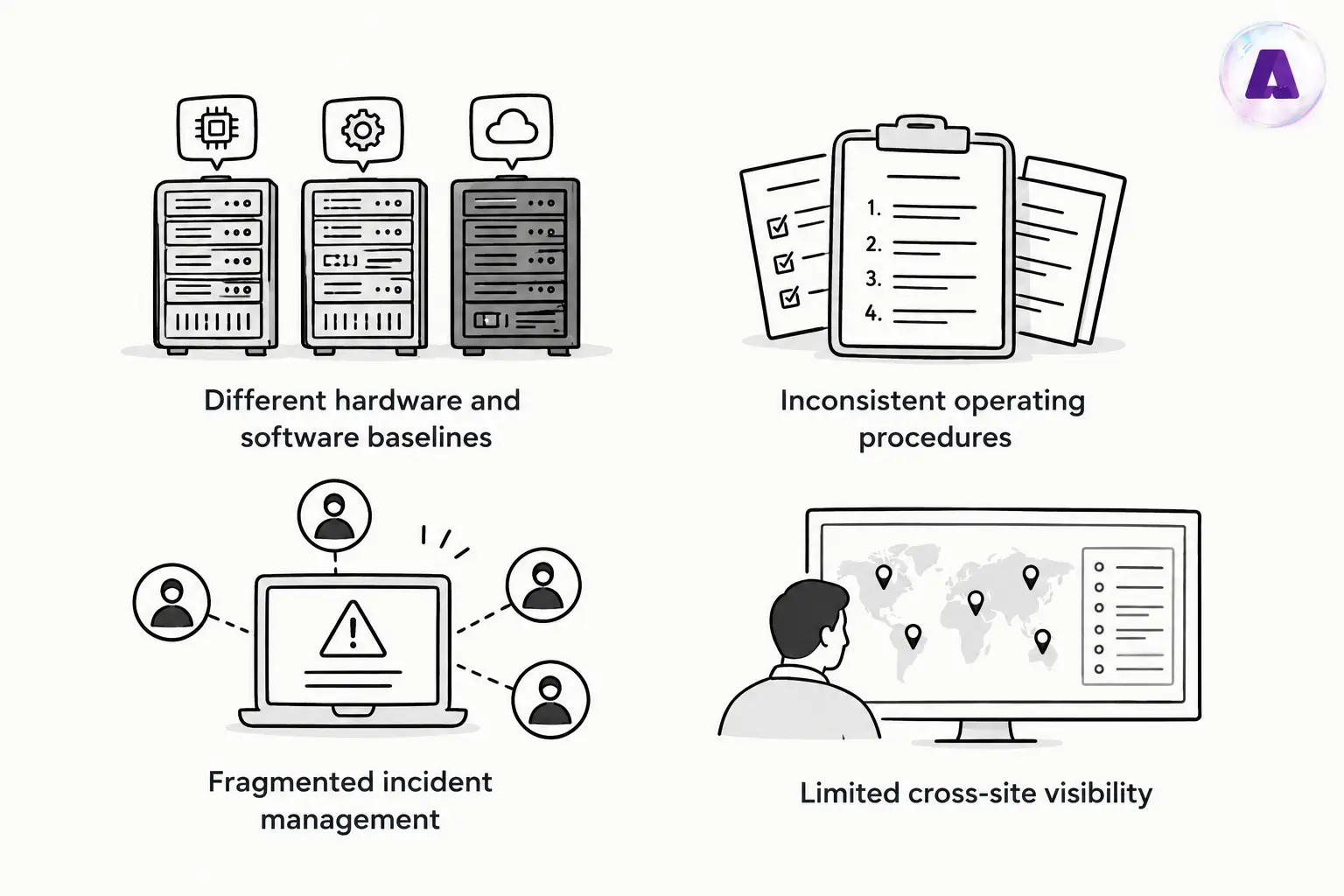
Different hardware and software baselines
GPU generations, server platforms, BIOS/BMC versions, drivers, firmware and CUDA environments can differ from site to site. Networks may run NVIDIA InfiniBand or RoCE Ethernet, each with its own topology and configuration requirements. Standardization should define approved configuration profiles for each platform instead of forcing every site onto one hardware configuration.
Inconsistent operating procedures
One team may follow a documented sequence for isolating a failed GPU node, while another relies on local experience. Preventive maintenance, firmware updates, thermal alarm responses, and post-repair validation may follow different practices.
This makes knowledge transfer difficult when specialists support several sites or regional teams to operate across time zones.
Fragmented incident management
Incident severity definitions can vary between regions. One site might classify repeated training failures as a high-priority incident, while another records the same symptoms as routine troubleshooting.
Escalation ownership also becomes unclear when incidents cross GPU hardware, networking, storage, platform engineering, and facility operations. Incomplete shift handovers can compound the problem by leaving incoming teams without diagnostic evidence, pending actions, or clear accountability.
Limited cross-site visibility
Different monitoring thresholds and reporting intervals make regional comparisons unreliable. Researchers estimated their cluster utilization at 62%, while measured utilization averaged about 14%. Configuration drift can stay hidden until it affects workload performance.
How to Standardize GPU Infrastructure Across Regions?
Standardizing GPU infrastructure across regions begins with a common governance model. Let’s see how to build a common operating framework for multi-region GPU infrastructure.
Establish approved configuration profiles
Create a standard baseline for every supported GPU platform or cluster type. Each profile should document:
- Hardware inventory: GPU models, server platforms, network interface cards, storage components, and asset identifiers.
- System firmware: BIOS, BMC, GPU firmware, NIC firmware, and other relevant component versions.
- Software stack: Operating system, GPU drivers, CUDA, container runtime, and orchestration versions.
- Network configuration: Topology, fabric settings, routing policies, and relevant performance parameters.
- Operational controls: Monitoring agents, health checks, security settings, and configuration validation requirements.
Maintain these profiles in version control with named owners and documented approval process. Meta’s reliability study drew on 4 million jobs and more than 150 million A100 GPU hours, and it used a common failure taxonomy to compare two clusters.
Use infrastructure as code and configuration management
Infrastructure as code (IaC) and configuration management help teams provision and maintain infrastructure against approved settings.
- Store configuration templates in version control
- Validate proposed changes before deployment
- Compare deployed configurations against approved baselines
- Record exceptions and rollback procedures
- Test updates on a limited cluster before regional rollout
Automated compliance checks can flag unauthorized changes before they affect production workloads. However, automation should operate within approved change controls, with suitable review and validation for high-impact changes.
The National Institute of Standards and Technology (NIST) recommends maintaining documented configuration baselines and controlling changes through configuration management processes.
Create a controlled exception process
Regional differences sometimes require approved deviations because of hardware availability, local regulations, network architecture, or capacity constraints.
Every exception should document:
- Business or technical justification
- Affected assets
- Risk assessment
- Compensating controls
- Approving authority
- Review date
Review each exception on its stated date, so that temporary deviations do not quietly become permanent drift that nobody owns.
Aptly Technology’s AI infrastructure lifecycle engineering and operational support can help enterprises maintain approved configurations, coordinate changes and manage GPU infrastructure throughout its operating lifecycle.
Define Consistent SOPs and Incident Management Across Every Site
Configuration standards establish what should be deployed. SOPs and incident-management (IcM) rules determine how teams respond when infrastructure deviates from those standards. Here are the ways to define SOPs and IcM rules:
Build a shared SOP library
Create a centrally governed library of SOPs for:
- GPU health checks and failed-node isolation
- GPU firmware and driver updates
- GPU cluster networking and fabric troubleshooting
- Thermal alarms, cooling interruptions and power events
- Node replacement, preventive maintenance and service restoration
- Disaster recovery and regional service disruptions
Each SOP should specify prerequisites, execution steps, validation checks, rollback conditions, required evidence, and escalation triggers. Local teams can add site-specific instructions without changing the common control requirements.
Review procedures after significant infrastructure changes, recurring incidents, and failed maintenance activities. A documented procedure is useful only when teams can execute it correctly and verify the outcome.
Define one incident severity matrix
Use common severity definitions based on business impact, workload disruption, affected capacity and recovery options.
| Severity | Example operational condition | Response approach |
| SEV-1: Critical | Major production outage or widespread GPU capacity loss | Immediate incident command and coordinated escalation |
| SEV-2: High | Significant cluster degradation or repeated job failures | Urgent specialist engagement and active mitigation |
| SEV-3: Moderate | Isolated node failure with available capacity or workaround | Assigned troubleshooting and tracked resolution |
| SEV-4: Low | Non-urgent defect, warning or maintenance finding | Planned remediation and routine review |
These categories are illustrative. Enterprises should define response and restoration targets according to their service commitments and operational risks.
Severity should reflect impact rather than symptoms alone. One failed GPU in a small production cluster could be more consequential than a failed node in a large cluster with sufficient spare capacity.
Establish explicit escalation ownership
Define responsibilities for site operations, GPU hardware engineering, networking, storage, platform engineering, workload operations, facilities teams, and external vendors.
Every incident need one accountable owner, a documented next action, and clear conditions for escalation. Technical specialists may contribute to troubleshooting, but responsibility for coordinating the incident must remain explicit.
For cross-team incidents, establish a global incident manager or operations lead who coordinates priorities, communications, and resolution milestones.
Aptly Technology’s AI data center support and 24×7 operations services can support enterprises seeking consistent monitoring, incident response, commissioning, and ongoing lifecycle support across distributed infrastructure.
How to Detect and Prevent Configuration Drift in GPU Infrastructure?
Configuration drift occurs when deployed infrastructure gradually diverges from its approved configuration. It can result from manual changes, inconsistent maintenance, emergency fixes, or software updates that are not applied uniformly.
Identify common signs of configuration drift
- A GPU node running an unapproved driver version.
- Different firmware versions within a cluster that requires a consistent baseline.
- Network settings or routing policies that differ from approved configurations.
- Missing monitoring agents or health checks on selected nodes.
- Manual changes that were never recorded in the configuration repository.
These differences can complicate troubleshooting because apparently similar nodes may behave differently under equivalent workloads.
Implement continuous configuration compliance checks
A practical configuration compliance process should follow six steps:
- Define the baseline: Maintain an approved, version-controlled configuration for each cluster profile.
- Collect configuration data: Gather inventory and configuration details from every region.
- Compare observed and approved states: Identify differences against the relevant baseline.
- Assess operational risk: Prioritize deviations according to security exposure, workload impact, and service risk.
- Remediate through approved changes: Apply authorized automation or documented corrective actions.
- Validate and record: Recheck the affected node or cluster and preserve evidence of the outcome.
Govern firmware and driver updates
- Maintain a compatibility matrix covering GPU firmware, system firmware, drivers, CUDA, operating systems, and networking components.
- Test updates against representative workloads and cluster configurations before production rollout.
- Schedule maintenance around workload commitments and regional operating windows.
- Define rollback criteria and post-update health checks before deployment begins.
This approach helps reduce the risk of introducing the same defect across every region while keeping configuration compliance measurable.
Build Reliable Shift Handovers for Global GPU Operations
A consistent handover process prevents unresolved incidents, temporary workarounds, and pending changes from disappearing between shifts.
Standardize the shift handover record
Every handover should capture:
- Open incidents, current severity, and affected sites, clusters, nodes, and workloads.
- Symptoms, diagnostic evidence, and troubleshooting steps already completed.
- Temporary workarounds, unresolved risks, and service limitations.
- Pending maintenance, configuration changes, and vendor cases.
- Named incident owners, next actions, and deadlines.
The record should distinguish confirmed findings from working hypotheses. This prevents incoming teams from repeating investigations or treating an unverified diagnosis as fact.
Establish a cross-region handover protocol
- Use one shared incident-management system with a consistent ticket structure.
- Require explicit acknowledgment of critical incidents by the incoming owner.
- Record decisions and timestamps in a common time standard such as UTC.
- Preserve local operating hours and regional escalation contacts.
- Escalate incidents that lack an accepted owner or miss defined milestones.
Separate global governance from local execution
A global operations function should own common policies, severity definitions, reporting standards, and configuration governance. Regional teams execute approved procedures and handle site-specific facility and hardware requirements. This creates consistency without requiring every team to follow identical maintenance schedules.
Build Centralized GPU Observability and Cross-Site Reporting
Monitoring only supports standardized operations when metrics, labels, thresholds and reporting definitions are consistent. Cast AI’s 2026 analysis of 23,000 Kubernetes clusters found average GPU utilization of just 5%, with organizations allocating roughly 20 times more GPU capacity than workloads actively used. Let’s look at some ways for better GPU observability.
Define a shared monitoring baseline
Track common metrics across all sites, including:
- GPU health: Temperature, power, memory errors, utilization, and hardware faults.
- Workload reliability: Failed or interrupted jobs, workload completion, and GPU availability.
- Network performance: Throughput, latency, connectivity, and fabric errors.
- Infrastructure health: Node availability and hardware failure rates.
- Configuration compliance: Approved-version adherence and monitoring coverage.
- Operational performance: Incident response, restoration time, and repeat failures.
Monitoring should connect infrastructure metrics with workload outcomes and incident records.
Create a consistent cross-site reporting model
Standardize metric definitions, reporting intervals, time zones, incident categories, and asset identifiers. Otherwise, two regions may report different results simply because they measure the same event differently.
A shared dashboard should show:
- Operational availability by site and cluster
- Installed GPU capacity versus capacity available for workloads
- Configuration compliance percentage
- Incident volume and mean time to repair (MTTR)
- Repeat incidents and unresolved high-severity events
- Maintenance compliance and change-related incidents
Use reports to identify systemic issues
Compare equivalent cluster profiles instead of ranking unlike hardware configurations against one another. Investigate repeated incidents, persistent configuration exceptions, and regions with unusually high rates of change-related failures.
Use these findings to improve training, refine SOPs, adjust maintenance processes, and identify opportunities for configuration management improvements.
Multi-Site Standardization Checklist for AI Data Center Operations
Use the following checklist to assess whether your GPU operations model is consistent across regions.
Configuration governance
☐ Approved hardware and software profiles for every cluster type
☐ Version-controlled configuration baselines and change approvals
☐ Automated drift detection and documented exception handling
Operational consistency
☐ Shared SOPs for GPU failures, network issues and maintenance
☐ Common incident severity definitions and escalation ownership
☐ Standard shift handover templates and incident records
Monitoring and reporting
☐ Consistent GPU health and workload monitoring across sites
☐ Common metric definitions, asset identifiers and reporting intervals
☐ Cross-site dashboards for availability, MTTR and configuration compliance
Lifecycle and resilience
☐ Tested firmware and driver rollout procedures with rollback plans
☐ Coordinated preventive maintenance and capacity planning
☐ Documented regional recovery procedures and recurring incident reviews
Review the checklist periodically and after any significant infrastructure change. Each control should have a named owner, evidence of compliance and a remediation path. Teams that cannot show evidence for a control should treat it as not yet in place, however informal practice may look.
Standardize Multi-Region GPU Operations with Aptly Technology Introduction
Aptly Technology helps enterprises turn standardization principles into daily operating practice across three areas:
- Infrastructure lifecycle engineering: supports consistent practices across GPU infrastructure deployment, validation, configuration and ongoing maintenance.
- Monitoring and incident response: helps establish operational visibility, incident handling and support workflows that work across distributed environments.
- 24×7 operational support: helps maintain continuity across shifts and coordinates troubleshooting, maintenance and escalation activities.
Aptly works alongside your internal teams rather than replacing them, adapting these practices to your existing hardware, tooling and service commitments. A useful first step is an assessment of your current procedures against the checklist above, which shows where standardization will have the greatest effect.
Ready to discuss your multi-site GPU operations requirements? Talk to us about opportunities to standardize operational procedures, monitoring and lifecycle support through our AI data center buildout, support, and operations services.
Conclusion
Multi-site GPU infrastructure needs common operational rules even when sites use different hardware. Approved configurations, standardized SOPs, shared severity definitions, clear escalation ownership and structured shift handovers form the foundation. Centralized monitoring and comparable metrics help teams spot recurring problems, while automation and lifecycle governance sustain those standards as infrastructure grows.
Start with the controls you can evidence least today, assign an owner to each, and review progress after every major infrastructure change. Standardize the operating model, not just the hardware. Consistent rules are what let a growing fleet stay reliable.
Contact Aptly Technology to start building a consistent operating model for your global AI infrastructure.
FAQs
Q1. What are multi-site AI data center operations?
Multi-site AI data center operations involve managing GPU infrastructure across multiple geographic locations using shared operational procedures, configuration standards, monitoring practices, and incident-management processes. This approach helps enterprises maintain consistent service reliability while accommodating regional hardware and facility differences.
Q2. How do you standardize GPU infrastructure across regions?
Standardize GPU infrastructure by defining approved hardware and software profiles, maintaining version-controlled configurations, implementing common SOPs, and establishing consistent incident severity definitions and escalation ownership. Centralized monitoring, controlled firmware updates, and regular configuration compliance checks help sustain these standards across regions.
Q3. What is configuration drift in GPU infrastructure?
Configuration drift occurs when deployed GPU infrastructure deviates from its approved baseline. Examples include unapproved GPU driver versions, inconsistent firmware, altered network settings, and missing monitoring agents. These differences can cause compatibility problems, complicate troubleshooting, and affect workload reliability.
Q4. How can enterprises detect configuration drift across GPU clusters?
Enterprises can detect configuration drift by maintaining approved configuration baselines, collecting inventory and configuration data from each site, and comparing observed settings against approved profiles. Automated compliance checks can flag deviations for risk assessment, authorized remediation, and post-change validation.
Q5. Why are standardized incident severity levels important for multi-region GPU operations?
Standardized severity levels help regional teams prioritize incidents according to business impact, workload disruption, affected GPU capacity, and recovery options. They also establish consistent escalation expectations and enable meaningful comparisons of incident volume, response performance, and recurring failures across sites.
Q6. What should a GPU infrastructure shift handover include?
A GPU infrastructure shift handover should include open incidents, severity levels, affected clusters and workloads, diagnostic evidence, completed actions, temporary workarounds, pending changes, vendor cases, and named owners for the next actions. Critical incidents should require explicit acknowledgment from the incoming team.
Q7. Which metrics should enterprises monitor across multi-site GPU infrastructure?
Enterprises should track GPU health, utilization, hardware errors, workload failures, cluster network performance, node availability, configuration compliance, and operational availability. Incident response time, mean time to repair (MTTR), repeat incidents, and available GPU capacity also help assess operational performance across regions.
Q8. Does GPU infrastructure standardization require identical hardware at every site?
No. GPU infrastructure standardization requires consistent governance, approved configuration profiles, operating procedures, and reporting definitions rather than identical hardware. Different GPU generations, server platforms, and network fabrics can operate under the same framework when their configurations and exceptions are properly documented and managed.
Q9. How can Aptly Technology support multi-site GPU infrastructure operations?
Aptly Technology supports AI infrastructure lifecycle engineering, data center commissioning, infrastructure monitoring, incident response, and 24×7 operational support. These services can help enterprises coordinate maintenance, standardize operational practices, and improve visibility across distributed GPU environments.