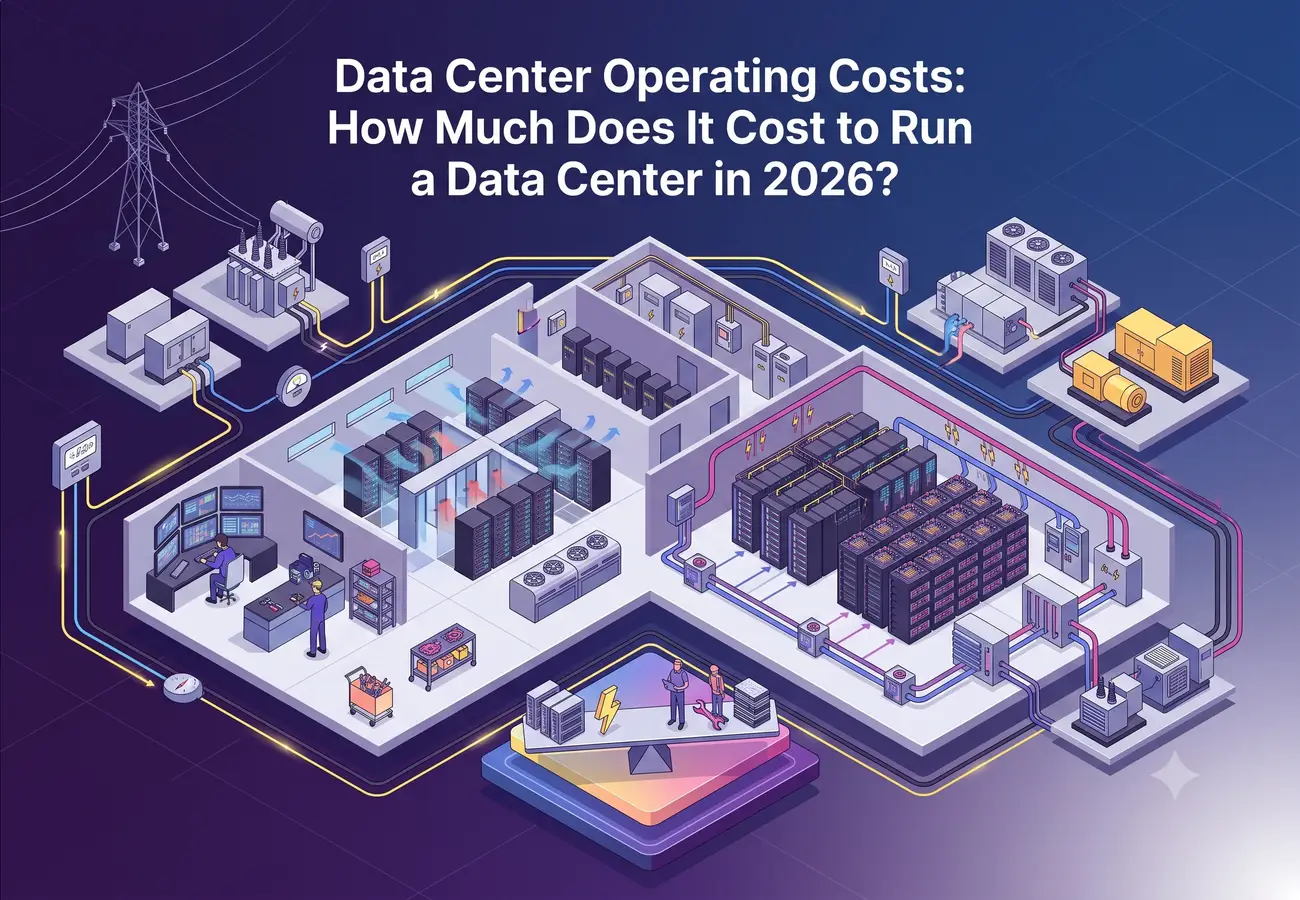
Introduction: The Financial Reality of Data Center Operating Costs
If you run enterprise infrastructure in 2026, your budget model looks nothing like the one you ran three years ago. High-density compute clusters, rising utility rates, and specialized mechanical systems have rewritten data center operating costs. This is not an annual accounting exercise anymore. Data center operating costs now demand daily operational discipline.
Worldwide spending on data center systems will reach $822 billion in 2026, part of $6.37 trillion in total global IT spending, according to Gartner and the International Energy Agency both project power demand across enterprise facilities will double by 2030. Rack densities are climbing from 8 kW to over 100 kW, and your budget has to absorb heavier utility bills, complex cooling, and specialized labor.
Aptly Technology, the only Microsoft-trusted supplier authorized to build and support third-party hyperscale datacenters worldwide, helps enterprise leaders manage this shift. Controlling enterprise data center operating cost demands real financial visibility. This guide breaks down the 2026 cost stack: power, cooling, staffing, maintenance, and TCO.
Data Center CapEx vs OpEx: Where Does the Money Go?
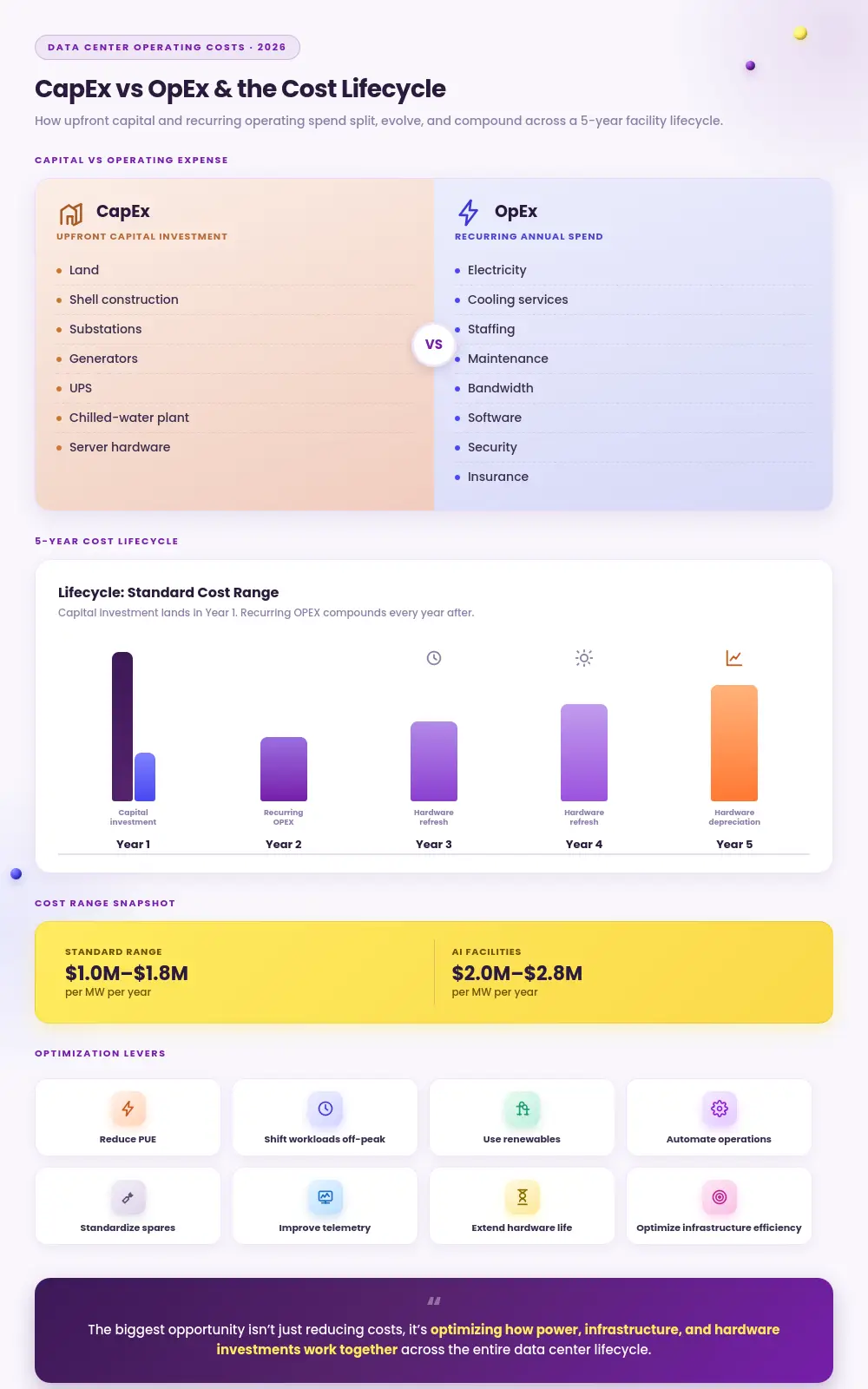
Data center capital expenditure (CapEx) covers the upfront investment to build or buy physical assets. Data center OpEx covers the recurring costs to run, power, cool, maintain, and staff the facility day to day. Across a typical five-year lifecycle, OpEx matches or exceeds the original CapEx.
CapEx includes site acquisition, shell construction, electrical substations, backup generators, UPS modules, chilled water plants, and server hardware. OpEx covers utility tariffs, maintenance contracts, engineering salaries, replacement parts, connectivity, and software licenses. Understanding data center capex vs OpEx matters for CFOs and infrastructure architects alike.
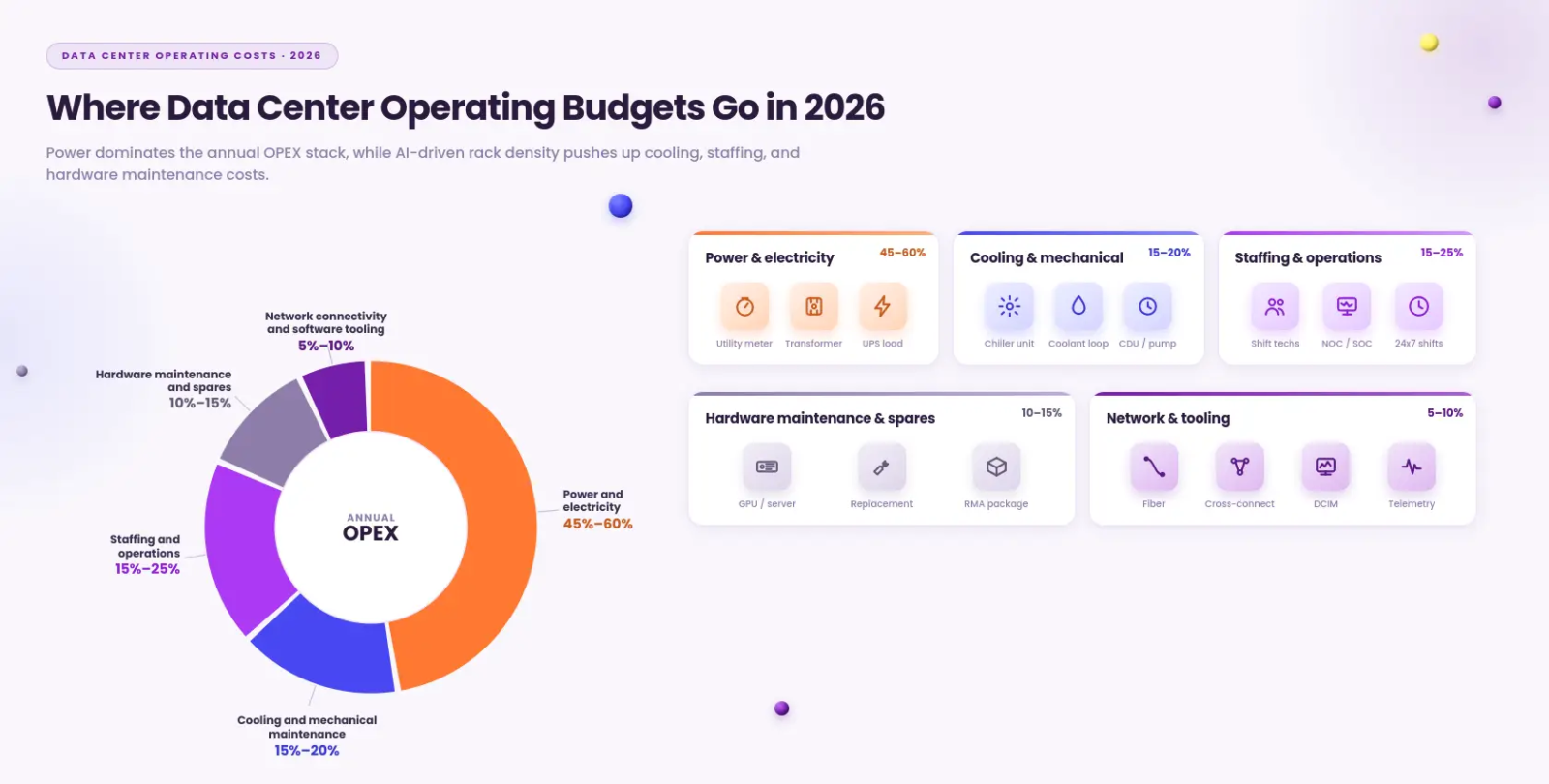
Recurring data center OpEx splits into five categories:
- Power and electricity tariffs (40% to 60% of OPEX): the largest expense, driven by server power supplies, transformers, UPS systems, and chillers.
- Cooling and mechanical maintenance (15% to 20% of OPEX): CRAH units, chillers, cooling towers, and CDUs carry service fees, water charges, and chemical treatment costs.
- Staffing and operations headcount (15% to 25% of OPEX): 24×7 shift technicians, facilities engineers, network specialists, and security staff.
- Hardware maintenance and spares (10% to 15% of OPEX): failed power supply swaps, transceiver replacement, and coolant loop repairs.
- Network connectivity and software tooling (5% to 10% of OPEX): fiber cross-connects, IP transit, DCIM licenses, and monitoring tools.
The table below breaks down data center operating costs by category for a standard 2026 enterprise facility.
| Cost Category | Share of Annual OpEx | Typical Annual Cost per MW | Primary Cost Drivers | Key Optimization Levers | Sources |
|---|---|---|---|---|---|
| Power & Electricity | 45%-60% | $550,000-$950,000 | IT load, utility tariff, PUE | PUE reduction, renewables, off-peak shifting | source 1, source 2 |
| Cooling & HVAC Systems | 15%-20% | $180,000-$320,000 | Thermal load, climate, chiller upkeep | Liquid cooling, raised setpoints (ASHRAE TC 9.9) | source 1, source 2 |
| Staffing & Operations | 15%-25% | $180,000-$350,000 | Shift rotation, certifications | Automation, remote NOC/SOC, managed ops | source 1, source 2 |
| Hardware Maintenance & RMA | 10%-15% | $120,000-$220,000 | Failure rates, SLA windows | Burn-in testing, standardized spares | source 1, source 2 |
| Network & Software Tooling | 5%-10% | $60,000-$140,000 | Bandwidth, cross-connects, DCIM | Carrier-neutral routing, unified telemetry | source 1, source 2 |
How Much Does It Cost to Run a Data Center per Year?
Annual data center operating costs in 2026 run $1.0 million to $1.8 million per megawatt for standard enterprise facilities, and $2.0 million to $2.8 million per megawatt for high-density AI clusters. Power density, location, and cooling architecture set the number for your facility, measured against three unit metrics: cost per kilowatt, cost per rack, and cost per square foot.
Data Center Cost per kW
Data center cost per kW is the standard metric for power-based budgeting. In 2026, monthly OPEX per kilowatt runs $120 to $250 in most primary markets, reaching $280 to $420 in power-constrained hubs like Northern Virginia, Frankfurt, and Silicon Valley.
Annualized, this comes to $1,440 to $3,000 per kW per year for standard workloads. High-density deployments with liquid cooling and 2N redundancy push annual costs to $3,200 to $4,800 per kW.
Data Center Cost per Rack
Data center cost per rack scales with power density and workload:
- Standard enterprise racks (5 kW to 10 kW): $15,000 to $30,000 a year.
- High-density compute racks (20 kW to 40 kW): $50,000 to $95,000 a year.
- Exascale AI racks (40 kW to 132 kW+): the NVIDIA GB200 NVL72 platform packs 72 GPUs into one liquid-cooled cabinet drawing up to 132 kW, costing $180,000 to $320,000 a year in electricity, coolant maintenance, and power support.
Data Center Cost per Square Foot 2026
Data center cost per square foot 2026 averages $350 to $650 a year for enterprise white space. Square footage cost tracks power capacity and mechanical density, not floor area. A 10,000-square-foot hall supporting 2 MW runs about $420 per square foot a year. The same footprint at 8 MW of liquid-cooled AI infrastructure runs above $850.
Total facility budgets scale directly with critical IT load: a small edge or server room (100 kW to 500 kW) runs $150,000 to $700,000 a year, a mid-sized enterprise data center (1 MW to 5 MW) runs $1.2 million to $7.5 million, and a hyperscale facility (50 MW or more) runs $55 million to $150 million or more.
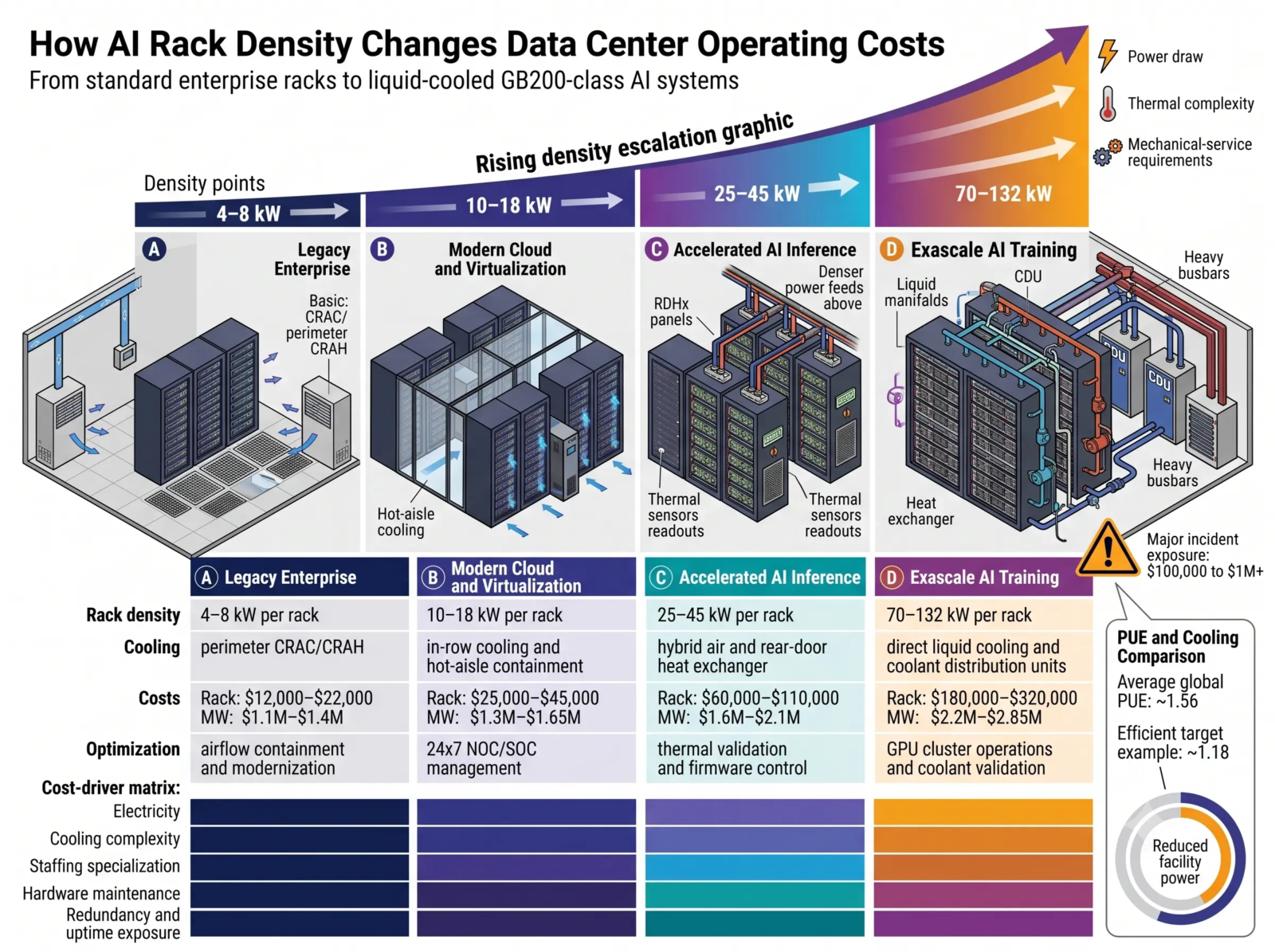
| Workload Profile | Rack Density | Cooling Topology | Annual Cost/Rack | Annual Cost/MW | Aptly’s Role |
|---|---|---|---|---|---|
| Legacy Enterprise | 4-8 kW/rack | Perimeter CRAC/CRAH | $12,000-$22,000 | $1.1M-$1.4M | Modernization, airflow containment |
| Modern Cloud & Virtualization | 10-18 kW/rack | In-row cooling, hot aisle | $25,000-$45,000 | $1.3M-$1.65M | 24×7 NOC/SOC management |
| Accelerated AI Inference | 25-45 kW/rack | Hybrid air / rear-door HX | $60,000-$110,000 | $1.6M-$2.1M | Thermal validation, firmware control |
| Exascale AI Training (GB200) | 70-132 kW/rack | Direct liquid cooling & CDUs | $180,000-$320,000 | $2.2M-$2.85M | GPU cluster ops, coolant validation |
What Drives Up Data Center Operating Costs? Critical Cost Drivers in 2026
Five factors drive data center operating costs higher: electricity, cooling complexity, labor, hardware depreciation, and redundancy.
1. Electricity & Energy Costs:
Electricity is the largest, most volatile piece of data center operating costs. Industrial rates range from $0.065 per kWh in hydropower regions to $0.18 to $0.24 per kWh in constrained markets like Northern Virginia, California, and Frankfurt.
PUE multiplies this expense. The Uptime Institute Global Data Center Survey puts average global PUE near 1.56. On a 5 MW facility at $0.12/kWh:
- At PUE 1.56, total draw hits 7.8 MW, costing $8,199,360 a year.
- At PUE 1.18, achieved through liquid cooling and efficient power distribution, draw drops to 5.9 MW, costing $6,202,080 a year.
- The gap alone saves $1,997,280 a year.
2. Cooling Systems and Thermal Demands:
Cooling eats 30% to 40% of total facility energy. Traditional CRAC and CRAH units lose efficiency once rack density passes 20 kW. Above 50 kW to 100 kW per rack, direct liquid cooling with CDUs stops being optional.
DLC lowers data center power and cooling costs by removing high-power chiller fans and running warmer water loops. ASHRAE TC 9.9 guidelines let operators raise chilled water setpoints safely, cutting compressor runtime and operating costs.
3. Data Center Staffing Costs and Labor Headcount:
Staffing runs 15% to 25% of annual operating budgets. Infrastructure engineers, electrical and mechanical technicians, and systems specialists earn $85,000 to $160,000 a year plus benefits.
A continuous 24x7x365 Tier III facility needs a five-shift rotation covering day, evening, night, and weekend shifts, plus training and vacation buffers. A typical 5 MW facility needs 12 to 20 full-time staff, putting data center staffing costs at $1.4 million to $2.5 million a year.
4. Hardware Refresh Cycle Costs and Maintenance:
Server hardware depreciates fast. Hardware refresh cycle costs include capital replacement, un-racking, secure media sanitization under NIST SP 800-88 guidelines, and logistics. Standard CPU servers refresh every 3 to 5 years. GPU servers refresh every 2 to 3 years to keep pace with silicon gains.
RMA failure rates, transceiver swaps, and cooling loop service generate steady maintenance costs. Budget for them upfront, not as a surprise.
5. Redundancy Architecture and Uptime Tier Levels:
An N+1 setup, one backup component per system, costs far less to run than a 2N concurrently maintainable Tier IV facility, which doubles your switchgear servicing, fuel storage contracts, and generator load-bank testing.
Cutting redundancy raises your financial exposure. Uptime Institute research shows more than half of impactful outages cost over $100,000, and 20% exceed $1 million in direct losses.
6. Location and Regional Cost Differences:
Geographic footprint establishes fixed structural baseline costs across tax, climate, and connectivity. Real estate property taxes, municipal permitting fees, and state/regional tax incentive abatements vary significantly between primary hubs (e.g., Northern Virginia, London, Frankfurt) and secondary or tertiary markets.
Climate and local infrastructure further compound recurring operational expenses:
-
Free cooling & ambient climate: Facilities in cooler, low-humidity climates leverage airside/waterside economizers for 4,000+ hours annually, significantly reducing mechanical chiller operation compared to hot, humid climates where chillers run year-round.
-
Water access & utility tariffs: Evaporative cooling systems encounter sharp operational expense differences depending on local municipal water tariffs and wastewater discharge surcharges in water-stressed regions.
-
Network transit & dark fiber: Sites positioned outside major carrier hotels face higher recurring cross-connect fees, dark fiber leasing, and backhaul transit costs to connect to primary Internet Exchange Points (IXPs).
Data Center Operating Costs Calculation: The Complete TCO Formula and Model
Data center OpEx and TCO Model
A precise data center cost calculation combines utility rates, efficiency ratios, labor, and maintenance into one model.
The Annual Data Center OpEx Formula
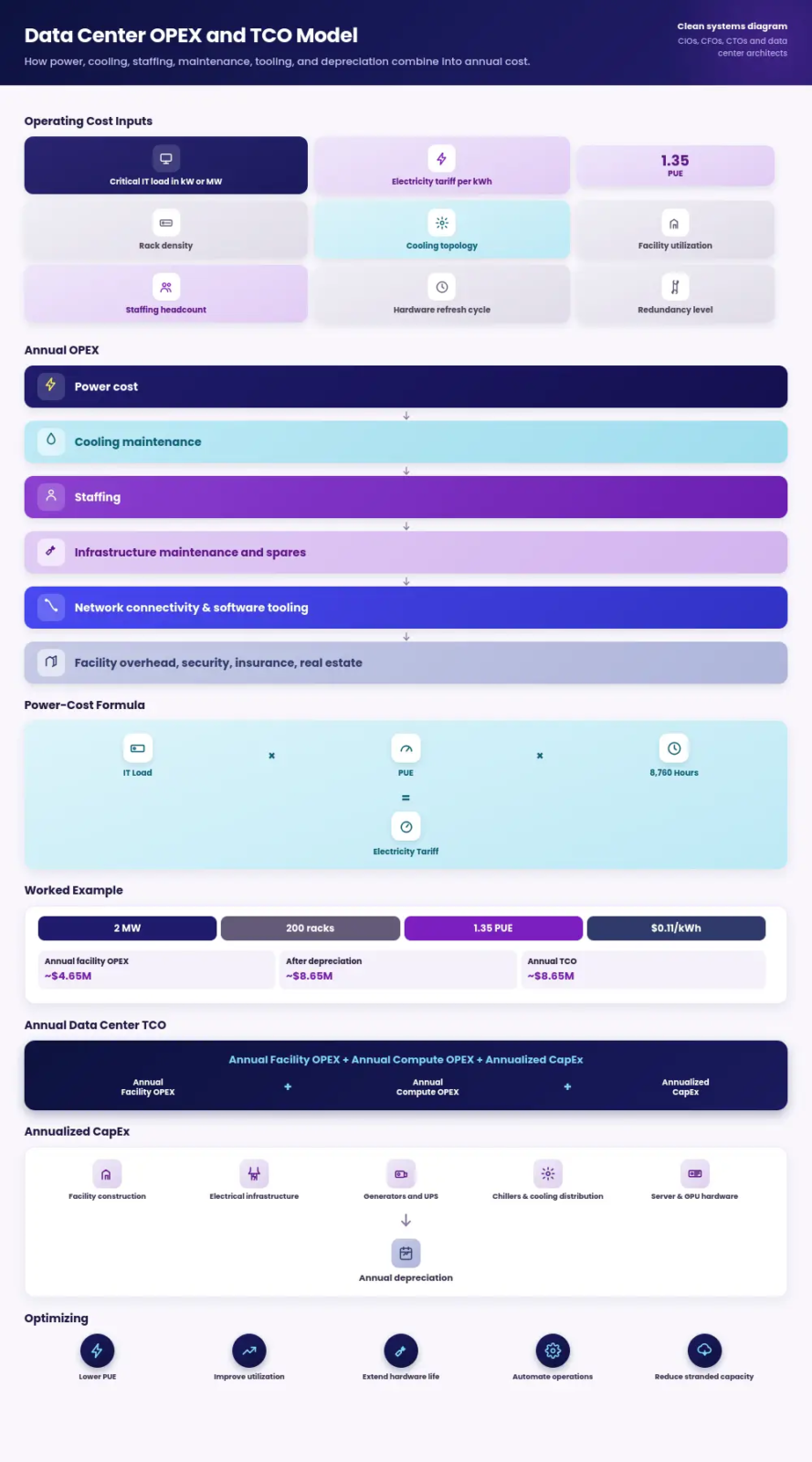
The standard data center operating cost formula combines six centers:
Annual Data Center OPEX = Power Cost + Cooling Maintenance + Staffing + Infrastructure Maintenance + Network Tooling + Facility Overhead
- Power Cost = IT Load (kW) x PUE x 8,760 Hours x Electricity Tariff ($/kWh)
- Cooling Maintenance = Chiller Servicing + Water Consumption + Chemical Treatment
- Staffing Cost = FTE Headcount x Fully Burdened Annual Labor Rate
- Infrastructure Maintenance = Electrical PM + Generator Servicing + Hardware Spares (RMA)
- Network Tooling = Dedicated Transit + Dark Fiber Leases + DCIM Licenses
- Facility Overhead = Real Estate Lease or Property Taxes + Security + Insurance
The Data Center TCO Calculation Model
To calculate data center TCO, add annualized capital depreciation to ongoing OPEX:
Annual Data Center TCO = (Initial Facility and Hardware CapEx minus Salvage Value) / Asset Lifespan + Annual Facility OPEX + Annual Compute OPEX
Epoch AI’s 2026 model of a 1 gigawatt AI campus found servers drive 60% of total annualized cost, well ahead of energy, making hardware lifespan the single biggest TCO lever. Stretching server life from 3 to 7 years cuts annualized cost nearly in half.
Worked Example: 2 MW Enterprise Data Center
Consider a 2 MW facility running 200 racks, 10 kW average, in 2026:
- Step 1, electricity: 2,000 kW x 1.35 PUE x 8,760 hours x $0.11/kWh = $2,601,720 a year.
- Step 2, cooling and mechanical maintenance: $320,000 a year.
- Step 3, staffing: 10 engineers at $110,000 burdened each = $1,100,000 a year.
- Step 4, electrical maintenance and spares: $280,000 a year.
- Step 5, network, DCIM, and facility overhead: $350,000 a year.
Total annual facility operating cost: $4,651,720 a year, or $2,325,860 per MW, or $23,258 per rack.
- Step 6, add hardware depreciation: $16 million in hardware over a 4-year cycle adds $4,000,000 a year.
Total annual data center TCO: $8,651,720 a year.
In-House vs Outsourced Data Center Operations Cost
Is running your own data center cheaper than colocation or managed services? Rarely, unless you operate at 20 MW or more with steady, predictable utilization. A captive facility costs $8 million to $12 million per MW upfront, per Turner & Townsend’s 2025-2026 construction cost index, and locks you into fixed 24×7 staffing regardless of load.
Colocation shifts facility CapEx into predictable monthly OPEX: the provider runs electrical infrastructure, chillers, and perimeter while you lease space and power. Managed operations go further: a specialized partner handles server lifecycle, rack-level validation, firmware patching, and 24×7 incident response.
For a full breakdown of in-house vs outsourced data center operations cost, see our Managed Data Center Services page.
How to Optimize Data Center Operating Costs: What Mature Organizations Do Differently
Reducing data center operating costs means moving from reactive maintenance to proactive engineering. Six practices cut OPEX without hurting reliability.
- Commissioning and Site Acceptance Testing (SAT). Full commissioning and SAT confirm switchgear, UPS strings, generators, and cooling distribution units perform under full load before go-live, catching defects before they waste power.
- Rack-Level Power and Cooling Validation. This step confirms three-phase loads balance across every busway and airflow containment matches server intake needs, removing hot spots and throttling.
- Environmental Monitoring and Telemetry Tuning. Dense sensor networks track temperature, humidity, and air pressure across every aisle. Mapping telemetry against ASHRAE Class A1/A2 envelopes lets you raise supply water temperatures from 18°C to 24°C or higher, cutting compressor energy 15% to 25%.
- BIOS, BMC, and Firmware Baseline Management. Standardized baselines keep power-capping policies, fan curves, and CPU governor states tuned for efficiency. Patch orchestration and staged rollout rings stop simultaneous cluster reboots and firmware-driven faults.
- Capacity Forecasting and Headroom Tuning. Stranded power and cooling capacity drains budget quietly. Automated forecasting lets your team balance headroom dynamically, raising rack density and delaying premature expansions.
- Hardware Burn-In Testing and Proactive RMA. Burn-in testing on new hardware catches defective memory, weak power supplies, and marginal silicon before deployment. Standardized RMA workflows keep spares lean and stabilize maintenance spend.
Case Study: Optimizing Cooling Telemetry at Scale
A global financial services firm struggled with climbing PUE at their primary 10 MW facility. By deploying high-density sensor networks and utilizing machine learning to map telemetry against ASHRAE guidelines (Point 3), the operations team safely raised chilled water setpoints from 18°C to 24°C. Combined with dynamically tuning variable frequency drives (VFDs) on cooling units based on real-time server load, this single adjustment reduced cooling energy consumption by 22%—saving over $850,000 annually without compromising SLA uptime or hardware reliability.
How Can Aptly Help
Executing these optimizations requires precise engineering and continuous monitoring, which is exactly where Aptly excels. As a global cloud and AI services provider trusted to build and support hyperscale data center environments, Aptly specializes in moving facilities from reactive operations to proactive, automated infrastructure.
Aptly’s teams can help optimize your operating costs by:
-
AI Workload & Power Optimization: Designing secure, cost-efficient infrastructure that dynamically aligns power and cooling with actual server compute demands.
-
Advanced Telemetry & Automation: Implementing unified monitoring to automate capacity forecasting, eliminate stranded power, and optimize rack density.
-
Managed IT & Cloud Operations: Providing 24/7 technical support, standardized baseline management, and lifecycle deployment services so your internal teams can focus on strategic growth rather than routine maintenance.
Conclusion: Managing Data Center Operating Costs with Precision
Controlling data center operating costs in 2026 takes engineering rigor and disciplined financial planning. As AI clusters push power requirements higher, managing OPEX demands efficiency across power procurement, liquid cooling, hardware management, and TCO governance.
Key takeaways:
- Power dominates spending. Electricity and cooling make up 60% to 80% of total facility OpEx. Optimizing PUE delivers seven-figure annual savings.
- Density sets rack economics. Standard racks cost $15,000 to $30,000 a year. High-density AI racks exceed $180,000 per rack per year.
- TCO modeling is not optional. Accurate forecasting must include hardware depreciation, 24×7 staffing, preventative maintenance, and spares logistics.
- Proactive operations cut waste. Site acceptance testing, rack-level validation, firmware baseline control, and capacity tuning lower OPEX in measurable ways.
Aptly Technology delivers enterprise and hyperscale data center operations built for modern compute demand. As the only Microsoft-trusted supplier authorized to build and support third-party hyperscale datacenters worldwide, Aptly runs 24×7 white-glove Global Operations Centers across North America, Europe, and Asia. Certified to ISO/IEC 42001:2023, with partnerships with NVIDIA and Supermicro, Aptly runs your mission-critical infrastructure at up to 99.9% uptime SLAs.
Explore how Aptly optimizes your infrastructure economics. Visit Aptly Technology or talk to our team about GPU Datacenter Buildout Services and AI Infrastructure Managed Services.
Frequently Asked Questions
- What is the average annual cost to run a data center in 2026?A: Average data center operating costs run $1.0 million to $1.8 million per MW of critical IT load for standard workloads. High-density AI and GPU infrastructure pushes data center operating costs to $2.0 million to $2.8 million per MW.
- What percentage of data center operating costs is electricity?A: Electricity typically makes up 40% to 60% of total data center operating costs. Cooling adds another 30% to 40% of facility energy on top of active IT load, making power procurement and PUE optimization your two most consequential financial levers.
- How do data center CapEx and OpEx differ?A: Data center CapEx covers the upfront capital to buy land, build the facility, and install electrical and mechanical infrastructure, including generators, chillers, and servers. Data center OpEx covers daily running costs: power tariffs, cooling maintenance, staffing, spares, and bandwidth. Over a 5-year lifespan, cumulative OpEx generally matches or exceeds initial CapEx.
- How much does data center staffing cost per year?A: Data center staffing costs typically run 15% to 25% of annual operating budgets. Fully burdened compensation for infrastructure engineers ranges from $85,000 to $160,000 a year. A continuous 24x7x365 Tier III operation needs 12 to 20 full-time staff, putting annual labor spend at $1.4 million to $2.5 million for a mid-sized facility.
- What is the data center cost per rack for AI workloads in 2026?A: Data center cost per rack for high-density AI workloads runs $60,000 to over $320,000 a year. Standard enterprise racks (5 kW to 10 kW) cost $15,000 to $30,000 a year. Exascale GPU racks, like the NVIDIA GB200 NVL72 drawing 120 kW to 132 kW, cost $180,000 to $320,000 a year in electricity and cooling maintenance.
- Is running your own data center cheaper than colocation or managed services?A: Rarely, unless you operate at 20 MW or more with steady, predictable capacity use. A captive facility needs $8 million to $12 million per MW in upfront capital and fixed 24×7 staffing regardless of load. Colocation and managed operations turn capital expense into predictable operating costs.
- What role does Aptly play in managing data center operating costs?
- Aptly Technology helps you manage data center operating costs through certified, end-to-end lifecycle management: site acceptance testing, rack-level power and cooling validation, automated firmware baselines, and 24×7 white-glove monitoring from our Global Operations Centers. As the only Microsoft-trusted supplier authorized to build and support third-party hyperscale datacenters worldwide, Aptly delivers maximum power efficiency and up to 99.9% uptime SLAs.
Related Articles:
- GPU Datacenter Strategy: Why Enterprises Need It in 2026 | AI Infrastructure
- End-to-End Data Center Lifecycle Management: A Blueprint for Scalable Infrastructure | Data Center Operations
- A Practical Guide to Data Center Security Best Practices in 2026 | Security & Compliance
Table of content
- TL; DR
- Introduction: The Financial Reality of Data Center Operating Costs
- Data Center CapEx vs OpEx: Where Does the Money Go?
- How Much Does It Cost to Run a Data Center per Year?
- What Drives Up Data Center Operating Costs? Critical Cost Drivers in 2026
- Data Center Operating Costs Calculation: The Complete TCO Formula and Model
- In-House vs Outsourced Data Center Operations Cost
- How to Optimize Data Center Operating Costs: What Mature Organizations Do Differently
- Conclusion: Managing Data Center Operating Costs with Precision
- Frequently Asked Questions
- Related Articles: