Introduction
Most enterprises run their critical workloads, huge datasets, and AI apps on the cloud. Despite rising investment in cloud infrastructure, security remains the greatest challenge and the true cost of cloud growth.
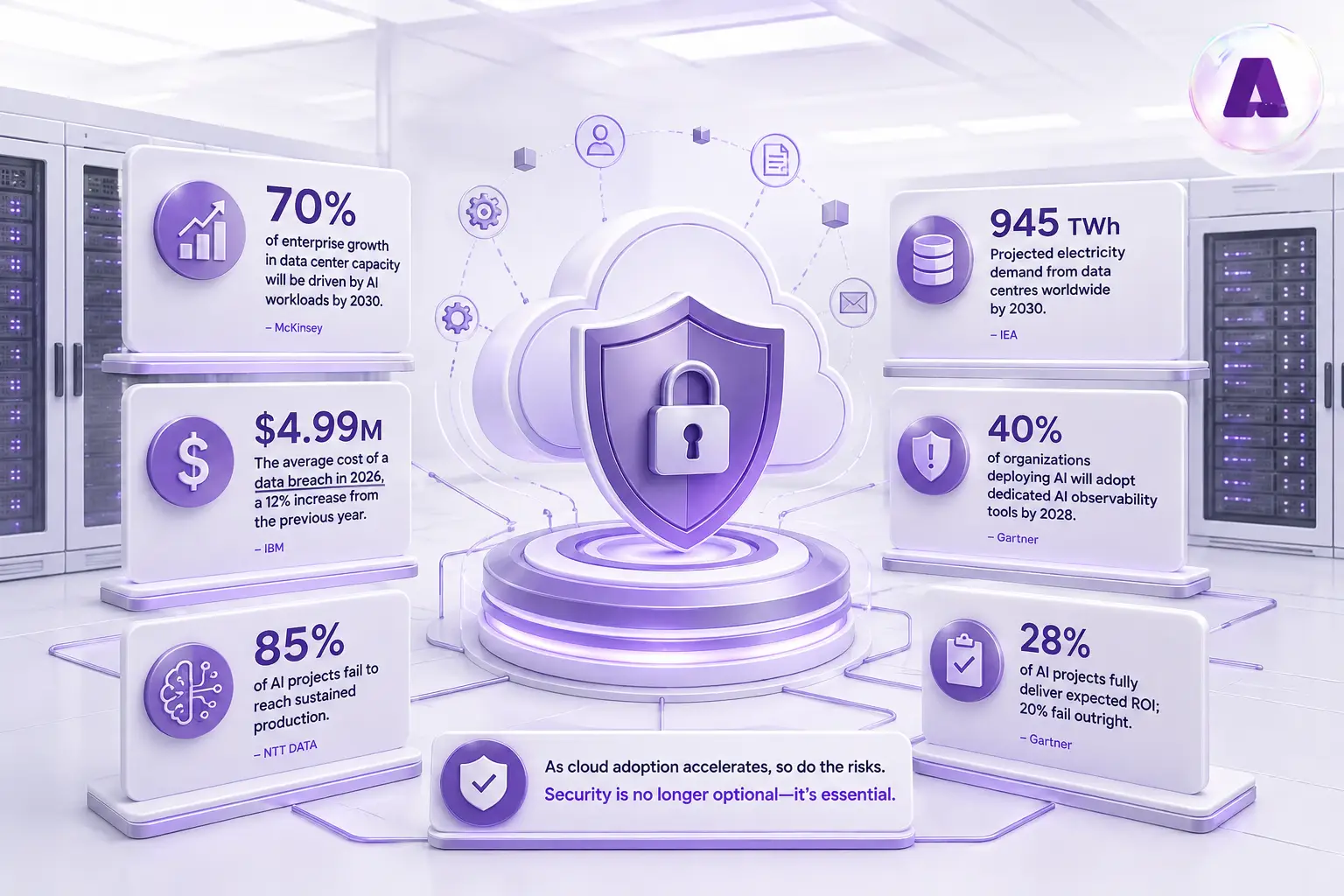
The numbers show why. IBM’s Cost of a Data Breach Report 2026 found the global average cost of a data breach reached $4.99 million. Organizations using AI-driven security automation, however, saved an average of $1.93 million per breach through faster detection and response.
So, the question for 2026 is not whether to use the cloud. The real question is how to protect cloud workloads, identities, and data without slowing down innovation.
This article covers the biggest cloud security challenges in 2026. It explains why they matter, shares practical ways to fix them, and shows how organizations can build a stronger security posture while staying ready for AI.
Why Cloud Security Matters in 2026?
Cloud security has become a strategic business priority as organizations accelerate AI adoption, multi-cloud deployments, and digital transformation. According to Gartner, cloud platforms themselves are not the primary cause of security or business continuity failures. Most cloud security incidents result from customer misconfigurations, poor identity and access management, and inadequate security practices rather than vulnerabilities in the cloud infrastructure.
When implemented and managed correctly, cloud computing provides a secure, resilient, and reliable foundation for modern enterprise workloads.
Top Cloud Security Challenges in 2026
The following challenges represent the most significant cloud security risks organizations should address in 2026.
Challenge 1: Identity and Access Management (IAM)
Identity has become the new security perimeter. Every user, application, service account, and API requires authentication before accessing cloud resources. If identity management is weak, attackers can move through cloud environments with little resistance.
Common identity-related cloud security issues include:
- Stolen credentials through phishing
- Weak or reused passwords
- Privilege escalation
- Excessive permissions
- Service account abuse
- Dormant privileged accounts
Many organizations grant users broad administrative permissions to simplify operations. Over time, these unnecessary privileges accumulate, creating opportunities for attackers after a single compromised account.
The following controls significantly reduce IAM-related risks.
| Best Practice | Benefit |
|---|---|
| Multi-factor authentication (MFA) | Prevents unauthorized logins using stolen passwords |
| Least privilege access | Restricts users to only required permissions |
| Zero trust security | Continuously verifies every request |
| Identity governance | Reviews and manages access throughout the user lifecycle |
| Conditional access policies | Applies security based on risk, device, and location |
Challenge 2: Cloud Misconfigurations
Before implementing security controls, it is important to understand where cloud environments commonly fail.
Cloud misconfigurations remain one of the most common cloud security challenges because many environments change daily through automation, DevOps pipelines, and infrastructure updates. Even a small configuration mistake can expose sensitive workloads to the public internet.
Many of these issues occur during rapid infrastructure deployment. Infrastructure teams often prioritize speed, while security validation receives less attention.
| Security Control | Purpose |
|---|---|
| Infrastructure as Code (IaC) Validation | Detects insecure configurations before deployment |
| Cloud security posture management | Continuously identifies misconfigurations |
| Automated compliance scanning | Verifies alignment with regulatory requirements |
| Continuous monitoring | Detects configuration drift in real time |
Challenge 2: AI and LLM Security Risks
AI has transformed cloud computing, but it has also introduced an entirely new category of cloud security risks.
LLMs, generative AI services, and AI-powered applications frequently process sensitive enterprise information. Without proper controls, confidential business data may be exposed through prompts, APIs, or third-party integrations.
Common AI-related threats include prompt injection attacks, data leakage, model poisoning, sensitive data exposure, insecure AI APIs, and unauthorized model access.
| Security Measure | Benefit |
|---|---|
| AI governance framework | Establishes policies for responsible AI usage |
| Model monitoring | Detects abnormal behavior and model drift |
| Secure API gateways | Protects AI endpoints from unauthorized access |
| Data masking | Prevents sensitive information exposure |
| AI-specific security controls | Addresses threats unique to LLMs and AI workloads |
Challenge 4: Multi-Cloud Complexity
As organizations adopt services from Amazon Web Services (AWS), Microsoft Azure, and Google Cloud, managing security across multiple platforms becomes increasingly difficult. Each cloud provider has its own identity model, networking architecture, logging capabilities, and security controls. This lack of consistency often creates visibility gaps and increases operational overhead.
The table below highlights common multi-cloud security issues and practical solutions.
| Security Impact | Recommended Practice |
|---|---|
| Inconsistent protection across clouds | Standardize security policies |
| Higher risk of configuration drift | Use centralized policy management |
| Delayed threat detection | Deploy unified monitoring platforms |
| Difficult audit preparation | Automate compliance reporting |
| Increased access management risks | Implement centralized IAM |
Challenge 5: Cloud Ransomware Threats
Cloud ransomware has evolved beyond encrypting virtual machines. Modern attackers target cloud backups, identity systems, storage services, and Software-as-a-Service (SaaS) platforms to maximize disruption. Once attackers obtain privileged credentials, they move laterally between workloads before launching the attack.
The following security measures help organizations reduce the impact of modern cloud attacks.
| Best Practice | Recommended Practice |
|---|---|
| Immutable backups | Prevent attackers from modifying backup data |
| Extended detection and response (XDR) | Correlates threats across cloud workloads |
| Continuous threat monitoring | Detects suspicious activity earlier |
| Network segmentation | Limits lateral movement |
| Incident response planning | Improves recovery during security events |
Mitigating Cloud Security Risks
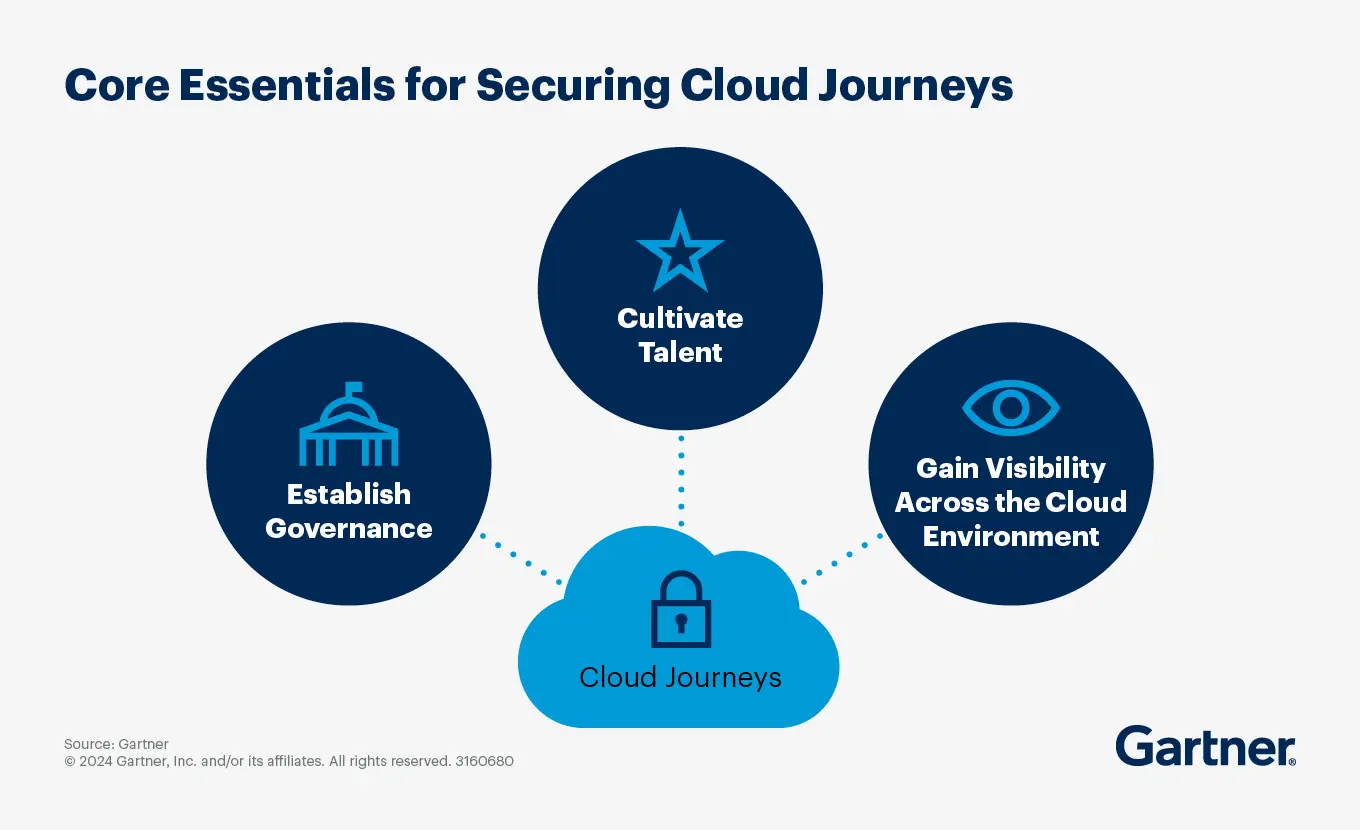
Build the Right Skills and Security Strategy
An effective cloud security program begins with the right expertise and a well-defined strategy. Organizations should align cloud security initiatives with business objectives, adopt recognized security frameworks, and equip security teams with the skills needed to manage cloud-native technologies and evolving cyber threats.
Establish Strong Governance
Strong governance ensures cloud security policies are applied consistently across the organization. Clearly define security responsibilities under the shared responsibility model, establish compliance requirements, and integrate security into every stage of the cloud lifecycle, from planning and deployment to ongoing operations.
Gain Visibility Across Cloud Environments
Continuous visibility is essential for identifying cloud security risks before they become incidents. Monitor cloud assets, user identities, workloads, configurations, and network activity using centralized logging, security monitoring, and Cloud Security Posture Management (CSPM) tools to detect misconfigurations, suspicious behavior, and compliance gaps in real time.
Importance of Proactive Cloud Security Measures
Reactive security is no longer enough in today’s cloud-first environment. Cyber threats are becoming more sophisticated and frequent. A proactive cloud security strategy helps identify vulnerabilities, detect threats early, and prevent attacks before they disrupt business operations.
Organizations that continuously monitor cloud environments, automate security checks, enforce strong identity and access controls, and regularly assess configurations can significantly reduce the risk of data breaches and compliance violations. Proactive security also improves business continuity, protects sensitive data, and enables organizations to innovate with confidence.
Rather than responding to incidents after they occur, proactive cloud security focuses on prevention, continuous visibility, and rapid threat detection. This approach strengthens an organization’s overall security posture while supporting secure digital transformation and long-term business resilience.
Future Trends in Cloud Security
Security teams are increasingly adopting intelligent platforms that detect threats faster while reducing manual investigation.
Several trends are expected to influence enterprise security strategies over the next few years. Enterprises that adopt Cloud-Native Application Protection Platforms (CNAPP) as part of an integrated security strategy are expected to reduce cloud-related security incidents.
The following trends are shaping the future of cloud security.
- AI-powered Security Operations Centers (SOC): AI assists analysts by prioritizing alerts, identifying attack patterns, and accelerating investigations.
- Autonomous threat detection and response: Automated workflows isolate compromised workloads before attacks spread.
- Confidential computing: Hardware-based protection secures sensitive data even during processing.
- Post-quantum cryptography readiness: Organizations are preparing encryption strategies for future quantum computing risks.
- Security for AI agents and autonomous systems: AI-powered applications require dedicated controls to protect models, APIs, and sensitive prompts.
- Shift-left security: Development teams integrate security testing earlier in the software lifecycle, reducing vulnerabilities before deployment.
These trends reflect an important shift in cloud security.
Secure, Modern, and AI-Ready Cloud Infrastructure with Aptly Technology
Building a secure cloud environment requires more than deploying security tools. You need a cloud strategy that integrates security into architecture, operations, governance, and application development from the beginning. This approach reduces risk while supporting business growth and AI innovation.
Aptly Technology helps organizations modernize their infrastructure with security built into every layer. Whether you are migrating legacy apps, expanding hybrid cloud environments, or deploying AI workloads, the focus remains on creating cloud platforms that are secure, scalable, and compliant by design.
The following capabilities demonstrate how Aptly Technology supports modern cloud security initiatives.
| Capability | Business Value |
|---|---|
| Secure cloud architecture design | Builds security controls into infrastructure from the planning stage |
| Cloud modernization | Migrates legacy apps using cloud security best practices |
| Zero-trust implementation | Verifies every user, device, and workload before granting access |
| Hybrid and multi-cloud deployment | Creates consistent security policies across cloud environments |
| Infrastructure as Code (IaC) | Automates infrastructure deployment with built-in security validation |
| Monitoring and observability | Improves visibility into cloud workloads, apps, and infrastructure |
| Governance and compliance | Simplifies policy management, auditing, and regulatory compliance |
| AI-ready cloud infrastructure | Protects AI, data pipelines, APIs, and cloud-native apps |
Conclusion
2026 brings forth many challenges for organizations seeking to secure their cloud environments. The threat landscape is constantly evolving, making data breaches, insider threats, and third-party integration challenges more prevalent.
Nonetheless, organizations can take proactive measures, implement robust security controls, and partner with cloud security providers to navigate these challenges and ensure the protection of their cloud data.
To overcome these cloud security challenges, it is crucial to seek assistance from Aptly cloud experts. Aptly provides comprehensive cloud security solutions, leveraging advanced technologies and industry best practices to safeguard your cloud infrastructure.
Ready to strengthen your cloud security posture?
Contact Aptly Technology today to discover how our cloud experts can help you build a resilient, compliant, and secure cloud environment.
FAQs
Q1. What are the biggest cloud security challenges in 2026?
The biggest cloud security challenges include identity and access management, cloud misconfigurations, AI and LLM security risks, multi-cloud complexity, ransomware attacks, and compliance with evolving data privacy regulations. Organizations should address these risks through continuous monitoring, Zero Trust, automation, and strong governance.
Q2. Why is cloud security important for AI workloads?
AI applications often process confidential business data and interact with multiple APIs. Without proper controls, organizations face risks such as prompt injection, sensitive data leakage, model poisoning, and unauthorized API access. Cloud security protects AI models, datasets, and supporting infrastructure throughout their lifecycle.
3. How can AI improve cloud security?
AI improves cloud security by analyzing large volumes of telemetry, detecting anomalies, prioritizing security alerts, identifying attack patterns, and automating incident response. Many Security Operations Centers (SOCs) now use AI to reduce response times and improve threat detection accuracy.
4. What is Cloud Security Posture Management (CSPM)?
Cloud Security Posture Management (CSPM) continuously scans cloud environments to identify security misconfigurations, compliance violations, and policy drift. It helps organizations detect risks such as publicly exposed storage, overly permissive access policies, and insecure network configurations before attackers exploit them.
5. How do cloud security providers protect multi-cloud environments?
Cloud security providers offer centralized monitoring, standardized IAM, unified policy enforcement, compliance reporting, threat detection, and workload protection across AWS, Microsoft Azure, and Google Cloud. This approach improves visibility while reducing operational complexity.
6. What is the role of Zero Trust in cloud security?
Zero Trust assumes that no user, device, or workload should be trusted by default. Every access request is verified continuously based on identity, device health, location, and risk level. This approach helps reduce credential theft, privilege escalation, and unauthorized access.
7. What are the best cloud security practices for hybrid and multi-cloud environments?
Organizations should implement Zero Trust Architecture, Multi-Factor Authentication, encryption for data at rest and in transit, Cloud Security Posture Management, continuous vulnerability scanning, centralized monitoring, DevSecOps practices, AI-powered threat detection, regular backup testing, and employee security awareness training.
Related Articles