Introduction: Why AI Workload Cost Optimization Should be a Board-Level Priority
GPU-powered data centers cost optimization strategy: Enterprise AI has transitioned from experimental to implementation phase, with CIOs and CFOs jointly responsible not only for AI innovation, but also the economics of running these systems at scale. GenAI pilots, LLM-based copilots, and predictive models are now entering business-critical workflows–from customer support to supply chain and risk management–thus transforming from laboratory prototypes into essential parts of daily workflows.
Thus, organizations have begun to recognize an unpleasant truth: AI can be costly if left unmanaged. Training state-of-the-art models on multi-node GPU clusters, maintaining always-on inference endpoints and moving massive volumes of data can quickly turn into seven or eight figure annual line items. AI workload cost optimization is the difference between AI as a strategic asset and AI as an uncontrolled cost center.
Why now? Critical Market Drivers
- Exploding Global AI Demand: Global AI spending projected to hit $1.5T in 2025, driving hyperscaler GPU investments to double AI server market size.
- Energy Limitations/Constraints: It is estimated that global electricity consumption by data centers may reach as much as 4% of total consumption by 2026. Hence, power grid bottlenecks limit GPU scaling more than chip supply.
- Sustainability Mandates: EU regulations and corporate ESG goals demand Power Usage Effectiveness (PUE) below 1.2 for AI infrastructure.
- Economic Pressure: GPU rack density hitting 50-100kW requires liquid cooling for GPU data centers; air cooling fails at >30kW/rack.
Key Insight: Energy Efficient GPU Infrastructure isn’t just a benchmark to be met – It’s now a standard or rather a necessity for scaling AI models at enterprise level.
In this guide, you will learn:
What are GPU-Powered Data Centers?
GPU-powered data centers are purpose-built facilities where GPUs act as primary processors for AI workloads, high-performance computing (HPC), and data analytics, unlike general-purpose CPU data centers optimized for transactional workloads.
Unlike CPU-centric data centers built for general-purpose computing, GPU-powered data centers are optimized for:
- Massive Parallelism: 10,000+ CUDA cores per GPU process matrix multiplications simultaneously, ideal for deep learning and LLM training.
- High Throughput Design: Sustained workloads at 85-95% utilization vs CPU’s 20-30% for AI tasks.
- High-Density Racks: 50-100kW per rack with H100/Blackwell GPUs, requiring direct liquid cooling or immersion.
- Workload-Specific Zoning: Separate clusters for AI training (burst, high-power) vs AI inference (continuous, latency-sensitive).
Example Architecture: NVIDIA DGX GB200 NVL72 superpod with 72 Blackwell GPUs delivers 1.4 exaFLOPS at ~30MW, optimized for trillion-parameter models.
GPU vs CPU Data Centre Architecture
| Feature | CPU-Centric | GPU-Powered |
|---|---|---|
| Primary Workload | Transactions, VMs | AI/HPC parallel compute |
| Rack Power | 10-20kW | 50-100kW+ |
| Cooling | Air (CRAC) | Liquid/Immersion |
| Utilization | 20-40% AI | 70-95% AI |
| PUE Target | 1.4-1.6 | 1.05-1.2 |
Gartner Insight: By 2026, 80% of enterprises will deploy GPU-accelerated data centers for GenAI, shifting from CPU-dominated infrastructure.
When to Choose GPU-Powered Architecture?
Go the GPU way if:
- AI/ML workloads exceed 30% of total enterprise IT workload (including processes like training, inference, and analytics)
- Predictable and sustained demand – 24/7 inference serving model
- If targeting 50% performance per watt improvement and current power budget exceeds $0.08/kWh.
If AI innovation and solutions drive more than 20% of business revenue growth, GPU powered data centers deliver 3-5x faster Go-To-Market (GTM) and 40% lower Total-Cost-of-Ownership (TCO) compared to scaling with CPU architecture.
Why are GPU-Powered Data Centers More Efficient? How Do They Outperform CPU Architectures?
GPU-powered data centers matter because they deliver 10-100x performance per watt for AI workloads, enabling performance scaling without proportional energy growth. Gartner forecasts hyperscaler GPU investments doubling AI IaaS market to $80B by 2028.
Key Strategic Drivers:
- AI Workload Parallelism: Matrix operations in transformers/LLMs map perfectly to GPU tensor cores; CPUs waste 90%+ cycles on sequential execution.
- Energy Costs as Constraint: At $0.10/kWh, a 30MW AI data center GPUs cluster costs $26M/year; 20% efficiency gain saves $5.2M annually.
- Sustainability Targets: AMD targets 30x energy efficiency improvement 2020-2025; NVIDIA GPUs deliver 45,000x LLM inference gains since 2016.
- TCO Leadership: Seagate achieved 50x simulation speedup with NVIDIA DGX + Ansys, cutting design cycles and energy 4x.
Market Validation:
- Hyperscalers: Meta deploys liquid-cooled 140kW racks with 72 GPUs/rack, targeting up to 31% cost savings.
- Enterprises: Stability AI managed to achieve 93% GPU utilization with WEKA storage, reducing costs per TB by 95%.
- Forecast: Global data center GPUs market grows 76% YoY, driven by Blackwell/Hopper deployments as determined by Gartner.
GPU acceleration in data centers is now table stakes for competitive AI; CPU-only approaches cannot economically scale to production. More information can be found in Gartner’s AI Infrastructure Forecast.
CPU-Centric vs GPU-Powered Data Centers: Efficiency Comparison
GPUs excel in performance per watt because they execute thousands of parallel operations simultaneously, slashing total energy per AI task. CPUs rely on sequential processing, extending runtime and cumulative power draw.
Quantitative Comparison: CPU-Centric Vs GPU-Centric Data Centers:
| Metric | CPU-Centric Data Centre | GPU-Powered Data Centre | Efficiency Gain |
|---|---|---|---|
| Parallelism | 64 cores (sequential) | 10,000+ CUDA cores (parallel) | 00-1000x |
| Performance per Watt | 0.5-1 TFLOPS/W | 10-50 TFLOPS/W (Tensor) | 10-100x |
| AI Training Time (1T param model) | 10-20 days | 1-2 days | 10x |
| Total Energy per Training | 500 MWh | 50 MWh | 10x reduction |
| Rack Density | 10-20kW | 50-100kW | 5x higher |
| PUE Impact | 1.5 (air cooling limit) | 1.1 (liquid cooling) | 36% better |
Real-World Examples/Success Stories/Case Studies:
- NERSC Perlmutter Supercomputer: DOE Gold Standard Classification:
The U.S. Department of Energy’s NERSC tested four production applications on Perlmutter, one of the world’s largest GPU-accelerated data centers with 7,100+ A100 GPUs.
Results: Average 5x energy efficiency improvement with A100 GPUs vs CPU-only nodes; up to 12x speedups on 4-GPU servers over dual-socket x86.
Scale of Impact: At equivalent performance, GPU systems save 588 MWh/month per server cluster. This equates to almost $4M+ in annual cloud savings for identical workloads. This allows NERSC’s 8000+ force of scientific professionals to tackle larger problems, accelerating incredible breakthroughs in green energy and quantum computing spaces.
- Green500 List: NVIDIA Dominates Energy Efficiency Rankings (Nov 2025)
The Green500 ranks world’s most energy-efficient supercomputers by GFlops/watt—NVIDIA GPU systems claim top positions:
| Rank | System | Efficiency (GFlops/W) | GPUs | Notable |
|---|---|---|---|---|
| 1 | KAIROS (EVIDEN, GH200) | 73.282 | NVIDIA GH200 | Grace Hopper Superchip |
| 2 | ROMEO-2025 (EVIDEN, GH200) | 70.912 | NVIDIA GH200 | Quad-rail NDR200 |
| 3 | Levante GPU (EVIDEN, GH200) | 69.426 | NVIDIA GH200 | Climate research |
| 4 | Isambard-AI (HPE, GH200) | 68.835 | NVIDIA GH200 | UK AI supercomputer |
| 5 | Capella (Lenovo, H100) | 68.053 | NVIDIA H100 | German research |
NVIDIA/AMD Dominance: Top 6/10 in the top 10 spots; resulting in 40/50 most efficient systems using NVIDIA GPUs (H100, GH200, A100). This is closely followed by AMD MI300X systems at #9-10, confirming that GPU acceleration is an effective reality.
Key Metric: Top GPU systems currently hit 70+ GFlops/W. This is impossible to achieve with current CPU architecture.
- RAPIDS Accelerator for Apache Spark: Enterprise Analytics Transformed
RAPIDS GPU-accelerated Spark delivers 5x average speedups and 80% carbon footprint reduction for data analytics, already tested and widely proven across Fortune 500 workloads.
Benchmark Results:
– Speed: 5x faster queries on terabyte-scale datasets
– Cost: 4x computing cost reduction
– Energy: 80% lower CO2 emissions
Global Impact:
If all Spark users (80% Fortune 500) adopted RAPIDS, annual savings = 7.8M metric tons CO2. This is equivalent to 878M gallons gasoline or 1.4M homes’ yearly energy consumption levels.
Adoption:
Thousands of enterprises use Spark. This extends GPU benefits to ETL pipelines and Machine Learning models beyond basic deep learning.
- Seagate: Production GPU Efficiency in Storage Design
Seagate, a leader in mass capacity storage, leverages NVIDIA DGX+ Ansys Fluent, a high-performance CFD Sim platform that combines the DGX AI systems containing multi-GPU servers with A100/H100 GPUs, for internal CFD simulations.
This has achieved 50x speedup on chassis aeroacoustics. The comparable scale of workload executed on a CPU based workstation would take more than a month that DGX manages to achieve in minutes.
Result:
– Energy Consumption: 4x reduction despite larger models.
– Mesh Size/Complexity handling: 50M to 100M, 2x complexity
Key Insight: Comparing Power Usage Parity (PUE) for CPU and GPU powered data centers
Identical PUE (1.4), 1.4 being every 1 watt of power used to run IT equipment and additional 04 watts used for cooling, lighting and power conversion, for both yields vastly different results:
| Scenario | CPU Data Centre (10MW, PUE 1.4) | GPU Data Centre (10MW, PUE 1.4) |
|---|---|---|
| AI Training Output | 1x (10 days, 500 MWh) | 10x (1 day, 50 MWh) |
| Monthly Work | 30 models | 300 models |
| Annual Savings | Baseline | $4M+ cloud equivalent |
Proven further by NERSC test findings/report that GPUs completed 12x more science (measured in scientific output per energy unit) using the same energy budget. Even with the same facility PUE (1.4), GPUs delivered 5x average energy efficiency across four applications, peaking at 9.8x for DeepCAM climate modeling project.
How GPUs Enable High-Performance, Energy-Efficient Data Centers?
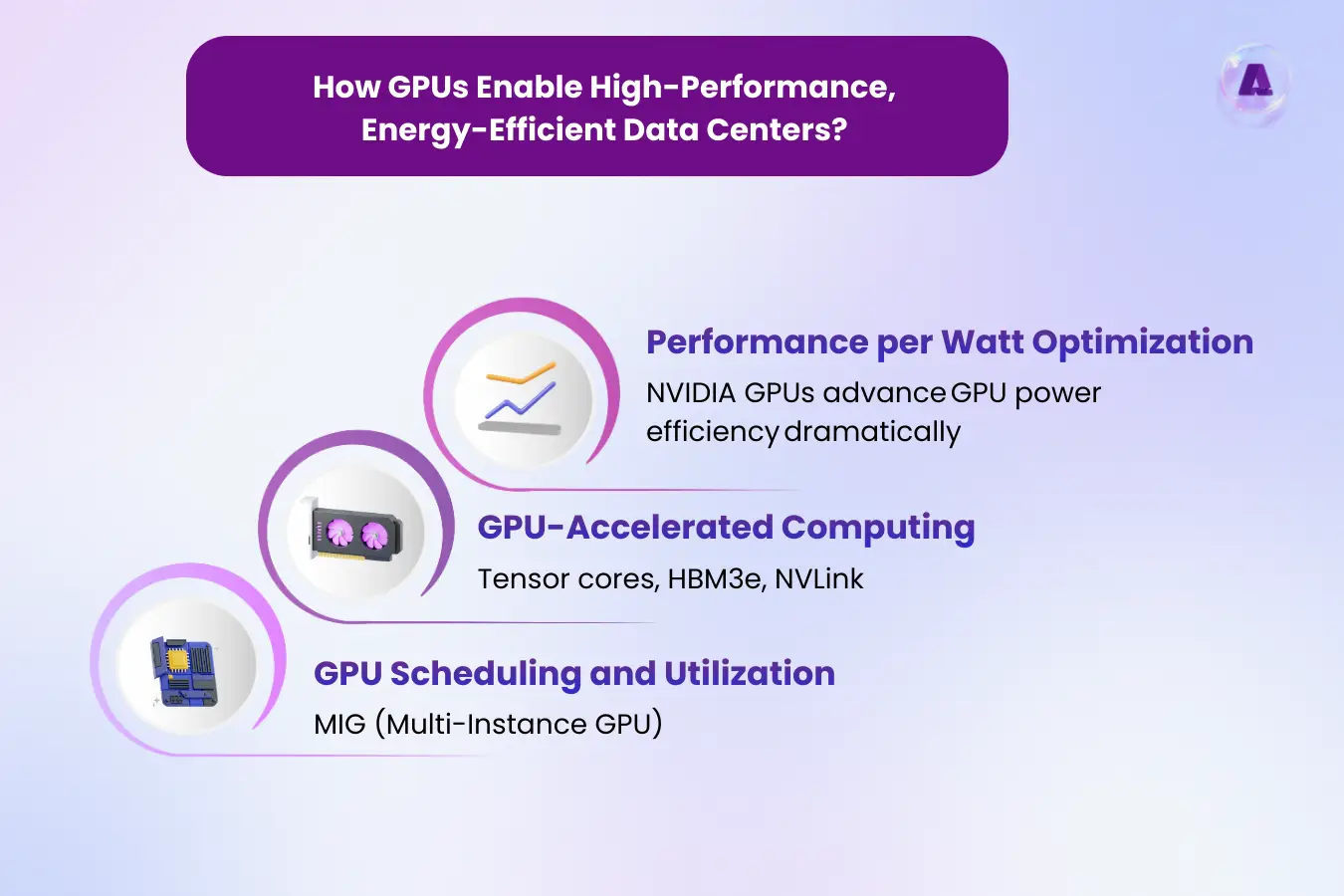
GPUs can power high-performance, energy-efficient data centers, by maximizing parallel execution, memory bandwidth utilization, and compute density. This allows for AI workloads to run quicker while using less energy for each task.
1. Performance per Watt Optimization:
NVIDIA GPUs advance GPU power efficiency dramatically: Blackwell GB200 offers 25x inference efficiency over Hopper at similar power envelopes. Lower precision (FP8/FP4) reduces energy per operation while preserving accuracy.
2. GPU-Accelerated Computing:
- Tensor Cores: Specialized matrix engines execute 1000s multiply-adds per cycle.
- HBM3e Memory: 5TB/s bandwidth eliminates data starvation in trillion-parameter models.
- NVLink-5: 1.8TB/s GPU-to-GPU bandwidth for multi-node scaling.
Result: GPU server efficiency hits 50 TFLOPS/W for AI vs CPU’s 0.5 TFLOPS/W.
3. GPU Scheduling and Utilization
MIG (Multi-Instance GPU) partitions H100 into 7 isolated instances with dedicated memory/cache—up to 7x more resources per GPU. Fault isolation ensures QoS; mixed workloads (training/inference/experiments) run simultaneously without interference.
Mirantis Best Practices: Target >80% compute utilization for training, 60%+ for inference via Kubernetes GPU sharing.
Case Study: Seagate Data Storage Innovation
Seagate uses NVIDIA DGX + Ansys Fluent for CFD simulations, achieving 50x speedup on chassis aeroacoustics—from 1 month (CPU) to mere minutes (GPU). Energy consumption dropped by 4x; design cycles shortened for Mozaic 3+ HAMR drives (3TB/platter).
Energy Efficiency Metrics in GPU Data Centers
GPU-powered data centers often show improved performance per watt even if raw PUE remains similar – because more AI work is completed per unit of energy.
Few Key Metrics Explained:
| Metric | Definition | GPU Target | Industry Benchmark |
|---|---|---|---|
| PUE (Power Usage Effectiveness) | Total facility energy / IT energy | 1.05-1.2 | 1.1 (liquid-cooled AI DCs) |
| DCIE (Data Center Infrastructure Efficiency) | IT energy / Total energy (1/PUE) | 83-95% | 91% (best-in-class) |
| Performance per Watt | TFLOPS / Watt | 20-50 TFLOPS/W | Blackwell: 30+ TFLOPS/W |
| GPU Utilization | Active compute time | 70-95% | 93% (Stability AI) |
The primary performance indicator in this case is Performance per Watt. Higher power per unit implies that companies can handle more AI workloads without a rise in the power usage of data centers.
Real Example: Stability AI’s 93% utilization & efficiency lets them run 3x more AI Inference workloads on identical power infrastructure as their CPU counterparts. This allows them to capture more market share without grid expansion.
Comparison Example: CPU-Centric vs GPU-Powered Data Centre
| Metric | CPU-Centric Data Centre | GPU-Powered Data Centre |
|---|---|---|
| PUE | 1.4 | 1.4 |
| Total Facility Power | 10MW | 10MW |
| Primary Workload | AI training on CPUs | AI training on GPUs |
| Training Time (Same Model) | 10 Days | 1 Day |
| Total Energy Consumed | High (long runtime) | Lower (shorter runtime) |
| Performance per Watt | Low | Significantly higher |
| Operational Outcome | Slower insights, higher energy cost | Faster results, better energy efficiency |
Key Takeaway:
Even with identical PUE values, the GPU-powered data center completes substantially more work using the same energy budget, demonstrating why performance per watt is a more meaningful efficiency metric for AI workloads than facility-level measurements alone.
Power & Cooling: The Hidden Efficiency Multiplier
Liquid & Immersion Cooling Advantages:
| Cooling Type | Power Removal | Fan Power Savings | Rack Density | Cost Reduction |
|---|---|---|---|---|
| Air (CRAC) | 20-30kW/rack | Baseline | Low | Baseline |
| Direct Liquid (DLC) | 70kW/rack | 21% | Medium-High | 40% |
| Immersion | 100kW+/rack | Column 3 Value 3% | Highest | 50%+ |
Implementation Best Practices
- Hybrid Approach: DLC for CPUs, immersion for GPU clusters.
- Redundancy: N+1 pumps, dual power feeds.
- Monitoring: Real-time flow/temperature sensors prevent hotspots.
Therefore, effective cooling solutions and upgrades alone deliver 30-50% TCO reduction over 3 years for GPU centric data centers. Immediate payback in 12-18 months through higher rack density (almost 2-3x more GPUs per MW) and 20%+ lower electricity bills.
AI Training vs AI Inference: Energy Efficiency Implications
AI training and inference demand distinct GPU infrastructure for AI workloads.
| Workload | Energy Profile | Optimization Goal | GPU Choice | Cluster Design |
|---|---|---|---|---|
| Training | High burst (700W+/GPU) | Max throughput | H100/B200 (80GB HBM) | Dense, liquid-cooled |
| Inference | Continuous low latency | Cost/power efficiency | L40S/H200 (FP8) | High-utilization, MIG |
Workload-Specific Design: Separate clusters prevent resource contention; training uses NVLink for scale-out, inference leverages MIG for sharing.
NVIDIA GB200: 25x inference efficiency over Hopper; FP4/FP6 tensor cores slash energy.
Stability AI: 93% utilization mixing training/inference via smart scheduling.
Enterprise Best Practices for Energy-Efficient GPU Data Centers
- Workload-Specific Cluster Design – Training vs inference separation; rack-level power planning.
- GPU Utilization Monitoring – Target 80%+ compute, 70%+ memory via Kubernetes + DCGM.
- Liquid Cooling Early – Plan for 50kW+ racks; hybrid DLC/immersion.
- MIG Partitioning – 7x resource multiplication for mixed workloads.
- Power Delivery Alignment – 1MW+ per aisle; N+1 redundancy.
- Prove ROI before scaling; monitor GPU utilization optimization pre-deployment.
Key Challenges and Solutions in Building GPU-Powered, Energy-Efficient Data Centers
GPU-powered data centers fail to achieve expected efficiency gains not because GPUs are inefficient, but because infrastructure, operations, and workload strategy are often misaligned. Industry research consistently shows that energy efficiency outcomes depend as much on design and governance decisions as on hardware capability.
Challenge 1: Low GPU Utilization Due to Poor Workload Placement
The challenge:
Many enterprises deploy GPUs at scale but run them at 30–40% average utilization, resulting in wasted energy and inflated costs. This typically occurs when heterogeneous workloads (training, inference, experimentation) are placed on identical GPU resources without scheduling intelligence.
The solution:
- Implement GPU-aware workload scheduling
- Separate AI training and AI inference clusters
- Use MIG (Multi-Instance GPU) to partition GPUs for smaller or bursty workloads
Why does this work:
Higher utilization reduces idle power draw and improves performance per watt, a key efficiency metric.
Verified source:
According to Gartner, inefficient accelerator utilization is one of the primary reasons enterprises fail to realize ROI from AI infrastructure investments.
Challenge 2: Power and Cooling Infrastructure Not Designed for GPU Density
The challenge:
GPU racks can exceed 30–80 kW per rack, far beyond what traditional air-cooled data centers were designed to support. This leads to thermal throttling, unstable performance, and excessive cooling energy consumption.
The solution:
- Adopt liquid cooling or hybrid cooling architectures
- Design power distribution specifically for high-density GPU racks
- Segment GPU zones from legacy compute zones
Why does this work:
Liquid cooling removes heat more efficiently than air, reducing fan power usage and preventing performance degradation.
Verified source:
The Uptime Institute identifies cooling limitations as one of the top operational risks for high-density GPU deployments and highlights liquid cooling as a critical enabler for sustainable AI infrastructure.
Sustainable GPU-Powered Data Centers: The Competitive Edge
As energy costs increase and power grids are under strain due to rising AI workload demand, GPU data center energy efficiency isn’t just a nice-to-have strategy but a key differentiator between leaders and laggards in the enterprise AI space.
Data center operators are starting to reach their limits, in which electricity availability is more important than supply of chips as the main bottleneck.
The next generation of GPU-powered data centers will emphasize:
- AI-Native Infrastructure: Full end-to-end platforms combining NVIDIA Grace Hopper (GPU+CPU) or AMD MI300X with DPUs for networking. These eliminate CPU-GPU bottlenecks entirely, squeezing out every watt of efficiency.
- Hybrid Models: Keep predictable production workloads (inference serving, nightly retraining) on-prem in optimized GPU clusters and only burst to cloud for unpredictable peaks. This strategy cuts sustained costs by 40-60% vs an all-cloud approach.
- Green Metrics: Target >20 TFLOPS/W at full rack density (not cherry-picked single-GPU specs). Real-world leaders hit 25+ TFLOPS/W with liquid cooling and smart power management.
Some Trailblazing Examples:
- NVIDIA Earth-2: World’s largest climate AI supercomputer on GPUs. What took CPU supercomputers weeks, Earth-2 does daily, slashing energy use while delivering actionable climate insights to governments and energy companies.
- AMD Goal: 20x rack efficiency by 2030, building on their MI300X hitting top 10 Green500 rankings. They’re pairing this with open-source liquid cooling designs to democratize high-density GPU deployments.
Conclusion: Efficiency Is Now a Compute Design Problem
GPU-powered data centers revolutionize how performance and energy efficiency can be boosted together. As AI workloads become more persistent and mission-critical, GPU acceleration is no longer optional; it is rather foundational!
Enterprises that align with GPU architecture, cooling, and workload strategy will lead in both performance and sustainability.
Some Actionable Next Steps:
- Assess current utilization
- Plan liquid cooling for >30kW racks
- Deploy workload-specific clusters
- Monitor performance per watt as primary KPI
FAQs: GPU-Powered Data Centers
- What is GPU utilization in AI workloads?
GPU utilization measures the percentage of GPU processing power actively computing (vs idle/waiting) during AI tasks like model training or inference.
Why It Matters:
– 90% utilization = max ROI on High-cost GPUs
– 30% utilization = wasting 70% of hardware investment
- Do GPU data centers always reduce power consumption?
They reduce energy per workload, though total power usage may increase as compute capacity scales.
- How does cooling impact GPU efficiency?
Efficient cooling prevents thermal throttling and reduces auxiliary power consumption.
- Are GPU-powered data centers only for AI?
No. They are also used for analytics, simulations, and high-performance computing.
- What role does GPU scheduling play in efficiency?
Scheduling improves utilization, reduces idle GPUs, and lowers wasted energy.
- How does MIG (Multi-Instance GPU) improve efficiency in data centers?
MIG allows a single GPU to be partitioned into multiple isolated instances, enabling better resource sharing, higher utilization, and lower energy waste for mixed or smaller workloads.
- Can GPU-powered data centers support sustainability goals?
Yes. By improving performance per watt and reducing time-to-compute, GPU-powered data centers help enterprises lower the energy footprint of AI workloads and support green data center and sustainability initiatives.
- Are GPU-powered data centers suitable for hybrid environments?
Yes. Many enterprises deploy GPU-powered data centers as part of a hybrid model, combining on-prem GPU infrastructure for predictable workloads with cloud GPUs for elastic demand, optimizing both efficiency and cost.
- Why are GPUs more energy-efficient than CPUs?
GPUs process workloads in parallel, completing tasks faster and consuming less total energy per operation.
Table of content
- TL; DR:
- Introduction: Why AI Workload Cost Optimization Should be a Board-Level Priority
- In this guide, you will learn:
- What are GPU-Powered Data Centers?
- Why are GPU-Powered Data Centers More Efficient? How Do They Outperform CPU Architectures?
- How GPUs Enable High-Performance, Energy-Efficient Data Centers?
- Energy Efficiency Metrics in GPU Data Centers
- Comparison Example: CPU-Centric vs GPU-Powered Data Centre
- Power & Cooling: The Hidden Efficiency Multiplier
- AI Training vs AI Inference: Energy Efficiency Implications
- Enterprise Best Practices for Energy-Efficient GPU Data Centers
- Key Challenges and Solutions in Building GPU-Powered, Energy-Efficient Data Centers
- Sustainable GPU-Powered Data Centers: The Competitive Edge
- Conclusion: Efficiency Is Now a Compute Design Problem
- FAQs: GPU-Powered Data Centers