Introduction
Many enterprises have deep domain expertise, yet their AI initiatives stall at chatbots or pilots with little business impact. This happens when AI operates in isolation and is not embedded into everyday workflows.
Without integration, AI is just a tool, not a transformation driver.
AI transformation solves this by turning your domain knowledge into enterprise-grade AI that is embedded into your core operations. It helps you move from experiments to scalable solutions where AI truly understands how the business works.
In this blog, you’ll learn how to transform domain expertise into AI systems.
What Is Enterprise AI Transformation?
Enterprise AI transformation refers to the strategic adoption of artificial intelligence (AI) across your organization’s core processes and decision-making workflows. It allows you to transform domain expertise and data into AI-driven solutions that provide enterprise-wide business value.
One common example is a bank using AI chatbot for customer support. However, the actual transformation happens when AI also supports credit risk assessment, fraud detection, and customer service operations.
With AI transformation in modern enterprises, your teams can:
- Apply knowledge more effectively
- Work faster
- Reduce risk
- Deliver consistent outcomes across the business
Why Enterprise AI Transformation Matters in 2026?
By 2030, AI is expected to impact all IT work. According to Gartner, IT will be run by humans, enhanced by AI (75%), and guided by the CIO. Even though AI adoption is accelerating across many businesses, real transformation remains limited.
To achieve scalable AI impact in your enterprise, you must manage the following factors that are holding back AI from scaling:
- Legacy data that is not AI-ready
- Lack of hands-on AI skills among teams
- Hidden risks due to Shadow AI
- Limited trust in AI
- No shared AI vision at the leadership level
- Pressure to deliver results fast
Once you manage these challenges, you can embed your AI solution across your workflows for long-term business value.
7 Benefits of Enterprise AI Transformation
The following benefits show the strategic importance of AI transformation for your organization as you plan enterprise-wide adoption in 2026.
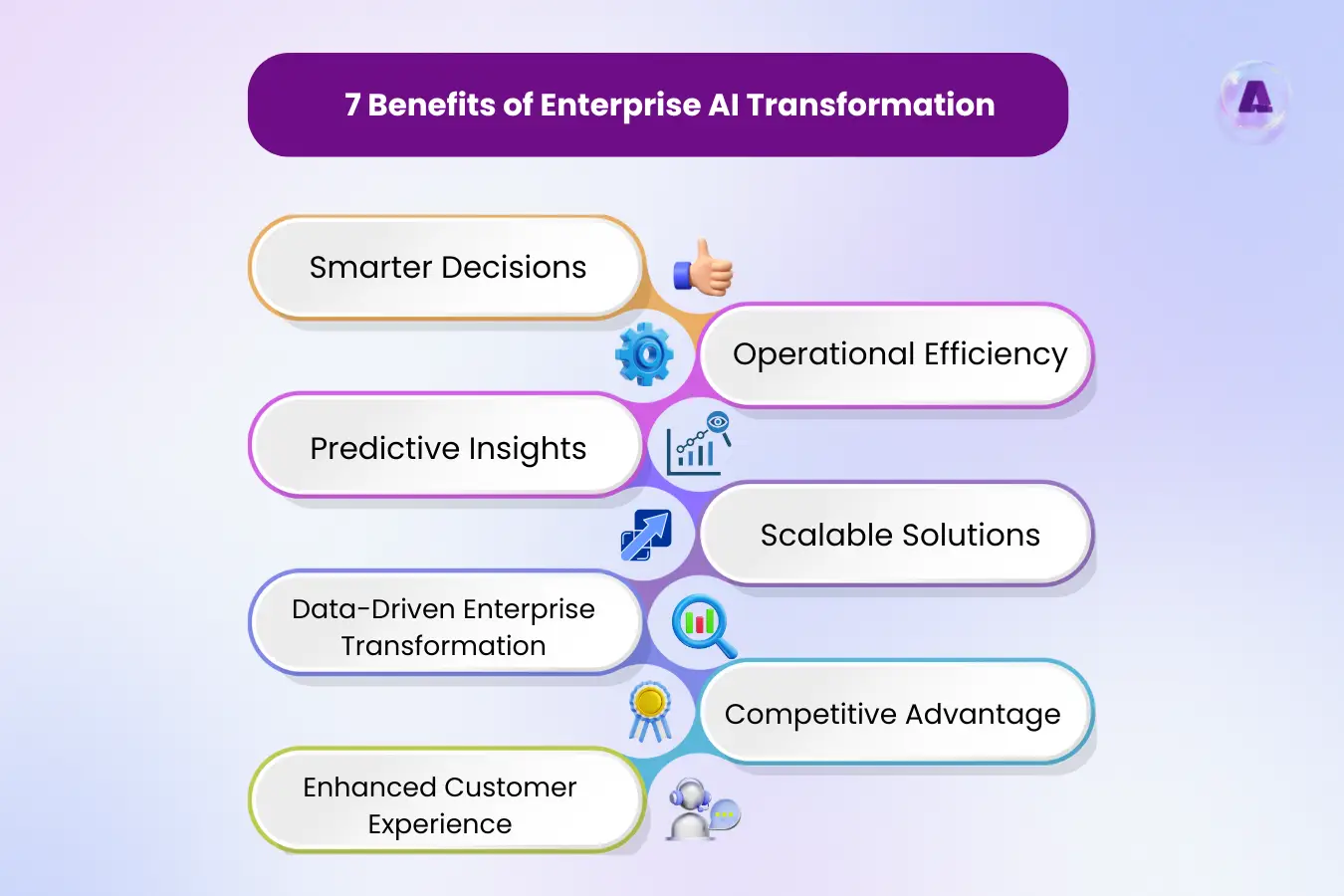
1. Smarter Decisions
AI enables you to analyze huge amounts of data quickly. This aids your companies in making decisions faster and more accurately than humans.
Example:
Netflix uses Generative AI (GenAI) tools that enable the rapid creation of new and creatively unique video, audio, text, and images across content production workflows.
2. Operational Efficiency
Automating repetitive tasks with AI can help you reduce errors, free you for higher-value work, and reduce costs.
Example:
Irish IT services company Evros Technology Group used UiPath AI-powered solutions to streamline its financial operations. Evros automated purchase invoice processing and achieved up to 80%-time savings.
3. Predictive Insights
AI does not look at what occurred, but it predicts what might happen next. This allows your business to stay ahead of trends.
Example:
Amazon use AI to forecast product demand, so warehouses are stocked efficiently before spiking in orders.
4. Scalable Solutions
AI lets your processes scale effortlessly without needing proportional increases in human resources.
Example:
By enabling native commerce across AI channels and co-developing an open standard with Google, Shopify lets merchants scale sales across multiple AI experiences using a single, consistent commerce infrastructure. This eliminates custom integrations and supports high transaction volumes.
5. Data-Driven Enterprise Transformation
Transforming with AI encourages your teams to rely on data insights instead of your own thoughts.
Example:
Starbucks uses a generative AI-powered virtual assistant known as Green Dot Assist. It is data-driven because it uses enterprise data to deliver real-time guidance to baristas at the point of work.
6. Competitive Advantage
Your business can innovate faster, respond to market changes better, and outperform competitors who depend only on conventional methods.
Example:
Tesla employs AI for self-driving technology and energy optimization. This keeps it ahead of traditional automative competitors.
7. Enhanced Customer Experience
AI-powered tools help your business to give customers exactly what they need before they even ask.
Example:
HubSpot launched Breeze, an AI tool suite that automates customer support with 24/7 agents and personalizes marketing outreach using real-time account data across its platform.
Enterprise AI Transformation vs. Digital Transformation
While both focus on technology, AI transformation adds intelligence and predictive power to business processes than digital transformation. Let’s see how they differ in terms of following aspects:
| Aspects | Enterprise AI transformation | Digital Transformation |
|---|---|---|
| Focus | Analyze data, automate decisions, and predict outcomes using AI | Modernize processes digitally |
| Decision-Making | AI Data-driven | Human-driven |
| Automation Level | High | Moderate |
| Technology Use | Gen AI, machine learning, predictive analytics, NLP | Cloud computing, mobile apps, CRM |
| Scope of Change | Deep | Broad |
| Predictive Insights | More predictive interactions | Less predictive |
| Customer Experience | High | Moderate |
| Examples | Product recommendations, self-driving AI, demand forecasting | Cloud adoption, ERP systems, digital marketing platforms |
AI Enterprise Transformation Roadmap
Before getting into the AI transformation roadmap, it is important to understand two aspects:
- Components of a successful Enterprise AI approach
- Levels for building enterprise AI maturity model
These factors provide the context needed to better evaluate and apply the roadmap effectively.
10 Key Components of a Successful AI Transformation Strategy
1. Business Objectives: Define what you want AI to do, such as improving efficiency, increasing revenue, or making the customer experience better.
2. Enterprise Data Readiness: Ensure you have high-quality, accessible data by conducting AI Readiness Assessment for enterprises. The AI operating model is only as good as the data it learns from.
3. Leadership Support: Strong executive sponsorship is important to drive adoption and overcome resistance.
4. Skilled Teams: Have the right combination of data scientists, AI engineers, and business experts to design, deploy, and manage AI solutions.
5. Integration Across Workflows: AI should not be siloed. It must be embedded into daily operations to get real business value.
6. Scalable Infrastructure: Invest in cloud platforms, computing power, and storage that can scale as initiative grows.
7. Change Management: Prepare employees for AI adoption with training, clear communication, and a culture to create data-drive decisions.
8. Governance: Establish guidelines to ensure AI is used responsibly, transparently, and without bias.
9. Continuous Improvement: Track AI performance, refine models, and iterate based on feedback and outcomes.
10. Measurable KPIs: Define metrics to measure AI’s impact on revenue, operations, and customer satisfaction.
Four Levels of Enterprise AI Maturity
The Enterprise AI maturity model is an AI innovation framework that helps you assess the adoption level of AI and current AI capability building for enterprises. The following table highlights the four levels required for building an enterprise AI maturity model.
| Maturity Levels | Key Attributes |
|---|---|
| Exploration | Educate workforce on AI, setup use policies, make data accessible, identify human-in-loop needs |
| Build business cases | Automate workflows, create use cases, share data via APIs, use LLMs to augment work |
| Scaling AI | Expand process automation, adopt test-and-learn, architect for reuse, use pretrained/proprietary AI, explore autonomous agents |
| Continuous AI Innovation | Embed AI in decision-making, create and sell AI-augmented services, combine multiple AI types |
Once your organization understands its AI maturity level, the next step is to ensure that AI initiatives offer meaningful business value. AI value realization framework can help achieve this by:
- Identifying high-impact opportunities
- Prioritizing feasible use-cases
- Designing and implementing AI solutions
- Measuring outcomes through KPIs
- Scaling successful projects across the enterprise
By following the framework, your firm can create tangible benefits from AI, including cost savings, revenue growth, and improved decision-making.
The Three Phase AI Transformation Roadmap
Here is the step-by-step approach that shows how enterprises can move from early AI efforts to full-scale transformation.
Step 1: Foundation Building
Your AI journey begins by establishing the foundations that enable everything else. This usually takes 3-6 months but is necessary for long-term success.
- Assess Current Infrastructure: Identify where data is stored, its quality, and who has access. This audit reveals gaps that must be addressed before scaling AI initiatives.
- Set up governance frameworks: Define policies for data classification, access control, quality standards, and retention. Implement technical systems that enforce these policies automatically.
- Build executive sponsorship: Educate leadership and run pilot projects to demonstrate value and gain buy-in.
- AI Use-Case Prioritization: Systematically identifying high-impact AI initiatives and ranking them based on business impact, feasibility, and scalability. Prioritizing high-value, achievable, and scalable use cases ensures resources are focused where AI can provide huge enterprise-wide benefits.
Step 2: Scaling AI Initiatives
Once foundations are in place, scaling focuses on expanding successful pilots into production systems to deliver measurable business results.
- Integrate AI into workflows: Redesign processes in which employees already use.
- Expand Systematically across Business Functions: Prioritize areas with clean data, clear metrics, and strong leadership support to maximize early impact.
- Measure and Refine: Track performance and adjust deployments to ensure AI delivers the intended business value.
Step 3: Enterprise-Wide Transformation
At this stage, AI becomes a core part of how your organization operates. It is no longer a special project and is fully integrated into your operating model.
- Autonomous Workflow Management: AI agents handle complex, multi-step processes such as collecting data, making decisions, and triggering actions. Humans are involved only when the system encounters something unclear, unusual, or requires judgement.
- Redesigned Operating Models: Routine tasks are automated, decision cycles accelerate, with real-time insights, and teams focus on higher-value work.
- Continuous AI Innovation: Mature AI adoption involves ongoing identification of new use cases, experimentation with new technologies, and evolution of systems as business needs to change.
This transformation roadmap is supported by AI lifecycle management, ensuring AI models are designed, deployed, monitored, governed, and continuously improved across every step of adoption.
Making Enterprise AI Roadmap Real
AI transformation is about building scalable capabilities. This drives long-term competitive advantage through AI automation and better decision-making. Here are four transformation imperatives you should consider in your modern enterprise:
- Start with business outcomes
- Use an AI transformation blueprint to guide design, deployment, and scale.
- Design for scale early
- Invest in skilled people and AI-augment culture
Real AI transformation takes more than a pilot. It takes sustained investment, clear outcomes, and permission to fail fast. That’s what separates the 30% that succeed from the rest.
As Gaurav highlights, a long-term roadmap is essential. Aligning stakeholders, selecting the appropriate use cases, following a disciplined execution approach are what transforms AI from a one-off project into a core enterprise capability.
Best Practices for AI Transformation
- Create an AI Center of Excellence (AI CoE) to centralize expertise, govern responsible AI usage, standardize tools and best practices, and accelerate enterprise-wide adoption.
- Build scalable, maintainable solutions rather than short-term fixes.
- Conduct an AI opportunity assessment to ensure clear direction and scalable outcomes.
- Prepare teams to confidently use AI systems through proper training and support.
- Establish clear KPIs early to measure impact and guide scaling decisions.
Real-World Use Cases for AI Transformation
AI transformation works best when focused on practical use cases which improve customer experience and organizational functions.
IT Operations
IT is a strong starting point for AI adoption because it supports both internal transformation and enterprise-wide enablement. Few examples include:
- Intelligent document processing across multiple file formats
- AI-generated reports from multiple data sources
- Predictive issue detection to reduce downtime
Human Resource (HR) Operations
HR teams manage high volumes of employee interactions. This makes AI ideal for reducing manual work and enhancing responsiveness. Few examples include:
- Automated HR FAQs with multilingual support
- AI-guided onboarding workflows
- Training recommendations
Financial Operations
Finance teams depend on accuracy and speed. AI reduces errors while accelerating core processes. Few examples include:
- Fraud detection and compliance monitoring
- AI-driven forecasting and trend analysis
- Automated expense validation and approvals
Challenges in Adopting AI in Enterprises and Solutions
Challenge 1: Data Governance
According to KPMG industry findings, 62% of organizations identify weak data governance as the biggest data challenge preventing AI initiatives from scaling.
Solution:
- Implement robust AI governance best practices for secure storage, processing, and compliance.
- Maintain high-quality, accuracy, and regularly updated data.
Challenge 2: Talent and Skill Gaps
Despite 71% of enterprises regularly using generative AI in 2025, many still struggle to scale deployments due to skill gaps. It indicates that talent remains a key challenge.
Solution:
- Invest in training and upskilling programs for existing employees.
- Use citizen-developer tools or low-code/no-code AI platforms
- Consider partnerships with vendors or consultants to fill specialized gaps.
Challenge 3: Enterprise AI Change Management
Close to 70% of change initiatives fail, largely due to employee resistance and concerns about AI-driven change. This reduces AI deployment success.
Solution:
- Communicate properly why AI initiatives are being implemented and how they support your employee’s work.
- Align incentives and encourage early adoption through pilot programs.
Challenge 4: Pilot Projects That Don’t Scale
95% of enterprise generative AI pilots fail to deliver measurable financial impact due to insufficient infrastructure and workflow integration.
Solution:
- Design pilots with scalability in mind, including architecture, governance, and operational processes.
Challenge 5: Integration with Legacy Systems
In 2025, nearly 65% of enterprises report legacy infrastructure as a major blocker for AI scalability. This makes integration strategy critical early on.
Solution:
- Use APIs and middleware to connect AI systems with existing enterprise platforms.
- Modernize incrementally instead of replacing core systems all at once.
- Prioritize use cases that provide value without deep system rewrites
How Aptly Star Powers Enterprise AI transformation?
Your enterprise wants to deploy AI assistants across customer support, HR, and IT. But it faces fragmented data, legacy systems, and security concerns. You might wonder how your firm can drive AI transformation while overcoming these challenges.
Consider leveraging AptlyStar.ai, a no-code platform to build and scale AI agents in minutes.
Features include:
- Multi-LLM integration with providers like OpenAI, Azure, and Anthropic.
- Connecting agents to documents, databases, cloud storages, and APIs for transforming enterprise data into intelligence.
- Secure collaboration with role-based access and enterprise-grade AI management.
- Accurate and up-to-date results with automated data syncs and scheduled retraining as knowledge sources evolve.
- Accelerate AI adoption using pre-built, enterprise-ready AI agent library.
Case Study: Accelerating Mayra Technologies’ Conversational AI Delivery with AptlyStar.ai
Mayra Technologies, a fast-growing digital solutions company, saw rising demand from their e-commerce and education clients for intelligent chatbots. The bot should integrate with websites and mobile apps, handle massive customer inquiries, and automate data collection/user interactions.
Building custom NLP logic for every client was slowing delivery and increasing complexity.
By integrating AptlyStar.ai’s Generative AI APIs into their chatbots, Mayra reduced development time, scaled conversational AI offerings faster, and delivered enterprise-grade digital assistants.
Read More: Mayra Technologies Scales Conversational AI Capabilities Using AptlyStar.ai APIs – AptlyStar.ai
FAQs
Q. What is AI transformation?
Enterprise AI transformation is the process of embedding AI across your core business functions. If you integrate AI into your workflows and operating models, you can improve efficiency, decision-making, and scalability
Q. How is AI transformation different from digital transformation?
Digital transformation specializes in digitizing processes and systems. AI transformation builds on that foundation by using AI to automate decisions, predict results, and continuously enhance operations using data and learning models.
Q. What are the common challenges in AI transformation?
Challenges include data governance, skill gaps, integration with legacy systems, change management, and difficulty measuring ROI. Most failures happen due to execution and scale issues rather than technology limitations.
Q. How long does enterprise AI transformation take?
AI transformation is not a one-time process. Initial foundations take 3-6 months, scaling takes another 6-12 months, and full enterprise adoption evolves continuously as AI becomes part of daily operations.
Q. How do enterprises measure the success of AI transformation?
You can measure success through your business outcomes. This includes cost reduction, faster decision cycles, enhanced accuracy, productivity gains, and employee experience improvements. You should define metrics properly before deployment.
Q. Do enterprises need in-house AI experts to succeed?
Not always. Many enterprises combine internal teams with external partners, managed platforms, and low-code tools. The key is operational maturity and governance, not building large AI teams from day one.
Final Thoughts
Enterprise AI transformation is an ongoing shift in how your organizations operate and compete. As the gap grows between early experiments and enterprise-ready AI, your company that acts with intent gains significant benefits. Consistently embedding AI consistently into daily operations is what unlocks greater value.
The next phase of enterprise AI transformation will focus less on experimentation and more on operational maturity. Success will require rethinking ownership, accountability, and operating models, with a stronger focus on customization over generic solutions.
The choice is simple: move early and lead, or delay and respond.
Looking for hands-on support?
Explore AptlyStar to turn your AI strategy into enterprise-scale outcomes quickly, safely, and visibly.
Table of content
- TL;DR
- Introduction
- What Is Enterprise AI Transformation?
- Why Enterprise AI Transformation Matters in 2026?
- 7 Benefits of Enterprise AI Transformation
- Enterprise AI Transformation vs. Digital Transformation
- AI Enterprise Transformation Roadmap
- Best Practices for AI Transformation
- Real-World Use Cases for AI Transformation
- Challenges in Adopting AI in Enterprises and Solutions
- How Aptly Star Powers Enterprise AI transformation?
- FAQs
- Final Thoughts