Introduction
The decision between colocation vs on premise data center is no longer just a technical choice. It is a high-stakes financial and strategic pivot. According to Deloitte, data centers already account for approximately 2% of global electricity consumption in 2025. This figure is projected to roughly double to 1,065 TWh by 2030 as generative AI training and inference continue to accelerate.
To address this surging demand while reducing environmental impact, organizations are increasingly turning to a combination of energy-efficient infrastructure and carbon-free energy colocation solutions. While on-premise provides total physical sovereignty, colocation offers a strategic middle path by letting you own your hardware while offloading complex facility management to specialists.
This guide breaks down these two models to help you align your infrastructure with your long-term growth and compliance goals.
Colocation vs On Premise Data Center: Definition
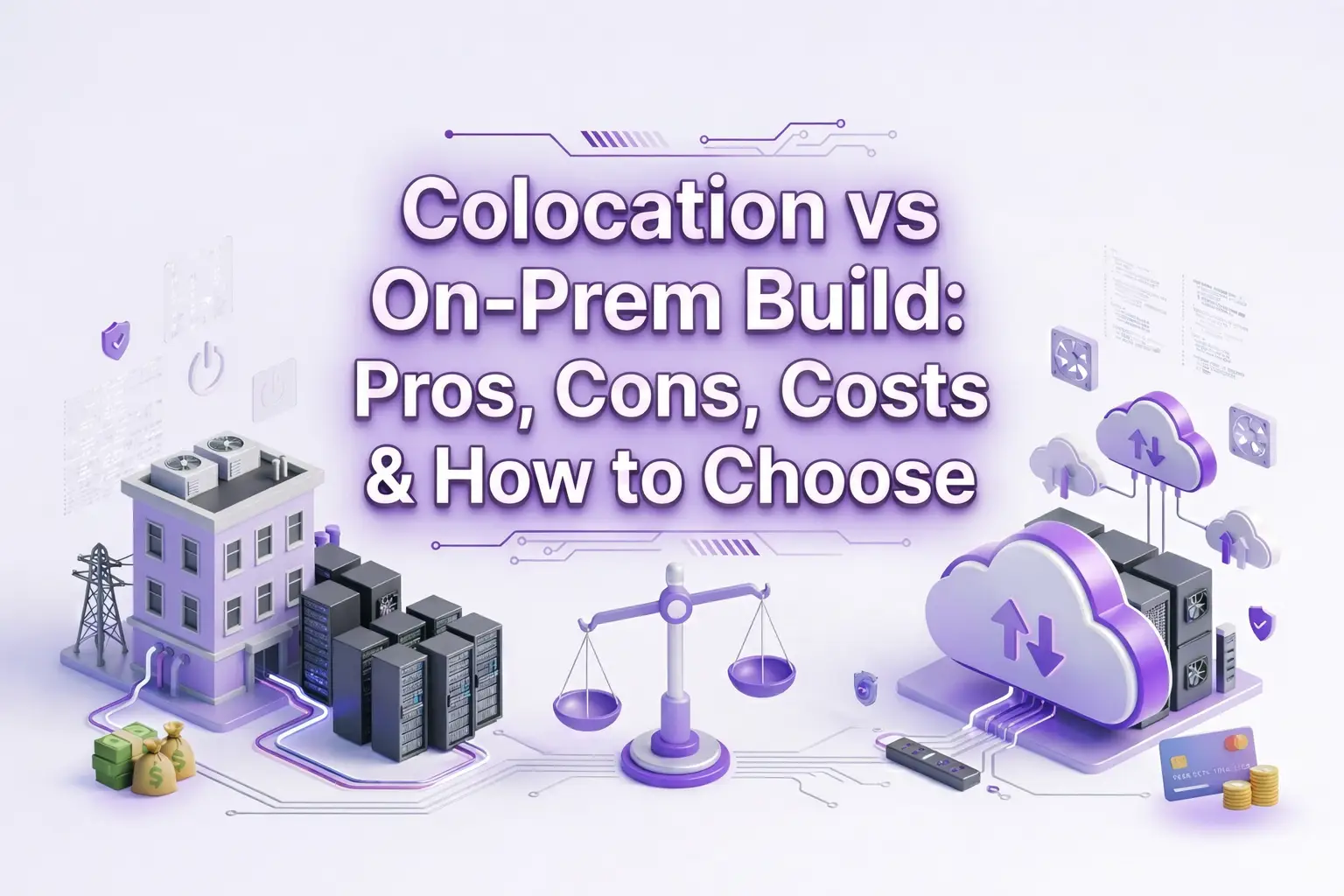
A colocation data center is a third-party facility where you place your servers, storage, and networking hardware. The provider manages power, cooling, physical security, and connectivity while you retain control over your equipment. You benefit from enterprise-grade infrastructure without building your own facility. This model supports hybrid cloud with colocation and reduces operational overhead.
In contrast, an on premise data center is a facility owned and operated within your organization’s premises. You manage everything from hardware procurement to power, cooling, and security. This approach gives you complete control over your infrastructure. However, it also means you handle all capital investment and operational responsibilities.
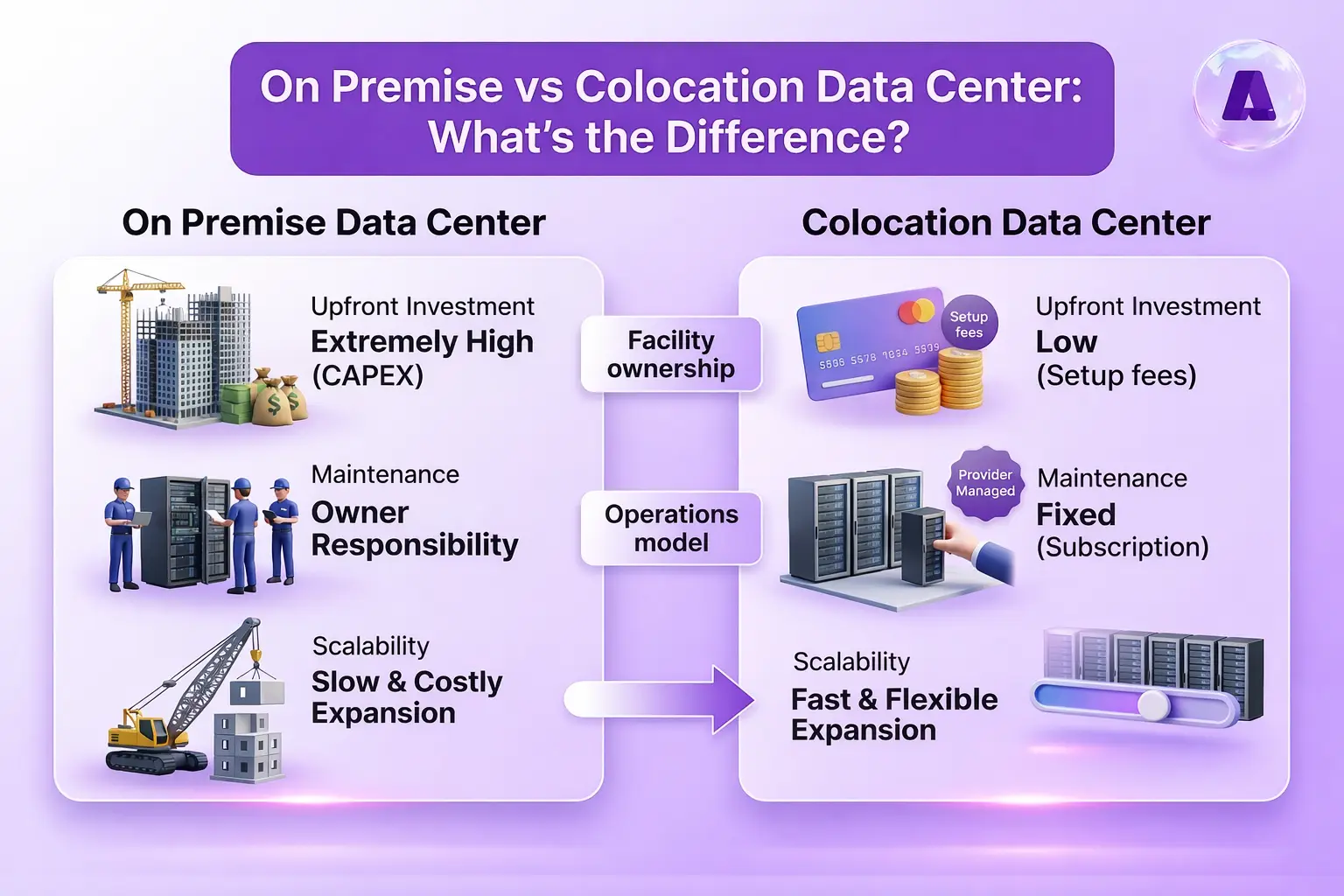
On Premise vs Colocation Data Center: What’s the Difference?
Choosing between a colocation vs in house data center involves more than just picking a location. You must look at how your team spends its time and capital. The following sections break down the core differences that impact your long-term infrastructure health.
Cost Considerations
The primary financial hurdle for an on premise data center is the initial capital expenditure (CAPEX). You must pay for land, construction, and specialized HVAC systems before installing a single server. These upfront costs often reach millions of dollars for even mid-sized enterprises.
In contrast, colocation moves your infrastructure to an operating expense (OPEX) model. You pay a monthly fee for rack space vs build data center costs. This monthly predictable rate covers electricity, cooling maintenance, and physical security.
| Feature | On Premise Data Center | Colocation Data Center |
|---|---|---|
| Upfront Investment | Extremely High (CAPEX) | Low (Setup fees) |
| Monthly OpEx | Variable (Utility/Staff) | Fixed (Subscription) |
| Scalability Costs | High (construction or new equipment) | Moderate (add rack space) |
| Maintenance | Owner Responsibility | Provider Managed |
| Cooling/Power | Full Owner Cost | Included in Service |
| Staffing | Full IT ops team required | Facility ops handled by provider |
| 10-Year TCO | Lower if high utilization | Lower if variable workloads |
Scalability Benefits
Comparing colocation vs on premise data center scalability reveals a clear advantage for leased spaces. If you need more power for AI infrastructure colocation, you simply lease another rack. The provider handles the additional power load and cooling requirements for you. When you build in-house, scaling requires new construction or upgrades.
Here’s how data center scalability comparison plays out:
| Aspect | On Premise Data Center | Colocation Data Center |
|---|---|---|
| Expansion Time | Slow | Fast |
| Capacity Planning | Complex | Flexible |
| AI/GPU Workloads | Limited by infrastructure | Designed for high density |
| Rack Space | Fixed | Scalable |
Security Implications
When evaluating colocation vs on premise data center in terms of security, physical access is the main differentiator. An on-premise setup allows you to decide exactly who enters the server room. However, maintaining 24/7-armed guards and biometric entries is expensive for a single company.
Colocation facilities offer enterprise-grade security that most small offices cannot afford. They use multi-factor authentication, man-traps, and constant video surveillance. While you share the building, your specific rack is locked and accessible only to you.
Here is a quick colocation vs on premise security comparison:
| Security Layer | On Premise Data Center | Colocation Data Center |
|---|---|---|
| Physical Security | Managed internally | Advanced multi-layer security |
| Compliance | Custom implementation | Pre-certified environments |
| Access Control | Internal policies | Strict access protocols |
| Disaster Recovery | Requires separate setup | Built-in DR options |
Performance, Uptime, and Reliability
Colocation facilities are designed for high availability. Many offer uptime guarantees of 99.99% or higher. In an on premise data center, achieving similar uptime requires significant investment. You need redundant systems, backup generators, and skilled staff.
Power and Cooling Efficiency
Power and cooling remain critical challenges in colocation vs in house data center discussions. Colocation providers optimize energy usage at scale. They use advanced cooling systems and efficient power distribution. On premise setups often struggle with data center power and cooling costs, especially as workloads grow.
Hybrid and Multi-Cloud Integration
Colocation plays a key role in colocation vs private data center for hybrid cloud strategies. You can connect directly to cloud providers from a colocation facility. This reduces latency and improves performance. This makes colocation a bridge between traditional infrastructure and hyperscalers vs colocation environments.
Colocation vs On Premises Data Center: Pros and Cons
Deciding between a colocation vs on premise data center advantages and disadvantages list requires a deep dive into how each model impacts your daily operations and long-term budget.
Let’s check out the pros of colocation vs on premise data centers:
| On Premise Data Center | Colocation Data Center |
|---|---|
|
|
Here are the cons of colocation vs on premise data centers:
| On Premise Data Center | Colocation Data Center |
|---|---|
|
|
For organizations prioritizing scalability, reliability, and cost predictability, colocation offers a compelling advantage. On-premise remains appropriate for highly regulated or classified workloads where absolute data sovereignty is non-negotiable. However, for many enterprises, particularly those running or planning AI workloads, colocation’s enterprise-grade infrastructure, carrier-neutral connectivity, and managed compliance make it the more operationally sound and financially prudent long-term choice.
How to Choose the Right Data Center for Your Organization?
You might think about how to choose a data center based on your business needs. To make the right choice in should I use colocation or on premise, follow this structured approach:
- Assess your business needs: Look at your growth projections and current budget limitations.
- Define your goals: Determine if you want to reduce costs or increase technical performance.
- Evaluate your requirements: Document your need for processing power, storage, and low latency.
- Evaluate costs: Conduct an enterprise data center colocation vs on premise cost analysis for five years.
- Consider organizational readiness: Check if your internal team has the time to manage a building.
- Evaluate SLAs and reputation: Review uptime guarantees and customer references for any provider.
Once you’ve worked through the steps above, Aptly Tech is a colocation provider well worth consideration. They offer well-architected data center buildouts with transparent pricing structure, robust uptime SLAs, and dedicated support.
Which One Should You Choose? Colocation vs On Premise Data Center
To simplify your decision, here is a quick comparison of build vs colocation data center:
| Scenario | Recommended Model | Reason |
|---|---|---|
| AI/GPU workload deployment | Colocation | High-density power and cooling infrastructure purpose-built for accelerated compute |
| Strict data sovereignty requirements | On-Premises | Physical control over hardware location and access |
| Startup or high-growth company | Colocation | Low CapEx, scalable capacity, and predictable monthly costs |
| Stable, predictable high-utilization workloads | On-Premises | Lower long-term TCO when utilization is consistently high |
| Hybrid cloud architecture | Colocation | Direct cloud connectivity and carrier-neutral network access |
| Limited internal IT staff | Colocation | Facility operations offloaded to provider specialists |
| Classified or defense workloads | On-Premises | Maximum physical access control and audit authority |
| Disaster recovery site | Colocation | Geographic redundancy without building a second facility |
| Regulated industry (healthcare, finance) | Either | Compliance requirements vary; evaluate specific certifications |
| Legacy infrastructure refresh | Colocation | Avoid costly on-prem upgrades by migrating to modern colocation facility |
If your priority agility, scalability, and faster time-to-market, colocation is the best. Otherwise, choose on-premises data centers for maximum control, enhanced security, and optimized long-term costs at high utilization.
To Optimize Colocation, Work with the Right Partner
The colocation vs on premise data center decision depends on your priorities. As infrastructure demands grow, many enterprises are shifting toward colocation. To get the most out of colocation, you need the right partner.
Aptly Tech experts can guide you through infrastructure planning, cost evaluation, and deployment strategies. Its Infrastructure Readiness Services help you evaluate your current setup and future requirements.
You can get in touch with Aptly today to build a future-ready enterprise infrastructure strategy tailored to your needs.
FAQs
Q: What is an on-premises data center?
An on premise data center is a facility owned and managed by your organization. You control hardware, security, and operations internally.
Q: What is a colocation data center?
A colocation data center is a third-party facility where you host your infrastructure. The provider manages power, cooling, and physical security.
Q: What is the difference between colocation and on premise data center?
The main difference lies in ownership and cost structure. On premise requires full investment, while colocation offers shared infrastructure with lower upfront costs.
Q: Is colocation cheaper than building a data center?
In most cases, yes. Colocation reduces capital expenses and offers predictable operational costs over time.
Q: When should a company choose colocation instead of on premise?
Choose colocation when you need scalability, lower upfront costs, and support for high-density workloads like AI.
Q: What is the colocation vs on prem build pros and cons?
On premise provides full control but involves high costs and limited scalability. On the other hand, colocation offers scalability and cost efficiency but reduces direct physical control over infrastructure.
Q: Is colocation better for AI infrastructure?
Yes, colocation supports high power density and cooling needs, making it suitable for GPU and AI workloads.
Table of content
- TL;DR
- Introduction
- Colocation vs On Premise Data Center: Definition
- On Premise vs Colocation Data Center: What’s the Difference?
- Colocation vs On Premises Data Center: Pros and Cons
- How to Choose the Right Data Center for Your Organization?
- Which One Should You Choose? Colocation vs On Premise Data Center
- To Optimize Colocation, Work with the Right Partner
- FAQs