The Cost Pressure Is Real. AI Agents Are the Response.
Indian companies are under pressure. Rising labour costs, margin compression, and global competition force every CFO to look harder at where money goes. The answer many are finding is AI agents for operational cost. More specifically, AI agents for operational cost reduction are now replacing entire categories of repetitive work across finance, HR, IT, and customer support. These autonomous software systems work round the clock, handle repetitive tasks, make decisions within defined rules, and trigger actions across systems without a human in the loop.
This is not a future prediction. A 2026 EY-CII report titled ‘Is India Ready for Agentic AI?’ found that 47% of Indian enterprises already have multiple AI use cases live in production. Another 23% are in the pilot stage. The shift from experimentation to execution is real, and the companies moving fastest are seeing measurable reductions in operational drag.
This guide breaks down exactly how Indian companies use AI agents for operational cost reduction, which sectors lead adoption, what real ROI looks like, and how you build a deployment plan that actually works. Operational cost reduction through AI is no longer a pilot promise — it is a documented outcome across BFSI, IT services, and retail in India.
What Are AI Agents and Why Do They Matter for Costs?
An AI agent is a software program that perceives its environment, processes data, decides on an action, and executes that action autonomously. Unlike a chatbot that responds to a single prompt, an AI agent completes multi-step workflows. It can read an invoice, check it against a purchase order, flag discrepancies, update a ledger, and notify the finance team, all without human input.
Enterprise AI automation India deployments are accelerating because a disproportionate share of operational costs here stems from labour-intensive, rule-based work. For Indian enterprises, this matters because a large portion of operational costs come from labour-intensive, rule-based work. Think: processing claims, answering support tickets, scheduling interviews, running compliance checks, or generating reports. AI agents for operational cost reduction target exactly these processes. When you replace a 10-step manual process with an autonomous AI workflow, you cut the time, the error rate, and the cost simultaneously.
The Deloitte State of GenAI report (April 2025) confirmed that over 80% of Indian organizations are actively exploring autonomous agent development. That number has since translated into real deployments. Beyond cost savings, AI operational efficiency gains compound over time: fewer errors, higher throughput, and zero downtime for rule-based tasks.
Where Indian Companies Deploy AI Agents?
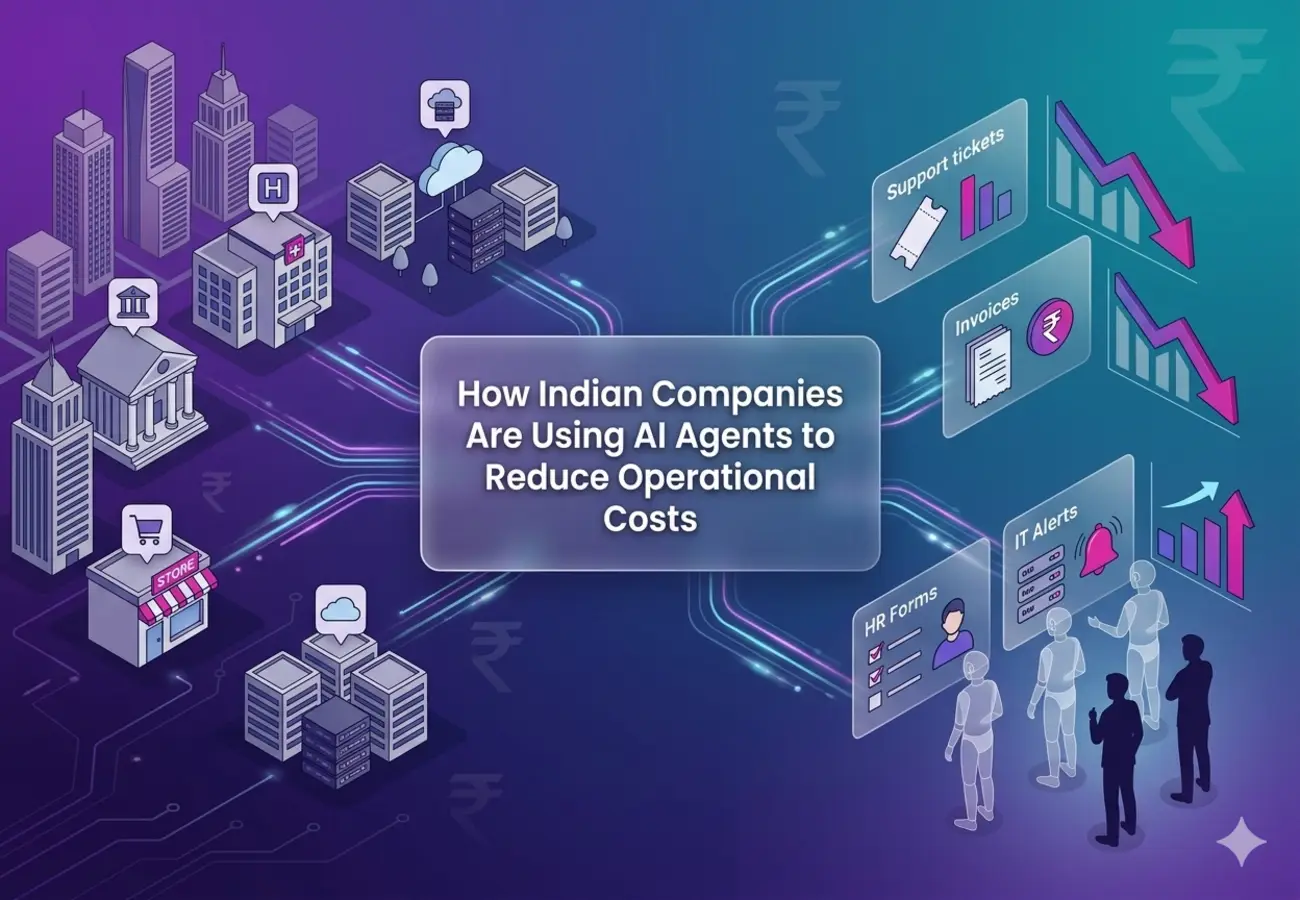
The use cases for AI agents in Indian companies cluster into five core operational areas. Each one represents a direct line to cost savings.
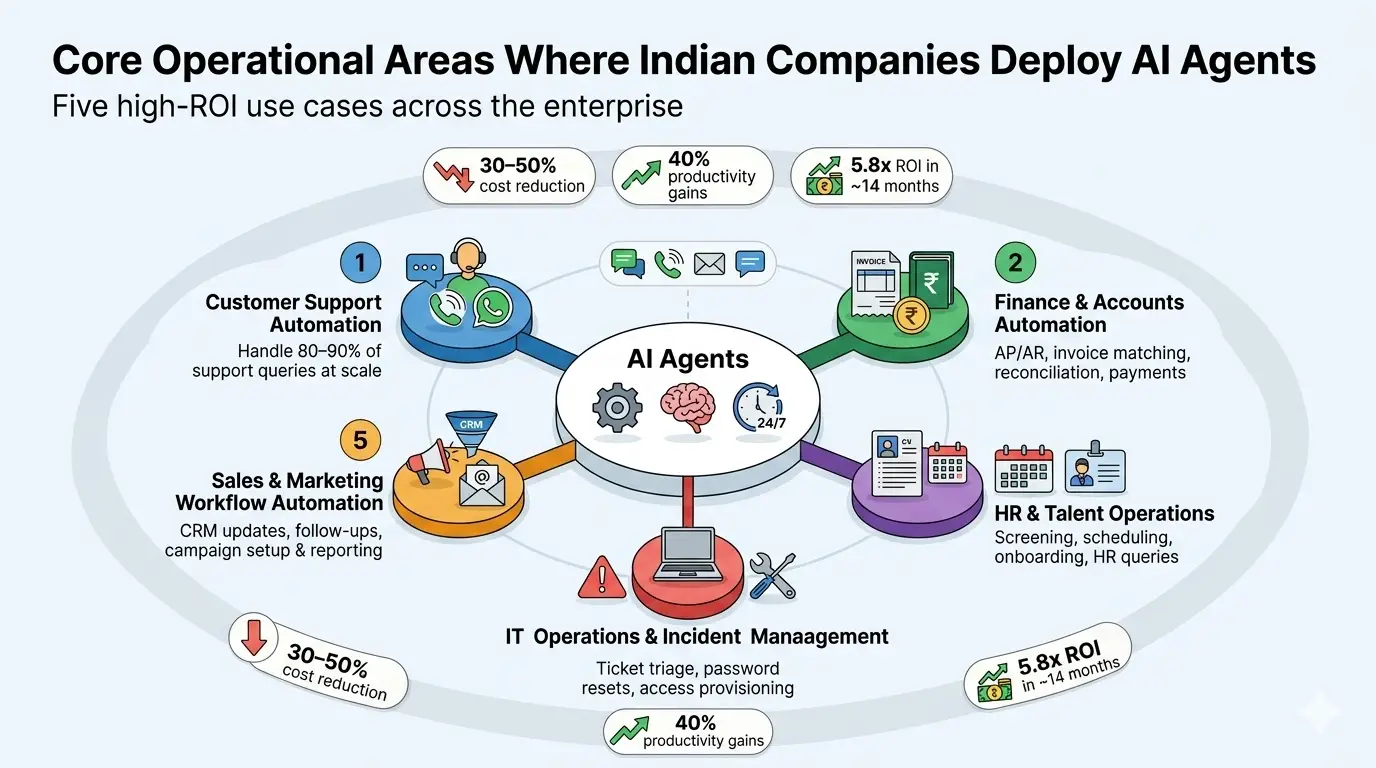
1. Customer Support Automation:
Customer support is the single largest use case. Yellow.ai, an Indian AI platform, reports that its agents handle 90% of support queries without human intervention across chat, voice, email, and WhatsApp. For any company running a support team of 50 or more agents, that translates to millions in annual savings.
AI agents for customer support automation work by reading the query, retrieving relevant knowledge, generating a response within brand and compliance parameters, and escalating to a human only when necessary. Response time drops from hours to seconds. Cost per interaction drops from hundreds of rupees to near zero at scale. AI-powered business automation in customer support is the fastest path to visible ROI — response times drop from hours to seconds, and cost per interaction collapses at scale.
2. Finance & Accounts Automation:
Finance teams in Indian enterprises spend enormous time on accounts payable, accounts receivable, invoice processing, and reconciliation. Finance teams that reduce operational costs with AI agents report eliminating up to 70% of manual touchpoints in their AP and AR cycles. AI agents for finance and HR automation handle these tasks end to end. A finance agent reads invoices, matches them to purchase orders, processes payments within approval thresholds, and logs every transaction. Infosys Finacle integrates AI directly into core banking workflows to cut manual overhead across exactly these functions.
According to AI automation statistics for 2026, companies deploying AI automation report an average ROI of 187% within the first year. For Indian BFSI companies managing high transaction volumes, the ROI of AI agents in enterprise finance functions reaches this threshold faster than most other sectors.
3. HR & Talent Operations:
Hiring at scale is expensive. Screening resumes, scheduling interviews, sending offer letters, running onboarding workflows – each step costs time. Indian enterprises using AI agents for finance and HR automation report reducing time-to-hire by 40 to 60%. The agent screens applications against job criteria, shortlists candidates, sends calendar invites, and collects onboarding documents without a recruiter touching those steps.
Beyond recruitment, HR agents handle leave management, payroll queries, policy Q&A, and performance review reminders. For a company with 5,000 employees, this type of AI workflow automation India deployment frees up significant HR bandwidth for strategic work.
4. IT Operations and Incident Management:
IT operations centers in Indian IT services firms deal with thousands of tickets daily. AI agents for IT operations management triage tickets, categorize them, assign them to the right team, and resolve a significant percentage autonomously. Routine issues like password resets, access provisioning, and system health checks get resolved without a human engineer.
TCS, Infosys, Wipro, and Cognizant have all moved towards agentic AI for internal IT operations. In December 2025, Microsoft announced that these four firms collectively deployed over 200,000 Copilot licences, creating the largest enterprise-scale AI agent rollout in the Indian IT sector.
5. Sales and Marketing Workflow Automation:
Sales teams lose hours to manual CRM updates, lead follow-ups, and pipeline reporting. Marketing teams spend cycles on campaign setup, A/B test tracking, and report generation. AI agents handle all of this. Infosys reports that agentic AI cuts campaign setup costs by 50% and time-to-market by half for marketing operations clients.
Real-World AI Agent Examples in India
These are not hypothetical deployments. These are documented, real-world AI agent examples in India that show what enterprise adoption looks like in practice.
- Infosys Topaz: Infosys built its enterprise AI platform, Topaz, to deliver AI agents across software development, customer service, and knowledge management. Internal usage alone has reduced manual coding effort and documentation overhead substantially, Topaz is among the clearest examples of generative AI for business operations at scale, with clients reporting 30 to 40% reductions in operational overhead.
- Zoho Zia: Zoho’s AI agent, Zia, powers intelligent automation across Zoho CRM, Books, Desk, and People. Indian SMBs and mid-market companies using Zoho Zia for business automation benefit from automated lead scoring, anomaly detection in finances, and smart HR workflows, all within one platform.
- FreshWorks Freddy AI: FreshWorks, a Chennai-founded SaaS company, embeds Freddy AI agents into its customer support and CRM products. Freddy handles ticket deflection, sentiment analysis, and agent assist, reducing resolution time and cutting support costs for thousands of Indian businesses.
- Yelllow.ai: This Bengaluru-based company offers enterprise-grade AI agents for customer engagement across 35+ languages. Indian enterprises in BFSI, retail, and telecom use Yellow.ai to automate customer support at scale, achieving AI agents for operational cost reduction within weeks of deployment.
- Augmen AI: A 2025-founded Indian startup, Augmen uses multilingual conversational AI agents to automate credit intake for NBFCs, banks, and MFIs. The agents guide borrowers through loan applications in their native language, reducing processing time and manual document handling for lenders.
- AptlyStar AI: AptlyStar is an India-built, enterprise-grade no-code AI agent platform powered by Aptly Technology. You build, train, and deploy fully functional AI agents for operational cost reduction in minutes, with zero coding required. The platform connects to your existing knowledge sources including documents, databases, cloud storage, and APIs, turning your internal data into a working intelligence layer. Indian enterprises use it to automate customer support on WhatsApp, Discord, and websites; handle HR queries; manage sales workflows; and run internal IT helpdesks, all without adding headcount.
The Numbers: What Does AI Agents ROI Actually Look Like?
The ROI data for AI agents for enterprises is now consistent enough to anchor board-level business cases, not just pilot proposals. Numbers cut through the noise. Here is what current data says about the ROI of AI agents in enterprise operations:
- 30 to 50% cost reduction: Enterprises report this range from AI agent deployment across operations, as per AI Agent Case Studies in Industry (Scribd, 2025).
- 40% productivity increase: The same study found that enterprises experience an average 40% productivity increase from AI implementation across business units.
- 8x ROI within 14 months: McKinsey Global AI Survey 2025 found this average return for enterprises with AI workloads in production.
- 187% average first-year ROI: Companies adopting AI automation report this return on their initial investment within 12 months.
- 40 to 60% outsourcing cost reduction: McKinsey estimates AI agents reduce outsourcing costs by this margin, which has direct implications for Indian IT services firms and their clients.
- 40% of enterprise applications will include task-specific AI agents by end of 2026: Gartner via Master of Code Generative AI Statistics 2026.
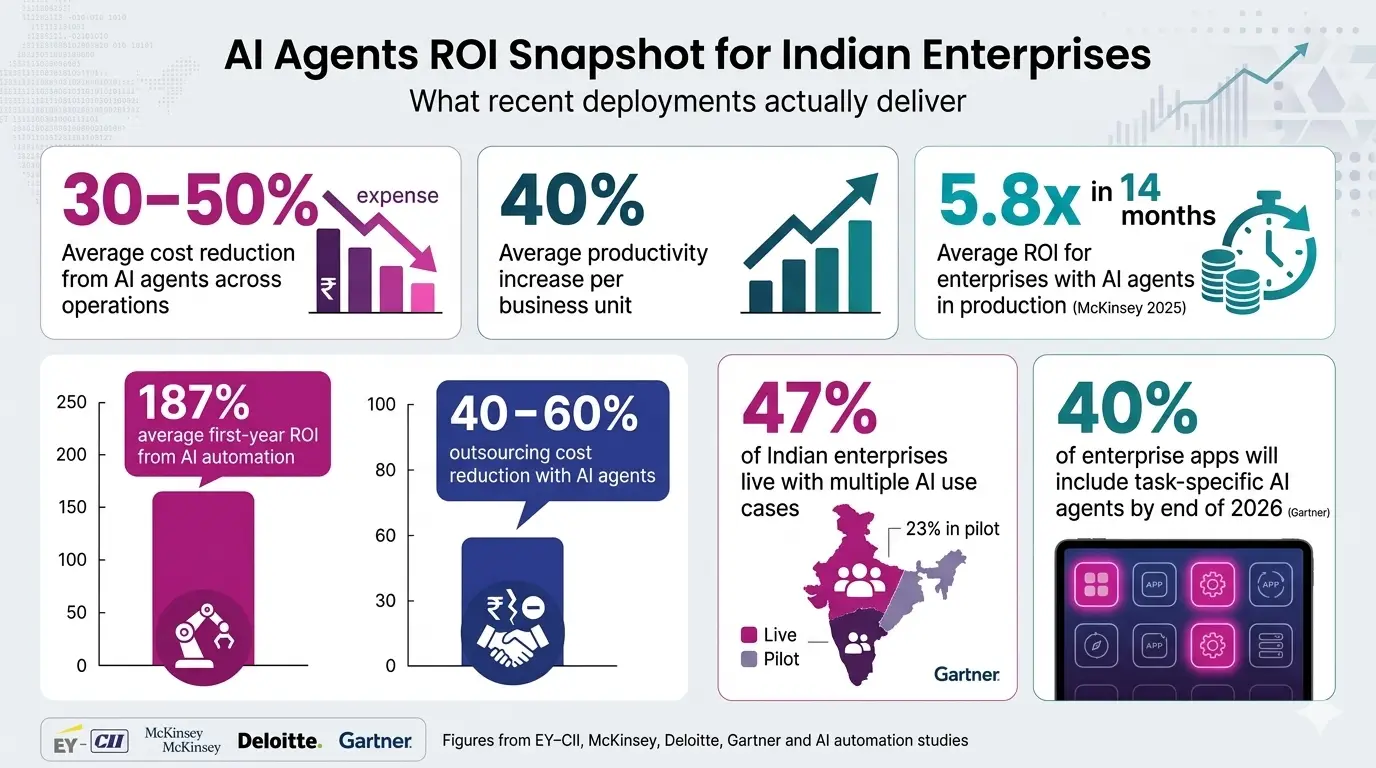
These numbers make clear that the AI agent deployment cost in India is not the obstacle it once was. Cloud-based agentic platforms have reduced setup costs dramatically, and the payback period for most deployments is under 18 months.
Which Sectors Lead AI Agents Adoption in India?
Not all sectors adopt at the same pace. AI adoption trends in Indian enterprises show clear sector leaders.
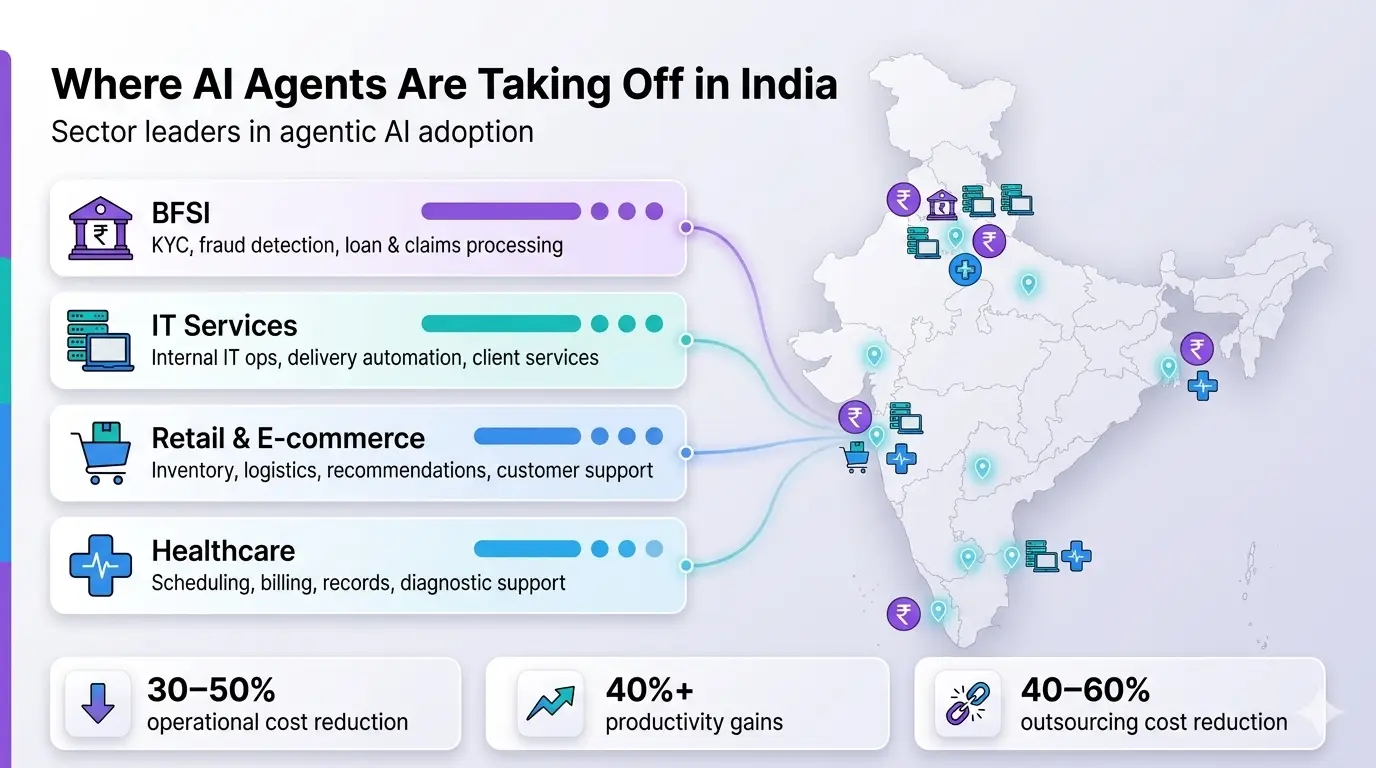
BFSI (Banking, Financial Services, Insurance):
BFSI leads AI agent adoption in India. Banks and insurers deploy AI agents for KYC verification, fraud detection, loan processing, claims management, and customer service. The compliance requirements in BFSI make autonomous, auditable AI agents a natural fit. AI agents in financial services continuously monitor transactions, enforce AML rules, and accelerate credit decisions without adding headcount.
IT Services:
India’s IT services sector faces direct pressure from AI agents for operational cost reduction. Companies like TCS and Infosys use AI agents internally to reduce delivery costs and externally to offer AI-powered services to global clients. The shift to agentic AI over foundational model development is a deliberate strategy to protect margins while growing revenue from AI-led engagements.
Retail & E-commerce:
Retail companies deploy AI agents for inventory management, demand forecasting, personalised recommendations, and supply chain optimisation. AI agent case studies show warehousing costs reduced by $15 million and staffing needs cut by 50% in a single deployment. Indian e-commerce players and quick commerce companies find AI workflow automation directly reduces logistics overhead.
Healthcare:
Indian healthcare companies use AI agents for patient scheduling, diagnostic support, billing automation, and medical records management. Autonomous AI agents reduce administrative burden on clinical staff, letting doctors and nurses focus on patient care rather than paperwork. Organisations that deploy agentic systems in healthcare report operational cost reductions of up to 30%.
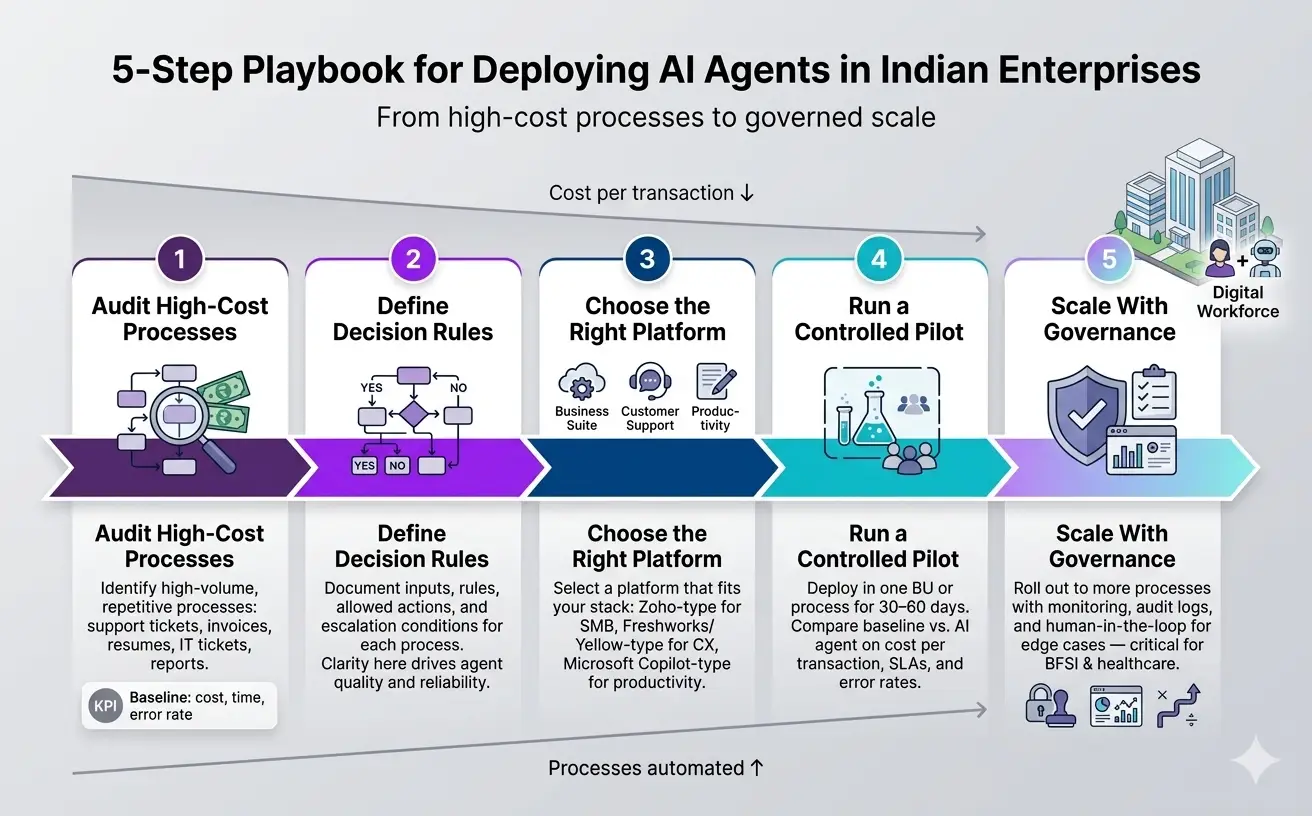
Implementing AI Agents for Operational Cost Reduction: A Step-by-Step Guide
If you want to know how to implement AI agents to reduce operational costs in your business, follow this process. It works for large enterprises and mid-market companies equally.
Step 1: Audit Your Highest-Cost Processes
- Start with where your money goes. Map every process that requires repetitive human work. Customer support ticket handling, invoice processing, resume screening, IT ticket triage, report generation. These are your highest-ROI targets for AI agents for operational cost.
Step 2: Define the Decision Rules
- AI agents work best when the decision logic is clear. For each process, document: what inputs the agent receives, what rules it follows, what actions it can take autonomously, and when it escalates to a human. This step determines whether your agent works well or poorly.
Step 3: Choose the Right Platform
- You do not build AI agents from scratch. You select an enterprise AI platform for Indian businesses that fits your existing tech stack. Consider Zoho Zia for integrated business automation, FreshWorks’ Freddy AI for customer support, Yellow.ai for multi-channel engagement, or Microsoft Copilot for enterprise productivity. Match the platform to the use case.
Step 4: Run a Controlled Pilot
- Deploy in one business unit or one process first. Measure baseline metrics before deployment: cost per ticket, time to process, error rate. Run the agent for 30 to 60 days and compare. This gives you clean ROI data before you scale.
Step 5: Scale with Governance
- Once the pilot proves ROI, scale systematically. Build a governance layer that monitors agent decisions, logs actions for compliance, and keeps humans in the loop for edge cases. AI-enabled decision-making works best when it operates within a clear oversight structure. This is especially important in regulated sectors like BFSI and healthcare.
The Infrastructure Challenge Behind AI Agent Deployments
AI agents for operational cost reduction require more than a platform subscription. They need reliable infrastructure: GPU compute for model inference, low-latency networking, persistent storage, and 24/7 monitoring.
Most Indian enterprises underestimate this. They sign up for an AI agent platform, run a successful pilot on shared cloud resources, then hit performance walls at production scale. Latency goes up. Throughput drops. Costs spike.
The enterprises that scale successfully treat AI infrastructure as a core capability, not an afterthought:
- Dedicated GPU clusters for inference workloads
- Low-latency networking between agent processes and data stores
- Enterprise-grade monitoring with real-time alerting
- Disaster recovery and failover for business-critical agent workflows
Aptly builds and manages this infrastructure for enterprises in India and globally. As the only Microsoft-trusted supplier authorized to build and support third-party hyperscale datacentres worldwide, Aptly delivers the compute backbone that AI agents need to perform at scale. With up to 99.9% uptime SLAs and 24×7 Global Operations Centers across North America, Europe, and Asia, Aptly ensures your AI agents stay online when your business depends on them.
For enterprises evaluating AI infrastructure for agent deployments, explore Aptly’s AI infrastructure managed services.
Human Teams vs. AI Agents: Where the Cost Difference Is Real
Comparing the operational cost of human teams vs AI agents requires honesty about both sides. AI agents do not replace all human work. They replace specific, defined, repeatable tasks.
| Task Category | Human Team Cost (Annual Estimate) | AI Agent Cost (Annual Estimate) |
|---|---|---|
| Customer support (1000 tickets/day) | Rs. 1.2 to 2 Crore | Rs. 15 to 25 Lakh |
| Invoice processing (500/month) | Rs. 30 to 50 Lakh | Rs. 5 to 8 Lakh |
| IT ticket triage (500/day) | Rs. 80 Lakh to 1.2 Crore | Rs. 10 to 20 Lakh |
| HR screening (200 applications/month) | Rs. 20 to 40 Lakh | Rs. 3 to 6 Lakh |
| Report generation (daily, multi-system) | Rs. 15 to 25 Lakh | Rs. 2 to 4 Lakh |
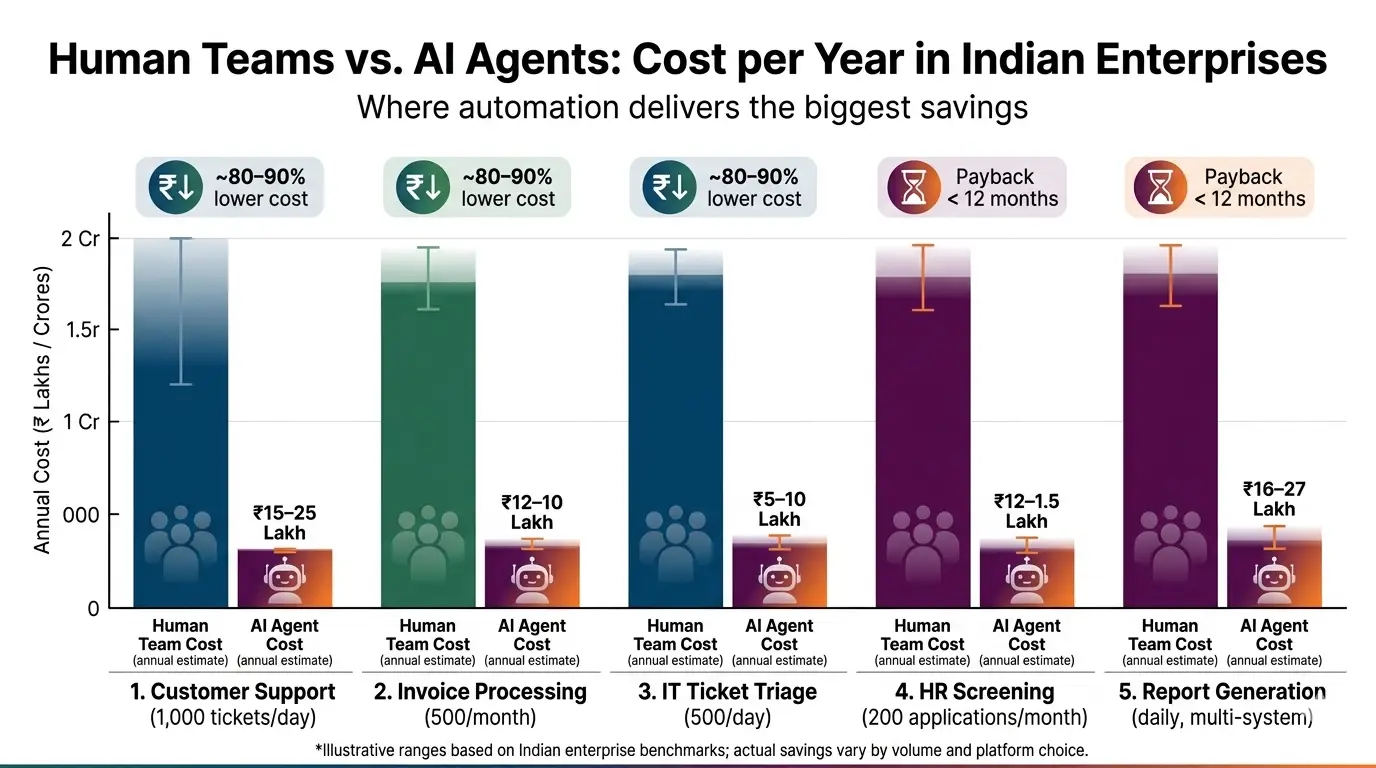
These are rough estimates based on Indian enterprise benchmarks. Your actual savings depend on process volume, current team size, and platform costs. The reduction in AI agent deployment cost India over the past two years means the payback period for most of these categories is now under 12 months.
AI Transformation in India: What 2026 Looks Like
AI transformation in India is entering a different phase in 2026. The question is no longer whether to deploy AI agents. It is how fast and how broadly.
Global AI spending reaches $2.52 trillion in 2026, a 44% increase from 2025, according to Gartner via AI Automation Statistics 2026. Indian enterprises, especially in IT services, BFSI, and retail, are allocating larger budget shares to agentic AI platforms. The EY-CII report projects that enterprises with mature AI agent deployments will maintain 15 to 20% lower operational cost structures than competitors who lag adoption.
The AI adoption trends in Indian enterprises show three clear patterns: first-movers are scaling from one use case to many, mid-market companies are adopting pre-built agent platforms rather than custom builds, and sector-specific agents (banking, healthcare, retail) are outperforming generic automation tools in measurable ROI.
If you run operations in India and you are not actively running pilots or scaling AI agents for operational cost reduction, your cost base will diverge from competitors within 18 to 24 months. That gap grows every quarter.
The Path Forward for Indian Enterprises
The data is consistent. The case studies are real. Indian companies using AI agents for operational cost reduction are building a structural cost advantage over those that wait. The technology is accessible, the platforms are mature, and the ROI window is well under two years for most deployments.
Your next step is simple: identify your highest-cost, highest-volume repeatable process. Map its decision logic. Find an enterprise AI platform for Indian businesses that fits your stack. Run a 30-day pilot with clear metrics. The results will tell you exactly where to scale next.
AI agents for operational cost are not an IT project. They are a business strategy. The Indian companies treating them that way are the ones showing 30 to 50% cost reductions in their quarterly reviews. You can do the same.
Key takeaways:
- AI agents reduce operational costs by 20-55% across IT, customer support, finance, HR, and supply chain.
- The biggest driver of ROI is integration quality, not platform choice.
- Infrastructure reliability determines whether pilots turn into production at scale.
- Indian SMEs and large enterprises both have viable, affordable paths to deployment.
- The companies acting now build a structural cost advantage over those that wait.
Ready to Scale Your AI Agent Infrastructure?
Aptly builds and manages the GPU compute, networking, and monitoring infrastructure that enterprise AI agents need to perform reliably. The only Microsoft-trusted supplier for third-party hyperscale datacentre infrastructure worldwide, Aptly delivers up to 99.9% uptime SLAs and 24×7 Global Operations Centers across three continents.
Explore AI Infrastructure Managed Services | Contact Aptly | aptlytech.com
Related Articles
AI-Ready Infrastructure for Enterprise Workloads | GPU Datacenter Strategy: Why Enterprises Need It In 2026 | End-to-End Data Center Lifecycle Management
FAQ (Frequently Asked Questions):
- How do AI agents reduce enterprise operational costs?
-
- AI agents automate multi-step, rule-based tasks end to end without human intervention. They process higher volumes faster, make fewer errors, and operate 24/7. This reduces the headcount required for repetitive work and cuts cost per transaction significantly.
- What are the best AI agent use cases for Indian businesses?
- Customer support automation, invoice and accounts processing, HR screening and onboarding, IT ticket management, and sales workflow automation deliver the highest and fastest ROI for Indian enterprises.
- Can AI agents automate customer support?
- Yes. Platforms like Yellow.ai and FreshWorks Freddy AI handle 80 to 90% of customer queries without human agents. They work across chat, voice, email, and WhatsApp in multiple Indian languages.
- How are enterprises using generative AI in operations?
- Enterprises use generative AI to draft documents, generate reports, create code, summarize data, and power conversational AI agents. Infosys Topaz, TCS TwinX, and Wipro’s AI platforms all embed generative AI into workflow automation and client delivery.
- How much operational cost can AI automation reduce?
- Published data from McKinsey, NASSCOM, and Gartner puts the range at 20-55% depending on the function. IT helpdesks and customer support see the highest reductions (40-65%) because they are high-volume and rule-based. Finance and HR see 30-50% reductions. Supply chain delivers 18-25%. The key variable is integration quality, not platform choice.
- What is the AI agent deployment cost in India?
- Deployment costs vary by platform and scope. SaaS-based agentic platforms like Zoho Zia, FreshWorks, or Yellow.ai start at a few lakhs per year for mid-market companies. Enterprise custom deployments on Microsoft Copilot or Infosys Topaz scale based on usage and integration complexity. Payback typically occurs within 12 months.
- How to implement AI agents to reduce operational costs in small businesses?
- Start with one high-volume process, pick a pre-built SaaS AI agent platform, measure baseline cost, run a 30-day pilot, and track cost per transaction. Tools like Zoho Zia or FreshWorks Freddy AI offer no-code setup for small business teams.