

Overview
AI Development – Industry Specific Model Tuning
Aptly’s engagement with an oil and gas industry partner focuses on tuning an AI vision model to assist with the manual review of complex, confidential Piping and Instrumentation Diagrams (P&IDs). The initiative aims to identify components and interpret engineering details to support the preparation of component lists, datasheets, safety and compliance documentation, and control logic diagrams. By adapting the model to industry-specific symbols and terminology, the project seeks to reduce manual effort and improve operational efficiency while protecting sensitive engineering information.
The Challenge
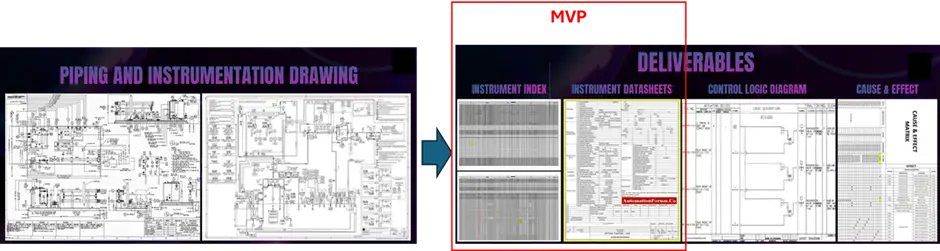
An Industry partner in the Oil and Gas segment is seeking toaccelerate digital transformation and operational efficiency byleveraging AI vision to assist in heavily manual P&ID process.
The process involves reviewing large, highly detailed, highly confidential diagrams and creating component lists,datasheets, safety/compliance, and control logic diagrams.
Our Solution
Due to the sensitivity and confidentiality of designs, all inference needed to be done within the customer’s data boundaries.
- Identified suitable Vision Language Models (VLMs) sufficient to inference large diagrams.
- Fine tuned VLMs for P&ID component recognition, classification, and accuracy (precision, recall, F1)
- Established benchmarking and validation process for each task in P&ID flow
- Benchmarked accuracy, inference time, inference cost against leading open and closed source VLMs
- Developed optimized training techniques to lower cost and time of model supervised fine tuning(SFT)
Engineering Approach
Aptly’s Impact
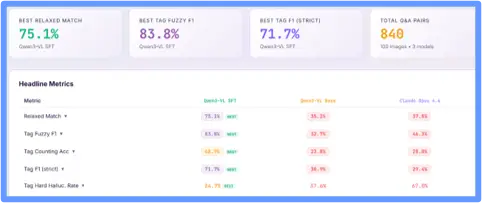
- Produced fine-tuned 8B parameter industry model that significantly exceeded Frontier Model performance in several P&ID tasks
- Increased accuracy of VLMs by 2.4x over baseline models through SFT. Further refinement possible with more training data.
- Inference speed increased 3.8x.
- Inference cost reduced 2x