
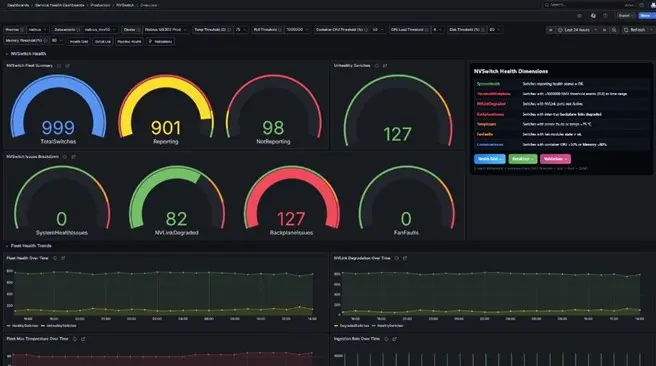
Overview
Aptly streamlined GPU network operations by unifying fragmented incident workflows across Jira, Zendesk, and ICM and standardizing issue classification, ownership, and routing. The solution addressed complex failures across multi-vendor InfiniBand and Ethernet environments, where differences in topology, switch operating systems, and network configurations made troubleshooting inconsistent. Architecture-aware triage combined topology validation, network configuration checks, switch health analysis, and host driver and firmware alignment to identify root causes faster. Correlating telemetry with incident trends enabled early detection, while standardized baselines and pre- and post-change validation helped prevent recurring failures. Together, these capabilities improved cluster availability and GPU utilization, accelerated production readiness, and supported greater billable capacity.
- Unified incident management: Consolidated three ticketing systems into one queue with consistent classification and ownership.
- Architecture-aware troubleshooting: Tailored triage and playbooks to each cluster’s InfiniBand or Ethernet design.
- Early fault detection: Correlated link instability, error counters, and switch events with incident spikes.
- Proactive failure prevention: Established configuration baselines, pre-change validation, and weekly post-change regression checks.
- Improved business outcomes: Reduced downtime and recurring incidents, helping protect revenue and increase available GPU capacity.
The Challenge
Challenge
- Fragmented workflow across Jira, Zendesk, and ICM, with inconsistent taxonomy andownership.
- Heterogeneous fabric architectures (different IB/Ethernet topologies, switch OS,routing/partitioning) drive non-repeatable failures.
- Complex IB signals—link flap/down, validation, symbol errors, switch polling—often masktrue root cause across layers.
Our Solution
- Build a single incident ontology and map every provider/tool ticket into one queue withdeterministic routing.
- Apply architecture-aware triage: topology validation, partition/MTU/ECN checks, switchhealth, and host-side driver/firmware alignment.
- Close the loop with trend-driven prevention: baseline configs, pre-change validation, and post-change regression checks weekly.
Engineering Approach
- Higher revenue through faster recovery with minimizing node unavailability from technicalissues and increased billable capacity driven by improved uptime.
- Reduced mean time to isolate and resolve by making triage tool-agnostic and architecture-specific.
- Fewer repeats through standardized baselines and validation gates across multi-vendorfabrics consistently.
- Improved cluster availability and GPU utilization, accelerating GA timelines and protectingrevenue at scale.