
Overview
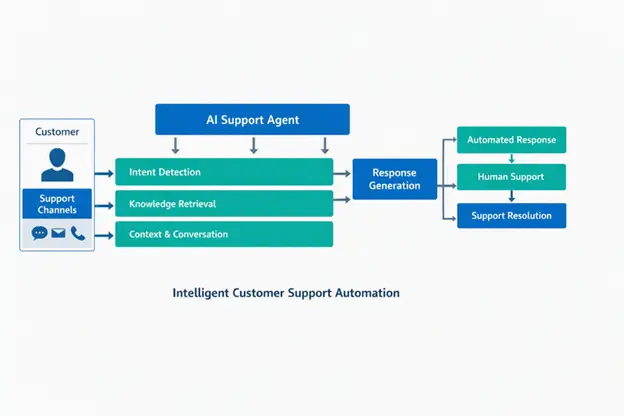
Customer interactions enter through support channels and are routed to an AI support agent. The agent detects intent, retrieves relevant knowledge, maintains conversation context, generates a response, and evaluates resolution confidence. High-confidence requests receive automated responses, while low-confidence, complex, or sensitive requests are escalated to human support with prepared context.
Increase support capacity without sacrificing customer experience by automating routine interactions and reserving human expertise for complex, sensitive, or high-value cases.
Executive Summary
Client Situation: Customer support teams were spending significant time on repetitive inquiries that could be answered using existing product documentation, policies, and knowledge bases.
Aptly Response: Aptly built an AI support agent that detected intent, retrieved relevant knowledge, generated contextual responses, and escalated complex cases to human representatives.
Results: The client improved response speed, increased support capacity, reduced manual search effort, and preserved human oversight for sensitive or low-confidence cases.
The Challenge
Engineering an AI support agent that works alongside human support teams. In a high-volume support environment, Aptly engineered an AI-powered customer support solution that understood customer requests, retrieved relevant knowledge, generated contextual responses, applied business rules, and escalated complex or low-confidence interactions to human representatives. The solution was designed to improve support speed and capacity without removing human judgment from sensitive or complex cases.
Our Solution
- Improved response speed for repetitive support inquiries
- Reduced manual knowledge searches by support representatives
- Improved consistency of customer-facing responses
- Preserved human oversight for complex, sensitive, or low-confidence cases
- Created a reusable support-agent foundation for additional channels and domains
Engineering Approach
The support automation solution was designed around a controlled human-in-the-loop model. Aptly mapped the most common customer intents, connected approved knowledge sources, defined escalation criteria, and implemented confidence thresholds so the AI agent could reliably handle routine inquiries while routing complex cases to representatives. The system also captured interaction telemetry to support response-quality review, knowledge-base improvement, and operational reporting.