
Overview
Transforming fragmented enterprise knowledge into an intelligent AI-powered knowledge system
Give employees a trusted AI interface for enterprise knowledge—reducing search time, improving answer consistency, and turning existing documentation into an accessible business asset.
Executive Summary
Client Situation: Enterprise knowledge was fragmented across repositories, forcing employees to search manually and rely on subject-matter experts for documented information.
Aptly Response: Aptly engineered a governed RAG-based knowledge intelligence platform that connected approved sources, normalized content, enabled semantic retrieval, and delivered grounded conversational responses.
Results: Employees gained faster access to trusted knowledge, reduced dependency on experts, and established a reusable AI knowledge foundation for additional business domains.
The Challenge
A large organization had critical business knowledge distributed across documents, internal portals, operational manuals, policies, product documentation, and multiple enterprise repositories. Employees spent significant time searching across different systems, while subject-matter experts were repeatedly approached for answers already documented within the organization. The organization needed a conversational knowledge experience that could retrieve relevant enterprise information, provide grounded responses, and operate reliably with enterprise controls.
Our Solution
Aptly’s Forward Deployed Engineering team designed and implemented an enterprise AI knowledge platform using Retrieval-Augmented Generation and AI agent technologies. The platform connected approved enterprise information sources to an intelligent conversational interface with data ingestion, document processing, metadata extraction, intelligent chunking, embedding generation, vector search, semantic retrieval, LLM orchestration, access control, usage monitoring, and AI observability.
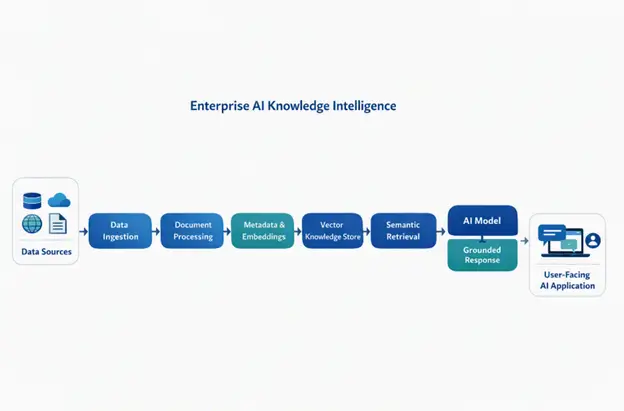
Knowledge Architecture Diagram
Diagram: Enterprise data sources flow through ingestion, document processing, content transformation, metadata classification, embedding generation, vector knowledge store, semantic retrieval, context construction, AI model, and grounded response. A user interacts with an AI application, which routes requests into semantic retrieval and returns grounded answers.
AI Agent Architecture Diagram
Diagram: User request enters an AI agent, moves through intent understanding, checks whether knowledge is required, retrieves relevant context when needed, generates a response, performs confidence and policy checks, and either returns an approved response or escalates to a human assistant.
Engineering Approach
The engagement began with a knowledge-domain assessment to identify high-value repositories, document types, source owners, refresh patterns, and access constraints. Aptly then designed a production-grade retrieval pipeline that normalized documents, preserved source metadata, generated embeddings, and created a governed knowledge layer that could be queried through a conversational interface. The team also designed evaluation workflows to test answer accuracy, retrieval relevance, source grounding, and unsupported-question handling before production rollout.
Production Capabilities
- Connector-based ingestion from approved enterprise sources
- Metadata-aware chunking and retrieval for higher answer relevance
- Access-aware response generation aligned with enterprise permissions
- AI observability for usage, latency, retrieval quality, and model behavior
- Operational monitoring for content freshness and retrieval performance
Business Impact
- Reduced time spent searching for information
- Reduced dependency on subject-matter experts
- Faster access to business knowledge
- More consistent responses
- Improved knowledge accessibility
- Reusable foundation for additional AI applications