Introduction
Scalable data center infrastructure has become essential in a digital-first world where workloads grow unpredictably. You are likely dealing with increasing demand from AI models, cloud-native applications, and IoT ecosystems. These workloads require scalable IT infrastructure that can adapt quickly without performance bottlenecks.
If you fail to plan for data center scalability, your organization risks downtime, rising operational costs, and poor resource utilization. Traditional setups cannot handle sudden spikes in demand or evolving business requirements.
This guide walks you through how to scale software-defined infrastructure for future-proofing data centers. You will explore hybrid data center architecture models, network capacity planning, data center modernization strategies, and practical best practices.
What Is Scalable Data Center Infrastructure?
Scalable data center infrastructure is a system designed to expand or contract resources (compute, storage, network) dynamically based on workload demand without requiring major architectural changes. Unlike traditional setups where growth meant buying massive, underutilized servers, scalable IT infrastructure focuses on agility. With data center scalability, you can expand your compute, storage, or network footprint as your demand increases.
Horizontal vs. Vertical Scaling
Vertical scaling means adding more CPU, memory, or storage to an existing server. On the other hand, horizontal scaling involves adding more nodes to distribute the workload. Most modern enterprises prefer horizontal scaling because it offers better redundancy and limits single points of failure.
Key Characteristics of Scalable Infrastructure
Four traits define truly scalable data center infrastructure:
- Flexibility: Provisioning, moving, or decommissioning resources without architectural rework.
- High availability: Ensuring services remain online even if individual components fail.
- Redundancy: Duplicate systems that take over during maintenance or outages.
- Elasticity: Automated resource allocation based on real-time application needs.
Key Components of Scalable Data Center Infrastructure
To understand data center scalability, you must break down the architecture into core layers. Below are the five critical layers that every enterprise should address for modular data centers.
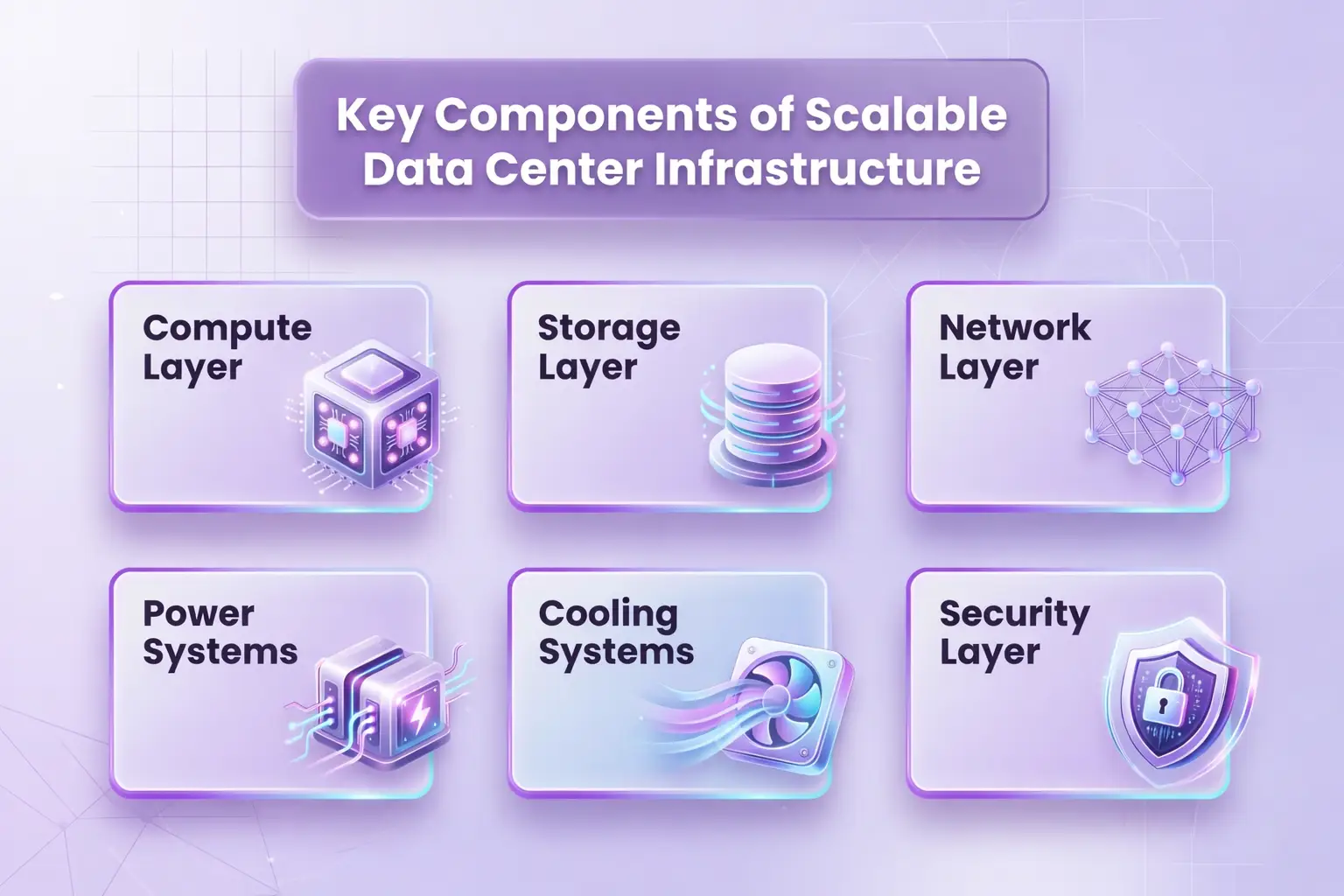
Compute Layer
Modern compute scaling relies heavily on virtualization to decouple software from hardware. Using containerization and Kubernetes allows your developers to deploy microservices that scale independently. If you want a more integrated approach, Hyperconverged Infrastructure (HCI) combines compute and storage into a single, easily repeatable building block.
Storage Layer
Conventional SANs can struggle with rapid growth. Software-defined storage (SDS) solves this by managing data through a software layer rather than proprietary hardware. Distributed storage systems allow you to spread data across multiple nodes, ensuring that your storage capacity and performance grow in tandem.
Network Layer
Your network is the backbone of any data center expansion strategy. Network capacity planning helps you anticipate the bandwidth needs of high-speed interconnects. SDN provides the control needed to automate traffic flow and achieve significant latency optimization for real-time apps.
Power and Cooling Systems
Scaling is not just about chips and cables; it’s about the facility itself. You must implement energy efficiency strategies to keep operational costs low. Scalable cooling ensures that high-density AI racks do not overheat as you pack more power into each square foot.
Security Layer
A growing footprint increases your attack surface. Adopting Zero Trust Security ensures that every connection is verified, regardless of where it originates. Furthermore, you must build redundancy and failover mechanisms to protect data integrity during a scaling event or hardware failure.
Why Data Center Scalability Matters for Future Growth?
As you integrate edge computing infrastructure and AI, your data needs will skyrocket. Here is why scalable data center infrastructure is vital for the future:
- Handles increasing demand: As users, applications, and data grow, scalable data centers can expand resources without major redesign.
- Supports business growth: Companies can add capacity as they scale operations, enter new markets, or launch new services.
- Cost efficiency: Scalability allows “pay-as-you-grow” instead of overinvesting upfront in unused infrastructure.
- Improves performance: Scaling resources prevents slowdowns, ensuring consistent speed and responsiveness even during peak usage.
- Enables cloud and hybrid strategies: Modern platforms like Amazon Web Services, Microsoft Azure, and Google Cloud Platform rely on highly scalable data center architectures.
- Supports emerging technologies: AI, IoT, and big data require flexible, scalable infrastructure to handle massive workloads.
- Enhances reliability and uptime: Scalable systems can distribute workloads and avoid single points of failure.
- Adapts to workload fluctuations: Businesses can scale up during high demand and scale down during low usage, optimizing resources.
- Faster innovation and deployment: Developers can quickly test and deploy new applications without waiting for infrastructure upgrades.
How to Plan Data Center Capacity for Business Growth?
Effective data center capacity planning ensures your infrastructure supports future demands.
Assess Your Current Infrastructure
- Start with a thorough workload analysis.
- Identify which applications consume the most compute, storage, and bandwidth.
- Run performance benchmarking to establish baselines.
Forecast Future Demand
- Look beyond current usage.
- Account for growth trends in your business — new products, new markets, expanding user bases.
- Factor in technology changes like the shift to real-time analytics or inference-at-the-edge.
Plan for Peak Versus Average Loads
- Provisioning for peak load can lead to significant waste if peaks are rare.
- Use automation and predictive analytics to scale resources up during anticipated high-demand windows and back down when traffic normalizes.
Tools and Techniques
- Leverage Infrastructure as Code (IaC) tools like Terraform and Ansible to define, version, and replicate your infrastructure configurations.
- Combine IaC tools with monitoring platforms and analytics dashboards to give your team the visibility needed to make informed scaling decisions before problems arise.
How to Modernize Legacy Data Centers?
To modernize a legacy data center, organizations must transition from rigid, manual hardware environments to flexible, software-driven architectures. This process typically involves two steps:
Step 1: Selecting a Strategic Migration Path
There are two primary methodologies used to transition workloads into a modern, modular environment:
- Lift-and-Shift (Rehosting):
- The Approach: Moving existing applications and data to newer hardware or cloud environments with minimal code changes.
- The Outcome: This is the fastest route to modernization. However, it fails to leverage the advanced efficiency and cost-saving features of modern architecture.
- Refactoring (Re-architecting):
- The Approach: Rebuilding applications from the ground up to utilize containerization, microservices, and software-defined infrastructure.
- The Outcome: While this requires a higher initial investment of time and resources, it provides superior long-term scalability and performance.
Step 2: Adopting Unified Infrastructure Model
The ultimate goal of modernization is the implementation of Hyperconverged Infrastructure. HCI integrates compute, storage, and networking into a single, software-defined platform. Key business benefits include operational efficiency, seamless scalability, and cost optimization.
How to Develop a Data Center Expansion Strategy?
When developing a data center expansion strategy, the choice between cloud, colocation, and on-premises models dictate how quickly and cost-effectively your infrastructure can scale. The following table shows on-premises vs cloud vs colocation scalability comparison:
| Aspect | Cloud | Colocation | On-Premise |
|---|---|---|---|
| Scalability Speed | Instant, on-demand scaling | Moderate (requires provisioning space & hardware) | Slow (depends on procurement & setup) |
| Upfront Cost | Low (pay-as-you-go) | Medium (rack space + hardware) | High (infrastructure investment) |
| Operational Cost | Variable, usage-based | Predictable recurring costs | High maintenance & operational expenses |
| Flexibility | Highly flexible and elastic | Moderately flexible | Limited flexibility |
| Control | Limited control over hardware | High control over hardware | Full control |
| Maintenance Responsibility | Managed by provider | Shared responsibility | Fully in-house |
| Performance Optimization | Dependent on provider | High (custom hardware possible) | Highest (fully customized environment) |
| Scalability Limitations | Virtually unlimited | Limited by physical space in facility | Limited by physical infrastructure |
| Deployment Time | Minutes to hours | Days to weeks | Weeks to months |
| Best Use Case | Rapid growth, startups, variable workloads | Growing enterprises needing balance | Large enterprises with strict control/security needs |
While the Cloud offers the most seamless scaling experience, a combination of Colocation for predictable growth and Cloud for flexibility often provides the most balanced ROI for modern tech infrastructure. A hybrid approach combining cloud, colocation, and on-premise delivers the best scalability, cost efficiency, and control for long-term data center expansion.
How to Build a Scalable IT Infrastructure for Enterprises?
Building a scalable IT infrastructure is a transition from rigid hardware to a flexible, software-defined ecosystem. For enterprises, this involves moving away from guessing future capacity and toward a modular growth plan.
Here is the step-by-step framework to build a scalable foundation:
Step 1: Shift to Software-Defined Everything (SDx)
The first step is to decouple your services from physical hardware. When your infrastructure is defined by software rather than physical cables and boxes, you can scale at the click of a button.
- Use virtualization through hypervisors to run multiple virtual machines on a single physical server.
- Centralize network control through SDN so you can reconfigure traffic flows without touching a switch.
Step 2: Implement Hyperconverged Infrastructure (HCI)
Legacy environments have separate silos for compute, storage, and networking. HCI collapses these into a single, modular building block. To grow, you simply add a pre-configured server unit. The software automatically recognizes the new resource and adds it to the total pool.
Step 3: Adopt a Hybrid Cloud Architecture
Enterprises shouldn’t put everything in one place. A hybrid approach balances security with infinite elasticity. Gartner states that infrastructure strategies are shifting rapidly. 85% of organizations will adopt a hybrid approach, combining on-premises, colocation, cloud, and edge delivery.
To manage this, companies use Wide Area Network (WAN) technologies to create a unified system. This allows applications and data to move seamlessly between different environments, making complex infrastructure both efficient and highly effective.
Step 4: Move Toward Microservices and Containers
Older monolithic apps are hard to scale because you must duplicate the entire program to handle more users.
- Break applications into tiny, independent pieces (microservices).
- If only the login part of your app is slow, you can scale just that piece rather than the whole system, saving massive amounts of compute power.
Step 5: Automate with Infrastructure as Code (IaC)
Scalability is useless if it takes a human three weeks to configure a new server.
- Use tools like Terraform or Ansible to write scripts that automatically set up servers, firewalls, and databases.
- Ensure that every time you scale out, the new infrastructure is identical to the old one, eliminating configuration drift.
Step 6: Implement Proactive Monitoring and AIOPs
You cannot scale effectively if you don’t know where the bottlenecks are.
- Use monitoring tools to track CPU, memory, and bandwidth.
- Set triggers so that if a server reaches 80% capacity, the system automatically provisions a new one without human intervention.
Future Trends in Data Center Infrastructure
Staying ahead of future trends in scalable data center infrastructure is essential for long-term survival.
- AI-Driven Data Centers: AI will handle predictive scaling and autonomous infrastructure management.
- Edge Computing Infrastructure: Low-latency applications will drive more deployments at the network edge.
- Sustainability: Expect a massive push for renewable energy and a smaller carbon footprint.
- Zero-Touch Provisioning: Automation will make human error a thing of the past in deployment.
How Hyperscalers Scale Their Data Centers?
Hyperscale cloud providers like AWS, Google, and Microsoft follow simple but powerful methods to scale their data centers. One key idea is modular expansion. They build data center units in a standard way, so each new section looks and works like the previous one. This makes it easier to deploy, manage, and maintain systems as they grow.
They also rely heavily on automation. Most tasks are handled by software instead of people. This includes setting up servers, monitoring systems, balancing workloads, and even creating repair tickets. Because of this, they can move faster and deliver services more quickly.
Another important practice is global workload distribution. Instead of depending on one location, they spread workloads across multiple data centers worldwide. This helps them use available capacity better, improve performance for users in different regions, and reduce the risk of downtime.
For enterprises, copying this model can be challenging without the right expertise. Aptly Tech manages infrastructure environments supporting over 200,000 GPU nodes globally, bringing real-world experience in modular design and automation. With their support in software-defined infrastructure, you can turn your data center into a flexible, high-performing system that supports growth and global operations.
Best Practices for Data Center Scalability
Here are proven data center scalability tips and best practices your team can start applying today:
- Design for scalability from the beginning
- Adopt software-defined infrastructure
- Implement automation and orchestration
- Ensure high availability and redundancy
- Continuously monitor and optimize performance
Conclusion
Building a scalable data center infrastructure is the ultimate strategy for future-proofing your business against the unknown. By integrating modern technologies like HCI and SDN, you transform rigid hardware into a dynamic, software-driven engine. Scalability is the foundation for long-term survival in an AI-driven world.
At Aptly, we move beyond the slow cycles of traditional integrators to provide agile, high-performance infrastructure tailored for growth. We ensure your systems evolve with you, turning potential bottlenecks into strategic assets.
Ready to scale? Contact Aptly for a scalability audit today.
FAQs
Q: How do companies scale data centers efficiently?
Companies scale data centers by using automation, modular infrastructure, and hybrid architectures. They also rely on predictive analytics for capacity planning.
Q: What is the best way to future-proof data center infrastructure?
You can future-proof infrastructure by adopting scalable IT infrastructure, automation tools, and software-defined systems. Continuous monitoring also plays a key role.
Q: How to design a scalable IT infrastructure architecture?
Focus on high availability, redundancy, and workload distribution. Use Kubernetes and Infrastructure as Code for better control.
Q: What are the latest trends in data center scalability?
AI-driven infrastructure, edge computing, automation, and sustainable data centers are key trends shaping scalability.
Q: How to scale infrastructure for AI workloads?
AI workloads require high-performance compute, distributed storage, and optimized networking. You should also plan for increased power and cooling needs.
Q: What is the difference between modular and traditional data centers?
Modular data centers use pre-built units for faster deployment. Traditional data centers rely on fixed infrastructure, which limits flexibility.
Q: How do hyperscalers scale their data centers?
They use automation, global workload distribution, and modular expansion. These strategies help manage large-scale operations.
Q: How to reduce cost while scaling infrastructure?
Use energy-efficient hardware, optimize cooling systems, and adopt pay-as-you-go models. Automation also reduces operational expenses.
Q: What technologies enable data center scalability?
Virtualization, containerization, Kubernetes, software-defined networking, and Infrastructure as Code are key technologies.
Q: What are the best scalable data center infrastructure solutions for enterprises?
Hybrid architectures, hyperconverged infrastructure, and modular data centers are among the best solutions for enterprises.
Q: Name the top companies offering scalable data center infrastructure services.
Some of the top companies that provide scalable data center infrastructure services includes Amazon Web Services, Google Cloud, Microsoft Azure, Equinix, IBM, Oracle Cloud Infrastructure, Cisco, Dell Technologies, and HP. Aptly Tech help businesses modernize and scale their data centers using automation and flexible architecture.
Table of content
- TL;DR
- Introduction
- What Is Scalable Data Center Infrastructure?
- Key Components of Scalable Data Center Infrastructure
- Why Data Center Scalability Matters for Future Growth?
- How to Plan Data Center Capacity for Business Growth?
- How to Modernize Legacy Data Centers?
- How to Develop a Data Center Expansion Strategy?
- How to Build a Scalable IT Infrastructure for Enterprises?
- Future Trends in Data Center Infrastructure
- How Hyperscalers Scale Their Data Centers?
- Best Practices for Data Center Scalability
- Conclusion
- FAQs