Introduction
Managed Data Center Services are enterprise outsourcing solutions that provide 24/7 monitoring, lifecycle management, hybrid cloud integration, and SLA-backed uptime for data center infrastructure. They enable enterprises to offload day-to-day IT operations to a specialized managed data center services provider that ensures continuous availability, optimized performance, and predictable cost models. Managed services cover server and storage operations, network management, security, disaster recovery, and remote data center support — freeing internal teams to focus on strategic innovation rather than infrastructure firefighting.
Today’s infrastructure spans on-premises systems, colocation facilities, and public cloud platforms. According to industry advisory firms, hybrid and multi-cloud models deliver greater agility and scalability by combining private and public resources, enabling fast workload deployment and high performance. External managed data center solutions unify governance, monitoring, and data center optimization across these diverse environments — improving uptime, reducing operational costs, and strengthening security posture for mission-critical workloads.
Why Do Enterprises Choose Managed Data Center Services?
Enterprises adopt these solutions to address operational complexity while achieving measurable business outcomes:
- Higher Uptime & Reduced Financial Risk: Industry outage research shows that a significant percentage of data center failures cost over $100,000 per incident, with large-scale outages reaching into the millions. Proactive 24/7 data center monitoring services and SLA-driven data center operations directly reduce this exposure.
- Hybrid Cloud as the Enterprise Operating Model: Cloud has become the centerpiece of modern digital infrastructure, with hybrid environments now standard across large organizations. Managed data center solutions unify governance across cloud and on-prem infrastructure, simplifying hybrid cloud and data center management while maintaining control.
- Operational Efficiency Through IT Operations Outsourcing: Outsourcing IT infrastructure management improves resource allocation, reduces internal overhead, and allows enterprise teams to focus on innovation rather than infrastructure management.
- AI-Ready Infrastructure & GPU Optimization: AI workloads require specialized GPU clusters, high-performance networking, and advanced cooling strategies. Managed services for GPU data centers ensure performance optimization, thermal management, and workload stability at scale.
- Stronger Disaster Recovery & Business Continuity: Integrated disaster recovery management and backup services reduce recovery time objectives (RTOs) and protect revenue during outages.
How Managed Data Center Services Work (Step-by-Step)
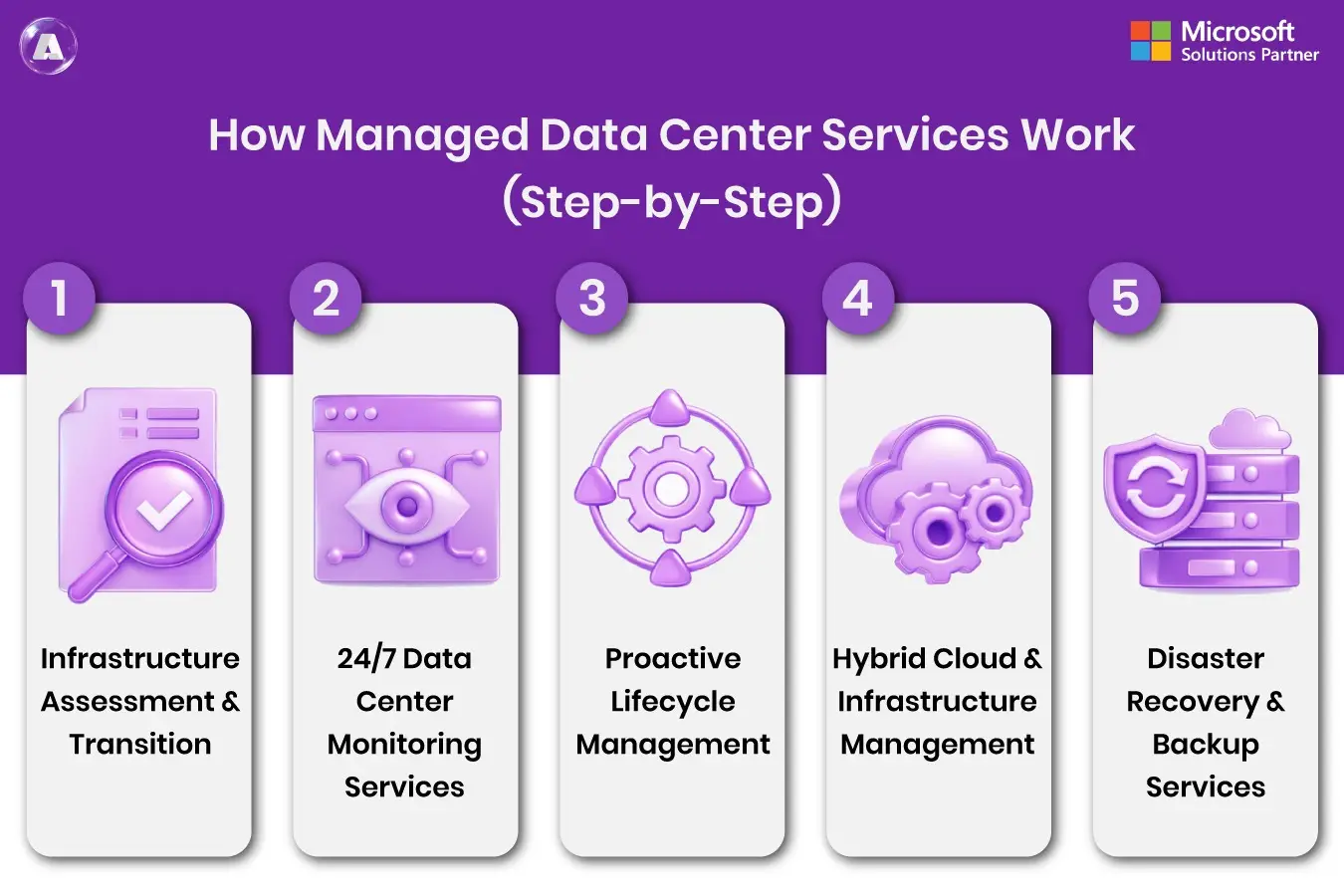
- Infrastructure Assessment & Transition: Audit existing cloud and on-prem infrastructure, compliance posture, and performance baselines.
- 24/7 Data Center Monitoring Services: Continuous server uptime management, network performance monitoring, and workload optimization.
- Proactive Lifecycle Management: Firmware updates, patching, capacity planning, hardware refresh cycles, and secure decommissioning.
- Hybrid Cloud & Infrastructure Management: Governance across cloud and on-prem infrastructure, enabling workload portability and SLA-driven data center operations.
- Disaster Recovery & Backup Services: Integrated disaster recovery planning reduces recovery time objectives (RTOs) and business impact.
What are the Challenges in Data Center Management?
Running a modern enterprise data center in-house introduces several structural challenges that grow exponentially as workloads scale.
Skill and Staffing Gaps
Modern data centers demand expertise in virtualization, hybrid cloud platforms, software-defined networking, cybersecurity, automation, and emerging areas such as AI-optimized infrastructure and liquid cooling.
- A shortage of qualified IT operations personnel drives many operational issues.
- Staffing gaps and turnover account for a large share of incidents and inefficiencies.
- Without strategic workforce development and upskilling, productivity losses and risk exposure can cost departments hundreds of thousands of dollars annually.
High Cost and Capital Expenditure
Maintaining on-premises data centers requires significant upfront and ongoing investment. Capital expenses include servers, storage systems, networking, cooling, power infrastructure, physical security, and specialized racks.
Operating costs — energy consumption, maintenance, licensing, hardware refresh cycles, and specialized staffing — can fluctuate and grow with demand. Power availability will increasingly constrain AI-oriented data centers, adding long-term operational expense.
Downtime and Reliability Risk
Even short outages can be costly, impacting revenue, customer trust, and contractual obligations. Industry research shows downtime can cost thousands to millions of dollars per hour for mission-critical systems.
- Outage frequency has declined, but rising complexity and external risks (weather, supply chain, power failures) continue to threaten reliability.
- Without real‑time monitoring and predictive analytics, issues like thermal anomalies or voltage irregularities may go undetected until failure occurs.
Scalability Constraints
Expanding in-house capacity is slow, often taking months to procure, install, configure, and integrate systems.
- Additional power, cooling, and staff are frequently required.
- Organizations struggle to respond quickly to seasonal demand, business growth, or workload spikes.
Hybrid and Multi-Cloud Complexity
Enterprises increasingly operate workloads across on-prem data centers, Azure, AWS, Google Cloud, and edge locations.
- Each environment has distinct APIs, monitoring tools, and identity frameworks.
- Managing security, compliance, and performance consistently across platforms adds operational overhead.
Security and Compliance
Data centers must comply with ISO 27001, SOC 2, HIPAA, PCI-DSS, and NIST standards.
- Continuous patching, monitoring, auditing, and documentation are required.
- Lack of dedicated security management can lead to audit failures, firmware vulnerabilities, and access control gaps.
- Compliance lapses may result in financial penalties and reputational damage.
Cost of Managed Data Center Services
Managed Data Center Services not only enhance performance and reliability but also deliver measurable cost benefits by shifting expenses from unpredictable capital projects to controlled operational spending. These services help enterprises reduce overhead, eliminate waste, and align infrastructure costs with actual demand.
Enterprise adoption of managed infrastructure solutions often leads to lower total cost of ownership (TCO) and ongoing operating expenses because providers optimize utilization, reduce idle capacity, and automate key operational tasks. Industry research shows that converting capital expenditure to operational expenditure, coupled with rightsizing and workload optimization, can lead to significant cost savings.
Enterprises using managed or hybrid IT support models report measurable reductions in maintenance and support spending, with consolidated management approaches delivering up to 25% lower support costs and 20% reduced hardware support time compared with traditional in‑house teams.
Key cost‑saving mechanisms include:
- Predictable OPEX vs. high CAPEX — Pay‑as‑you‑go service models lower upfront infrastructure expenses.
- Resource rightsizing and utilization improvement, which cuts waste and idle capacity.
- Centralized support and automation, reducing maintenance and personnel costs by consolidating vendor responsibility.
Infrastructure Scalability and Flexibility
Managed services enable dynamic scaling across private data centers, colocation facilities, and public cloud platforms. Key benefits include:
- Workloads can move seamlessly between environments without downtime.
- Centralized governance across on-prem and cloud environments using technologies like Microsoft Azure Arc.
- Consistent security policies and operational controls, regardless of workload location.
This approach gives enterprises the flexibility to scale infrastructure quickly while maintaining control and compliance.
Lifecycle Management
Providers handle the entire data center lifecycle, ensuring infrastructure remains secure, optimized, and supported throughout its life. Key activities include:
- Architecture and design
- Hardware procurement and integration
- Rack and stack
- Burn-in testing
- Firmware updates
- OS patching
- Capacity planning
- Hardware refresh
- Secure decommissioning
This structured process guarantees that all components are maintained proactively, reducing risks of downtime or operational inefficiencies.
Cost Optimization
Managed services convert capital expenditure into predictable operational expenditure. Providers eliminate idle capacity, right-size infrastructure, and optimize energy usage through automation. Industry research consistently shows that intelligent infrastructure operations reduce operational costs by 20–30% while improving utilization.
Business Continuity and Disaster Recovery
Managed providers design resilient architectures with redundancy at every layer, including:
- Multi-site replication
- Automated failover
- Regular disaster recovery testing
- Continuous backup
Enterprises using managed hybrid environments can reduce recovery times from hours to minutes, ensuring continuity even during disruptions.
Security by Operations
Security is embedded directly into operational workflows. Services include:
- Zero-trust access controls
- Continuous vulnerability scanning
- Automated patching
- Network segmentation
- Physical access logging
- Compliance reporting
This model delivers stronger security posture than most in-house teams can achieve.
AI and GPU Data Center Operations
For enterprises running AI workloads:
- GPU clusters, high-speed interconnects, and specialized cooling require careful operational planning.
- Managed providers oversee GPU networking, thermal management, and hardware utilization to ensure performance, reliability, and energy efficiency.
Aptly’s GPU Datacenter Buildout and Support leverages Microsoft-trusted experience across tens of thousands of GPU nodes, enabling rapid AI infrastructure deployment without added operational risk.
Self-Managed vs Managed Data Center Services
|
|---|
Managed Data Center Services shift enterprise IT from reactive infrastructure management to scalable, SLA-backed operations that reduce risk, control costs, and enable strategic innovation.
Real-World Examples and Case Studies
Financial Services
Many financial institutions are expanding hybrid cloud and managed data center operations to improve resilience and agility. Research shows that hybrid multicloud adoption in financial services is expected to triple as organizations prioritize security, cost optimization, and AI‑driven operations. These environments support disaster recovery strategies and help enterprises rapidly restore services after outages while safeguarding sensitive data.
Healthcare
In healthcare, hybrid cloud and managed platforms help providers modernize clinical systems while protecting sensitive patient data. Hybrid solutions enable workloads like analytics and population health reporting to run in cloud environments, while keeping regulated data on‑premises under unified governance — improving uptime and simplifying audits.
AI and High-Performance Computing
Tech companies deploying AI and HPC workloads increasingly leverage managed GPU and hybrid infrastructure to avoid the complexity of designing, scaling, and operating clusters. Hybrid cloud use cases include disaster recovery, on‑demand capacity, and performance optimization without forcing teams to rearchitect legacy systems.
Enterprise IT Transformation
Across industries, enterprises are modernizing legacy data centers by adopting hybrid cloud models and managed services. These projects often replace manual tasks with automated lifecycle management, rapid provisioning, and unified monitoring, helping teams reduce operational errors and accelerate deployment timelines.
Energy and Sustainability
Hybrid and sustainable infrastructure choices also translate into significant operational efficiencies. Research shows hybrid multicloud deployments can reduce rack space and energy consumption while cutting carbon emissions, producing sustainability gains alongside cost and space efficiencies.
Conclusion
Managed Data Center Services have become a foundational pillar of modern enterprise IT. They are no longer just about outsourcing operations — they are about enabling scalable, secure, and intelligent infrastructure.
By partnering with a managed provider, organizations achieve:
- Higher uptime
- Lower operational costs
- Stronger security
- Faster innovation
- Seamless hybrid cloud control
- AI-ready infrastructure
With Aptly’s Managed Data Center Services, enterprises benefit from Microsoft-trusted expertise and hyperscale operational rigor. As the only provider trusted by Microsoft to build and support third-party hyperscale data centers, Aptly delivers proven scalability, reliability, and enterprise-grade performance across complex environments.
As AI and multi-cloud adoption increase infrastructure complexity, managed services become a critical driver of resilience and long-term growth.
Ready to modernize your data center strategy?
Connect with Aptly’s experts to build a secure, scalable, future-ready infrastructure.